Stations of the Cross Catholic: prayers and meaning
Stations of the Cross Catholic: prayers and meaning
The Catholic Stations of the Cross are a prayerful walk through 14 moments associated with Jesus’ suffering and death. You move from station to station, usually in a church, while reflecting on Scripture, praying, and asking how Christ’s sacrifice calls you to greater love.
You can pray the stations alone or with a group during Lent, especially on Good Friday. The traditional devotion follows a familiar sequence, although some versions include a fifteenth station celebrating the Resurrection.
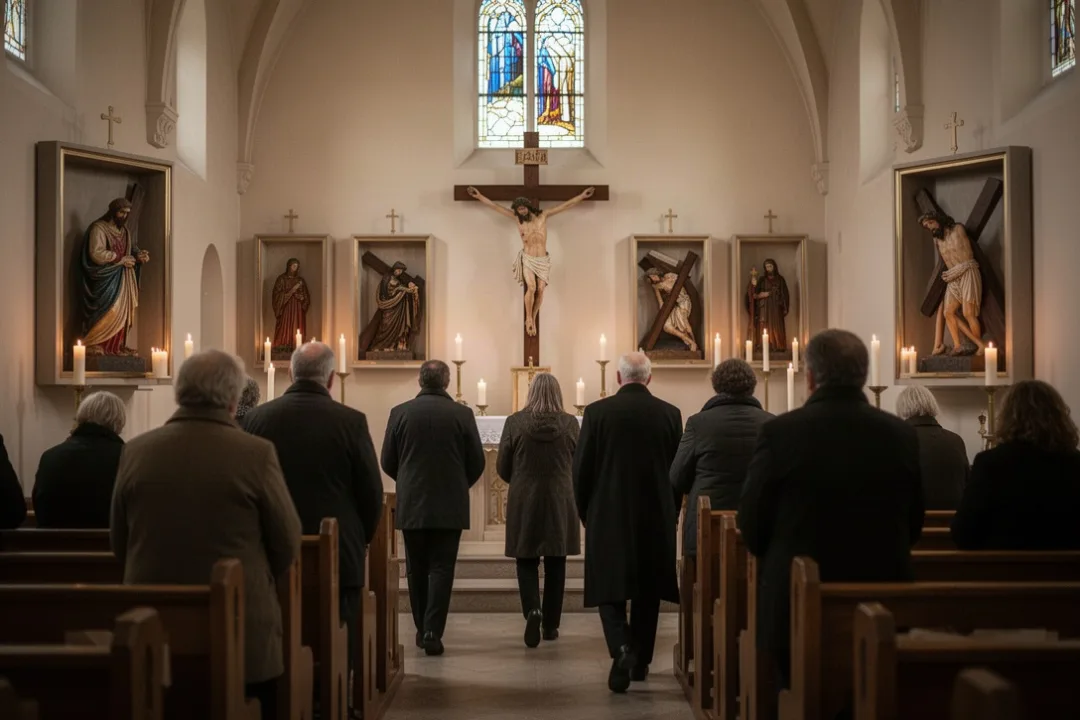
The Stations of the Cross, also called the Way of the Cross or Via Crucis, are a form of Christian meditation centered on the final hours of Jesus’ earthly life. Each station presents a scene from his Passion, from his condemnation to his burial. The person praying pauses at each image or marker and considers what that moment reveals about Christ, sin, mercy, suffering, and hope.
A station is more than a picture on a church wall. It is an invitation to stand spiritually beside Jesus and to respond with prayer. The devotion joins faith and imagination: you may look at a depiction of the scene, read a short reflection, remain silent, and then offer a prayer before continuing.
The stations are especially associated with Lent, the 40-day season of preparation before Easter. Many parishes pray them on Fridays, following the traditional remembrance of Jesus’ Passion. They can also be prayed at any time of year, including privately at home with a printed guide or a set of religious images.
At the heart of the devotion: The Stations of the Cross are not meant to make suffering an object of fascination. They help you contemplate Christ’s self-giving love and bring your own burdens into prayer with honesty and hope.
The 14 traditional Catholic Stations of the Cross
The traditional Catholic sequence contains 14 stations. Some scenes come directly from the Gospel accounts, while others belong to the longstanding Christian tradition of meditating on Jesus’ journey to Calvary. The exact wording of the titles can vary slightly by parish or prayer book.
Jesus is condemned to death. Jesus is sentenced despite his innocence. This station invites reflection on injustice, false judgment, and the courage to remain faithful when others misunderstand or reject you.
Jesus carries his cross. Jesus takes up the instrument of his execution. The scene points to his willing obedience and can lead you to consider the responsibilities, hardships, and sacrifices you are called to carry with love.
Jesus falls the first time. The first fall emphasizes the physical weakness of Jesus under the burden of the cross. It reminds you that Christian perseverance does not require pretending to be strong; it includes accepting help and rising after failure.
Jesus meets his mother. Mary encounters her suffering Son. The station presents the pain of a mother who cannot remove Jesus’ suffering, yet remains close to him. It encourages compassionate presence when someone you love is hurting.
Simon of Cyrene helps Jesus carry the cross. Simon is compelled to assist Jesus on the road. His unexpected service shows that people may enter another person’s suffering suddenly, and that practical help can become an act of mercy.
Veronica wipes the face of Jesus. According to Christian tradition, Veronica offers a cloth to Jesus. Although this scene is not described in the Gospel narratives, it has long represented a small act of tenderness offered amid cruelty and confusion.
Jesus falls the second time. Jesus falls again under the weight of the cross. This station speaks to repeated struggles and discouragement. It can help you pray for people who face relapse, chronic illness, addiction, poverty, or recurring injustice.
Jesus meets the women of Jerusalem. Women mourn as Jesus passes, and he directs their concern toward the suffering that will affect them and their children. The station calls for compassionate sorrow joined to honest self-examination and responsible action.
Jesus falls the third time. Near Calvary, Jesus falls once more. The final fall brings to mind exhaustion at the limits of human strength. It also invites trust that God remains present when your resources, plans, and confidence have run out.
Jesus is stripped of his garments. Jesus is publicly deprived of his clothing before crucifixion. This painful scene represents humiliation, vulnerability, and the abuse of human dignity. It challenges you to treat every person as worthy of respect, especially those exposed to shame or exploitation.
Jesus is nailed to the cross. Jesus is fastened to the cross and accepts the violence directed against him. The station turns your attention to the cost of redemption and to the ways hatred, fear, and power can injure others.
Jesus dies on the cross. Jesus gives his life on Calvary. Christians see his death as the supreme expression of love and the saving act at the center of the Gospel. The appropriate response is reverence, gratitude, repentance, and trust in God’s mercy.
Jesus is taken down from the cross. Jesus’ body is placed in the care of his mother and his followers. The station honors grief and the quiet duties that follow a death. It also reminds you that love continues through acts of care when words are inadequate.
Jesus is placed in the tomb. Jesus is laid in a tomb, and the scene ends in silence. The burial station does not erase the pain of Good Friday. Instead, it prepares the heart to wait for God’s action and to hope beyond what can immediately be seen.
How to pray the Stations of the Cross
There is no single required script for this devotion. Parish booklets often provide an opening prayer, a reflection for each station, a response, and a closing prayer. You may also use a shorter form, pray with Scripture, or remain in silence for several minutes at each station.
In a church, begin near the first station and move in the direction established by the parish. If you are praying at home, place a cross, crucifix, or set of images where you can see them. The physical movement is helpful, but the heart of the devotion is attentive meditation, not completing a route as quickly as possible.
Begin with a clear intention. Offer the prayer for a particular need, such as repentance, a sick person, peace, comfort, or deeper gratitude for Christ’s sacrifice.
Announce the station. Read or name the scene slowly. Let the title bring the event into your attention.
Reflect on Christ. Consider what Jesus experiences physically, emotionally, and spiritually in that moment.
Connect the scene with your life. Ask where you see similar suffering, injustice, weakness, mercy, or faithfulness in your own circumstances.
Pray a response. Use the prayer provided by your parish, or speak to God in your own words.
Pause before moving on. A brief silence can be more fruitful than adding many words. Continue when you are ready.
Many traditional versions begin each station with an act of sorrow for sin and end with a prayer for mercy. Other versions use a repeated response after every reflection. Neither style changes the central purpose: to contemplate Jesus’ Passion and allow that contemplation to shape your life.
“We adore you, O Christ, and we bless you, because by your holy cross you have redeemed the world.”
This widely used response is associated with the stations and expresses the central Christian paradox: the cross is an instrument of suffering, yet through Christ it becomes a sign of redeeming love. A parish may use a different approved response or translation.
What each station teaches about Christian discipleship
The stations are not only a chronological account of events. They form a pattern of discipleship. Jesus remains faithful through rejection, physical pain, public humiliation, and death. Those who accompany him learn that love is not measured only by comfort or success.
The first stations expose the damage caused by injustice and cowardice. Jesus is condemned even though he has done no wrong. His silence is not approval of injustice; it is a refusal to answer hatred with hatred. When praying these scenes, you might examine how you judge others, accept rumors, remain silent before mistreatment, or use authority without compassion.
The middle stations emphasize companionship and mercy. Mary remains near Jesus. Simon helps carry the cross. Veronica offers a gesture of kindness. These scenes show that not every act of love removes suffering, but a loving presence can prevent someone from suffering alone.
The later stations focus on vulnerability, death, and surrender. Jesus is stripped, nailed to the cross, and placed in a tomb. The images can be difficult, particularly for people who have experienced violence, abuse, war, or the death of someone close. Prayer should be honest about that difficulty. You do not have to force an emotional reaction or interpret every painful experience as something God directly caused.
A gentle approach: If a station brings up trauma or overwhelming grief, pause, step away, or choose a version with less graphic language. Christian prayer can include lament, silence, and the simple request for safety and help.
How the Stations of the Cross relate to Scripture
The Stations of the Cross are rooted in the Gospel accounts of Jesus’ Passion. The four Gospels describe his arrest, trial, crucifixion, death, and burial, with differences in detail and emphasis. The stations gather these accounts into a sequence that supports prayer rather than presenting a modern-style reconstruction of every event.
Several stations are directly connected with scenes described in the New Testament, including Jesus’ condemnation, his carrying of the cross, his crucifixion, his death, and his burial. Other traditional scenes, such as the three falls, Jesus’ meeting with Mary, and Veronica wiping his face, are drawn from Christian meditation and devotional tradition rather than explicit Gospel passages.
That distinction matters because it allows you to pray the devotion with both biblical attentiveness and respect for tradition. When a station does not have a direct Gospel account, you can receive its spiritual meaning without treating every detail as a documented historical report.
Some contemporary versions replace traditional scenes with stations based more closely on Gospel passages. These may include Jesus praying in Gethsemane, Peter’s denial, or the risen Christ appearing to his disciples. Such versions often aim to keep the complete biblical movement from Passion to Resurrection in view.
Reading a short Gospel passage before beginning can deepen the prayer. The Passion narratives are found in Matthew 26–27, Mark 14–15, Luke 22–23, and John 18–19. Rather than trying to read all four at once, choose one account and notice what it emphasizes about Jesus, his disciples, the authorities, and the people gathered around the cross.
Why Catholics pray the stations during Lent
Lent is a season of conversion, prayer, fasting, and generosity. The Stations of the Cross fit naturally within that pattern because they draw attention to the seriousness of sin while also revealing the depth of divine mercy. They help keep the Passion from becoming an abstract doctrine by placing you prayerfully near the suffering Christ.
Friday has a particular place in the devotion because Catholics traditionally remember Jesus’ death on the cross on that day. Many parishes schedule communal stations on Lenten Fridays, sometimes followed by a period of silent prayer or another liturgical service. The exact schedule varies by parish, so checking the local bulletin or website is useful.
Praying the stations during Lent does not mean staying focused on suffering without hope. The Passion is inseparable from the Resurrection. Even when a particular service ends with the burial of Jesus, the Christian faith understands the tomb in light of Easter. Some communities therefore add a fifteenth station devoted to the Resurrection, while others keep the traditional 14-station form and celebrate the Resurrection separately.
Practical tips and common mistakes when praying
A fruitful prayer does not depend on having strong feelings, knowing every traditional response, or completing the stations in a particular amount of time. Preparation can help, but simplicity is often best.
Arrive early for a group service. This gives you time to settle, find a booklet, and identify the route through the church.
Read the guide beforehand. Familiarity with the sequence lets you pray instead of trying to find your place while walking.
Keep the pace unhurried. Moving too quickly can turn meditation into a tour of the artwork rather than prayer.
Use silence deliberately. You do not need to fill every pause with words. Quiet attention can be a genuine act of worship.
Bring a specific intention. Pray for a person, community, or situation that needs mercy, healing, justice, or courage.
Respect your physical limits. If walking is difficult, remain seated and pray from one place. The devotion is not invalidated by limited mobility.
Do not treat the images as objects of magic. Their purpose is to direct your mind and heart toward Christ, not to function as charms.
Do not assume every detail is a Gospel quotation. Traditional scenes can carry spiritual meaning even when they are not explicitly recorded in Scripture.
Do not compare your prayer with someone else’s. One person may weep, another may feel quiet, and another may struggle to concentrate. None of these reactions alone determines the value of the prayer.
Let the prayer affect your actions. If you meditate on Simon’s help or Veronica’s compassion, look for a concrete way to serve someone after the devotion.
A common mistake is to focus exclusively on the physical pain shown in the images. The Passion includes bodily suffering, but it also includes betrayal, abandonment, humiliation, political injustice, compassion, forgiveness, and trust. Attending to all these dimensions produces a fuller meditation.
Another mistake is to use the stations to punish yourself emotionally. Catholic devotion calls you to repentance, but repentance is a movement toward God’s mercy, not a demand to despise yourself. If the prayer leaves you trapped in shame rather than drawn toward conversion and hope, speak with a trusted priest, spiritual director, or mental health professional.
How to pray the Stations of the Cross at home
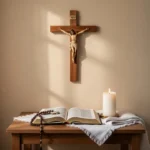
You can pray the stations at home with a book, an online parish resource, artwork, or a simple list of the 14 titles. Choose a quiet place where you can remain undisturbed for 20 to 40 minutes. A candle, crucifix, or Bible may help create a prayerful setting, but no special equipment is required.
One approach is to pray all 14 stations in a single sitting. Another is to pray one station each day, especially when you want to connect the Passion with a particular area of life. For example, you might meditate on Simon of Cyrene while considering how you respond to a family member who needs practical help.
At home, you can create modest movement by standing at different points in a room. If that is not practical, use a printed image for each station or simply read the titles in sequence. The essential movement is inward: from attention to the scene, to reflection, to prayer, and finally to a concrete response.
A simple home format can include:
An opening act of faith and a stated intention.
The title of the station and a short Scripture reading or paraphrase.
One or two minutes of silent reflection.
A prayer for mercy and a prayer connected to your intention.
A pause before continuing to the next station.
A closing prayer of gratitude and a commitment to one act of love.
Families can adapt the devotion for children by using shorter reflections and asking one clear question at each station. Instead of describing graphic details, ask what act of kindness, courage, or forgiveness appears in the scene. Children can carry a small cross, light a candle with adult supervision, or draw one image that represents what they heard.
How the stations differ from the Mass and other Catholic devotions
The Stations of the Cross are a devotional prayer, not a substitute for the Mass. The Mass makes the Church’s sacramental celebration of Christ’s death and Resurrection present in its liturgical worship. The stations help you meditate on the Passion and prepare your heart for deeper participation in the Church’s prayer.
The stations also differ from the Rosary. The Rosary traditionally moves through sets of mysteries from the lives of Jesus and Mary, while the Stations of the Cross concentrate on Jesus’ Passion. Both use repetition and meditation, but their images, structure, and spiritual emphasis are different.
They are also distinct from Eucharistic adoration, the Divine Mercy Chaplet, and personal Bible reading, although these practices can complement one another. A parish may schedule several of them during Lent, but each has its own purpose. You do not need to combine every devotion to pray the stations well.
The proper relationship is one of support. The stations can lead you toward the sacraments, Scripture, works of mercy, and a more attentive Christian life. Their value is shown not by how many times you complete them, but by whether they help you receive God’s mercy and extend it to others.
Living the message of the stations after prayer
The final station leaves Jesus in the tomb, but your response does not have to remain inside the church. The devotion asks what you will do with what you have contemplated. A prayer about Christ’s compassion can become a visit to someone who is lonely. A meditation on injustice can lead to a more careful defense of someone being mistreated.
Try choosing one practice after each prayer:
Offer patient attention to someone who is grieving.
Ask forgiveness where your actions have caused harm.
Accept appropriate help instead of hiding your need.
Provide practical assistance to a person carrying a heavy burden.
Refuse gossip or public humiliation directed at another person.
Pray for people affected by violence, poverty, imprisonment, or war.
Spend a few minutes in silence rather than reacting immediately in anger.
The stations do not promise that suffering will become easy to understand. They offer a way to face suffering in the presence of Christ, who knows rejection, pain, abandonment, and death. At the same time, they keep Christian prayer oriented toward love: the love that remains, serves, forgives, and waits for the life God brings from the tomb.
Frequently asked questions
How long does it take to pray the Stations of the Cross?
A private prayer can take about 15 to 30 minutes, depending on how long you remain silent at each station. A parish service may last longer because it includes hymns, Scripture readings, a leader’s reflections, and movement between images. There is no required minimum length. A slower, attentive prayer is generally more helpful than rushing through every station.
Do I have to kneel or walk during the Stations of the Cross?
No. Kneeling and walking are traditional gestures, but they are not requirements for the devotion. You may pray seated, stand when comfortable, or remain in one location if mobility, health, or the setting makes movement difficult. What matters is your attentive participation, not the physical form of the prayer.
Can non-Catholics pray the Stations of the Cross?
Yes. The devotion is particularly associated with Catholic practice, but Christians from other traditions may find its meditation on Jesus’ Passion meaningful. If you are unfamiliar with Catholic prayers, you can read the station titles, reflect on the Gospel accounts, and pray in your own words. Parish customs may differ, so follow the local leader during a communal service.
Why do some Stations of the Cross include a 15th station?
The traditional Catholic form has 14 stations and ends with Jesus being placed in the tomb. Some churches and prayer guides add a 15th station for the Resurrection, emphasizing that the Passion cannot be separated from Easter hope. The additional station is a devotional option, not a replacement for the traditional sequence or a required part of every service.













Leave a Reply