Roman Catholic crucifix: meaning, use, and symbolism
Roman Catholic crucifix: meaning, use, and symbolism
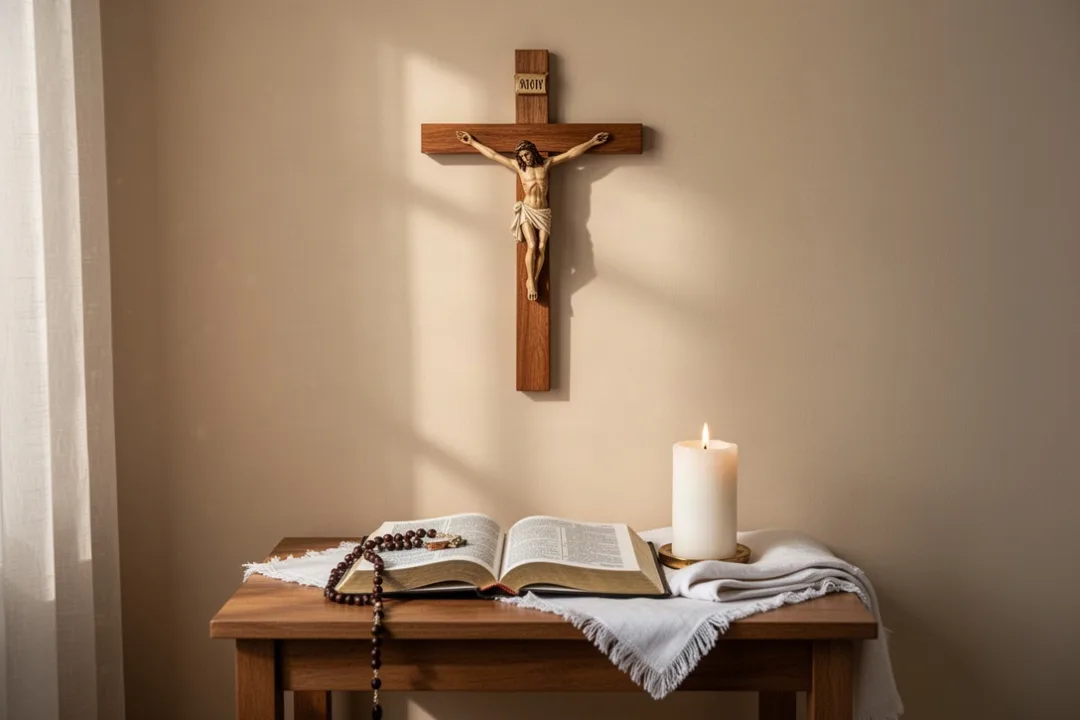
A Roman Catholic crucifix is a cross that includes a representation of Jesus’ body, usually called the corpus. It differs from a plain Christian cross, which has no figure of Christ. Catholics use the crucifix in churches, homes, classrooms, prayer spaces, rosaries, and personal devotion as a visible reminder of Jesus’ Passion and death.
The crucifix does not represent a belief that Christ remained dead. It points to the complete Paschal Mystery: his suffering, death, Resurrection, and the hope of eternal life. The image keeps the cost of Christian redemption in view while also directing attention toward Christ’s victory over sin and death.
What makes a Roman Catholic crucifix different from a cross
A plain cross consists of two intersecting beams or another cross-shaped design. A crucifix adds the figure of Christ crucified, often with his arms extended, his head inclined, and his body attached to the cross. The word “crucifix” comes from Latin roots meaning “fixed to a cross.”
The distinction is practical as well as visual. A cross may express Christianity in a broad sense, while a crucifix presents the specific event of the Crucifixion. It asks the viewer to contemplate not only the instrument of execution but also the person who accepted suffering out of love and obedience to the Father.
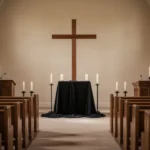
Roman Catholic churches commonly place a crucifix where the congregation can see it during Mass. The General Instruction of the Roman Missal calls for a cross with the image of Christ crucified to be present on or near the altar, positioned so that it can be seen clearly. Local church architecture and approved liturgical arrangements can affect its exact placement.
The crucifix is especially associated with the Latin, or Roman, Catholic tradition. Other Catholic traditions may use different artistic forms, including crosses, icons, and depictions of the risen Christ. These differences do not change the central Christian belief that Jesus truly suffered, died, and rose again.
The defining feature: A plain cross shows the symbol of Christianity; a crucifix shows the cross together with the body of Jesus. Both can support Christian prayer, but the crucifix places special emphasis on Christ’s sacrificial death.
What the crucifix symbolizes in Catholic belief
The central meaning of the crucifix is Christ’s self-giving love. Catholics understand Jesus’ death as more than an example of courage or an unfortunate historical event. Through the Crucifixion, Christ offers himself for the salvation of humanity and opens the way to reconciliation with God.
The image also expresses the reality of the Incarnation. Christians believe that the Son of God truly became human, with a real body capable of suffering. Showing Jesus on the cross emphasizes that his human suffering was not imaginary or merely symbolic. His wounded body points to the seriousness of sin and the depth of divine mercy.
Several themes are held together in the same image:
Love: Christ gives himself freely rather than responding to hatred with hatred.
Sacrifice: His death is understood as an offering for the salvation of the world.
Mercy: The crucifix recalls God’s willingness to forgive and restore sinners.
Solidarity: Jesus enters fully into human pain, rejection, injustice, and death.
Hope: The Crucifixion is inseparable from the Resurrection and the promise of new life.
The crucifix can therefore be a source of comfort for someone who is grieving, ill, afraid, or facing an unfair situation. It does not suggest that suffering is good in itself. Instead, it recalls that God can meet people within suffering and bring life, healing, and meaning beyond it.
Passages such as Philippians 2:5–11 describe Christ’s humility and obedience, while the Gospel accounts of the Passion describe his death on the cross. First Corinthians 1:18 presents the cross as the place where God’s power appears in a way that overturns ordinary human expectations. These references help explain why Catholics treat the crucifix as a profound theological sign rather than a decorative object.
The traditional details found on many crucifixes can add further meaning. The letters “INRI,” often shown on a small plaque above Jesus’ head, refer to the charge associated with his execution: Jesus of Nazareth, King of the Jews. The exact wording and language vary by artistic tradition, and some crucifixes omit the plaque altogether.
Different artists may portray Jesus with a bowed head, an upward gaze, a crown of thorns, or wounds emphasized in varying ways. Some images are restrained and serene; others show the physical severity of the Passion. These styles can lead viewers toward different aspects of the same faith: sorrow for sin, compassion for Christ, confidence in mercy, or hope in redemption.
How Catholics use a crucifix in prayer and worship
A crucifix is not treated as a god or as a magical object. Catholic worship belongs to God alone. When Catholics kneel before or kiss a crucifix, they are honoring Christ, not assigning divine power to wood, metal, plaster, or another material.
Catholic theology distinguishes between adoration and veneration. Adoration is worship offered only to God. Veneration is respectful honor shown to sacred signs, saints, and holy objects because of what they represent. A crucifix receives honor because it directs the believer to Jesus Christ and his saving work.
During private prayer, a person may look at the crucifix and speak honestly to Christ about fear, guilt, gratitude, grief, or hope. The image can help make prayer more attentive, especially when the mind is distracted. It can also give a person a quiet place to consider how Christian discipleship involves forgiveness, patience, service, and trust.
Common forms of prayer connected with a crucifix include:
The Sign of the Cross: A physical reminder of baptism and the Christian confession of the Trinity.
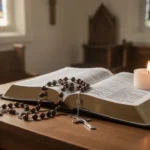
The Rosary: The opening prayers are traditionally made while holding the crucifix attached to the rosary.
The Stations of the Cross: A series of meditations on Christ’s Passion, often prayed during Lent.
Lectio divina: Prayerful reflection on Scripture, with the crucifix helping the reader remain focused on Christ.
Personal examination: A person may ask how Christ’s love should shape choices, relationships, and responses to suffering.
The crucifix also has a clear role in the Mass. The liturgy makes present sacramentally the one sacrifice of Christ; it does not repeat the historical Crucifixion as a new event. The visible crucifix helps the congregation understand the connection between Christ’s sacrifice and the Eucharistic celebration.
At a funeral or beside the bed of someone who is dying, a crucifix can communicate the Church’s faith in Christ’s presence through death. At a wedding, it can remind a couple that Christian love includes self-giving and faithfulness. In a classroom, it can identify the space as connected with Catholic education and point students toward the life and teaching of Jesus.
People sometimes make the Sign of the Cross when entering a church, passing a crucifix, or beginning prayer. These gestures are not required to have value. A person can pray sincerely without touching or displaying a crucifix, while someone who uses one can do so with varying levels of devotion. The object supports prayer; it does not replace prayer.
Where to place a Roman Catholic crucifix
Placement should help the crucifix be treated with respect and seen as a sign of faith. There is no single required location for every private home. A small crucifix may be placed above a doorway, near a family prayer area, beside a bed, in a home office, or in another clean and visible location.
Many Catholic homes place a crucifix in a central room because it represents the family’s faith and reminds household members to practice charity and forgiveness. Others choose a quieter location for personal prayer. A bedroom crucifix can be especially meaningful for someone praying at the beginning or end of the day.
Consider these practical questions when choosing a location:
Can the crucifix be seen easily without being crowded by unrelated decorations?
Is the wall or surface secure enough to support its weight?
Will sunlight, moisture, heat, or frequent handling damage the finish?
Does the location encourage prayer rather than turning the crucifix into background décor?
Is it placed respectfully if the room is used for several purposes?
A crucifix does not need to be large or expensive to be meaningful. A simple wooden cross with a modest corpus can serve the same devotional purpose as an elaborate metal or carved crucifix. The value of the object is not measured by its price, material, or size.
In a Catholic church, the altar crucifix has a liturgical purpose and should follow the guidance of the parish, diocese, and Roman Missal. A parishioner should not move a church crucifix or alter its placement without permission. In a school, hospital, or workplace, local policies may also govern where religious images may be displayed.
Some people wear a small crucifix as a necklace or keep one in a pocket. This can be a personal reminder of faith, but it should not be used to judge other Catholics whose devotion looks different. A crucifix is most fruitful when it leads to a life shaped by Christ’s teaching rather than functioning as a public badge alone.
Respect matters more than expense: Choose a crucifix that fits your space, budget, and devotional life. A modest crucifix used faithfully is more meaningful than an expensive piece displayed without reflection.
How to choose the right Roman Catholic crucifix
When buying a Roman Catholic crucifix, start with its intended use. A piece for a church sanctuary needs different proportions, construction, and visibility than a small crucifix for a rosary or a child’s bedroom. Knowing the purpose helps you avoid choosing an attractive item that is too fragile, too large, or difficult to mount safely.
Materials and construction
Wooden crucifixes are common because wood has a warm, traditional appearance and can be carved, painted, or left natural. They are often suitable for homes and prayer corners, but unfinished wood may need protection from humidity and direct sunlight.
Metal crucifixes can be durable and easy to clean. Brass, bronze, pewter, and stainless steel produce different colors and weights. A heavy metal crucifix may need stronger wall hardware than its size suggests.
Resin or molded composite crucifixes can reproduce detailed designs at a lower cost. They are often lighter than solid metal or wood, which can make them practical for travel or wall mounting. Check for cracks around thin parts such as the arms, fingers, or crossbar.
Handmade pieces can show small variations in color, carving, or finish. Those differences are not necessarily defects. For a valuable antique or family heirloom, however, repairs should be handled by someone familiar with religious art and the material involved.
Size, style, and imagery
Choose a size that allows the image of Christ to be seen clearly from the intended distance. A small crucifix may be appropriate for a nightstand, while a larger room may require a more substantial design. Avoid placing a very small crucifix high on a large wall where its details disappear.
Consider the emotional effect of the style. A realistic crucifix may help you contemplate the physical suffering of the Passion. A simpler design may make prayer feel more peaceful and less visually intense. Neither approach is automatically more faithful; the best choice is one that supports reverent prayer and fits the setting.
Measure the available wall or surface, including the clearance needed for mounting.
Confirm the materials and whether the item is intended for indoor or outdoor use.
Look closely at the attachment points, especially on larger or heavier crucifixes.
Decide whether you want a traditional, contemporary, carved, painted, or minimalist style.
Ask whether the item has been blessed if that matters to your devotional practice.
Some Catholics choose to have a crucifix blessed by a priest or deacon. A blessing is a prayer that dedicates the object to a sacred purpose; it does not transform the material into something magical or make it an object of worship. You can ask a parish about the appropriate time and process, since practices may differ.
How to care for, repair, and dispose of a crucifix
Care depends on the material and finish. Dust a wooden or painted crucifix with a soft, dry cloth. Avoid soaking wood, using harsh household cleaners, or applying polish unless the maker or conservator recommends it. Moisture can loosen joints, lift paint, or damage a protective coating.
Metal crucifixes usually need only gentle dusting. If tarnish or corrosion appears, identify the metal and finish before using a cleaning product. Abrasive pads can remove plating, scratch a surface, or erase fine details. A valuable crucifix should be assessed by a professional before cleaning.
Inspect wall-mounted crucifixes occasionally. Look for loose hooks, bending, cracks, or signs that the wall fastener is failing. A falling crucifix can injure someone and may damage the object. Use mounting hardware suited to both the weight of the crucifix and the wall material.
If a crucifix becomes damaged, do not assume it must be thrown away. A parish may know a religious-art restorer, woodworker, or metal conservator who can advise you. For a sentimental family piece, take photographs and record its history before arranging repairs.
When a crucifix is beyond repair, Catholics generally avoid treating it as ordinary trash because it has been used as a sacred sign. Practices can vary by parish and diocese, but appropriate options may include returning it to a church, asking a priest for guidance, or respectfully burying or burning a material that can be safely handled. Do not burn painted, plastic, treated, or chemically finished materials indoors or in unsafe conditions.
Damaged religious objects do not indicate damaged faith. The material object can wear out while the prayer, memory, and belief associated with it remain meaningful. A replacement crucifix can be chosen with care, while the old one is handled respectfully according to local Catholic guidance.
Frequently asked questions
Is a Roman Catholic crucifix required in every Catholic home?
No. The Church encourages Catholic devotion, but there is no universal rule requiring every household to display a crucifix. Many families use one as a reminder of Christ’s sacrifice and a focal point for prayer. Others may pray with a plain cross, an icon, Scripture, or no visible image at all. The sincerity of faith is not measured by the number of religious objects in a home.
Can non-Catholics use a crucifix?
Yes. Anyone may use a crucifix as a reminder of Jesus’ death, love, and Resurrection. Its symbolism is especially associated with Catholic devotion, but Christians from other traditions may also find it meaningful. If you are giving one as a gift, consider the recipient’s beliefs and artistic preferences. A respectful explanation of its meaning can prevent confusion about why Christ is shown on the cross.
Why do some Christians prefer a cross without Jesus on it?
Some Christian communities emphasize the empty cross as a sign of the Resurrection and Christ’s victory over death. Catholics also believe in the Resurrection, but the crucifix keeps Christ’s real suffering and sacrificial death visibly present. The two forms highlight different aspects of the same Christian story, and choosing one does not by itself determine the depth of a person’s faith.
Should a crucifix be blessed before it is displayed?
A blessing is optional, not a condition for using or displaying a crucifix. If you want one blessed, ask a Catholic priest or deacon about the parish’s practice. The blessing dedicates the object to a sacred purpose and encourages devotion; it does not give the crucifix magical powers. A crucifix can still serve as a meaningful reminder of Christ without having received a formal blessing.











Leave a Reply