Roman Catholic icons: Meaning, types, and proper use
Roman Catholic icons: Meaning, types, and proper use
Roman Catholic icons are sacred images that direct the viewer toward God rather than replacing God. They may show Jesus Christ, the Virgin Mary, angels, or saints, and they can be painted in the traditional icon style or created as statues, mosaics, stained-glass scenes, and other religious artwork.
The word icon comes from a Greek term meaning “image.” In ordinary Catholic conversation, however, people often use it for any especially meaningful devotional image. Technically, the Catholic tradition speaks more broadly of sacred images, while the Eastern Catholic Churches preserve a more defined icon tradition with particular styles, symbols, and rules.
The central distinction: Catholics do not worship wood, paint, plaster, or paper. Worship belongs to God alone; sacred images receive honor because of the person they represent.
A Roman Catholic icon is meant to make a spiritual reality visible. The image may present Christ as teacher, shepherd, crucified Savior, or risen Lord. It may show Mary holding the infant Jesus, a saint carrying the instrument of martyrdom, or an angel serving God’s purposes.
The image does not claim that the depicted person is physically present inside the material. Instead, it works as a visible reminder of an invisible reality. Looking at an image of Christ can help you focus on his life and saving work. Looking at an image of a saint can recall that person’s faith, example, and prayers.
This purpose connects with the Catholic understanding of the Incarnation. Christians believe that the Son of God truly became human in Jesus Christ. Because Christ took a visible human body, Catholics believe that depicting him is not automatically an attempt to limit or contain God. The image points to the person of Jesus, who is both truly divine and truly human.
Mary and the saints are represented for a different reason. They are not divine, and Catholic teaching does not treat them as gods. Their images point toward God’s grace at work in human lives. A painting of Saint Peter, for example, can recall both his weaknesses and his restoration by Christ. An image of Saint Francis of Assisi may bring to mind humility, care for creation, and love for the poor.
Sacred images also help connect Christian worship with the communion of saints. Catholics believe that the Church includes believers on earth, the faithful being purified after death, and the saints who are with God. A church filled with images expresses the idea that Christian worship takes place in fellowship with the whole body of Christ.
The purpose is therefore more than decoration. A well-chosen image can support memory, meditation, reverence, and prayer. It can also teach people who cannot read easily or who are encountering biblical stories for the first time.
Why the person matters more than the material
The physical object remains a created thing. Paint, wood, stone, metal, and fabric have no divine power simply because they are used in religious art. Any blessing given to an image does not turn the object into a god or make it a magical device.
When Catholics kneel before an image, light a candle, bow, or kiss a cross, the gesture is directed beyond the material object. The intended recipient is Christ, Mary, or the saint represented. The gesture should express faith and love, not superstition or the belief that an object controls God.
This distinction also explains why an old or famous image may be treated respectfully without being considered indispensable. If a particular statue is damaged, the Christian faith has not been damaged. The image is valuable because it serves devotion, not because the materials possess independent supernatural status.
How Catholics distinguish worship from honor
The Catholic tradition uses different terms to describe different kinds of respect. Adoration, sometimes called latria, belongs only to God: the Father, Son, and Holy Spirit. This is the worship offered in the Mass and in personal prayer.
Mary receives a unique form of honor because she is the mother of Jesus and occupies a special place in salvation history. Catholic theology commonly calls this honor hyperdulia. It is greater than the honor given to other saints, but it remains completely different from worship.
The saints receive veneration, often described with the term dulia. This means deep respect for people who followed Christ faithfully and now share in God’s life. Catholics may ask the saints to pray for them, much as a person might ask a trusted Christian friend to pray. The saint is not the source of grace; God is.
Special honor: respect given to Mary because of her unique relationship to Christ.
Veneration: honor given to the saints as faithful servants and friends of God.
Respect for sacred objects: care shown to images because of what they represent, not because the material is divine.
These distinctions can be difficult to see from the outside because physical gestures may look similar. A Catholic may bow before a crucifix, kneel before a statue, or kiss an icon. The meaning depends on the act of faith behind the gesture. The same outward movement can express worship in one context and respectful honor in another.
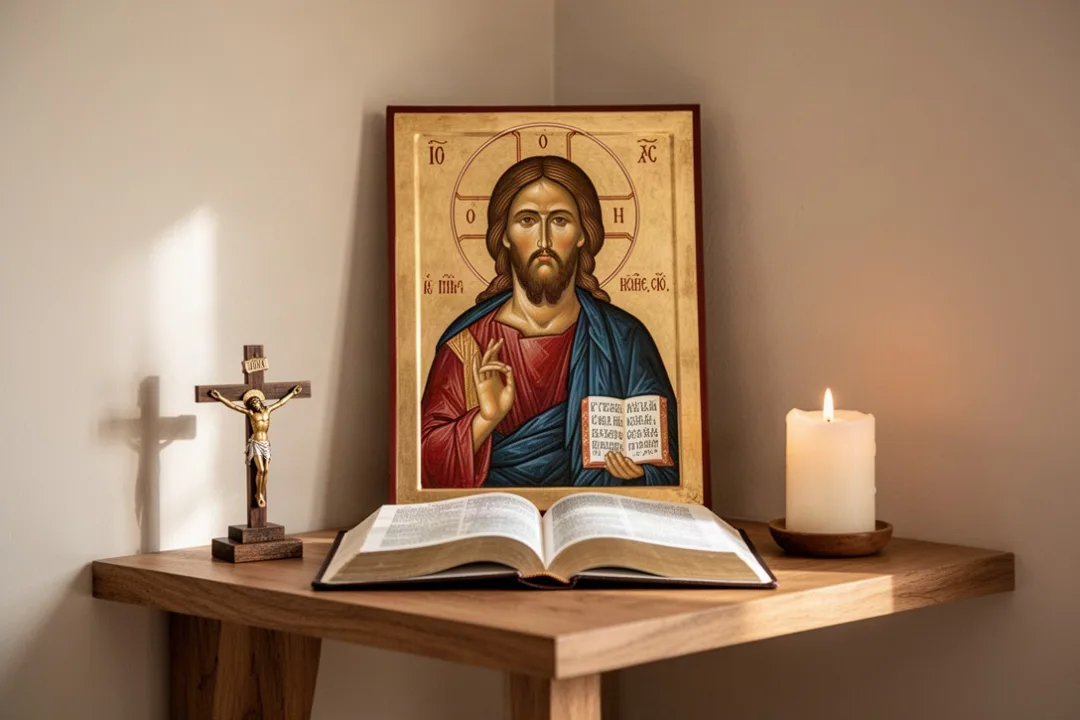
The crucifix makes this point especially clearly. Catholics do not believe that Jesus is physically trapped in a wooden cross. The crucifix presents the sacrifice of Christ and invites the viewer to remember his suffering, love, and victory over death. The focus is on the person and saving action of Jesus, not on the material object.
“The honor paid to a sacred image is directed to the person represented.”
This principle is associated with the Catholic defense of sacred images and is reflected in the Church’s teaching on images. It protects devotion from two opposite errors: treating images as gods, or assuming that every religious image is automatically forbidden.
A practical test: Ask what the image helps you remember and whom your prayer is addressing. If the image leads your attention to God and the Gospel, it is serving its proper devotional purpose.
Common types of Roman Catholic icons and sacred images
Roman Catholic sacred art includes many subjects and visual forms. Some images are closely associated with particular traditions, while others appear throughout the worldwide Church.
Images of Jesus Christ
Images of Jesus are central to Catholic devotion. The crucifix shows Christ on the cross and emphasizes the self-giving love of his Passion. A Resurrection image may show Christ rising from the tomb or appearing in glory. Other images portray the Sacred Heart, Christ the Good Shepherd, Christ as teacher, or Christ blessing the world.
The Sacred Heart devotion focuses on the love of Jesus, represented by his heart as a sign of his compassion and self-sacrifice. It is not a separate deity or a second person of the Trinity. The image uses a visible symbol to draw attention to the personal love of Christ.
Images of Mary
Marian images often show Mary with the child Jesus, emphasizing that her identity is inseparable from her role as the mother of Christ. Other images portray events such as the Annunciation, Visitation, Assumption, or Mary standing beneath the cross.
Many titles for Mary describe a particular devotional tradition or a location where a devotion developed. Examples include Our Lady of Guadalupe, Our Lady of Lourdes, Our Lady of Perpetual Help, and Our Lady of Sorrows. These titles do not refer to different goddesses or different versions of Mary. They identify different ways Catholics remember and approach the same mother of Jesus.
Images of saints and angels
Saints are often shown with symbols that identify their lives. Saint Peter may be depicted with keys, Saint Paul with a sword, Saint Joseph with a lily or carpenter’s tools, and Saint Catherine of Siena with a Dominican habit. Such symbols help viewers recognize the person and recall a major part of that saint’s witness.
Martyrs may be shown with the instrument of their death or with a palm branch, an ancient Christian sign of victory through faithful endurance. Doctors of the Church may appear with books, pens, or other signs of teaching. Angels may be depicted as messengers, guardians, or worshipers before God.
Stations, symbols, and biblical scenes
The Stations of the Cross use a sequence of images to guide prayer through the Passion of Jesus. A parish may use carved reliefs, painted panels, or simple crosses. The exact artistic style can vary, but the devotional purpose is to help worshipers accompany Christ through the events leading to his crucifixion.
Other common sacred images include the Nativity, the Last Supper, Pentecost, the Baptism of Jesus, and the Transfiguration. Symbols such as the lamb, dove, vine, fish, chi-rho, and alpha and omega can communicate Christian beliefs without portraying a complete scene.
Traditional Eastern-style icons
Some Roman Catholic icons follow the visual conventions of Byzantine Christianity. These may use a frontal pose, a gold background, symbolic colors, stylized proportions, and a deliberate lack of ordinary perspective. The goal is not photographic realism. It is to present a sacred person as belonging to the transformed reality of God’s kingdom.
Eastern Catholic Churches, which are fully Catholic while preserving their own liturgical and spiritual traditions, have especially strong iconographic practices. Their churches may include an iconostasis, a screen covered with carefully arranged icons that separates the sanctuary from the nave. Latin-rite Catholics may also use Byzantine-style icons, but the surrounding customs can differ.
How icon style communicates spiritual meaning
Traditional icons are not simply portraits with religious subjects. Their composition, posture, colors, gestures, and placement can carry theological meaning. The details vary across cultures and schools, so no single symbol has exactly the same force in every image. Still, several patterns appear frequently.
A frontal figure can suggest presence and attentiveness. Large eyes may symbolize spiritual perception, while a small mouth can suggest silence and restraint. A gold background commonly evokes divine glory or the heavenly realm rather than a specific physical location.
Artists may use an unusual perspective to prevent the image from looking like an ordinary window onto a worldly scene. In some icon traditions, lines seem to move toward the viewer rather than disappear into a distant point. This can suggest that the sacred world is addressing the worshiper.
Colors can also carry associations. Blue may suggest humanity or the created world, while red can suggest life, sacrifice, or royal dignity. These meanings are not a universal code, and the same color can serve several purposes. The viewer should consider the entire composition instead of assigning a rigid meaning to one shade.
Mary’s clothing in Byzantine-style images is often marked with three stars, traditionally associated with her virginity before, during, and after the birth of Christ. The child Jesus may be shown with a mature expression because the image emphasizes that he is not merely an ordinary infant but the eternal Son made human.
Letters and abbreviations sometimes appear in traditional icons, but they are not required for an image to be Catholic or devotional. They identify Christ, Mary, or a particular scene for viewers familiar with the tradition. A contemporary Catholic sacred image may communicate its subject through naturalistic art, local cultural symbols, or a simpler design.
The most effective image is not necessarily the most ornate. A simple cross, a small print of a Gospel scene, or an icon painted with restrained colors can focus prayer more effectively than an elaborate object chosen only for visual impact.
How Roman Catholic icons are used in churches and homes
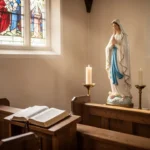
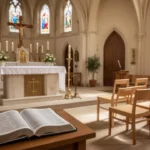
In a church, sacred images help establish a visual focus for worship and private prayer. A crucifix is placed where the congregation can see it during Mass. Images of Mary and the saints may stand in side chapels or near shrines. Statues, mosaics, and stained-glass windows can present the biblical story and the history of Christian witness throughout the building.
Church art should support the liturgy rather than compete with it. Catholic teaching asks that images be arranged with order and proportion, so that the central mysteries of the faith remain clear. The altar, tabernacle, ambo, baptismal font, and crucifix each have a distinct role, and devotional images should not make those primary elements difficult to recognize.
At home, a Catholic prayer corner can be modest. You might place a crucifix, Bible, rosary, and one or two meaningful images on a small shelf. Some households keep a Marian image, a patron saint, or a picture connected to baptism, confirmation, marriage, or a family member’s patron saint.
A home shrine is not a private altar for offering the Eucharistic sacrifice. It is a place for personal and family prayer. You can use it for morning prayer, a decade of the Rosary, Scripture meditation, prayers for the sick, or quiet reflection before bed.
Choose a meaningful subject: Select Christ, Mary, a saint, or a biblical scene that supports the kind of prayer you actually practice.
Place it where prayer can happen: A clean, calm location is usually more helpful than a prominent spot chosen only for display.
Keep the arrangement simple: One central image can be more focused than a crowded collection of unrelated objects.
Use the image actively: Read the related Gospel passage, recall the saint’s life, or sit quietly with the image before beginning a prayer.
Care for it respectfully: Protect paper images from moisture and direct sunlight, and keep fragile icons away from unstable shelves or open flames.
Candles can be part of Catholic prayer, but they require ordinary safety precautions. Keep flames away from curtains, books, children, and pets, and never leave a burning candle unattended. An electric candle can serve as a practical alternative in a small home or shared living space.
When buying an icon, consider the quality and origin of the artwork. A handmade icon from a reputable religious artist may have a strong connection to a particular tradition. A printed reproduction can be just as useful for prayer if it helps you attend to God. Price, rarity, and age do not determine the spiritual value of an image.
Prayer with an icon does not require a special technique. Begin by placing yourself in God’s presence and identifying what the image shows. If it depicts Christ, let the details lead you to the Gospel. If it depicts a saint, remember that person’s relationship with Jesus and ask for prayers rather than treating the saint as the source of divine power.
Allow the image to slow your attention. Notice the posture, expression, gestures, and setting. You do not need to analyze every detail. A few quiet minutes with one image can be more fruitful than quickly moving through many devotional objects.
You may use a simple pattern such as this:
Look: Observe the image without rushing to speak.
Remember: Recall the biblical event, Christian truth, or saintly witness it presents.
Respond: Offer God praise, sorrow, gratitude, or a request connected with what you see.
Remain: Sit quietly for a short time, allowing the image to keep your attention on prayer.
For an image of Christ, you might meditate on his mercy, teaching, Passion, or Resurrection. For an image of Mary, you might reflect on her trust in God and her role in pointing people toward her Son. For an image of a saint, you could ask for help in practicing a virtue that marked that person’s life.
Icons should not become a substitute for the sacraments, Scripture, charity, or the responsibilities of Christian life. They are aids to faith. If an image draws you toward Mass, the Bible, repentance, compassion, and trust in God, it is serving a healthy purpose.
How to recognize a respectful and authentic Catholic use
A Catholic image is used well when it supports the Gospel and respects the person represented. It should not present a saint as a rival to God or suggest that a particular object guarantees healing, protection, wealth, or success. Claims that an image automatically produces a result can shift devotion toward superstition.
Good sacred art also avoids confusion about Christian belief. Images of the Trinity, angels, Mary, or the saints should be understood within the Church’s teaching, not treated as literal photographs of heavenly realities. A symbol can be true in what it communicates without being a physical description of God.
If you are unsure about an image, ask a Catholic priest, deacon, religious educator, or knowledgeable church artist. This can be especially useful when an image combines Catholic elements with unrelated spiritual symbols, commercial promises, or practices that do not belong to Catholic devotion.
Different cultures express Catholic faith through different artistic languages. A Mexican retablo, Filipino Santo image, African Catholic sculpture, European devotional print, and Byzantine icon may look very different while serving the same basic purpose: helping Christians remember Christ and live in communion with the Church.
The best Roman Catholic icons do not ask to be admired as isolated works of art. They invite the viewer to see, remember, and pray. Their value lies in the way they direct the mind and heart toward the living God revealed in Jesus Christ, while honoring the people whose lives bear witness to that faith.
Frequently asked questions
Are Roman Catholic icons the same as Orthodox icons?
They share many roots, subjects, and symbolic traditions, especially when they follow Byzantine forms. The main difference is often cultural and liturgical rather than a simple question of whether one is “Catholic” and the other is not. Eastern Orthodox and Eastern Catholic Churches preserve especially formal icon traditions, while Latin-rite Catholic parishes may use a wider range of realistic and modern sacred art.
Can Catholics pray to an icon?
Catholics pray before an icon, not to the material object as though it were divine. A prayer may be addressed to God, or a Catholic may ask Mary or a saint to intercede. The image helps focus attention on the person represented. Worship is directed only to God, even when respectful gestures are made before a sacred image.
Should a Catholic have an icon blessed?
A blessing is optional, not a requirement for an image to be useful in prayer. Having a priest or deacon bless an icon can mark its intended devotional use and encourage reverence. A blessing does not make the object magical or guarantee a particular outcome. The image remains an aid to prayer and Christian remembrance.
Where should you place an icon at home?
Choose a clean, stable location where you can pray without frequent distractions. A small shelf, desk, bedroom corner, or family prayer area can work well. Place the image away from moisture, direct sunlight, and unsafe flames. Keep the arrangement simple, with a crucifix or image of Christ as the central focus when appropriate.











Leave a Reply