Saint Luke is traditionally regarded as the patron saint of artists, particularly painters, iconographers, and other visual artists. Christian tradition says that Luke painted an image of the Virgin Mary, although the Bible does not record him creating artwork.
Luke is also known as an evangelist and the traditional author of the Gospel of Luke and Acts of the Apostles. His connection with artists comes from later traditions about his skill as a painter, his attention to human detail, and the important role of images in Christian devotion.
The connection between Luke and artists developed through early Christian tradition, not through a direct biblical statement. According to longstanding accounts, Luke painted a portrait of Mary, the mother of Jesus, while she was still alive. Some versions say he also painted images of Jesus and the apostles.
These stories helped establish Luke as a special patron for painters. In particular, they supported the idea that a sacred image could serve as a respectful aid to prayer rather than merely as decoration. Artists who created images of Christ, Mary, and the saints often saw Luke as a spiritual predecessor.
The tradition became especially influential in the Christian East, where the making of icons developed into a disciplined religious practice. Some famous icons have been attributed to Luke by tradition, although historians generally cannot prove that he personally painted them. The attribution expresses their connection with his reputation rather than documented authorship.
Historical distinction: Saint Luke is the traditional patron of artists because of later accounts about his painting, not because Scripture explicitly describes him as an artist.
Luke’s written work also helps explain why artists identify with him. His Gospel includes vivid scenes, memorable individuals, and careful attention to encounters between people. He portrays compassion, healing, hospitality, poverty, repentance, and joy with unusual narrative detail. For many artists, this sensitivity to human experience feels closely related to the work of observation and representation.
The traditional association also reflects the early Church’s growing understanding of visual art. As Christian communities created paintings, mosaics, illuminated manuscripts, sculptures, and icons, they looked for respected figures who could represent the vocation. Luke offered a natural choice: a companion of the apostles who was remembered not only as a writer and evangelist but also as a maker of sacred images.
What Saint Luke represents to painters and visual artists
Saint Luke represents more than technical ability. Artists often look to him as an example of faithful observation, patient craftsmanship, and service through creative work. His traditional story suggests that art can preserve memory, communicate belief, and direct attention toward something greater than the artist.
For painters, Luke’s patronage can carry several meanings:
Skill used in service: Artistic talent can be offered for the good of others rather than treated only as personal achievement.
Careful attention: Creating an image requires patience, concentration, and respect for the subject.
Visual storytelling: Art can communicate ideas and emotions when words are limited or unavailable.
Reverence for people: Portraiture can honor the dignity, sorrow, beauty, and individuality of human beings.
Perseverance: A finished work usually depends on steady practice rather than sudden inspiration.
These themes apply beyond religious painting. A portrait artist may think about how an image reveals a person’s character. A landscape painter may see close observation as a form of gratitude. A sculptor, photographer, illustrator, or ceramic artist may likewise connect creative discipline with attention, humility, and care.
Luke is especially meaningful to artists who work with religious subjects. His traditional role suggests that sacred art should be approached with preparation and responsibility. The artist is not simply producing an attractive object; the work may shape how viewers imagine a biblical event, a saint, or a central mystery of faith.
That does not mean every Christian artist must create devotional work. Saint Luke’s patronage can also speak to artists whose subjects are secular. The broader principle is that creative work can be practiced with integrity, compassion, and an awareness of its effect on other people.
Artists who pray through Luke’s intercession may ask for help with practical concerns as well as spiritual ones. They might seek patience during a difficult project, clarity when choosing a subject, honesty in portraying another person, or courage when their work is misunderstood. Some ask for protection from discouragement and for the wisdom to use their abilities responsibly.
Saint Luke’s connection with Christian art and icons
The most famous part of Luke’s artistic tradition is his supposed role as the first painter of the Virgin Mary. Various Christian communities preserve different versions of this account. The stories are not identical, and particular images have been connected with Luke in different places over the centuries.
In Eastern Christianity, an icon is not treated simply as a realistic picture. It is created according to established theological and artistic conventions, with the goal of pointing beyond the material surface. The icon’s colors, gestures, posture, and composition may communicate the identity and spiritual significance of the person shown.
Because Luke was believed to have painted Mary from life, his name became associated with the legitimacy of sacred images. This mattered during periods when Christians debated whether religious pictures should be used in worship and devotion. The tradition about Luke offered support for those who believed that holy images could help believers remember and honor Christ and the saints.
It is useful to distinguish between veneration and worship in this context. In Christian theology, worship belongs to God, while an image may receive respect because of the person or sacred reality it represents. The exact language differs among Christian traditions, but the basic argument is that honor directed toward an image is connected to its subject.
Western art also drew deeply on Luke’s association with painting. Medieval and Renaissance artists frequently depicted Luke painting the Virgin Mary. These scenes often show him at an easel, seated before Mary and the child Jesus, or working under divine guidance. The image of Luke at work became a visual statement about the dignity of the artistic vocation.
Guilds and professional associations sometimes placed themselves under Luke’s protection. In several European cities, painters celebrated his feast day or identified him as their patron. These associations helped connect artistic training, professional standards, religious identity, and community life.
Traditional attributions should still be treated carefully. An icon or painting described as “by Saint Luke” may be historically much later than the first century. Such a label usually means that the work belongs to a devotional tradition connected with Luke, not that researchers have established his physical involvement.
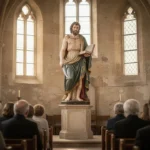
For choosing an image: A depiction of Luke painting Mary is appropriate for a studio, parish, art school, or personal prayer space, while an image of Luke holding the Gospel emphasizes his role as evangelist.
The New Testament gives a limited but meaningful picture of Luke. He is named in several of Paul’s letters, and Colossians identifies him as a physician. Another letter refers to him as a fellow worker. These references support the view that Luke was part of Paul’s circle and was a trusted member of the early Christian community.
The Gospel associated with Luke presents Jesus as the Savior whose ministry reaches people often overlooked by society. It gives particular attention to the poor, the sick, women, outsiders, sinners, and those who need mercy. Parables and episodes found especially in Luke include stories that emphasize forgiveness, generosity, prayer, and compassion.
Acts continues the story of the early Church after Jesus’ resurrection. In several passages, the wording changes from third-person descriptions to “we” passages, which has traditionally been taken as evidence that the author joined some of Paul’s travels. Scholars continue to discuss the details of authorship and composition, but Luke’s traditional identity remains central to Christian history.
None of these biblical passages says that Luke painted a portrait of Mary. That detail belongs to later Christian tradition. Separating biblical evidence from devotional tradition does not require dismissing the tradition; it allows readers to understand what is documented, what is inherited, and what remains uncertain.
Luke’s identity as a physician also contributes to his appeal to artists. Both medicine and art can require close observation, practical training, and attention to the individual person. A physician studies the body in order to care for it; an artist may study appearance, gesture, and expression in order to communicate something about a person or experience.
The Gospel of Luke is also associated with a strong concern for embodied human life. Jesus touches, heals, eats, travels, weeps, and speaks with people in specific situations. Artists may find in these narratives a reminder that spiritual ideas are often communicated through physical details: a face, a hand, a posture, a meal, or a road.
For that reason, Luke can serve as a patron not only for artists who make Christian images but also for anyone trying to represent human life with truth and compassion. His traditional example encourages creative work that pays attention to people rather than reducing them to symbols.
Other patron saints for specific kinds of artists
Saint Luke is the broadest answer to the question about the patron saint of artists, but different creative fields have their own traditional patrons. These associations can vary by country, denomination, guild, and local custom.
Saint Cecilia: Traditionally associated with musicians, singers, and sacred music. Her feast is observed on November 22.
Saint Genesius: Commonly regarded as a patron of actors and performers. Tradition describes him as an actor who converted to Christianity.
Saint Apollonia: Often invoked by dentists, but sometimes connected with performers or those suffering tooth pain because of the story of her martyrdom.
Saint Joseph: Traditionally associated with workers and craftsmen, making him meaningful to woodworkers, builders, artisans, and makers.
Saint Benedict Joseph Labre: Sometimes connected with people living on the margins and with those seeking help in poverty, though his patronage is not primarily artistic.
For a painter, illustrator, sculptor, or iconographer, Luke is usually the most direct choice. A musician may choose Cecilia, while an actor may turn to Genesius. Someone whose creative practice is also a skilled trade might feel a strong connection with Joseph as a patron of workers.
You do not have to choose only one patron. An artist who composes sacred music and paints could ask both Luke and Cecilia for intercession. A theater designer might combine Luke’s connection with visual art and Genesius’s connection with performance.
Patron saints are not substitutes for learning, planning, or professional care. Their role is spiritual and symbolic: they offer examples, companionship, and a focus for prayer. A patron can remind you of the values you want to bring to your work, especially when deadlines, criticism, financial pressure, or creative uncertainty make those values difficult to maintain.
Artists can honor Luke through prayer, study, service, and disciplined creative practice. The form does not need to be elaborate. A short prayer before beginning work, a reading from Luke’s Gospel, or a deliberate act of generosity toward another artist can express the connection.
Practical ways to observe his patronage include:
Set aside time on October 18, the traditional feast of Saint Luke, for prayer or reflection.
Read a passage from Luke’s Gospel and consider how its people, setting, and emotions could be represented visually.
Study sacred art responsibly, including the history of icons, church commissions, and the traditions connected with Christian imagery.
Dedicate a project to a charitable purpose, such as donating a portion of proceeds or creating work for a community organization.
Keep a practice of honest observation, drawing or writing regularly even when the results are unfinished.
Ask for humility and patience, especially when receiving criticism or revising a piece.
A studio prayer card might show Luke with a book, a brush, a palette, or an image of Mary. The symbols do not need to follow one universal design. Some artists prefer Luke shown as an evangelist with a book; others choose the traditional scene of him painting.
Artists may also honor Luke by treating subjects with dignity. This is particularly relevant when portraying people who are vulnerable, poor, sick, displaced, or socially ignored. Luke’s Gospel repeatedly draws attention to such people, so respectful representation can become a practical expression of the values associated with him.
For students, Luke can represent the patience required to develop a craft. For professional artists, he can serve as a reminder that recognition and income are not the only measures of meaningful work. For hobbyists, he offers reassurance that creative practice has value even when it is private, unfinished, or shared with only a small audience.
The central tradition remains simple: Saint Luke is the patron saint of artists because Christians came to remember him as a painter of sacred images and as a careful witness to the life of Jesus. Whether you create paintings, icons, photographs, sculptures, illustrations, or another kind of work, his example points toward close attention, compassion, and faithful use of your abilities.
Frequently asked questions
Is Saint Luke officially the patron saint of all artists?
Saint Luke is widely recognized as the traditional patron of artists, especially painters and iconographers. Patronage customs can differ among churches and countries, and some creative professions have more specific patrons. “Official” can therefore mean different things depending on the religious authority or organization involved. In common Christian usage, however, Luke is the standard answer for artists generally.
Did Saint Luke really paint the Virgin Mary?
Christian tradition says that Luke painted Mary, and several religious images have been connected with him. The New Testament does not mention him painting, and historians cannot verify that he created those surviving works. The story remains significant as a devotional tradition explaining why Luke became associated with sacred art and visual representation.
When is Saint Luke’s feast day?
Saint Luke’s traditional feast day is October 18. Artists may use the date for prayer, a studio gathering, a church service, or reflection on their creative vocation. The observance may look different across denominations and local communities, so checking your church’s calendar is sensible if you want to participate in a formal service.
What symbol is associated with Saint Luke?
Luke is traditionally represented by a winged ox, one of the four symbols of the evangelists. The ox suggests sacrifice and service. In images related specifically to artists, Luke may also appear with a book, writing tools, a palette, a brush, or a painting of the Virgin Mary and Christ.












Leave a Reply