Roman Catholic holy water: meaning, uses, and prayers
Roman Catholic holy water: meaning, uses, and prayers
If you dip your fingers into a church’s font before entering the pew, you may wonder what the gesture means or whether you can use Roman Catholic holy water at home. The short answer is that holy water is ordinary water set apart by a blessing from the Church. Catholics use it to recall Baptism, express repentance, ask for God’s protection, and dedicate ordinary moments to prayer.
Holy water does not work as a charm, guarantee safety, or replace the sacraments. Its purpose is to direct your attention toward Jesus Christ and the grace God gives through the Church. When you make the Sign of the Cross with it, the physical action supports a spiritual act: you remember that you belong to Christ and ask to live faithfully.
In Catholic practice, water is closely associated with creation, cleansing, life, and Baptism. The Bible presents water as a sign of God’s care and as part of important moments in salvation history. Catholic worship uses water in Baptism, in blessings, and sometimes in rites that recall the Church’s dependence on God’s mercy.
Holy water is therefore a sacramental. A sacramental is a sacred sign established by the Church that helps prepare people to receive grace and encourages them to respond to God in faith. Sacramentals include blessed objects, actions, and places, such as a crucifix, rosary, blessing, or the Sign of the Cross.
The water itself does not become a divine substance or acquire magical powers. The Church’s blessing sets it apart for a sacred purpose, while the person using it is called to pray with faith and a sincere heart. The benefit is connected to God’s grace and to the believer’s disposition, not to a special physical force in the liquid.
Central idea: Holy water is a reminder and aid to Christian prayer. It points beyond itself to Baptism, Christ’s saving work, and the protection and mercy of God.
Why Catholics make the Sign of the Cross with holy water
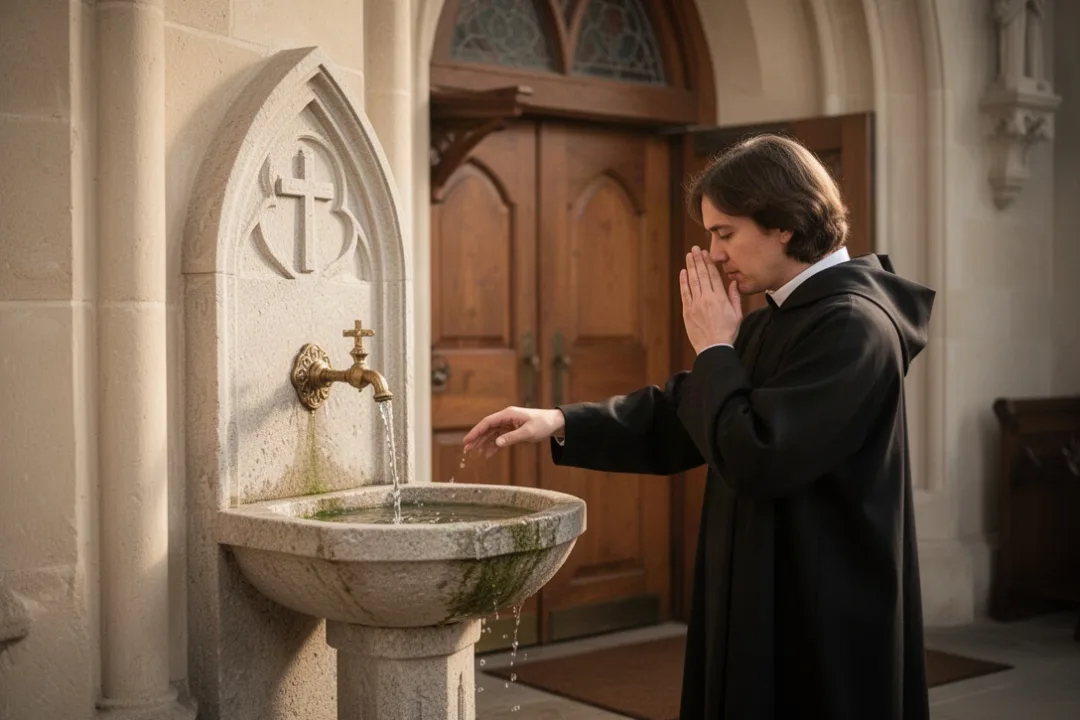
When Catholics enter or leave a church, they often touch holy water and make the Sign of the Cross. This gesture recalls the name of the Father, Son, and Holy Spirit and connects the person’s prayer to Baptism. It can be a quiet way to pause, turn away from distraction, and recognize that the church is a place set apart for worship.
The gesture also expresses a basic Christian identity. Baptism begins a person’s sacramental life in the Church, and the Sign of the Cross renews awareness of that commitment. It is not a second Baptism and does not forgive sins in the same way as the Sacrament of Reconciliation.
You do not need to perform the gesture mechanically. You might say inwardly, “Lord, help me remember my Baptism and worship you with a faithful heart,” using your own words. The external action is valuable when it supports attention, humility, and prayer.
How to use Roman Catholic holy water step by step
There is no single required formula for using holy water privately. The familiar church custom is simple, but you can adapt it to your circumstances. A respectful practice can follow these steps:
Pause before using the water. Become aware of God’s presence instead of treating the font or container as a routine object.
Touch a small amount of water. Use clean fingers and avoid splashing or taking more than you need.
Make the Sign of the Cross. Move from forehead to chest, then from one shoulder to the other according to your customary practice.
Recall your Baptism. Thank God for calling you to Christian faith and ask for the grace to live it faithfully.
Offer a brief prayer. You may pray for forgiveness, protection, a family member, a difficult decision, or the needs of the Church.
At home, you can use holy water when you wake up, before going to bed, before leaving for work, or when beginning a family prayer. You might bless yourself before a trip or use it while praying for someone who is sick. These practices are devotional customs, not obligations required at every moment.
Make the Sign of the Cross when entering a church.
Pray for your household and bless the home during family prayer.
Use it before reading Scripture or beginning a rosary.
Recall your Baptism when facing temptation or discouragement.
Use it respectfully when praying for the dead or for someone in need.
How Catholics obtain holy water
The most reliable way to obtain holy water is to ask a parish priest or deacon for it. Many churches keep a font near the entrance or provide a dispenser where parishioners may fill a clean bottle. Some parishes offer holy water during particular liturgical seasons or after a scheduled blessing.
Ask the parish office about its local practice if you are unsure. A priest or deacon can tell you where the water is available and may bless water for your home, a sick person, or a specific devotional purpose. Do not remove water from a baptismal font unless the parish permits it, because baptismal areas are arranged for worship and are not always intended as refill stations.
You can bring a clean, closed container labeled only for this purpose. A small glass or plastic bottle is practical, but there is no required shape, size, or material. Avoid using containers that previously held chemicals, medicines, or substances that could contaminate the water.
Catholics should not assume that water sold online or labeled “holy water” has been blessed according to Catholic practice. A bottle may contain ordinary spring or distilled water, or it may have been blessed by someone outside the Catholic Church. If the blessing matters to you, obtain the water through a Catholic parish or Catholic clergy member.
How holy water is blessed
A blessing is a prayer in which the Church asks God to bless people or objects and to use them for a sacred purpose. When water is blessed, the minister prays that it may help the faithful remember Baptism, resist sin, and seek God’s mercy. The rite may include Scripture, a prayer of blessing, and the Sign of the Cross.
The exact wording and form can vary according to the approved liturgical book, the occasion, and the local custom. Water may be blessed during a parish service, as part of a blessing of a home, or in connection with a liturgical celebration. The minister’s prayer is more important than any special appearance, smell, color, or container.
In the Latin Catholic tradition, a priest or deacon commonly presides at blessings of this kind, following the Church’s liturgical norms. A layperson may also use blessed water in prayer and may lead certain family devotions, but should not present a private prayer as the Church’s official liturgical blessing.
Some traditional forms of blessing water have included prayers concerning protection from evil and the use of blessed salt. Practices can vary by rite, parish, and approved ritual. Catholics should follow the guidance of their parish rather than attempting to reproduce a specialized rite from an unverified source.
The connection between holy water and Baptism
Holy water is most directly connected to the Sacrament of Baptism. In Baptism, a person is incorporated into Christ, receives the baptismal character, and becomes a member of the Church. The water used in a church font does not repeat those effects, but it recalls the event and encourages the baptized person to live according to its promises.
During some Catholic liturgies, the assembly is sprinkled with water as a reminder of Baptism. This can take place especially on Sundays or at other celebrations when the rite calls for it. The sprinkling is a communal sign, while making the Sign of the Cross with holy water at the church entrance is usually a personal devotional act.
For this reason, holy water can be especially meaningful during periods of renewal, repentance, and preparation. A person might use it while preparing for Confession, beginning Lent, celebrating Easter, or praying about a return to active participation in parish life.
Holy water recalls Baptism and turns an ordinary gesture into an opportunity for prayer.
Holy water, blessed water, and baptismal water
People sometimes use these terms interchangeably, but the setting and purpose can differ. Holy water generally means water blessed for devotional and liturgical use. It may be kept in church fonts, used to bless people and objects, or taken home for prayer.
Baptismal water refers to water used in the celebration of Baptism or water associated with a baptismal font. It may be blessed during the Easter Vigil or another baptismal celebration according to the Church’s liturgy. Once distributed for personal use, it may be used devotionally, but it does not replace the Sacrament of Baptism.
The word blessed water can have a broader everyday meaning. It may describe water blessed during a particular ceremony, for a home blessing, or for a special parish event. If you need to know what a container contains or how it was blessed, ask the parish rather than relying on a label.
A small holy water font near the entrance can help make prayer part of daily life. Some Catholic households keep a wall-mounted font by the front door, while others use a small bottle or bowl during family prayer. The arrangement should be clean, safe, and respectful, especially if young children or pets live in the home.
You can bless yourself as you leave the house, pray for family members as they begin the day, or use the water during a home blessing. A simple prayer might ask God to protect the household from harm, strengthen its members in charity, and help everyone live according to the Gospel.
Holy water can also accompany specific moments of prayer. For example, you may use it when praying for a new home, after a difficult argument, before a long journey, or when sitting with someone who is ill. It is not a substitute for medical care, professional help, emergency services, or the sacraments. It is a devotional support within a wider life of faith.
A home font is not required. If you do not have one, you can keep a small sealed bottle in a clean place and use it thoughtfully. The absence of a special container does not make your prayer less sincere.
Can holy water protect a person or home?
Catholic tradition treats holy water as a prayerful sign of God’s protection, but it does not teach that the water acts automatically. A person should not believe that a room is spiritually secure merely because water was sprinkled there, or that a harmful event cannot occur after someone has been blessed.
When a priest blesses a home, the blessing asks God to protect those who live there and to help the household grow in peace, faith, and love. The water supports that prayer as a sign. Protection in Christian life includes spiritual strength, wise action, community support, and trust in God—not dependence on a material object.
People who experience frightening events, suspected abuse, serious mental health symptoms, or possible danger should seek appropriate practical help. Prayer and holy water can accompany responsible action, but they must not delay contacting emergency services, a doctor, a counselor, or a trusted authority when circumstances require it.
Avoid superstition: Holy water is not a talisman. Use it with prayer and faith, while taking ordinary safety measures and seeking professional or pastoral help when a situation calls for it.
Holy water and prayers for protection
A Catholic may use holy water while praying for protection from sin, danger, temptation, or spiritual discouragement. The prayer can be short and personal. You might ask God to guide your thoughts, protect your family, give courage to someone who is suffering, or help you reject actions that harm yourself or others.
The Sign of the Cross is itself an appropriate prayer. You can also pray the Lord’s Prayer, a psalm in your own words, a prayer to the guardian angel, or a petition to the Blessed Virgin Mary and the saints. The particular prayer does not make the water more powerful; it helps you bring your concerns before God.
Some Catholics seek holy water in connection with prayers of deliverance or concerns about evil. These situations should be handled carefully. A parish priest can offer pastoral guidance and determine whether a person needs ordinary spiritual support, professional care, or referral to someone authorized to handle a formal Church rite.
How to store and care for holy water
Holy water should be treated with respect, but it does not need elaborate handling. Keep it in a clean, covered container away from direct contamination. If it is stored for a long time, inspect it occasionally for cloudiness, odor, algae, or other signs that it should be replaced.
Do not drink holy water as though it were bottled drinking water unless a parish specifically confirms that it has been prepared and handled for that purpose. Water kept in an open font can be touched by many people and may not meet drinking-water standards. A small amount accidentally swallowed is generally not a cause for alarm, but routine consumption is unnecessary.
Water that has spoiled should not be poured casually into a sink or trash can if a respectful alternative is available. Ask your parish how to dispose of it. In many Catholic settings, blessed water is returned to the earth in a dignified place, but local guidance should determine the practice.
Use a clean container with a secure lid.
Do not mix holy water with cleaning products or other liquids.
Keep it away from food preparation if its cleanliness is uncertain.
Do not share a bottle by touching the opening to people’s skin or lips.
Replace water that has become visibly contaminated or unpleasant.
Ask your parish about respectful disposal.
Common misunderstandings about Roman Catholic holy water
Is holy water more powerful than regular prayer?
No. Holy water is intended to support prayer, not compete with it. Its value comes from its role as a sacred sign and from the Church’s prayer of blessing. A sincere prayer without holy water is fully possible, and holy water used without faith can become an empty habit.
Does holy water forgive mortal or venial sins?
Holy water does not replace Confession or absolve sins in the way the Sacrament of Reconciliation does. It can encourage repentance and remind you of Baptism, but a Catholic conscious of serious sin should seek the sacrament according to Church teaching. Devotional gestures and sacramental absolution are not interchangeable.
Can anyone bless water at home?
A person can pray over water and ask God’s blessing, but that private prayer is not identical to an official Catholic blessing performed according to the Church’s rites. If you want water blessed for Catholic devotional use, ask a priest or deacon. A family prayer over water may still be a meaningful act of devotion when it is described accurately.
Does holy water have to be kept in a church?
No. Catholics may take blessed water home and use it respectfully in personal or family prayer. Churches commonly provide it for this reason. The essential concern is not the location but the water’s blessed purpose and the reverent way it is used.
When holy water is most meaningful in Catholic life
Holy water can become especially meaningful when it connects a daily habit to a major Christian truth. Entering church with the Sign of the Cross recalls Baptism. Blessing a child before school expresses a parent’s prayer. Using water during a home blessing asks God to make family life a place of peace and faithful love.
The practice also gives you a concrete way to pause during ordinary routines. A brief gesture at the front door can remind you to speak truthfully, treat others with patience, and seek God’s help throughout the day. Used well, holy water does not draw attention to itself; it points you toward conversion, worship, and charity.
Its meaning becomes deeper when joined to the ordinary life of the Church: Sunday Mass, Scripture, prayer, service to others, Confession, and participation in the sacraments. The water is a small sign, but it can help keep those larger commitments present in your mind and actions.
Frequently asked questions
Can I take holy water from a Catholic church without asking?
Practices differ from parish to parish. If a font or dispenser is clearly provided for parishioners, you may usually fill a clean container modestly. If the arrangement is unclear, ask the parish office or a priest first. This is especially important for water from a baptismal area, which may be reserved for liturgical use rather than personal collection.
Can I use holy water to bless another person?
You may use it as part of a personal prayer for someone, such as making the Sign of the Cross and asking God to care for that person. Do not present yourself as performing an official Church blessing unless you have the appropriate role and authorization. For a formal blessing, ask a priest or deacon.
Is it acceptable to use holy water every day?
Yes. Daily use can be a helpful devotional habit, especially when it recalls Baptism and leads to prayer. There is no requirement to use it at a particular frequency. The practice should remain sincere rather than superstitious, and it should support—not replace—Mass, Scripture, personal prayer, charity, and the sacraments.
What should I do if holy water becomes dirty?
Stop using it and ask your parish about respectful disposal or replacement. Do not drink it or keep using it after visible contamination, unpleasant odor, algae, or other spoilage appears. A parish may advise returning it to the earth in an appropriate location. Store replacement water in a clean, covered container.












Leave a Reply