Mass in Spanish: what to expect and how to follow along
Mass in Spanish: what to expect and how to follow along
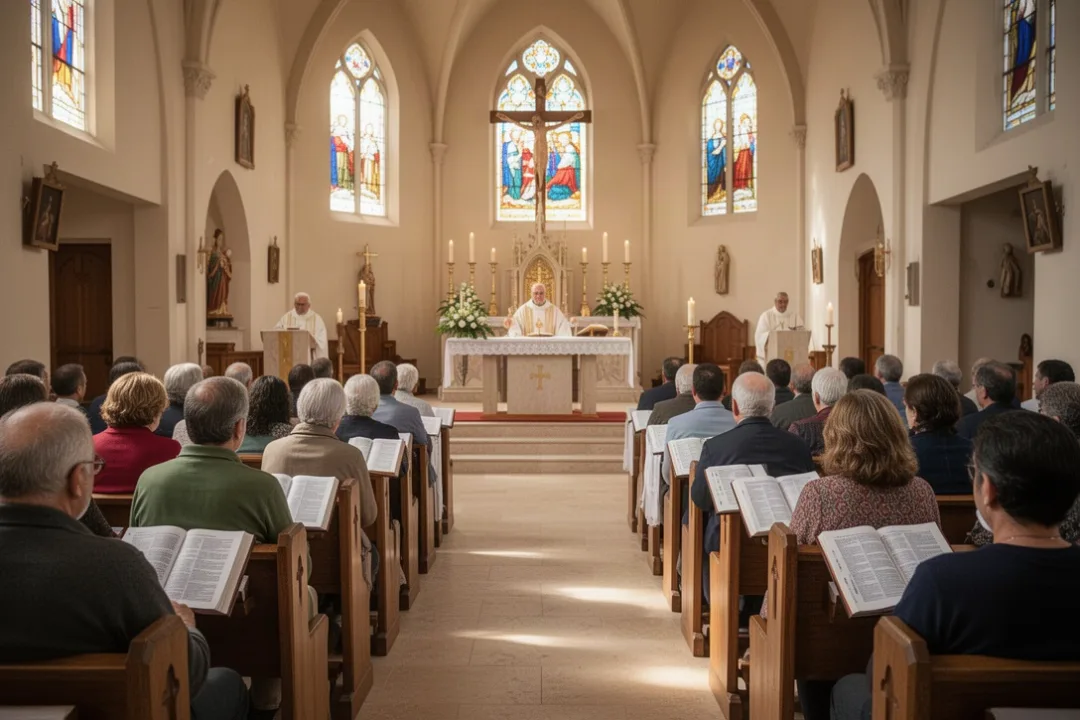
If you are looking for Mass in Spanish, you may be wondering what to search for, what the service will be like, or how to participate if your Spanish is limited. In Catholic communities, the service is called la misa, and its basic structure is the same as Mass celebrated in English or another language.
You can attend a Spanish-language Mass even if you do not understand every word. A worship aid, missal app, bilingual booklet, or a nearby parishioner can help you follow the readings, prayers, music, and Communion rites. The most useful preparation is learning the order of the service and a few common Spanish responses.
Mass in Spanish is a Catholic liturgy celebrated primarily in Spanish. Depending on the parish, the congregation may include people from Mexico, Central and South America, the Caribbean, Spain, or other Spanish-speaking communities. The music, pronunciation, and local customs can vary, but the central parts of the celebration remain familiar.
The Spanish word misa means Mass. You may also see these phrases when searching for a parish or schedule:
Misa en español: Mass in Spanish.
Horario de misas: Mass schedule.
Misa dominical: Sunday Mass.
Misa entre semana: weekday Mass.
Misa bilingüe: bilingual Mass.
Parroquia católica: Catholic parish.
Misa de vigilia: vigil Mass, commonly held on Saturday evening.
A Spanish Mass is not a separate kind of Catholic worship. It is the same Roman Catholic liturgy in a different language, although a parish may use regional songs, devotions, or announcements that reflect its community.
Helpful expectation: You do not need fluent Spanish to attend respectfully. Sit where you can observe others, follow a worship aid when one is available, and participate in the gestures you understand.
How to attend your first Spanish Mass
Finding a Spanish Mass usually takes only a few practical steps. Parish websites, diocesan directories, Catholic church listing services, and phone calls to parish offices can all provide the schedule. Because a parish may offer Spanish Mass only once or twice each weekend, check the language for the specific day and time rather than assuming every service is bilingual.
Search for a nearby Catholic parish. Use terms such as “misa en español near me” or “Spanish Catholic Mass near me.”
Confirm the schedule. Look for the exact service marked “Spanish,” “español,” or “bilingual.”
Arrive 10 to 15 minutes early. This gives you time to find parking, locate the sanctuary, and ask for a missal or worship guide.
Choose a seat that helps you follow along. Sitting near the middle often makes it easier to observe the congregation without feeling conspicuous.
Follow the posture of the congregation. People generally sit, stand, and kneel at the same points as they would during an English Mass.
Decide how you will approach Communion. Catholics who are properly prepared may receive; others may remain seated or approach with their arms crossed if that is the local custom.
Stay for the closing and announcements. The priest may share parish information, and the congregation is dismissed at the end of Mass.
If you are visiting because you need a sacrament, such as baptism, marriage preparation, confession, or anointing of the sick, contact the parish office separately. The Mass schedule will not usually contain all the information needed for those services.
The main parts of Mass in Spanish
Mass has four broad sections: the Introductory Rites, the Liturgy of the Word, the Liturgy of the Eucharist, and the Concluding Rites. Knowing these sections gives you a dependable map, even when the vocabulary or music is unfamiliar.
1. The Introductory Rites welcome the congregation
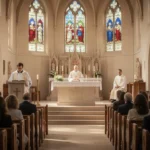
Mass begins with an entrance procession or opening song. The priest and ministers enter, the congregation stands, and the priest greets everyone. A common greeting begins with “El Señor esté con ustedes”, meaning “The Lord be with you.” The congregation responds, “Y con tu espíritu,” meaning “And with your spirit.”
The congregation then acknowledges the need for God’s mercy. This may include the Acto penitencial, or Penitential Act, followed by the Gloria on Sundays outside certain penitential seasons and on major celebrations. The opening prayer, called the Oración colecta, gathers the intentions of the community before the congregation sits.
The exact words and music can change, so listening for the priest’s invitation is more useful than trying to memorize every line. The congregation’s gestures also provide clear signals: people generally stand for the opening rites, sit for the readings, and stand again for the Gospel.
2. The Liturgy of the Word presents the biblical readings
During the Liturgia de la Palabra, a reader proclaims the first reading, followed by a responsorial psalm. On Sundays and solemn celebrations, a second reading is usually included. The Gospel is then proclaimed by a deacon or priest, and the congregation stands for it.
After the Gospel, the priest or deacon gives the homilía, or homily. The homily connects the readings with Christian life, current community concerns, and the call to follow Jesus. Even if you understand only part of the Spanish, listening for repeated words such as Dios, Jesús, amor, familia, fe, and esperanza can help you recognize the main theme.
On Sundays and certain feast days, the congregation recites the Credo, or Creed. The Oración de los fieles, also called the Prayer of the Faithful, follows. These petitions may ask for peace, care for the sick, support for families, help for the poor, and guidance for the Church and wider community.
3. The Liturgy of the Eucharist prepares and shares Communion
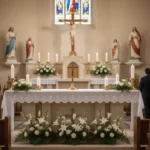
The Liturgia de la Eucaristía begins with the preparation of the altar and the presentation of bread and wine. The collection is often taken during this part of Mass. A prayer over the offerings leads into the Eucharistic Prayer, during which the congregation stands or kneels according to local practice and the priest’s direction.
The Eucharistic Prayer is the central prayer of the Mass. It includes praise and thanksgiving, the calling down of the Holy Spirit, the remembrance of Jesus’ Last Supper, and prayers for the Church and the faithful. Catholics understand the Eucharist as the sacramental presence of Christ, so this portion is treated with particular reverence.
The congregation then prays the Padre Nuestro, or Lord’s Prayer, followed by the sign of peace. The Rito de la paz may involve a handshake, nod, or spoken greeting such as “La paz esté contigo”, meaning “Peace be with you.”
Before Communion, the congregation sings or says the Cordero de Dios, or Lamb of God. People then approach the altar in an orderly line. The minister may say, “El Cuerpo de Cristo,” meaning “The Body of Christ,” and the communicant responds, “Amén.”
4. The Concluding Rites send the congregation out
After Communion, the congregation observes a period of silence or sings a hymn. The priest says a closing prayer and gives a blessing. The despedida, or dismissal, sends the people out to live their faith beyond the church building.
Announcements may come before the final blessing or immediately afterward. A Spanish-speaking parish may announce religious education, food distribution, community meetings, immigration resources, cultural celebrations, or opportunities for service. If you need assistance, remain after Mass and ask a volunteer or staff member to connect you with the right person.
Common Spanish responses and phrases to recognize
You do not need to memorize the entire Spanish order of Mass. These recurring phrases can make the service easier to follow and help you identify when the congregation is expected to respond.
En el nombre del Padre, y del Hijo, y del Espíritu Santo: In the name of the Father, and of the Son, and of the Holy Spirit.
Amén: Amen; an affirmation meaning “so be it” or “truly.”
El Señor esté con ustedes: The Lord be with you.
Y con tu espíritu: And with your spirit.
Oremos: Let us pray.
Palabra de Dios: Word of God.
Te alabamos, Señor: We praise you, Lord.
Gloria a ti, Señor: Glory to you, Lord.
El Evangelio del Señor: The Gospel of the Lord.
Gloria a ti, Señor Jesús: Praise to you, Lord Jesus.
Este es el Cordero de Dios: This is the Lamb of God.
Señor, no soy digno: Lord, I am not worthy.
Vayan en paz: Go in peace.
Pronunciation does not need to be perfect. Speak quietly and naturally, or simply listen until you feel comfortable. The purpose of the responses is shared prayer, not a language examination.
What to bring and how to follow the service
A Spanish-language missal or worship aid may include the order of Mass, readings, songs, and responses. Some churches place printed booklets at the entrance, while others use a seasonal booklet or project the music on a screen. You can also bring a bilingual Roman Missal or use a Catholic worship app that supports Spanish.
For the readings, a bilingual resource is especially useful because you can compare the Spanish and English passages before or after Mass. Avoid using your phone in a way that distracts people around you; enable silent mode and keep the screen dim if you need it during the liturgy.
Language tip: If you need help, say “Disculpe, ¿tiene un misal en español e inglés?” This means, “Excuse me, do you have a Spanish-English missal?” You can also ask, “¿Me puede ayudar?”—“Can you help me?”
Wear clothing that is clean and respectful for a place of worship. Parish customs differ, but modest everyday clothing is generally suitable. Silence or quiet conversation before Mass helps people pray, and keeping children close during the service is customary.
When to stand, sit, kneel, and respond
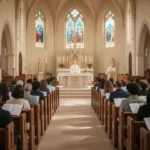
Posture is one of the easiest ways to follow a Mass you do not fully understand. The congregation normally stands for the entrance, the Gospel, the Creed, the Prayer of the Faithful, and parts of the Eucharistic rite. People sit for the readings and homily, then kneel during the Eucharistic Prayer where that practice is observed.
There may be differences between parishes, especially regarding kneeling, the sign of peace, or how the congregation receives Communion. When uncertain, wait a moment and follow the people around you. No one expects a visitor to know every local custom immediately.
Children may move, whisper, or need to leave the sanctuary briefly. Families are accustomed to this, and many parishes have a cry room, nursery, or children’s liturgy. Ask an usher where those spaces are before Mass begins.
The language of the Mass does not change the Catholic requirements for receiving Communion. Catholics generally receive when they are properly prepared according to Church practice, including observing the required fast and being free from serious sin that has not been brought to confession. If you are not Catholic, are not prepared, or prefer not to receive, you may remain in your seat.
Some parishes invite those who do not receive Communion to come forward for a blessing. The local custom may be to cross your arms over your chest, but practices differ. If you are unsure, staying seated is always a respectful option. You do not need to explain your decision.
If you do receive, follow the minister’s instructions. You may receive the consecrated host in the hand or on the tongue according to Catholic norms and local practice. Respond “Amén” after the minister says “El Cuerpo de Cristo.” Consume the host immediately and return to your place quietly for prayer.
Differences you may notice between Spanish-speaking parishes
A Spanish Mass in the United States may feel different from one celebrated in another country, even though the liturgical structure is shared. The most noticeable differences often involve music, devotions, preaching style, and community announcements.
Music may include traditional hymns, guitar-led songs, a choir, or instruments associated with a particular country or region. A parish serving a large Mexican community may have customs familiar to Mexican Catholics, while a Caribbean or Central American community may use different melodies and feast-day traditions.
Some communities give special attention to devotions such as the rosary, Marian celebrations, processions, or patron-saint observances. These may happen before or after Mass rather than as part of the official liturgy. Ask whether the activity is part of the Mass or a separate parish devotion if you want to understand its purpose.
Preaching can also vary. A priest may use formal Spanish, regional expressions, or a mixture of Spanish and English when many parishioners are bilingual. A bilingual homily does not necessarily mean the entire Mass is bilingual, so check the schedule and ask the parish if you need a particular language.
Spanish Catholic Mass vocabulary for parish communication
Knowing parish vocabulary helps when you call the office, read a bulletin, or ask about sacraments. These terms appear frequently in church schedules and announcements:
La iglesia: the church building.
La parroquia: the parish community or parish organization.
El sacerdote: the priest.
El diácono: the deacon.
El lector: the lector or reader who proclaims Scripture.
El ministro de la Eucaristía: the extraordinary minister of Holy Communion.
La confesión: confession or the Sacrament of Reconciliation.
El bautismo: baptism.
La primera comunión: First Communion.
La confirmación: Confirmation.
La boda religiosa: religious wedding or church wedding.
El boletín: parish bulletin.
La colecta: collection or offering.
La sacristía: sacristy.
For a simple phone call, you can say: “Buenos días. Quisiera saber a qué hora es la misa en español el domingo.” This means, “Good morning. I would like to know what time the Spanish Mass is on Sunday.” You can also ask whether confession, religious education, or baptismal preparation is available in Spanish.
How to find a Spanish Mass near you
Start with the parish locator for your Catholic diocese or search online for a Spanish Catholic parish in your city. Many parish websites identify language by flags, words such as español, or separate weekend schedules. Some churches publish schedules only in a weekly bulletin, so the parish office may provide the most current information.
Before traveling, confirm four details: the date, time, language, and location. Large parish campuses sometimes have more than one building, chapel, or entrance. Also check whether the schedule changes for Holy Week, Christmas, Easter, major local events, or severe weather.
If the nearest Spanish Mass is not convenient, ask about a bilingual service. Some parishes alternate languages by weekend, include Spanish readings and music in an English Mass, or offer a Spanish service at a nearby mission church. A diocesan office can often identify additional options.
Questions to ask the parish before attending
A short call or email can remove uncertainty, especially if you are attending for the first time or bringing someone who needs accessibility or interpretation support. Parish staff are used to answering practical questions.
“¿A qué hora es la misa en español?” — What time is Mass in Spanish?
“¿La misa es completamente en español o es bilingüe?” — Is the Mass entirely in Spanish or bilingual?
“¿Hay estacionamiento accesible?” — Is accessible parking available?
“¿Tienen misales bilingües?” — Do you have bilingual missals?
“¿Hay confesiones en español?” — Is confession available in Spanish?
“¿Hay cuidado de niños?” — Is child care available?
“¿Dónde puedo encontrar la oficina parroquial?” — Where can I find the parish office?
If you are seeking help with food, housing, immigration referrals, employment, or other needs, ask whether the parish has a ministerio de ayuda, or outreach ministry. A parish may not provide every service directly, but it may know trusted local organizations.
How to participate when you understand only some Spanish
Partial understanding is enough to participate meaningfully. Listen for the rhythm of the service, recognize the repeated responses, and use the readings or a translation to follow the central message. You can also participate through silence, posture, singing when you know the melody, and respectful attention.
Try learning one part at a time rather than translating every sentence. Start with the greeting, Amén, the sign of peace, and the Communion response. After a few visits, the sequence of the Mass will become familiar even if some homily or prayer vocabulary remains new.
Do not worry if your accent differs from that of other worshipers. Spanish-speaking Catholics come from many countries, and pronunciation varies naturally. Courtesy, patience, and a willingness to listen matter more than sounding like a native speaker.
After Mass, introduce yourself to an usher, priest, deacon, or parish volunteer if you need further assistance. You can say, “Es mi primera vez en una misa en español”, meaning, “It is my first time at a Mass in Spanish.” That simple explanation usually gives people enough context to help you find the right resources.
Spanish Mass for weddings, funerals, and holy days
Not every Spanish-language service follows the ordinary Sunday schedule. Weddings, funerals, quinceañeras, Christmas liturgies, and holy day celebrations may be entirely in Spanish, bilingual, or led by a priest who uses both languages. The order of the Catholic liturgy may also include special readings, music, or rituals.
For a funeral, the service may be called a Misa exequial or Misa de cuerpo presente, depending on local usage. A wedding Mass may be called a Misa de boda. If you are a guest, arrive early and follow the family or wedding party’s directions, particularly for seating and Communion.
Holy days and major feast days can draw larger crowds than an ordinary weekday Mass. Parking, seating, and confession times may be different, so confirm the parish schedule before you go. If you are attending a sacramental celebration as a guest, respectful presence is valuable even if you do not understand every Spanish phrase.
Using a bilingual order of Mass
A bilingual guide normally places Spanish and English side by side. Look for the four main sections and use the page headings to move through the service. The guide may contain the congregation’s responses but not every word of the homily, announcements, or locally chosen song.
When a prayer changes for a Sunday, feast, or season, the guide may direct you to another page. The readings also change according to the liturgical calendar. This is normal and does not mean you have the wrong booklet.
A worship aid is there to support prayer, not to require constant reading. Look up when the congregation stands, sits, or kneels, and listen when you can. The shared gestures and pauses will help you remain connected to the service even when a translation is not immediately available.
Frequently asked questions
Is “misa” the correct Spanish word for Mass?
Yes. “Misa” is the standard Spanish word for the Catholic Mass. To ask specifically for Mass celebrated in Spanish, use “misa en español.” You may also see “misa hispana,” although that can refer broadly to a Mass serving a Hispanic community rather than guaranteeing that every part is in Spanish.
Can I attend a Spanish Mass if I am not Catholic?
Visitors are generally welcome at Catholic Mass regardless of religious background. You can participate in the prayers and gestures as comfortable, but Communion is reserved for those who meet Catholic requirements. If you are not receiving, remain seated or follow the parish’s local practice for coming forward for a blessing.
How long does a Spanish Mass usually last?
A regular Sunday Mass often lasts about an hour, although music, preaching, announcements, and local customs can make it shorter or longer. Weddings, funerals, feast days, and celebrations with processions may take additional time. Arriving early for parking and seating is more useful than planning around an exact end time.
What should I say when receiving Communion in Spanish?
When the minister says “El Cuerpo de Cristo,” respond “Amén.” If you are receiving from the chalice, the minister may say “La Sangre de Cristo,” and you again respond “Amén.” If you are not receiving Communion, you may stay seated or follow the parish custom for requesting a blessing.










Leave a Reply