Feast of Mary Mother of God: meaning and traditions
Feast of Mary Mother of God: meaning and traditions
The Feast of Mary Mother of God, celebrated on January 1, honors Mary as the mother of Jesus Christ, who Christians believe is both fully human and fully divine. In the Roman Catholic Church, its formal name is the Solemnity of Mary, the Holy Mother of God, and it falls on the octave, or eighth day, of Christmas.
The feast is not meant to suggest that Mary existed before God or gave Jesus his divine nature. Rather, it expresses a central Christian belief: the child Mary bore is one person, Jesus Christ, truly God and truly human. By honoring Mary’s motherhood, the Church points attention to the identity of her Son.
The feast celebrates Mary’s unique relationship with Jesus and the mystery of the Incarnation, the Christian teaching that the Son of God became human. Mary conceived and gave birth to Jesus, so Christians call her the Mother of God because the person she bore is God the Son in human flesh.
This title does not mean that Mary is the source of the Trinity or that she existed before God. It means that motherhood is directed toward a person, not merely toward a nature. Mary is the mother of Jesus, and Jesus is one divine person with both a divine nature and a human nature.
The title Mother of God protects an important belief about Jesus. If someone said Mary was only the mother of Jesus’ humanity, that wording could make Jesus sound like two separate persons: one human and one divine. The Church uses the title to affirm that the baby born in Bethlehem is the same divine Son whom Christians worship.
The central idea: The feast honors Mary because of who Jesus is. Its focus is ultimately the mystery of Christ’s birth, his divine identity, and his real human life.
The January 1 celebration also continues the joy of Christmas. The Church does not treat Christmas as a single day that ends immediately after December 25. The Christmas season extends beyond the birth celebration, and Mary’s feast keeps attention on the woman who welcomed, carried, and gave birth to Christ.
Mary’s response to God is also part of the feast’s meaning. In the Gospel accounts, she accepts a difficult vocation with trust, even though she does not know every detail of what lies ahead. Her example is associated with faith, humility, courage, and faithful obedience.
Why the Church calls Mary the Mother of God
The title comes from the early Church’s effort to explain accurately who Jesus Christ is. The Greek term often associated with the title is Theotokos, commonly translated as God-bearer or Mother of God. It does not describe Mary as a goddess. It identifies the child she bore as God the Son.
The title became especially important during debates about Christ’s identity in the fifth century. Some Christians worried that calling Mary the Mother of God might give her too exalted a position. Others feared that refusing the title could divide Jesus into separate human and divine subjects.
At the Council of Ephesus in 431, the Church affirmed the use of Theotokos. The council’s teaching supported the belief that Jesus Christ is one person, not two loosely connected persons. Mary’s title therefore serves as a statement about Christology, the Christian study of who Jesus is.
The council did not teach that Mary created God or that she is equal to God. Instead, it defended the teaching that the eternal Son truly entered human history through Mary. Her motherhood belongs to the real human birth of a divine person.
Mary’s title directs Christians to the identity of the child she bore: Jesus Christ, the Son of God made human.
The title also emphasizes that Jesus’ humanity was real. He was not merely appearing to be human or using a human body temporarily. He was born, lived, suffered, and died as a true human being. Mary’s motherhood is one reason the Church speaks so strongly about the reality of the Incarnation.
For Catholics, Mary’s role does not compete with Christ’s role as Savior. Catholic teaching presents her as entirely dependent on God’s grace and connected to Jesus’ saving work. The honor given to Mary is called veneration, while worship belongs to God alone.
How January 1 became Mary’s feast day
The date of January 1 has a long connection with the Christmas celebration. In the ancient Roman calendar, it was associated with the eighth day after Christmas. In the biblical tradition, the eighth day was also connected with the naming and circumcision of a male child, and the Gospel of Luke records that Jesus was named on that day.
Earlier Roman Catholic calendars identified January 1 in different ways, including as the octave day of Christmas and as a celebration connected with the circumcision and naming of Jesus. The day also had Marian associations in the liturgical life of Rome. Over time, the emphasis and official name changed.
In 1931, Pope Pius XI established a universal feast of the Divine Maternity of Mary in connection with the 1,500th anniversary of the Council of Ephesus. It was initially observed on October 11. The calendar reforms that followed the Second Vatican Council moved the celebration to January 1 and gave it its current place within the Christmas octave.
The revised Roman calendar restored a direct connection between Mary’s motherhood and the birth of Christ. Rather than separating the feast from Christmas, January 1 places Mary beside the mystery that gives her title its meaning: the Son of God has become human.
The same date has another major liturgical emphasis. January 1 is also observed as the World Day of Peace, established by Pope Paul VI in 1967. The day’s prayers often connect Mary’s motherhood, the newborn Christ, and the Christian responsibility to seek peace in families, communities, and nations.
Liturgical calendars outside the Roman Catholic tradition may use different names or observe related celebrations on another date. Eastern Catholic and Eastern Orthodox churches, for example, have their own calendar traditions and may commemorate Mary’s motherhood in connection with other feasts. The exact customs depend on the church and local calendar.
What the Bible says about Mary and Jesus
The Bible does not use every later liturgical title in the same wording, but it provides the scriptural foundation for the feast. The Gospel of Luke describes Mary’s announcement, pregnancy, and birth of Jesus. It presents her as the mother of the promised child and as someone who responds to God with trust.
In Luke 1:26–38, the angel announces that Mary will conceive Jesus through the power of the Holy Spirit. The message identifies the child as the Son of God. This passage links Mary’s motherhood directly with Jesus’ divine identity rather than treating them as unrelated subjects.
Luke 1:39–45 describes Mary’s visit to Elizabeth. Elizabeth recognizes the significance of Mary’s pregnancy and calls her the mother of her Lord. The passage is one of the biblical texts Christians use when reflecting on Mary as the mother of the Lord and on the blessing associated with her faith.
Luke 2:1–20 recounts Jesus’ birth, the visit of the shepherds, and Mary’s response to the events around her. She treasures and reflects on what she hears. The scene shows her not as a distant symbol but as a mother participating in the ordinary and difficult realities surrounding her child’s birth.
Luke 2:21 records Jesus’ naming and circumcision on the eighth day. This explains why January 1 historically carried a strong connection to the infant Jesus as well as to the Christmas octave. The current feast places that biblical event within a broader celebration of Mary’s motherhood.
Galatians 4:4–5 says that, when the appointed time came, God sent his Son, born of a woman, to bring human beings into freedom and adoption as God’s children. The passage does not name Mary, but it strongly supports the Christian belief that the Son truly entered human life through a human mother.
The Gospel of John does not give a birth narrative, but it begins by describing the eternal Word who enters human existence. Read alongside the accounts in Matthew and Luke, this teaching helps Christians understand why Mary’s motherhood relates to the mystery of God becoming human.
Mary’s place in the Gospel is not limited to the Nativity. She appears at the wedding at Cana in John 2, where she brings a need to Jesus and directs the servants to follow his instructions. She is also present near the cross in John 19. These passages show her connected with Jesus throughout his life and mission.
The primary observance is the celebration of Mass. The liturgy usually includes readings about Mary, the birth of Christ, blessing, and the beginning of a new calendar year. The exact readings, prayers, music, and customs may vary according to the year and the local church.
Many Catholic communities use the day to pray for peace. Some parishes hold special services, Eucharistic adoration, rosaries, or prayer gatherings. Others focus on a parish Mass and a quiet beginning to the year. The observance does not require elaborate decorations or a particular family ritual.
Common ways to mark the solemnity include:
Attending Mass according to the schedule and requirements of your local parish.
Reading Luke 1–2 and reflecting on Mary’s response to God.
Praying for peace in the home, community, and world.
Praying the Hail Mary, the Angelus, or another Marian prayer.
Thanking God for the gift of Christ and for the people who have cared for you.
Beginning the year with an act of mercy, reconciliation, or service.
The Hail Mary is especially associated with the feast because it addresses Mary as the mother of Jesus. Its words draw from the Gospel accounts and ask for Mary’s prayers. Catholics may pray it individually, with family members, or as part of the Rosary.
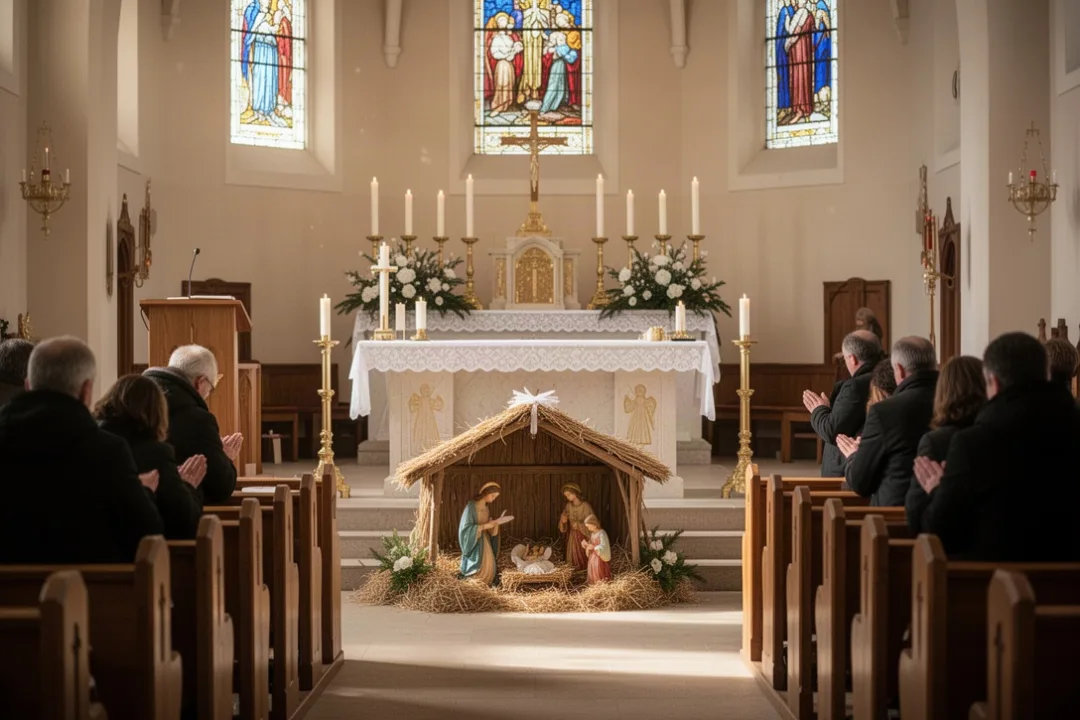
Some families display a Nativity scene through the Christmas season and give special attention to Mary and the infant Jesus on January 1. A simple meal, a family blessing, or a shared prayer can make the day meaningful without turning it into a required cultural performance.
The feast can also be a time to honor motherhood without reducing Mary to an idealized image. The Gospel narratives include uncertainty, danger, displacement, grief, and responsibility. Reflecting on Mary may help people pray for mothers facing pregnancy complications, poverty, violence, loneliness, or the demands of caring for children.
Practical note: January 1 is a holy day of obligation in many Catholic settings, but the obligation can vary when the date falls on a Saturday or Monday and according to local bishops’ decisions. Check your diocese or parish calendar for the current rule and Mass times.
The solemnity is also suitable for prayer about the year ahead. Mary’s presence at the beginning of the civil year can remind Christians that time belongs to God and that Christian hope rests on Christ rather than on resolutions alone.
How this feast differs from other Marian celebrations
The Feast of Mary Mother of God is sometimes confused with other important celebrations honoring Mary. Each one has a distinct focus, even though they are connected by Catholic teaching about her life and relationship with Jesus.
Mary Mother of God and the Immaculate Conception
The Immaculate Conception, celebrated on December 8, refers to Mary’s conception in the womb of her mother. Catholic teaching holds that Mary was preserved from original sin from the first moment of her existence by God’s grace and in view of Christ’s saving work.
It does not refer to Jesus’ conception in Mary’s womb. The January 1 solemnity, by contrast, centers on Mary as the woman who gave birth to Jesus and on the identity of the child she bore.
Mary Mother of God and the Annunciation
The Annunciation, celebrated on March 25, recalls the angel’s announcement that Mary would conceive Jesus. It focuses on the beginning of the Incarnation and Mary’s consent to God’s call.
The January 1 feast comes after Jesus’ birth. It highlights the completed reality of Mary’s motherhood and the presence of the newborn Christ within the Christmas season.
Mary Mother of God and the Assumption
The Assumption, celebrated on August 15, honors the belief that Mary was taken body and soul into heavenly glory at the end of her earthly life. It points to Mary’s destiny and to the hope of resurrection.
The Feast of Mary Mother of God focuses on her earthly motherhood of Jesus. The two celebrations are related, but they do not commemorate the same event or teach the same specific point.
Mary Mother of God and the Visitation
The Visitation, celebrated on May 31 in the Roman Catholic calendar, recalls Mary’s visit to Elizabeth. It emphasizes Mary’s charity, her service to another person, and the joy surrounding the children both women carry.
January 1 emphasizes the birth of Jesus and the doctrinal meaning of calling Mary his mother. The Visitation highlights what Mary does after receiving the angel’s message: she goes to help Elizabeth.
Keeping these distinctions clear can make Marian celebrations easier to understand. Catholics do not celebrate Mary as a substitute for Christ. They honor different moments in her life because each moment reveals something about God’s grace and Jesus’ mission.
Why the feast matters at the start of a new year
January 1 can carry pressure to make immediate changes, set ambitious goals, or judge the past year. The Marian solemnity offers a different starting point. It directs attention first to God’s presence, Christ’s birth, and the quiet faithfulness shown by Mary.
Mary’s story also shows that significant spiritual work may begin in hidden circumstances. Pregnancy, birth, family care, and patient reflection are not secondary to faith. They are places where love, trust, and courage become visible.
The feast invites Christians to consider how they receive Christ in daily life. Mary welcomes God’s call, gives birth to Jesus, protects him, and remains near him through suffering. Her example can lead to practical questions:
Where do you need greater trust rather than complete control?
Who needs your attention or care at the beginning of this year?
What would peace look like in your household or relationships?
How can your faith become more concrete through service?
What fears can you place before God instead of carrying alone?
For Catholics, Mary’s motherhood also points toward the Church’s spiritual care. In John 19, Jesus entrusts his mother and beloved disciple to one another. Christians interpret this passage in different ways, but Catholic tradition sees in it a sign of Mary’s continuing maternal relationship with Jesus’ followers.
The feast therefore joins doctrine and devotion. It asks the Church to confess who Jesus is, while also encouraging a personal response shaped by prayer, trust, compassion, and peace. The celebration is Marian because Mary is honored, but its deepest subject remains Jesus Christ, born of Mary and Savior of the world.
Frequently asked questions
Is the Feast of Mary Mother of God the same as New Year’s Day?
It occurs on New Year’s Day, January 1, but the religious observance has its own focus. In the Catholic liturgical calendar, it is the Solemnity of Mary, the Holy Mother of God, celebrated during the Christmas octave. Civil New Year’s customs and the Church’s feast may be observed together, but they are not the same celebration.
Do all Christians call Mary the Mother of God?
Many Christians, including Roman Catholics, Eastern Orthodox, Oriental Orthodox, and some Anglican and Lutheran communities, use the title. Other Christians may prefer different wording because of concerns about misunderstanding it. The title is intended to affirm who Jesus is, not to suggest that Mary is divine or the source of God.
Is January 1 a Catholic holy day of obligation?
The answer depends on the local Catholic calendar and sometimes on the weekday when January 1 occurs. The solemnity is a holy day of obligation in many places, but national bishops’ conferences can provide exceptions. Check your parish, diocese, or national conference for the current obligation and Mass schedule.
What prayer is appropriate for this feast?
You might read Luke 1–2, pray the Hail Mary or Angelus, recite part of the Rosary, or offer a prayer for peace. A personal prayer thanking God for Christ and asking for Mary’s example of faith can also fit the day. The best choice is one that helps you focus on Jesus and faithful living.











Leave a Reply