Saint Maximus: life, teachings, feast day, and prayers
Saint Maximus: life, teachings, feast day, and prayers
If you searched for Saint Maximus because you saw his name in a prayer book, calendar, or church reading, you may be wondering which Maximus it means. The name belongs to several Christian saints, but the person most often identified by that title is Saint Maximus the Confessor, a seventh-century monk and theologian who defended the full humanity and divinity of Jesus Christ.
Maximus is remembered for his courage under pressure, his disciplined prayer, and his belief that Christian faith should shape the whole person. He did not treat theology as an abstract subject. For him, what Christians believe about Christ affected how they prayed, made moral choices, endured suffering, and learned to love God and other people.
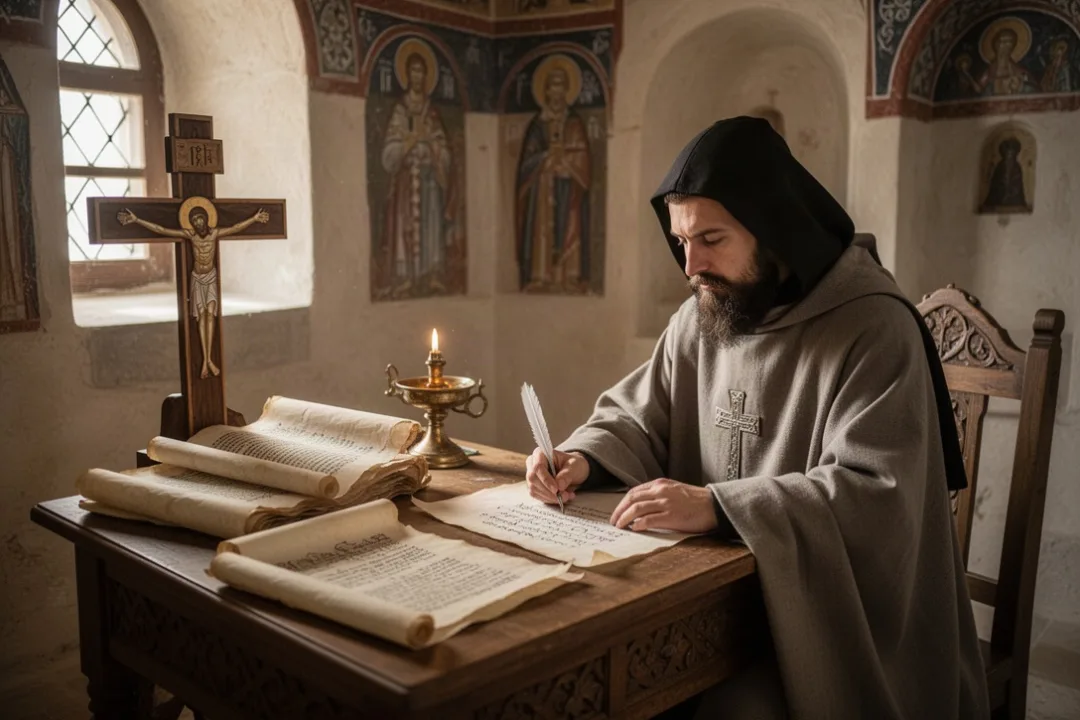
Saint Maximus the Confessor lived during a period of serious disagreement in the Christian Church about the person of Jesus. His life is generally placed around 580 to 662, although some details of his early years remain uncertain. He was probably born in Constantinople and received an excellent education before entering public service.
According to traditional accounts, Maximus served for a time as a secretary to the Byzantine emperor Heraclius. He later left imperial service and became a monk. That change was not simply a withdrawal from responsibility. Maximus believed that a life centered on prayer, self-control, and truth could serve the Church more deeply than a position of political influence.
He spent part of his monastic life in North Africa, where he became known as a thoughtful teacher and spiritual writer. He also traveled to Rome and worked with church leaders who opposed a theological policy called Monothelitism. The controversy concerned whether Christ had only one will or one mode of willing, or whether he possessed both a divine will and a human will.
Maximus argued that Jesus Christ is fully God and fully human. If Christ had no real human will, Maximus reasoned, then human freedom and obedience would not truly be taken up and healed in Christ. His position protected the Christian teaching that Jesus genuinely experienced human life while remaining united with God.
At the center of Maximus’s teaching: Christ does not save humanity from a distance. By becoming truly human, he enters human life and restores it from within.
The title “the Confessor” refers to someone who suffers for the faith without being killed as a martyr. Maximus was arrested, interrogated, exiled, and severely punished because he would not accept a theological formula he believed contradicted the apostolic faith. Accounts of his final punishment say that his tongue and right hand were cut off, preventing him from speaking and writing in the way he had before.
Maximus died in exile in 662. Later, the Church formally affirmed the position he had defended. His teaching became especially influential in Eastern Christianity, and he is honored as a major theologian, monk, and witness to the truth about Christ.
Why Maximus defended two wills in Christ
The dispute surrounding Maximus can sound technical, but its central question is personal: Was Jesus truly human? Christians had long confessed that Christ was both divine and human. The controversy asked what that meant when applied to human decision, desire, and obedience.
A human being does not merely possess a body. Human life also includes a rational mind, the capacity to choose, natural desires, and the ability to respond freely to what is good. Maximus believed that Christ assumed the complete reality of human nature, not merely a human body or an appearance of humanity.
For that reason, he taught that Christ had a divine will and a human will. These wills were not in conflict. Christ’s human will freely followed the divine will because his humanity was perfectly united with God. In Maximus’s explanation, obedience is not the destruction of freedom. It is freedom acting in harmony with the good.
This point mattered for salvation. If Christ lacked a genuine human will, then human willing would not be healed. People might be forgiven, instructed, or rescued from outside, but the deepest movement of human life would remain untouched. Maximus saw salvation as the restoration of the entire person, including the will.
His reading of the Gospels also emphasized Christ’s real human struggle and obedience. In the account of Jesus praying before his arrest, especially in the Garden of Gethsemane, Maximus saw evidence that Christ truly possessed a human will. The passage in Matthew 26 and Luke 22 presents Jesus accepting the Father’s will while facing suffering. Maximus understood this as freely obedient humanity, not as a denial of human experience.
The issue was eventually settled in favor of Maximus’s position at the Third Council of Constantinople, held from 680 to 681, after his death. The council taught that Christ has two natural wills and two natural operations, divine and human, united in one person. This teaching is part of the Christological faith shared by historic Christian traditions.
Christ is fully divine: he possesses everything proper to God.
Christ is fully human: he possesses a real human body, mind, will, and life.
The two natures remain united: Christ is one person, not two separate persons.
His human will is not erased: it freely cooperates with and follows the divine will.
Maximus’s importance therefore extends beyond a dispute from Byzantine history. His teaching answers a question many Christians still ask: Can God truly understand human weakness? Maximus’s answer is yes, because the Son of God truly entered human existence. At the same time, Christ’s human life shows that freedom reaches its fullest expression in love and faithful obedience.
What Saint Maximus taught about spiritual growth
Maximus did not separate doctrinal truth from daily spiritual practice. He believed that correct belief should lead to healed relationships, clearer judgment, and a more generous love. A person may know religious ideas and still remain ruled by anger, pride, fear, or resentment. For Maximus, spiritual knowledge becomes real when it changes the way a person lives.
One of his best-known themes is the movement from disordered desire toward love. Human beings often cling to possessions, status, comfort, or personal advantage as if these could provide lasting security. Maximus taught that such attachments divide the heart. The cure is not hatred of creation but learning to receive created things rightly, with gratitude and without making them into idols.
He described the spiritual life as a gradual restoration of the person’s inner unity. Thoughts, desires, habits, and actions can pull in different directions. Through prayer, repentance, patience, and disciplined love, these scattered parts can be brought into a more faithful relationship with God.
Maximus on love and the treatment of other people
For Maximus, love of God cannot be separated from love of other people. A person who claims to love God while cultivating hatred has misunderstood the Christian life. This does not mean ignoring injustice or pretending that serious harm does not matter. It means refusing to let hatred become the organizing principle of the heart.
His spiritual writings repeatedly challenge readers to examine the passions that distort judgment. Anger can make an enemy seem less than human. Envy turns another person’s good into a personal threat. Pride makes correction feel like an attack. Maximus believed that prayer should expose these movements so that they can be healed rather than defended.
His reflections on forgiveness are demanding but practical. Forgiveness does not require you to deny what happened, remain in danger, or abandon appropriate boundaries. It means seeking freedom from the desire to return evil for evil. That freedom can take time, especially after betrayal or abuse, and may require pastoral, legal, or professional support.
Maximus on the meaning of creation
Maximus viewed the created world as meaningful rather than disposable. Creation points toward God, and different creatures reveal different aspects of divine wisdom. Human beings have a particular responsibility because they can consciously bring creation together in thanksgiving and love.
This vision gives his theology a broad scope. Food, work, family, culture, the natural world, and the body are not automatically enemies of holiness. The question is how they are used. Gratitude, moderation, and responsibility help a person enjoy created goods without becoming controlled by them.
Maximus also wrote about the relationship between visible and invisible reality. Christian worship uses material signs—water, bread, wine, oil, gesture, music, and sacred space—to express spiritual truth. His thought supports a sacramental understanding of the world, in which physical reality can become a means of communion with God rather than an obstacle to it.
Maximus on becoming like God
A central Christian idea in Maximus’s writing is deification, sometimes called theosis. This does not mean that human beings become gods by nature or replace God. It means that people can share in God’s life by grace, becoming increasingly conformed to divine love.
The process involves the transformation of the whole person. Prayer, worship, moral effort, suffering, and acts of mercy are not separate compartments. They can all become ways in which a person is gradually turned toward God. Maximus emphasizes that this transformation is God’s gift, yet human cooperation matters because love cannot be forced.
A practical reading of Maximus: Ask not only, “What do I believe?” but also, “What kind of person are these beliefs making me?” His answer joins theology, prayer, habits, and relationships.
How to pray with Saint Maximus’s example
There is no single prayer that every Christian must use when seeking Saint Maximus’s intercession. You can ask for his prayers in your own words, use a prayer from your church tradition, or read a short passage from one of his works before speaking honestly to God.
His example is especially relevant when you are pressured to compromise your conscience, confused about difficult teaching, or struggling to unite faith with daily conduct. Maximus does not encourage combative religious argument for its own sake. His life points instead toward truth joined to humility, courage joined to patience, and conviction joined to love.
A simple prayer might ask God to give you the grace to remain faithful, to think clearly, and to avoid treating opponents with contempt. You might also ask for healing of the particular inner division that makes faith difficult: fear versus trust, resentment versus forgiveness, or self-protection versus generosity.
Begin with stillness. Set aside a few quiet minutes and become aware of God’s presence.
Name the pressure you are facing. Be specific about the decision, fear, conflict, or temptation.
Ask for an undivided heart. Pray for the freedom to choose what is good rather than what merely protects your image or comfort.
Remember Christ’s humanity. Bring your weakness to the Christ who truly entered human life and suffering.
Choose one faithful action. A truthful conversation, a restrained response, an apology, or a needed boundary can make prayer concrete.
Reading Maximus can also be part of a regular spiritual practice. His works are sometimes dense, so a short passage may be more fruitful than trying to read everything quickly. Look for a sentence that reveals something about desire, anger, love, freedom, or the purpose of human life, then consider how it applies to a real situation.
Useful questions for reflection include:
What desire is controlling my attention right now?
Am I treating another person as a problem rather than as a human being?
Where have fear or pride distorted my judgment?
What would faithful freedom look like in this situation?
How can my belief become a concrete act of love?
Maximus’s example should not be used to romanticize suffering or to pressure people into remaining in harmful situations. He endured persecution because of a public theological conflict, but Christian wisdom also recognizes the need for safety, counsel, medical care, and lawful protection. Faithfulness can include speaking, leaving, reporting harm, or asking others for help.
Saint Maximus’s writings and lasting influence
Several works associated with Maximus remain important in Christian theology and spirituality. His Ambigua offers explanations of difficult passages and ideas from earlier Christian writers, especially Gregory the Theologian and Dionysius the Areopagite. The text is demanding because it addresses symbolism, Scripture, creation, human nature, and the way all things are brought toward unity in Christ.
His Four Hundred Chapters on Love, also known by related titles in different translations, presents concise reflections on love, temptation, anger, prayer, and the spiritual life. The short chapters are designed for meditation. They often expose the hidden motives behind outward actions and encourage the reader to replace self-centered habits with charity.
The Questions to Thalassius responds to questions about difficult biblical passages. Maximus interprets Scripture spiritually while retaining a strong focus on Christ and the transformation of human life. His answers can be complex, but they show how early Christian writers read the Bible as a unified account of God’s work in creation and redemption.
Maximus also contributed to the development of Christian mystical theology. Later writers drew on his account of the human person, the relationship between nature and grace, and the destiny of creation. His influence can be seen particularly in Eastern Christian theology, though scholars and theologians from other traditions have also studied him.
When reading him today, it helps to remember that he wrote within a monastic and Byzantine context. Some expressions reflect the assumptions of his time and require careful interpretation. A reliable modern translation, study edition, or guide from a recognized theological publisher can help prevent isolated sentences from being misunderstood.
His influence rests on several connected convictions:
Christ’s humanity is complete, including a true human will.
Human freedom is healed when it turns toward love and truth.
Spiritual maturity involves the whole person, not only private belief.
Creation has meaning and can be received with gratitude.
Love is the test of knowledge, because truth should transform conduct.
These themes explain why Maximus remains relevant for people facing moral pressure, internal conflict, and questions about how faith relates to ordinary life. He presents holiness not as escape from being human, but as the restoration of humanity through communion with God.
Other saints named Maximus and how to identify them
If a church calendar simply says “Saint Maximus,” it may refer to someone other than Maximus the Confessor. The name was common in the Roman and Byzantine worlds, and several bishops, martyrs, and monks carried it. The surrounding date, location, or description usually identifies the intended saint.
Saint Maximus of Turin was a bishop and preacher whose homilies survive from late antiquity. He is associated with the church of Turin in northern Italy and is remembered for teaching on Scripture, Christian morality, and the meaning of liturgical celebrations.
Saint Maximus of Trier was a bishop connected with Trier in the fourth century. He is remembered in the context of the Church’s struggles during periods of theological controversy and political pressure. His life is distinct from that of Maximus the Confessor, who lived several centuries later in the Byzantine world.
There are also saints called Maximus who are remembered as martyrs or local bishops. Their feast days differ according to the calendar and tradition. Some may be honored mainly in a particular region, diocese, monastery, or Eastern Christian community.
To identify the right Saint Maximus, check:
The feast date: different calendars assign different dates to different saints.
The title: “the Confessor,” “of Turin,” “of Trier,” or “the Martyr” is often decisive.
The location: Constantinople and North Africa usually point toward Maximus the Confessor, while Turin points toward the bishop of that city.
The subject of the reading: Christ’s two wills suggests the Confessor; a martyrdom account indicates another Maximus.
Your church’s calendar: Catholic, Orthodox, Anglican, and other traditions may use different feast days or naming conventions.
Saint Maximus the Confessor is commonly commemorated in January in Eastern Christian calendars, while some Western calendars observe him on a different date. Feast-day customs vary, so the calendar used by your parish or denomination is the best guide for liturgical observance.
Whether you are looking for a patron, a theologian, or a model of courage, Maximus offers a demanding but hopeful vision. He teaches that truth about Christ and transformation of the human heart belong together. Faith becomes most credible when it produces a freer will, a steadier love, and greater respect for the dignity of every person.
Frequently asked questions
What is Saint Maximus the patron saint of?
Saint Maximus the Confessor is not universally assigned one single patronage in the way some saints are associated with a profession or illness. People often turn to him for prayers concerning theological fidelity, courage during persecution, intellectual clarity, and the healing of inner conflict. His example is especially meaningful for those trying to unite sound belief with humility, prayer, and charitable conduct.
When is Saint Maximus the Confessor’s feast day?
The feast day depends on the Christian calendar and tradition. Eastern Christian calendars commonly commemorate Saint Maximus the Confessor on January 21, while some Western calendars use another date, including August 13. Check the calendar followed by your parish or denomination, since local observances and commemorations can differ.
What does “Confessor” mean in Saint Maximus’s title?
In Christian usage, a confessor is a person who suffers for publicly holding to the faith but is not killed as a martyr. Saint Maximus was arrested, exiled, and severely punished because he rejected a theological position he believed distorted the Church’s teaching about Christ. The title highlights his faithful witness through suffering.
What is the main lesson of Saint Maximus’s theology?
His central lesson is that Jesus Christ is fully divine and fully human, including a genuine human will. Because Christ truly assumed human nature, human life can be healed and brought into communion with God. Maximus also taught that authentic spiritual knowledge should produce love, self-control, forgiveness, and a more faithful use of human freedom.











Leave a Reply