Maximos the Confessor: life, teachings, and legacy
Maximos the Confessor: life, teachings, and legacy
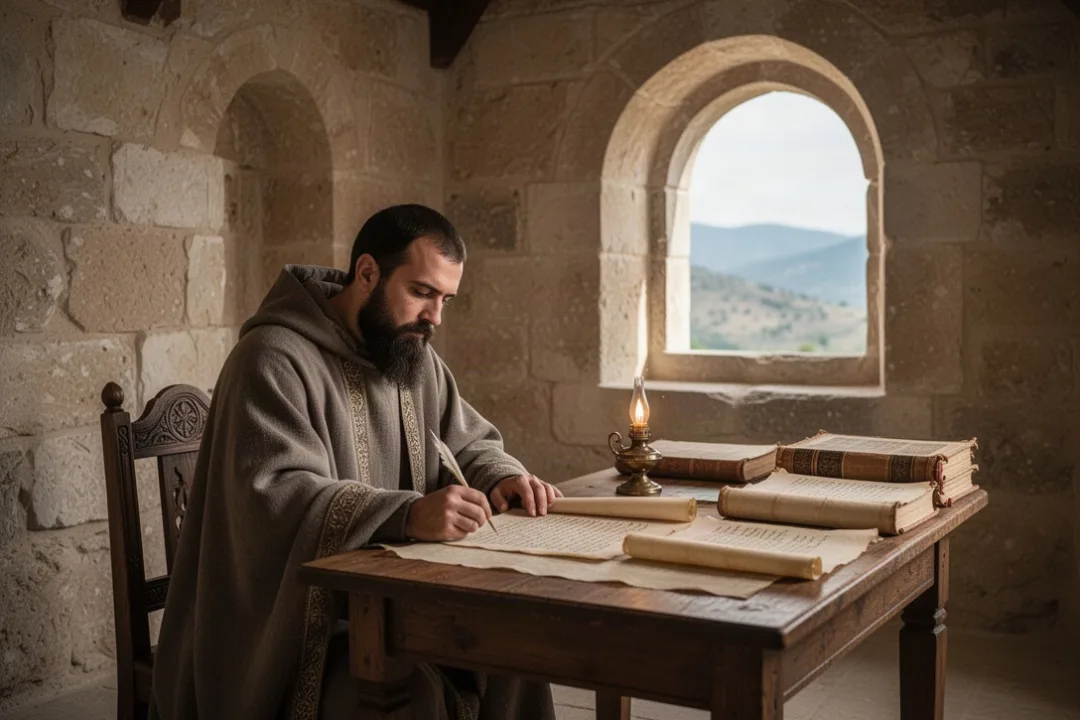
Maximos the Confessor was a seventh-century Christian monk, theologian, and defender of orthodox teaching about Jesus Christ. He is best known for insisting that Christ possesses both a divine will and a human will, because the full healing of human nature required Christ to become fully human.
Maximos also wrote extensively about prayer, virtue, Scripture, human freedom, and union with God. His thought connects careful theology with everyday spiritual practice: believers are called to resist the disordered passions, love God and other people, and allow divine grace to restore the whole person.
Maximos was born around 580, probably in Constantinople, and first served in an administrative position connected with the imperial court. He later left public service and entered monastic life, seeking a more focused life of prayer and theological study.
His monastic career unfolded during a period of intense debate about how to describe the person of Christ. Christian leaders were trying to express faithfully the teaching that Jesus Christ is one person who is both fully divine and fully human. The controversy centered on whether Christ had one will or two.
Maximos argued that Christ has two natural wills, divine and human, because will belongs to nature. Christ’s human will is not sinful or rebellious; instead, it freely and perfectly agrees with the divine will. This position became central to the orthodox teaching later confirmed by the Sixth Ecumenical Council.
Because Maximos refused to accept imperial and ecclesiastical policies that promoted a one-will understanding of Christ, he suffered imprisonment, exile, and mutilation. He died in exile in 662. The title “Confessor” refers to someone who suffers for the faith without dying as a martyr.
Central point: For Maximos, Christ’s human will matters because salvation includes the healing and restoration of human willing. What Christ did not assume, he argued, would not be healed.
The historical setting behind Maximos’s theology
Maximos lived after the Council of Chalcedon in 451, which had taught that Christ is one person in two natures, divine and human. Although that council had clarified a major question, disagreements continued over how Christ’s activity and willing should be described.
Some theologians and political leaders promoted Monothelitism, the teaching that Christ had only one will. This proposal was intended to preserve Christ’s unity, especially in regions where Christians were divided over earlier Christological disputes. Maximos believed it created a serious theological problem: if Christ lacked a genuinely human will, then human nature had not been fully taken up by the Son of God.
The issue was not a technical argument detached from prayer and salvation. Maximos saw it as a question about the purpose of the Incarnation. Christ came not merely to appear human or to guide humanity from a distance, but to unite human nature to God and restore it from within.
His resistance brought him into conflict with emperors and church officials. He was questioned and condemned more than once, and his punishment included exile. Later tradition records that his right hand and tongue were cut off, symbolizing the authorities’ attempt to prevent him from writing and teaching. The church eventually recognized that his Christological position was correct.
How to understand Maximos’s main ideas
Begin with the Incarnation. Maximos’s theology starts with the claim that the eternal Son truly became human in Jesus Christ.
Distinguish person from nature. Christ is one person, but he possesses both divine and human natures.
Connect nature with will. Since divine and human nature each have a proper mode of willing, Christ has both a divine will and a human will.
See salvation as healing. Christ restores humanity by assuming human existence completely, including human willing.
Understand freedom as movement toward the good. Human freedom reaches its proper fulfillment when it willingly turns toward God rather than being trapped by disordered desire.
Read spiritual practice through love. Prayer, fasting, forgiveness, and obedience are not isolated duties; they help re-form the person in love.
This sequence helps explain why Maximos’s writings can seem philosophical in one passage and intensely practical in the next. He is always asking how beliefs about Christ shape the way human beings live, pray, choose, and love.
Why Christ’s two wills mattered to Maximos
Maximos distinguished between natural will and the personal way a particular person uses that will. A human being naturally seeks what is good, even though the effects of sin can distort desire and judgment. Christ’s human nature includes a real human capacity and inclination to will, but his human willing is never opposed to God through sin.
In Christ, the human will does not compete with the divine will. Instead, it freely follows and expresses perfect harmony with God. Maximos used Christ’s agony and prayer before his Passion as evidence that Christ possessed genuine human willing. Christ truly experienced the human movement away from suffering while freely accepting the Father’s saving purpose.
This distinction allowed Maximos to reject two opposite errors. One error would make Christ’s humanity incomplete by denying a human will. The other would suggest that Christ’s human will was sinful simply because it was genuinely human. For Maximos, humanity itself is not evil; sin is a disorder of humanity, not part of its created essence.
The theological importance is substantial. If Christ’s human will is real and obedient, then human obedience is taken up into the life of the Son. The Christian life is not an attempt to become less human, but a process of becoming fully human through communion with God.
Maximos on freedom, desire, and the human person
Maximos’s account of freedom is more demanding than the idea that freedom simply means having many options. He often describes human life as a movement toward an end. People are free when their powers are ordered toward the good, but sin divides the person and causes desire, judgment, and action to pull in conflicting directions.
He distinguishes between the natural will, which tends toward the good, and a mode of choosing that can hesitate, deliberate, and become confused. Christ possesses a true human will but not the sinful instability that marks fallen humanity. His human willing moves freely and consistently toward the good.
For ordinary Christians, this teaching has a practical implication: freedom grows through the gradual healing of desire. A person may initially experience obedience to God as difficult or restrictive. Through prayer and practice, however, the heart can learn to recognize the good more clearly and love it more steadily.
Maximos does not treat moral failure as proof that human nature is worthless. He sees failure as evidence of a will needing healing. Repentance, therefore, is not self-contempt. It is a return to the proper direction of human life.
His teaching on love and the passions
One of Maximos’s best-known works is the Four Centuries on Love, also called the Four Hundred Chapters on Love. It presents short reflections on love, anger, resentment, humility, prayer, and spiritual purification.
For Maximos, love is not merely warm feeling or admiration. It is a stable movement of the person toward God and neighbor. Love becomes visible when a believer refuses hatred, resists revenge, and seeks another person’s good even when relationships are difficult.
He pays close attention to the way thoughts develop into passions. A troubling thought may appear without being chosen, but entertaining it can gradually shape desire and behavior. Maximos therefore recommends vigilance: notice the thought, identify the attachment behind it, and bring it into prayer before it governs action.
Anger can become destructive when it seeks personal revenge, but moral seriousness must not be confused with hatred.
Possessions can become spiritually dangerous when they create dependence, fear, or indifference toward people in need.
Memory can preserve wisdom, but repeated recollection of an injury can nourish resentment.
Prayer becomes more truthful when it is joined to forgiveness and a willingness to change.
Humility is not denial of one’s gifts; it is freedom from the need to make the self the center.
These teachings are demanding, but they are also realistic. Maximos understands that a person often changes through repeated small choices rather than one dramatic decision. The passions lose their force as the mind learns to see clearly and the heart learns to love what is genuinely good.
How Maximos interpreted Scripture
Maximos read Scripture on several levels. He respected the literal or historical meaning of biblical passages, while also looking for their spiritual significance. He believed that the Bible reveals a unified divine purpose centered on Christ and the restoration of creation.
His biblical interpretation often asks how an event, command, or image reveals the relationship between God, humanity, and the created world. He does not treat spiritual meaning as permission to ignore the text’s concrete sense. Instead, he sees the literal and spiritual dimensions as belonging together.
In his Questions to Thalassius, Maximos responds to difficult passages from the Bible. His answers frequently connect biblical interpretation with ascetic practice. A passage about anger, temptation, law, or worship becomes an opportunity to examine how the reader’s own life must be changed.
He also emphasizes that Scripture should be read through Christ. The Old Testament and New Testament are not competing religious systems. They form a unified story whose deepest meaning becomes visible in the Incarnation.
The logoi and the meaning of creation
A major feature of Maximos’s thought is his teaching about the logoi, the divine principles or meanings present in created things. The logoi are not separate gods or independent spiritual beings. They are the creative intentions of God through which each creature exists and has its proper purpose.
Every created thing has a meaning rooted in God, while all these meanings find their unity in the divine Logos, the Word. Human beings are called to recognize creation as gift rather than treating it as raw material for uncontrolled desire.
This vision gives Maximos’s theology a strongly cosmic dimension. Salvation is not limited to the private improvement of an individual soul. Humanity has a mediating role within creation, called to unite what has become divided and to offer the world back to God through thanksgiving.
Maximos identifies several divisions that humanity is meant to overcome: divisions between created and uncreated reality, heaven and earth, the spiritual and sensible aspects of creation, male and female, and humanity and God. These distinctions are not erased. They are brought into harmonious communion through Christ.
The church, in his understanding, is a living sign of this unity. Its worship gathers people from different backgrounds into one body, while the Eucharistic life of the church points toward the restoration of the whole creation.
The importance of the Mystagogy
Maximos’s Mystagogy explains the meaning of the church’s worship, especially the relationship between the gathered community, the church building, and the Eucharistic celebration. The work does not offer a simple ritual commentary. It presents worship as a revelation of God’s plan to unite humanity and creation.
He sees the church building as an image of the visible and invisible worlds brought together. The congregation is not merely an audience watching a religious performance. It is a community being formed into unity through prayer, Scripture, sacrament, and shared participation.
For Maximos, liturgy also teaches believers how to understand time. The church remembers the saving work of God, receives grace in the present, and anticipates the fulfillment of creation. Worship therefore shapes the whole person’s perception of reality.
This approach explains why Maximos’s theology can be useful for people studying Christian worship. He does not separate doctrine from liturgy. What the church confesses, it enacts in prayer; what it enacts in prayer, it is called to live through love and holiness.
Maximos’s major writings and what they offer
Four Centuries on Love: Short spiritual teachings on love, virtue, temptation, prayer, and the transformation of the passions.
Questions to Thalassius: Responses to difficult biblical passages, with theological and ascetic interpretations.
Ambigua: Explanations of challenging passages from Gregory the Theologian and Pseudo-Dionysius, often addressing creation, the Incarnation, and deification.
Mystagogy: A theological interpretation of the church, Christian worship, and the Eucharistic gathering.
Disputation with Pyrrhus: A dialogue focused on the question of Christ’s will and the relationship between divine and human willing.
Ascetic and theological letters: Brief works that apply Christian teaching to spiritual struggle, community life, and the practice of love.
Readers should approach these works at different levels. The Four Centuries on Love offers compact reflections that can be read slowly. The Ambigua is more difficult and assumes familiarity with earlier Christian theology. The Mystagogy is especially helpful for readers interested in worship and the church.
Reading tip: Maximos’s short sayings are not designed to be rushed. Read one passage at a time, define unfamiliar theological terms, and ask how the teaching relates to a concrete habit such as resentment, distraction, pride, or indifference.
Maximos’s suffering and the meaning of “Confessor”
Maximos’s title reflects the cost of his theological convictions. He did not merely write about Christ’s two wills as an academic question. He defended the teaching when imperial pressure favored a formula he believed compromised the fullness of Christ’s humanity.
He was arrested in the 650s and subjected to repeated questioning. The authorities tried to portray his position as divisive, but Maximos maintained that the issue concerned the center of Christian faith. If Christ did not possess a true human will, then the Christian claim that God had truly entered human life would be weakened.
Traditions concerning his punishment describe exile, bodily mutilation, and eventual death in a remote region. The details of the proceedings are preserved in later accounts and should be read with awareness that ancient hagiographical narratives often combine historical testimony with theological interpretation.
His endurance does not mean that Christians should seek conflict for its own sake. Maximos’s example concerns faithful witness under pressure: he refused to affirm a formula that he believed contradicted the church’s confession about Christ, even when compliance would have been safer.
How later Christianity received Maximos
Maximos died before the church formally settled the controversy in the way he had hoped. The Third Council of Constantinople, held from 680 to 681 and recognized as the Sixth Ecumenical Council, affirmed that Christ possesses both a divine will and a human will.
This later confirmation established Maximos as one of the principal defenders of orthodox Christology. His influence reached beyond the specific debate. Byzantine theologians, monastic writers, and liturgical commentators drew from his account of deification, creation, Scripture, and prayer.
His works also influenced later Christian thinkers in Eastern Christianity and became increasingly important to modern discussions of human freedom, personhood, embodiment, and ecological responsibility. Scholars continue to debate how best to interpret his terminology and how his writings relate to earlier authors.
Maximos is honored as a saint in Eastern Orthodox and Eastern Catholic traditions, and he is also remembered in Western Christianity. His feast is commonly observed on January 21 in the Byzantine tradition, while calendars in other Christian communities may assign different commemorations.
What Maximos can teach a reader today
Maximos offers a unified vision of Christian life. Theology is not only about defending correct statements, and spiritual practice is not only about private emotion. Both are directed toward the restoration of the human person in communion with God.
His teaching encourages you to examine the connection between belief and habit. If you confess that every person bears a purpose grounded in God, you should resist contempt. If you believe Christ assumed full humanity, you should treat the body, emotions, work, and relationships as part of spiritual life rather than obstacles to it.
His account of love also gives a practical standard for spiritual maturity. A person may know many theological ideas yet remain controlled by resentment, vanity, or fear. For Maximos, genuine knowledge of God must eventually appear as patience, forgiveness, self-control, and care for others.
His approach to creation has modern relevance as well. The world is not spiritually meaningless matter, nor is it divine in itself. It is a created reality filled with God-given meaning and ordered toward communion. Human beings exercise proper stewardship when they receive creation gratefully and use it without exploitation.
A practical way to begin reading Maximos
Start with a reliable introduction. Learn the basic vocabulary of nature, person, will, passion, Logos, logoi, and deification.
Read selected passages slowly. A short section from the Four Centuries on Love can provide a manageable beginning.
Keep the Incarnation in view. Ask how each teaching relates to Christ becoming fully human.
Separate unfamiliar language from the central argument. Some expressions belong to the philosophical vocabulary of late antiquity and require explanation.
Connect doctrine with practice. Identify one habit addressed by the passage, such as anger, distraction, judgment, or fear.
Use a guide for the difficult works. The Ambigua and Questions to Thalassius are more rewarding with notes or scholarly commentary.
The most accessible entry point is often a collection of selections rather than a complete technical study. Once Maximos’s basic vision becomes familiar, his more challenging works become easier to place within the larger pattern: creation comes from God, humanity is divided by sin, Christ unites what is divided, and grace draws creation toward its fulfillment.
Why Maximos the Confessor still matters
Maximos remains significant because he brings together questions that are often separated: Who is Christ? What is a human being? What does freedom mean? How should Christians pray? How can creation be understood? What does love require when relationships are difficult?
His answer is centered on the Incarnation. In Christ, divine and human life are united without confusion or destruction. This union reveals the destiny of humanity: not escape from created life, but its healing and transformation through participation in God.
That vision explains the enduring power of his writings. Maximos the Confessor was a careful theologian, but he was also a guide to the disciplined life of love. His central claim remains clear: the truth about Christ is inseparable from the restoration of human willing, the healing of relationships, and the transfiguration of the whole creation.
Frequently asked questions
Was Maximos the Confessor a monk or a bishop?
Maximos was primarily known as a monk, theologian, and monastic leader rather than as a diocesan bishop. He held no ordinary episcopal office during his most influential controversies. His authority came from his theological learning, ascetic life, and steadfast defense of the church’s teaching about Christ’s divine and human wills.
What is the difference between Maximos and Maximus the Confessor?
They are two forms of the same name. “Maximos” follows a Greek transliteration, while “Maximus” is the traditional Latin spelling used in many English books and church calendars. Both names refer to the seventh-century theologian and saint who defended the doctrine of Christ’s two wills.
Did Maximos believe that human beings could become God?
Maximos taught deification, meaning that human beings can participate in God’s life by grace. He did not mean that creatures become divine by nature or turn into another god. Deification describes communion with God through Christ, in which human nature is healed, transformed, and brought to its intended fulfillment.
Which work by Maximos should a first-time reader choose?
The Four Centuries on Love is often the most approachable starting point because it consists of brief reflections on prayer, virtue, temptation, and relationships. Readers interested in worship may then try the Mystagogy. The more technical Ambigua is best read with explanatory notes or a scholarly introduction.











Leave a Reply