Gregory of Palamas and the theology of divine experience
Gregory of Palamas and the theology of divine experience
If you have heard the name Gregory of Palamas connected with the Jesus Prayer, mystical prayer, or the “uncreated light,” you may wonder what he actually taught. The short answer is that Palamas defended the possibility of genuinely knowing and experiencing God while insisting that God’s inner essence remains beyond human comprehension.
That distinction became central to Eastern Orthodox theology. Palamas did not claim that people become God by nature, nor did he reduce prayer to an intellectual exercise. He argued that through prayer, the sacraments, and the life of the Church, human beings can participate in God’s grace and transforming presence.
Who Gregory of Palamas was and why his teaching mattered
Gregory of Palamas was a Byzantine monk, theologian, and later archbishop of Thessalonica. He lived approximately from 1296 to 1359, during a period when the Byzantine Empire faced political pressure, theological disputes, and deep questions about the relationship between reason and spiritual experience.
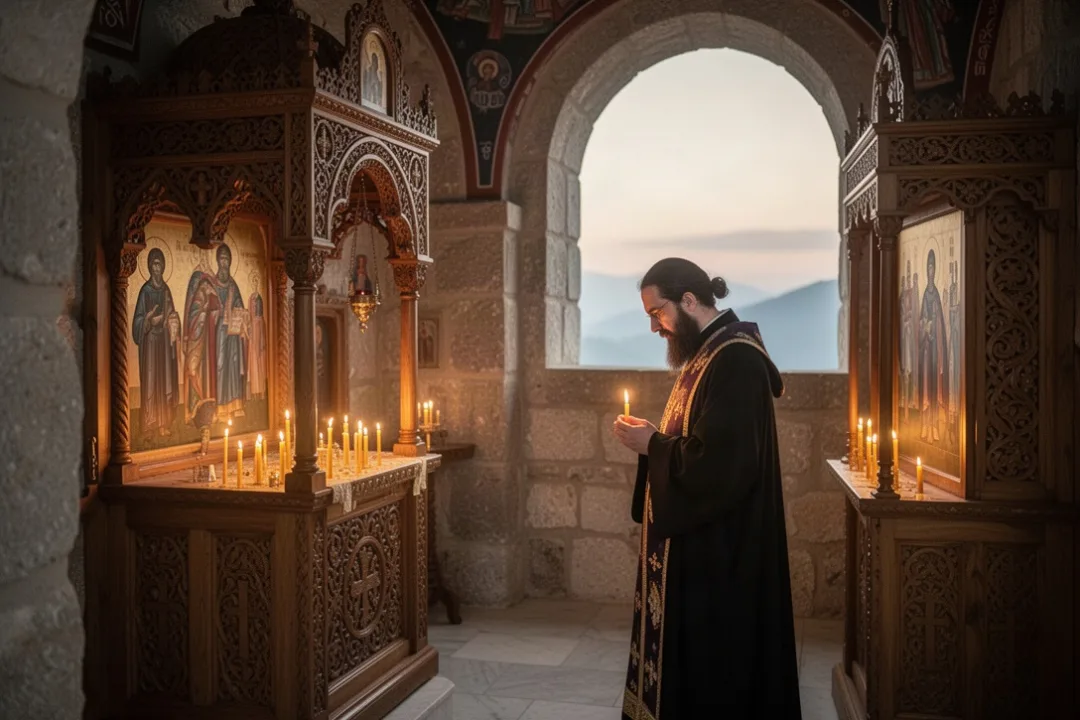
Palamas spent much of his adult life in monastic communities on Mount Athos, a major center of Eastern Christian spirituality. There he became associated with hesychasm, a tradition of disciplined stillness and prayer. The Greek word hesychia suggests quiet, rest, or inner stillness.
His importance comes from the way he gave theological expression to a practice that monks believed had been handed down through earlier Christian writers. Palamas maintained that contemplative prayer was not an escape from Christian doctrine. Properly practiced, it was a way of turning the whole person toward God.
The central idea: Palamas distinguished between God’s unknowable essence and God’s truly present, life-giving energies. This allowed him to affirm both divine transcendence and real human communion with God.
How to understand Gregory of Palamas in four steps
Palamas’s thought can seem abstract because it deals with the nature of God, human transformation, and mystical experience. A simple sequence makes the main argument easier to follow.
Human beings are called to communion with God. Christianity is not only about learning facts about God or following external rules. Its goal includes healing, holiness, and participation in divine life.
God cannot be grasped in his essence. No created mind can contain or fully comprehend what God is in himself. Divine transcendence remains real.
God genuinely communicates himself. God is not distant or absent. His grace, presence, and activity reach creation and can be experienced without making creatures divine by nature.
Prayer transforms the whole person. Through repentance, worship, sacramental life, and attentive prayer, the believer becomes more receptive to God’s action.
This framework explains why Palamas rejected two opposite conclusions. One would make God so remote that direct communion with him becomes impossible. The other would confuse a creature’s experience of grace with possession of the divine essence itself.
What hesychasm meant in Palamas’s Christian context
Hesychasm was not simply sitting quietly or pursuing a private mystical feeling. It referred to a disciplined way of life centered on repentance, watchfulness, silence, and prayer. Its practitioners sought to gather the mind and heart before God rather than allowing attention to remain scattered among constant thoughts and desires.
Hesychast spirituality commonly used the Jesus Prayer, a brief prayer asking Jesus Christ for mercy. The exact wording varies among traditions, but its purpose is not to produce a magical result through repetition. The prayer expresses humility, dependence, and continual remembrance of Christ.
Monastic teachers also emphasized bodily discipline, fasting, vigils, confession, and guidance from an experienced spiritual elder. These practices were meant to support repentance and attentiveness, not to force a vision or guarantee a supernatural experience.
Palamas defended the hesychasts against the charge that their practices were misguided or intellectually unsound. He argued that Christian prayer involves the whole human person, including the body. That does not mean that a particular posture or breathing technique automatically produces communion with God.
Repentance: turning away from sin and reorienting life toward God.
Watchfulness: recognizing destructive thoughts before they become actions or settled habits.
Stillness: creating an attentive interior posture rather than chasing every distraction.
Prayer: remaining directed toward Christ with humility and trust.
Discernment: testing spiritual experiences within the life and teaching of the Church.
For Palamas, authentic mystical life was inseparable from Christian ethics. A person who claims extraordinary prayer but remains ruled by pride, cruelty, or vanity has not reached the spiritual maturity hesychasm seeks.
Why Barlaam of Calabria criticized the hesychasts
The controversy surrounding Palamas began when Barlaam of Calabria, a Greek-speaking monk and scholar from southern Italy, criticized hesychast claims. Barlaam was familiar with classical philosophy and Christian theology, and he objected to what he understood as an overly confident claim that monks could see God directly.
He was especially suspicious of reports that hesychasts experienced a divine light. Barlaam believed that human beings should approach theology through intellectual reasoning and negative descriptions of God—saying what God is not—rather than claiming direct perception of divine realities.
Palamas agreed that God’s essence cannot be seen or comprehended by creatures. His disagreement concerned what follows from that truth. If the essence is unknowable, Palamas argued, it does not follow that every experience of God is merely symbolic, created, or psychological.
The debate became sharper because both sides were trying to protect important Christian convictions. Barlaam wanted to preserve God’s transcendence and guard against false claims of mystical knowledge. Palamas wanted to preserve the reality of salvation as participation in God rather than mere moral improvement or intellectual information.
What the essence-and-energies distinction means
The most recognizable feature of Palamite theology is the distinction between God’s essence and God’s energies. The terms can be misleading if they suggest two separate gods or two unrelated parts inside God. Palamas was not dividing God into components.
God’s essence means God as God is in himself: the divine reality that no creature can comprehend or possess. God’s energies mean God as he acts, gives himself, and is present to creation. They are not created effects that merely resemble God. They are truly divine, yet they do not make creatures identical with God’s essence.
A comparison can help, although every comparison has limits. You cannot look directly at the sun without damaging your eyes, but you can genuinely receive its light and warmth. The light and warmth are not the sun’s entire inner reality, yet they are not imaginary. Likewise, Palamas used the language of divine energies to explain how God can be truly encountered without becoming an object that the human mind completely contains.
The distinction protects two claims at once:
God remains transcendent: the divine essence is beyond every created category and cannot be comprehended.
God remains present: grace, holiness, and communion with God are not merely created substitutes that keep believers at a distance.
Human transformation is real: sanctification involves participation in God’s life, not only an external legal status.
Creation is not absorbed into God: a saint remains a creature, even when profoundly united to God through grace.
In Orthodox theology, this distinction is often linked to the doctrine of theosis, or deification. Theosis does not mean that a person becomes a second god or ceases to be human. It means that human nature is healed and brought into communion with God through grace.
A necessary caution: “Essence” and “energies” should not be imagined as physical substances or detachable pieces of God. They are theological terms for speaking carefully about the mystery of God’s transcendence and self-communication.
What the “uncreated light” means
The uncreated light refers to the divine glory experienced by the apostles at the Transfiguration of Christ. In the Gospel accounts, Jesus is revealed in radiant glory before Peter, James, and John. Palamas connected this event with the spiritual experience described by hesychasts, while stressing that such experience is a gift of God rather than a technique that humans can manufacture.
Calling the light “uncreated” means that it is not merely a physical phenomenon or a created symbol standing between God and the believer. It is understood as the manifestation of God’s own glory. At the same time, the experience does not mean that the person has comprehended God’s essence.
Palamas’s argument therefore involved more than reports of visions. The deeper question was whether the glory revealed in Christ is truly divine and whether human beings can genuinely participate in it. If all contact with God were limited to created representations, he believed that the Christian promise of communion would be weakened.
Palamas also knew that spiritual experiences require caution. Orthodox spiritual writers repeatedly warn against pride, self-deception, and the desire for extraordinary phenomena. The aim of prayer is union with God expressed through love, humility, and holiness, not the pursuit of unusual sensations.
How the Palamite controversy was settled in the Byzantine Church
The dispute continued through a series of church councils in Constantinople during the 1340s. Palamas’s position was affirmed, while his opponents’ criticisms were rejected. In 1347, Palamas became archbishop of Thessalonica, although conflict and political instability affected his ministry.
Further disputes followed, and the theological settlement was reaffirmed in later councils. These decisions became a major part of the doctrinal inheritance of the Eastern Orthodox Church. The second Sunday of Great Lent is dedicated to Gregory of Palamas in the Byzantine liturgical tradition, placing his defense of hesychasm alongside the broader movement toward Easter.
He is also commemorated annually on November 14. His place in the calendar reflects more than admiration for a historical theologian. It presents his teaching as part of the Church’s confession that salvation is real participation in divine life.
Palamas’s opponents were not all motivated by a rejection of prayer or holiness. The controversy involved difficult questions about the limits of human knowledge, the role of philosophy, and how to interpret earlier Christian authorities. Reducing the dispute to “reason versus faith” misses the complexity of both sides.
How Palamas viewed reason, philosophy, and theology
Palamas did not reject rational thought, education, or philosophical argument. He had received a strong intellectual formation and wrote carefully argued theological works. His concern was that philosophical reasoning should not become the measure that limits what God can reveal or how grace can be experienced.
He distinguished between knowledge about God and direct participation in God. Theology, language, and reasoning are valuable because they protect the Church from confusion and articulate the faith. Yet they cannot replace prayer or make a person holy by information alone.
This approach also reflects a common pattern in Eastern Christian thought. Theological language is necessary, but God exceeds every statement. A doctrine can be true without giving the human mind exhaustive possession of the reality it describes.
For Palamas, the healthiest theology joins accurate belief with transformed life. A person may speak correctly about God while remaining spiritually unchanged. Conversely, private experience without doctrinal and communal discernment can become unreliable. Orthodox theology therefore treats doctrine and spiritual practice as mutually connected.
Where Gregory of Palamas fits in Orthodox Christian life
Palamas is especially influential in Orthodox discussions of prayer, grace, salvation, and human nature. His teaching helps explain why Orthodox worship gives such attention to divine glory, the sanctification of the body, and the possibility of holiness in ordinary human life.
His influence appears in several areas:
Prayer: silent and spoken prayer can involve the whole person, not only the intellect.
Sacraments: divine grace is understood as a real participation in God’s life, not merely a reminder of religious ideas.
Icons and worship: created forms can serve communion with God without being confused with God’s essence.
Ascetic practice: fasting and self-control are intended to heal desire and restore freedom, not earn divine favor as a payment.
Saints: holiness shows what human beings can become through grace while remaining creatures.
His theology is also connected with the Orthodox emphasis on the heart. In this context, the heart is not merely the seat of emotion. It refers to the deep center of the person, where attention, desire, understanding, and will can be gathered before God.
That language should not be turned into a claim that the mind is unimportant. Palamas’s goal was an integrated person: a mind purified from distraction, a will turned toward the good, and a body participating in prayer rather than treated as an obstacle to spiritual life.
How Western readers often interpret Palamas
Gregory of Palamas has attracted growing interest outside Eastern Orthodoxy, including among Roman Catholic and Protestant theologians. Some readers see his work as a valuable account of participation in God and a corrective to versions of Christianity that describe grace in purely external terms.
Others approach the essence-and-energies distinction through debates about divine simplicity, divine action, and the relationship between nature and grace. These discussions can become technically complex because different Christian traditions use the same words in different ways.
It is best not to assume that “essence” and “energies” mean exactly the same thing in every theological system. Palamas’s position belongs to the particular history of Byzantine Christian theology and should first be understood on its own terms.
At the same time, several questions raised by Palamas have broad relevance:
Can people truly know God without comprehending God completely?
Is grace merely a created benefit, or is it God’s own self-giving?
How should mystical experiences be tested and interpreted?
Can spiritual transformation be described without erasing the difference between Creator and creature?
These questions explain why Palamas remains relevant even for readers who do not belong to the Orthodox Church. He offers a sustained account of how divine transcendence and intimate communion can be affirmed together.
What reading Gregory of Palamas requires from you
Palamas’s writings are not always easy to read. They respond to a specific controversy and assume familiarity with Scripture, earlier Christian theology, monastic practice, and Byzantine intellectual culture. A reader who begins with isolated phrases may mistake specialized language for a simple formula.
A useful approach is to read his work through a few guiding questions:
What problem is Palamas answering? Determine whether a passage concerns prayer, divine knowledge, the Transfiguration, grace, or the limits of philosophy.
What does he mean by participation? He is not describing absorption into God or possession of the divine essence.
How does doctrine connect with practice? His theology is meant to illuminate repentance, prayer, and holiness rather than remain an abstract theory.
What role does the Church play? Personal experience is not treated as self-authenticating; it belongs within worship, tradition, and spiritual discernment.
His best-known theological work is commonly called the Triads, written in defense of the holy hesychasts. Readers may also encounter shorter works and later collections that present his sermons or theological arguments. Reliable introductions can be helpful before approaching the primary texts.
Why Gregory of Palamas still matters
Gregory of Palamas matters because he addressed a question that remains difficult for many Christians: How can God be beyond understanding and still be personally present? His answer was not to choose between divine mystery and human experience. He preserved both by distinguishing God’s essence from the divine energies through which God gives life and grace.
His teaching also presents salvation as more than forgiveness understood in isolation. It includes healing, transformation, and participation in God. The believer does not become divine by nature, but can become holy through communion with divine grace.
For anyone exploring Orthodox Christianity, hesychasm, or Christian mysticism, Palamas provides a framework for taking prayer seriously without treating every unusual experience as authentic. His legacy points toward a disciplined spirituality in which doctrine, worship, moral conversion, and contemplative attention belong together.
Frequently asked questions
Was Gregory of Palamas a mystic or a theologian?
He was both a contemplative monk and a systematic theologian. His defense of mystical prayer was expressed through careful theological arguments about God, grace, and human transformation. He did not separate spiritual experience from doctrine. Instead, he believed authentic contemplation should be guided by the Church’s faith and should produce humility, repentance, love, and holiness.
What is the difference between hesychasm and the Jesus Prayer?
Hesychasm is a broader spiritual tradition involving stillness, watchfulness, repentance, ascetic discipline, and prayer. The Jesus Prayer is one important practice used within that tradition. Repeating the prayer is not understood as a mechanical technique. Its purpose is to turn the person continually toward Christ with humility and attention.
Do Orthodox Christians believe people become God through theosis?
Orthodox Christians who follow Palamite theology do not mean that humans become God by nature or become separate divine beings. Theosis means participation in God’s life through grace. A person remains a creature while being transformed, healed, and united to God. The distinction between divine essence and energies protects both communion and the Creator-creature difference.
Is the uncreated light supposed to be a physical light?
In Palamite theology, the uncreated light is not simply an unusual physical phenomenon. It refers to the divine glory associated especially with Christ’s Transfiguration and, by grace, with authentic contemplation. Spiritual writers caution that believers should not chase visions or assume that every bright experience is supernatural. Humility and discernment remain essential.











Leave a Reply