Saint Hilary of Poitiers: Life, Teachings, and Legacy
Saint Hilary of Poitiers: Life, Teachings, and Legacy
Have you ever wondered how a Christian leader should respond when a widely accepted teaching seems to conflict with the faith handed down by the Church? Saint Hilary of Poitiers faced that question in the fourth century, when disputes about the identity of Jesus Christ divided bishops, emperors, and Christian communities across the Roman Empire.
Hilary was a bishop, theologian, writer, and defender of the Nicene faith. He argued that the Son is truly divine and shares the same divine nature as the Father, while also remaining distinct from the Father. His most influential work, On the Trinity, gave Western Christianity a careful explanation of the Father, Son, and Holy Spirit. His feast is celebrated on January 13, and the Catholic Church recognizes him as a Doctor of the Church.
Hilary was born around 310, probably in or near Poitiers in Gaul, a Roman region corresponding broadly to parts of modern France. He grew up in a pagan environment and received the kind of education available to a cultured Roman: grammar, rhetoric, and philosophy. His later writings show a strong command of Scripture and classical reasoning.
Accounts of his early life indicate that Hilary became a Christian as an adult. His search for the meaning of God, truth, and human existence led him toward the Christian faith. Scripture, especially the Gospel of John, appears to have played a major role in his intellectual and spiritual development. He was eventually baptized and became known for a serious, reflective approach to Christian belief.
Hilary was married before becoming a bishop, according to early traditions, and had a daughter named Abra. The surviving evidence about his family life is limited, so later stories should be treated with care. What is clear is that he belonged to a Christian community in Gaul and was chosen as bishop of Poitiers around the middle of the fourth century.
His episcopal ministry began during one of the most difficult periods in early Christian history. The Church was no longer facing only persecution from outside. It was also struggling with internal arguments over language, authority, and the meaning of salvation. Hilary became one of the strongest Western defenders of the Nicene position.
At a glance: Saint Hilary of Poitiers was a fourth-century bishop who defended the full divinity of Christ, wrote extensively about the Trinity, endured exile for his beliefs, and helped preserve Nicene Christianity in the Latin-speaking Church.
Why Hilary opposed Arian theology
The central controversy of Hilary’s time concerned the relationship between the Father and the Son. Arius, a priest from Alexandria, had taught that the Son was created by the Father and therefore did not possess the same eternal divine nature. Supporters of this view used language that seemed to protect belief in one God, but it also placed Christ below the Father.
The Council of Nicaea, held in 325, rejected Arius’s position. Its creed taught that the Son is truly God and described him as being of the same substance, or same divine nature, as the Father. The Greek term commonly associated with this confession is homoousios. The council’s decision did not end the dispute, however. Political pressure, changing alliances, and disagreements about terminology kept the conflict alive for decades.
Hilary believed the issue was more than a technical argument. If Christ were a created being, Christians could no longer say that God himself had entered human history to save humanity. Worship of Christ would also become difficult to explain. For Hilary, the Christian claim that people are united to God through Christ required Christ to be genuinely divine, not merely the highest creature.
He also resisted the idea that defending the unity of God required denying the Son’s equality with the Father. Hilary taught that the Father and Son are distinct persons, but they share one divine reality. This distinction allowed him to affirm both monotheism and the full divinity of Christ.
His method was biblical as well as philosophical. Hilary drew on passages such as John 1, John 10, Philippians 2, and Colossians 1, interpreting them in light of the Church’s baptismal faith. He did not treat isolated verses as independent proof texts. Instead, he asked how the whole pattern of Scripture presents Christ’s relationship to the Father and his role in creation and redemption.
The Father is truly God, not one deity among several.
The Son is eternally divine, not a creature produced in time.
The Son is distinct from the Father, so Christian language does not simply collapse the two into one person.
Salvation depends on Christ’s true identity, because the one who reconciles humanity to God must truly belong to God’s own life.
Hilary’s writing also addressed the Holy Spirit, although his treatment is less extensive than his discussion of the Father and Son. He affirmed the Spirit’s holiness and divine work in the life of the Church. His theology helped Western Christians speak more carefully about the Trinity without reducing the mystery to a simple formula.
How exile shaped Saint Hilary’s ministry
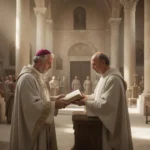
Hilary’s opposition to pro-Arian policies brought him into conflict with powerful church leaders and the emperor Constantius II. Around 356, Hilary was exiled from Gaul and sent to Phrygia in Asia Minor, a region in the eastern part of the Roman Empire. Exile removed him from his diocese, but it did not silence him.
In Phrygia, Hilary encountered the complicated state of the eastern controversy firsthand. Several groups used different formulas to describe the Father and Son, and the disagreements were not always easy to classify. Some avoided the Nicene term because they feared it might be interpreted in a way that confused the Father and Son. Others used language that placed the Son beneath the Father.
Hilary tried to distinguish legitimate concern from theological error. He understood why some bishops worried about words that might appear to deny the Father and Son as distinct persons. At the same time, he argued that vague or carefully balanced formulas could not replace the Church’s clear confession of Christ’s true divinity.
His period of exile produced several important works. The best known is De Trinitate, usually translated as On the Trinity. He also wrote On the Synods, which examined the councils and statements involved in the controversy, and a work often known in English as Against Constantius, which criticized the emperor’s interference in Church affairs.
Hilary’s experience in the East made his defense more informed and measured than it might otherwise have been. He was not simply repeating a Western slogan. He studied the positions of eastern bishops, explained the differences among their formulas, and sought ways to restore unity without sacrificing the Nicene confession.
A useful lesson from his exile: Hilary treated disagreement seriously enough to understand its language and history, but he did not confuse institutional pressure or political favor with theological truth.
When Hilary eventually returned to Gaul, the controversy had not disappeared. He continued to oppose bishops who supported positions incompatible with Nicaea and worked to strengthen the faith of clergy and congregations in the West. His return also showed that exile had not weakened his commitment. It had expanded his knowledge and sharpened his ability to explain the issues.
What Saint Hilary taught about the Trinity
On the Trinity is Hilary’s major theological achievement. The work is arranged in twelve books and combines biblical interpretation, doctrinal argument, prayer, and personal reflection. Rather than beginning with an abstract definition, Hilary often starts from the Christian experience of baptism and the worship of the Church.
For Hilary, Christians are baptized into the name of the Father, Son, and Holy Spirit. This threefold pattern is not a later invention added to the faith. It expresses the reality of the God whom Christians confess and worship. Hilary therefore treats the Trinity as a mystery that must be approached with humility but also defended with intellectual care.
He gives special attention to the names and actions associated with the Father and Son. The Son creates, reveals the Father, gives life, judges, and saves. These are not the actions of a secondary spiritual being. They point to the Son’s participation in divine power and identity.
Hilary also argues that the Son’s eternal relationship with the Father is not the same as the birth of a creature. Human beings come into existence through generation in time, but the Son’s generation from the Father belongs to God’s eternal life. Hilary recognizes that human language cannot fully describe this reality. Even so, words such as eternal, begotten, and one in divine nature protect important truths from distortion.
His theology includes several themes that remain useful for readers today:
Faith seeks understanding. Christian belief is not reduced to private feeling; it can be examined through Scripture, reason, and the Church’s confession.
God’s unity and personal distinction belong together. The Father, Son, and Holy Spirit are not three separate gods, yet the persons are not interchangeable.
Christ reveals the Father. Jesus is not merely a messenger who stands outside God’s life. In knowing the Son, Christians encounter the Father’s self-revelation.
Salvation depends on communion with God. Christ’s true divinity matters because Christian salvation is participation in divine life, not merely moral instruction from a superior teacher.
The Church’s language has a purpose. Terms such as “same substance” were used to guard the meaning of the Gospel, not to replace the Gospel with philosophy.
Hilary’s writing is often more devotional than readers expect from a theological treatise. He recognizes that the Trinity is not a puzzle to solve completely. The goal is faithful speech about God that leads to worship, gratitude, and transformed life.
Hilary’s approach joins careful thought with reverence: Christians speak about God because God has made himself known, while remembering that divine reality surpasses human language.
His biblical interpretation also deserves attention. Hilary frequently reads the Old Testament as pointing toward Christ and the New Testament as revealing the fulfillment of those promises. He sees the unity of Scripture in the identity and work of the Son. That approach influenced later Latin theology and helped shape Western Christian reflection on the relationship between the two Testaments.
Hilary’s writings, hymns, and influence
Hilary was one of the earliest major Latin theologians from Gaul. His writings helped bring eastern theological debates into the Latin-speaking West. He translated and adapted ideas from Greek Christian thinkers, but he also developed a distinctive style shaped by Latin rhetoric and close reading of Scripture.
His surviving works include theological treatises, letters, biblical commentaries, and polemical writings. On the Trinity remains his most important work for systematic theology. On the Synods is valuable for understanding the doctrinal formulas and political circumstances surrounding the fourth-century councils.
Hilary also wrote commentaries on biblical books, including Matthew and the Psalms. His interpretation of the Psalms often reads them as speaking about Christ and the Church. He believed the Psalms form the prayer of the whole body of believers, while also revealing the mystery of Christ’s suffering, glory, and relationship with the Father.
He is sometimes called the first Latin Christian hymn writer whose work survives in a substantial way. His hymns were written partly to give ordinary Christians sound teaching they could sing. This mattered because doctrinal conflict was not limited to bishops and scholars. Hymns could place competing beliefs in the memory and worship of the congregation.
Hilary’s influence continued after his death around 367. Later theologians, including Augustine of Hippo, recognized the value of his work. The Church honors him as a Doctor of the Church, a title granted to saints whose teaching has special importance for Christian doctrine and spiritual life.
Trinitarian theology: He gave Latin Christians a clear defense of the Son’s equality with the Father.
Biblical interpretation: He showed how Scripture can be read as a unified witness to Christ.
Church leadership: He remained responsible for his people even when political authority removed him from his diocese.
Christian worship: His hymns demonstrated that theological truth belongs in prayer and song, not only in academic debate.
Public witness: He resisted the use of imperial power to settle questions that required the Church’s faithful discernment.
Why Saint Hilary of Poitiers still matters
Saint Hilary’s story speaks to readers who want to understand how Christian doctrine develops under pressure. He did not treat doctrine as a collection of disconnected rules. He saw the Church’s teaching about Christ and the Trinity as inseparable from baptism, prayer, Scripture, worship, and the hope of salvation.
His example is especially relevant when public disagreement becomes confusing. Hilary did not respond by accepting every formula that promised peace, nor did he assume that every opponent was equally dishonest or uninformed. He listened, studied, clarified terms, and identified the point at which compromise would change the Christian confession.
His life also shows that courage can take an intellectual form. Hilary’s resistance was expressed through books, letters, biblical interpretation, and persistent pastoral leadership. He understood that clear teaching protects people who may not have the time or training to analyze every theological argument themselves.
For personal prayer or study, you might begin with the Gospel of John, the baptismal command in Matthew 28, or Paul’s teaching about Christ in Philippians 2 and Colossians 1. Read the passages in context, then ask what they imply about Christ’s identity, his relationship with the Father, and the work of the Holy Spirit.
The feast of Saint Hilary of Poitiers on January 13 offers an opportunity to remember a bishop who united conviction with patience, scholarship with worship, and pastoral care with public courage. His central message remains direct: the Christian faith depends on who Jesus Christ truly is, and the Church must speak about that truth with both precision and reverence.
Frequently asked questions
What is Saint Hilary of Poitiers the patron saint of?
Saint Hilary of Poitiers is commonly associated with protection against snakes and with people affected by snakebites, although patronage traditions can vary by region and source. He is also remembered especially as a patron of theologians and defenders of orthodox Christian teaching because of his work against Arian theology and his writings on the Trinity.
When is the feast day of Saint Hilary of Poitiers?
The Catholic Church celebrates Saint Hilary of Poitiers on January 13. The date commemorates his life and witness as a bishop and theologian. Some Christian calendars or local traditions may observe saints differently, but January 13 is the principal feast date associated with Hilary in the Western Church.
Was Saint Hilary of Poitiers a Doctor of the Church?
Yes. Saint Hilary was named a Doctor of the Church because his teaching has lasting importance for Christian theology. His most significant contribution is his explanation of the Trinity and his defense of the belief that Jesus Christ is fully divine. His biblical commentaries and theological works also influenced later Western Christian writers.
What is Saint Hilary’s most famous book?
His best-known work is On the Trinity, a major fourth-century defense of Nicene Christianity. In it, Hilary explains the relationship of the Father, Son, and Holy Spirit through Scripture, theology, and prayer. He also wrote On the Synods, biblical commentaries, letters, and works addressing the political and doctrinal conflicts of his era.











Leave a Reply