Cyril of Jerusalem: Life, teachings, and catechetical lectures
Cyril of Jerusalem: Life, teachings, and catechetical lectures
Cyril of Jerusalem was a fourth-century bishop, teacher, and defender of Christian doctrine whose surviving lectures give one of the clearest pictures of early Christian initiation. He taught candidates preparing for baptism and newly baptized Christians in Jerusalem, explaining the Creed, biblical faith, the sacraments, and the worship of the Church.
His life was shaped by both pastoral teaching and the doctrinal disputes of the fourth century. Cyril served as bishop of Jerusalem, endured exile during the Arian controversy, returned to his see, and was present at the First Council of Constantinople in 381. His most famous work, the Catechetical Lectures, remains valuable because it connects theology with the practical experience of prayer, baptism, Communion, and Christian living.
Cyril was born in or near Jerusalem, probably in the early fourth century. The exact year of his birth is not known, and the surviving accounts of his early life are limited. He was ordained a deacon and later a priest before becoming bishop of Jerusalem, traditionally around the middle of the fourth century.
As bishop, Cyril inherited responsibility for a church located at the center of Christian memory. Jerusalem was associated with the ministry, death, resurrection, and ascension of Jesus, so its bishop served a community visited by pilgrims and closely connected with the places remembered in the Gospels. That setting gave Cyril’s teaching a strong geographical and liturgical character: he regularly connected Christian beliefs with places, biblical events, and actions performed in worship.
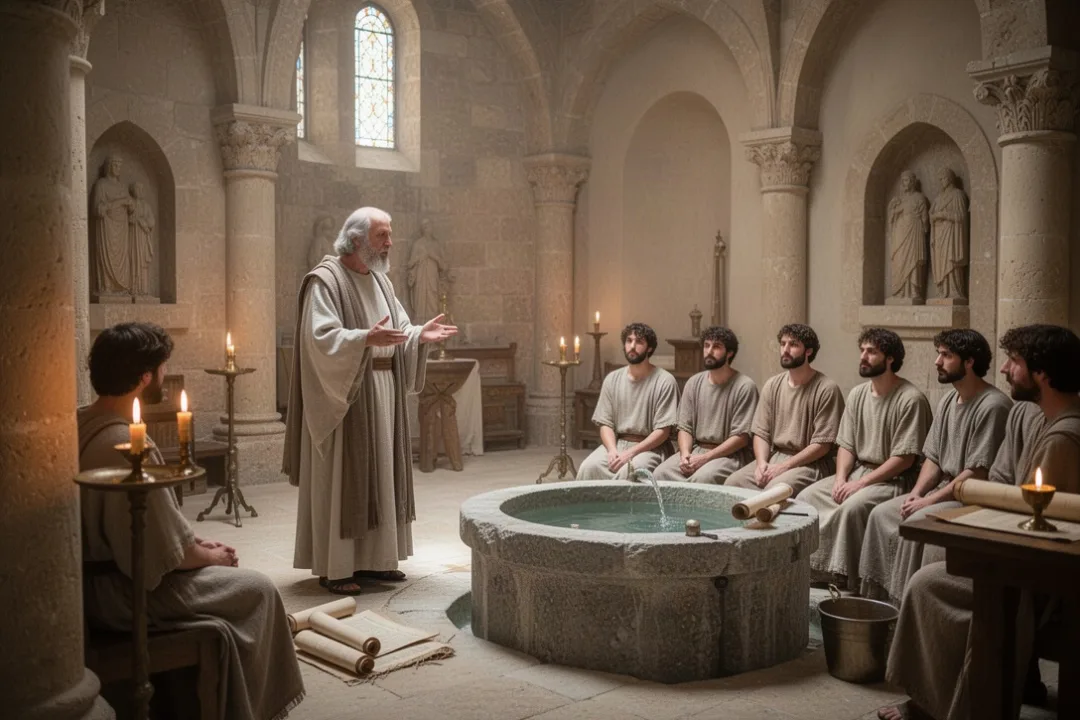
Cyril was not primarily a speculative theologian writing for academic debate. His surviving lectures were delivered to people who were preparing for Christian baptism or had recently received it. He explained difficult doctrines in a pastoral way, using Scripture, the Creed, and the Church’s liturgical practice to form a Christian understanding of faith.
Why Cyril matters: His lectures show how a major church taught ordinary worshipers through spoken instruction, biblical interpretation, memorized creeds, and participation in the sacraments.
Cyril’s role in the Arian controversy
Cyril lived during the long dispute over how Christians should describe the relationship between the Father and the Son. The controversy became associated with Arius, who argued that the Son was not eternal in the same way as the Father. The Council of Nicaea in 325 rejected that teaching and confessed the Son as truly divine, but disagreement continued for decades over terminology, authority, and the proper interpretation of the Nicene faith.
Cyril’s own position was shaped by this conflict, although historians continue to discuss the precise details of his theological alignment. He emphasized the full divinity of the Son and the unity of Christian teaching, while also facing accusations from his opponents that he had acted improperly as bishop. One dispute involved church property and resources that Cyril used during a period of famine. His opponents claimed that the money or goods had been handled unlawfully.
At a council held at Caesarea in 357, Cyril was condemned and removed from Jerusalem. He appealed to a later council at Seleucia, but political and ecclesiastical changes continued to affect his position. He spent years in exile, with periods of residence in different regions of the eastern Roman Empire.
Cyril eventually returned to Jerusalem under Emperor Julian, whose policies briefly allowed exiled bishops to come back. His return did not end the controversy. He was again forced into exile under Emperor Valens, who supported a different theological party. After Valens died in 378, the new political situation allowed Cyril to return once more.
In 381, Cyril attended the First Council of Constantinople, where the bishops reaffirmed the Nicene faith and developed the Church’s teaching concerning the Holy Spirit. Cyril died sometime after the council, traditionally in 386, although the exact date is not certain. His repeated exile shows how closely theological disputes were connected to imperial policy and episcopal politics during the fourth century.
What the Catechetical Lectures contain
Cyril’s main surviving work is commonly called the Catechetical Lectures or Catecheses. The collection contains a preliminary address followed by eighteen lectures traditionally associated with the preparation of baptismal candidates. These students are often called catechumens, people who were receiving instruction before entering the Church through baptism.
The lectures appear to belong to the season leading up to Easter, when many candidates were prepared for baptism. Cyril’s teaching follows a deliberate progression. He begins with conversion and the seriousness of Christian commitment, then explains the Creed and central doctrines of the faith. The later lectures focus more directly on the rites of baptism, anointing, the Eucharist, and prayer.
Five additional lectures are traditionally known as the Mystagogical Catecheses. “Mystagogy” means instruction in the mysteries, especially teaching given after initiation. These lectures explain what the newly baptized had experienced during the Easter liturgy, including renunciation of Satan, immersion in water, anointing, and reception of the Eucharist.
Scholars have discussed whether all the mystagogical lectures were written by Cyril himself or whether some were delivered by a close successor. The traditional attribution remains influential, and the lectures are commonly read alongside the earlier catecheses because they provide a unified picture of Jerusalem’s baptismal teaching.
Cyril treats the Creed as a concise statement of the Christian faith that candidates must learn carefully. He warns them not to alter its wording casually or replace the Church’s teaching with personal speculation. For him, the Creed is not merely a test to pass before baptism; it is a guide to the whole shape of Christian belief.
His instruction covers belief in the Father, the Son, and the Holy Spirit, as well as creation, the incarnation, the crucifixion, the resurrection, the ascension, judgment, and the Church. He explains each topic through biblical references and connects individual statements to the wider story of salvation.
Cyril strongly defends the divinity of Christ. He teaches that the Son is truly God and truly became human, while rejecting the idea that Jesus was only an inspired person or a created intermediary. His language reflects the doctrinal concerns of his time, but his purpose is practical: Christians must know whom they worship and why the saving work of Christ is effective.
He also teaches about the Holy Spirit as divine and active in creation, prophecy, sanctification, and Christian life. The Spirit is not treated as an impersonal force. Instead, Cyril presents the Spirit as the one who enlightens, sanctifies, reveals truth, and gives spiritual life to believers.
For Cyril, learning the Creed requires both memory and moral change. A candidate should not repeat doctrine while continuing to live as though baptism had no consequences. Faith must shape conduct, prayer, worship, relationships, and the rejection of practices that conflict with Christian allegiance.
Cyril’s understanding of Scripture and biblical interpretation
Cyril quotes or refers to a wide range of biblical books, making his lectures an important witness to how Scripture was taught in the fourth-century Church. He uses the Old Testament and New Testament together, reading earlier events as preparation for and interpretation of Christ’s saving work.
His approach often follows typological interpretation. In this method, an earlier person, event, object, or ritual is understood as pointing toward a later fulfillment. The crossing of the Red Sea, for example, can help explain baptism because both involve deliverance through water. The manna in the wilderness can help illuminate Christian teaching about spiritual nourishment and the Eucharist.
Cyril does not use biblical images merely as decorative comparisons. He treats them as part of the Church’s way of understanding God’s unified work across history. The God who acted in Israel is the same God revealed in Christ, and the sacraments are understood within that continuous biblical story.
He also insists that Scripture must be read in harmony with the Church’s faith. His students are warned against isolated interpretations that contradict the apostolic teaching. This does not mean that Cyril ignores the text. Rather, he presents Scripture as a book received, proclaimed, prayed, and interpreted within the worshiping community.
His lectures show how biblical literacy and liturgical participation worked together. A candidate learned the meaning of baptism partly by hearing biblical stories, but also by seeing those stories reflected in the actions of the baptismal service.
What Cyril taught about baptism
For Cyril, baptism is not simply a public symbol of a decision already made. It is a sacramental participation in the death and resurrection of Christ. The candidate enters the water, renounces the old allegiance, and rises to a new way of life through God’s grace.
Before baptism, candidates were instructed to renounce Satan and all works associated with him. Cyril describes this renunciation as a serious act of turning away from evil. The candidate then confesses faith in the Father, Son, and Holy Spirit, showing that baptism involves both rejection and allegiance.
The immersion in water is interpreted through the death and burial of Christ. Rising from the water represents resurrection and new life. Cyril emphasizes that the rite is not a theatrical imitation with no spiritual effect. God uses the sacramental action to unite the baptized person with Christ’s saving work.
Cyril also connects baptism with forgiveness of sins, illumination, adoption, and sanctification. The newly baptized person receives a new identity within the Church. This identity does not mean that future moral choices become irrelevant. Instead, it creates the foundation for a life of obedience, prayer, and ongoing repentance.
His teaching includes a careful distinction between the visible action and the divine power at work through it. Water remains ordinary water in a physical sense, but through the command of Christ and the work of the Holy Spirit, it becomes the means by which baptism is celebrated. Cyril therefore joins material signs with spiritual realities rather than treating them as opposites.
What Cyril taught about the Eucharist
The Mystagogical Catecheses contain some of Cyril’s most frequently discussed teaching about the Eucharist. He urges Christians not to judge the sacrament only by what appears to the senses. The bread and wine used in the liturgy are understood, through Christ’s words and the action of the Holy Spirit, as truly communicating Christ’s body and blood.
Cyril’s language is direct because he wants newly baptized Christians to approach Communion with faith and reverence. He does not describe the Eucharist as a bare reminder or a merely mental exercise. He presents it as a sacramental gift through which believers receive Christ and are joined more deeply to him.
He also gives practical instructions for receiving Communion. The communicant should approach carefully, make an act of reverence, and take care not to lose any consecrated portion. Cyril’s details reveal the seriousness with which the Jerusalem church regarded the Eucharist and show that early Christian worship involved embodied habits, not only inward belief.
The Eucharist is also connected with the unity of the Church. Christians receive one sacramental food as members of one body. This does not erase personal responsibility; rather, it places personal faith within a shared act of worship and a common life.
A useful distinction: Cyril’s sacramental language should be read in the context of fourth-century Christian worship. He is explaining what the Church celebrates and receives, not offering a modern philosophical definition of every detail of Eucharistic change.
How Cyril describes Christian prayer and worship
Cyril’s teaching reflects a Church in which doctrine was learned through public worship. Candidates did not study Christian ideas in isolation from the community. They listened to Scripture, recited the Creed, prayed with other believers, underwent baptism, and received Communion.
The Lord’s Prayer receives special attention in the post-baptismal instruction. Cyril treats it as a prayer given by Christ and therefore as a pattern for Christian life. Its petitions teach believers to honor God, seek his kingdom, depend on daily provision, ask forgiveness, forgive others, and seek protection from temptation.
Prayer is not presented as a way to manipulate God. It is an act of trust and a means of forming the desires of the person who prays. When Christians ask for forgiveness, they must also practice forgiveness. When they ask for daily bread, they acknowledge dependence rather than self-sufficiency.
Cyril also speaks about the Church’s prayers for the living and the departed. These references help historians understand the variety of intentions included in fourth-century liturgical prayer. They also show that worship was conceived as an act involving the whole Christian community across generations.
Practical ways to read Cyril of Jerusalem
Cyril’s lectures can feel unfamiliar because they assume a world of public baptismal ceremonies, extended preparation, and memorized doctrinal formulas. A careful reading becomes easier when you pay attention to the purpose and setting of each lecture rather than treating every passage as a detached theological definition.
Identify the audience: ask whether Cyril is speaking to candidates before baptism or to people who have already been initiated.
Notice the liturgical setting: connect his comments about water, oil, clothing, prayer, and Communion with the actions being performed in worship.
Track biblical connections: look for the Old Testament event or image that Cyril uses to explain a Christian sacrament.
Separate central claims from local details: some instructions reflect the customs of fourth-century Jerusalem, while others express broader theological convictions.
Read doctrine and ethics together: Cyril expects belief in the Creed to produce changes in conduct and prayer.
Compare translations carefully: technical words can vary between editions, especially in discussions of the sacraments and the Holy Spirit.
Several common mistakes can lead to a distorted picture of Cyril. Readers sometimes treat the lectures as if they were a modern systematic theology textbook, even though they were delivered as pastoral instruction to people entering a worshiping community.
Do not assume every phrase answers a later controversy: Cyril addresses the issues of his own time, not every question asked by later Christian traditions.
Do not isolate one Eucharistic sentence: read his teaching alongside the surrounding discussion of faith, liturgy, reverence, and participation.
Do not ignore the candidate’s moral preparation: baptismal teaching includes renunciation, repentance, and a changed life.
Do not confuse uncertainty with irrelevance: questions about the authorship or dating of some lectures do not erase their historical value.
Why Cyril’s Jerusalem setting shaped his teaching
Jerusalem gave Cyril a distinctive setting for Christian instruction. The city was associated with the central events of the Gospel, and its churches developed forms of worship that connected those events with particular places and seasons. Pilgrims and local Christians encountered a faith expressed through memory, movement, Scripture, and ritual.
Cyril’s explanations often assume that Christian worship makes the biblical past present to the community. Baptism is not only described with abstract terms; it is linked to the burial and resurrection of Christ. The Eucharist is not only defined in theological language; it is received through a visible rite involving bread, wine, bodily gestures, and prayer.
This setting also helps explain the urgency of his teaching. Candidates were not preparing for a private ceremony with no public consequences. They were being received into a community with its own confession, moral expectations, worship, and pattern of life.
The Jerusalem tradition preserved in Cyril’s lectures therefore offers more than biographical information about one bishop. It provides evidence for how early Christian communities formed new members, taught doctrine orally, and interpreted the sacraments through Scripture.
Cyril’s place among early Christian teachers
Cyril is often read alongside other fourth-century teachers such as Athanasius of Alexandria, Basil of Caesarea, Gregory of Nazianzus, and John Chrysostom. Each had a different setting and emphasis. Cyril’s particular contribution lies in the close relationship between doctrinal instruction and the rites of initiation.
His work is especially useful for studying the development of Christian catechesis. He shows that preparation for baptism involved much more than learning a short list of beliefs. Candidates were taught how to interpret the Bible, understand the Trinity, approach worship, receive Communion, pray, and live as members of the Church.
He is also important for the history of early Christian doctrine. His language about Christ, the Holy Spirit, baptism, and the Eucharist illustrates how fourth-century teachers defended orthodox belief while addressing people who needed clear and usable instruction. The lectures preserve a theological vocabulary that is closely tied to preaching and worship.
At the same time, Cyril should not be presented as a completely detached figure above the conflicts of his period. His episcopate was marked by accusations, councils, imperial intervention, and exile. The combination of pastoral authority and political vulnerability is part of his historical significance.
What remains valuable in Cyril’s teaching
Cyril’s lectures remain valuable because they bring together several dimensions of Christianity that are sometimes separated in modern discussions. He presents belief, worship, Scripture, and moral life as parts of one formation. A Christian learns the faith by hearing it, confessing it, celebrating it, and living according to it.
His treatment of baptism emphasizes that conversion involves a decisive change of allegiance. His teaching about the Eucharist emphasizes reverence and participation. His explanation of the Creed emphasizes the identity of the God Christians worship. His use of biblical patterns shows how early Christians understood the sacraments within the full story of Scripture.
Cyril’s work also reminds readers that the early Church taught through the calendar and the body. Candidates waited, fasted, listened, stood, turned, were immersed, were anointed, prayed, and received Communion. Theology was not confined to written arguments; it was learned through repeated practices shared by the community.
For anyone seeking a primary source on fourth-century Christian life, the Catechetical Lectures offer a direct and substantial witness. They reveal a bishop teaching people at the threshold of baptism and helping them understand what they were about to confess, receive, and become.
How to approach Cyril’s legacy today
Readers from different Christian traditions may interpret Cyril’s teaching in different ways, especially his language about the Eucharist, baptism, the Church, and the authority of tradition. Those differences do not prevent careful historical reading. They make it useful to distinguish what Cyril says from the later theological systems through which readers may approach him.
A productive reading asks several concrete questions: What problem is Cyril addressing? Who is listening? Which biblical passage shapes his explanation? What action is taking place in worship? What change does he expect in the Christian life?
These questions preserve the original force of his teaching. Cyril was not simply recording information about fourth-century beliefs. He was preparing people to enter the Church with understanding, reverence, and commitment. His lectures continue to matter because they show how Christian doctrine can be taught as a lived pattern of worship and discipleship.
Frequently asked questions
When did Cyril of Jerusalem live?
Cyril lived in the fourth century, although the exact year of his birth is unknown. He became bishop of Jerusalem around the middle of that century, endured more than one period of exile, attended the First Council of Constantinople in 381, and probably died around 386. The chronology of some events in his life remains debated because the surviving evidence is incomplete.
What is Cyril of Jerusalem best known for?
Cyril is best known for his Catechetical Lectures, a collection of teachings given to people preparing for baptism and to newly baptized Christians. The lectures explain the Creed, Scripture, baptism, the Eucharist, prayer, and Christian conduct. They are also an important source for understanding fourth-century worship and the process of Christian initiation.
Was Cyril of Jerusalem an Arian?
Cyril’s exact position within the complicated theological alliances of the fourth century is debated, but he defended the full divinity of Christ and was recognized within the Nicene Christian tradition. His conflicts with other bishops involved both theology and accusations about church administration. He later participated in the Council of Constantinople, which reaffirmed Nicene teaching.
Why are Cyril’s Mystagogical Catecheses significant?
The Mystagogical Catecheses explain the meaning of baptismal and Eucharistic rites to Christians who had just experienced them. They describe renunciation, immersion, anointing, Communion, and prayer as participation in Christ’s saving work. The lectures are especially significant because they connect theological claims with the concrete actions of early Christian worship, though their traditional authorship has been discussed by scholars.













Leave a Reply