May Crowning 2026: dates, meaning, and planning ideas
May Crowning 2026: dates, meaning, and planning ideas
If you are trying to find the right date for May Crowning 2026, the short answer is that there is no single universal date. Catholic parishes, schools, and families usually hold a May Crowning ceremony on a convenient Sunday, a weekday during May, or a date connected with a local Marian celebration.
In May 2026, May 1 falls on a Friday and May 31 falls on a Sunday. That gives communities several practical options, including the first weekend of May, a parish weekday liturgy, or the final Sunday of the month. The ceremony should fit the parish calendar and local custom rather than compete with a major liturgical celebration.
May Crowning is a Catholic devotion in which a statue or image of the Blessed Virgin Mary is crowned with flowers. The crown represents Mary’s honored place as the mother of Jesus and a model of faithful discipleship. It is not worship of Mary; Catholics worship God alone and honor Mary because of her unique role in salvation history.
The custom developed alongside Catholic devotion to Mary during the month of May. Flowers, processions, hymns, and prayers create a visible expression of affection and respect. The ceremony can be especially meaningful for children because it gives them a concrete way to participate in a tradition that might otherwise seem abstract.
Different communities use different titles for the statue, including Mary, Queen of Heaven, Our Lady of Grace, or another local Marian title. The title chosen should reflect the parish’s devotional life and the particular image being honored.
Mary’s role is understood through her relationship to Christ: her “yes” points beyond herself to Jesus and to faithful service.
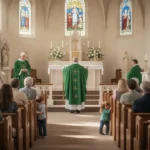
The ceremony often includes a procession, a Marian hymn, a Scripture reading, prayers, and the placement of the crown. Some communities also invite children to carry flowers, a rosary, a Bible, or a parish banner. These details are optional. The central purpose is prayerful Marian honor, not an elaborate performance.
When should May Crowning 2026 take place?
May Crowning may take place on any suitable day in May, but many parishes choose a Sunday so that the wider community can attend. In 2026, the first Sunday is May 3, the middle Sundays are May 10 and May 17, and the final Sunday is May 31. A parish might also select a weekday evening to make room for a school group or a family-focused service.
When choosing the date, check the parish liturgical calendar, school schedule, First Communion plans, graduations, and other May events. The best date is usually the one that allows participants to pray without rushing and gives the congregation a clear role.
May 2026 also includes important parts of the Easter season. Ascension celebrations and Pentecost-related observances may affect the parish schedule, depending on local practice. A May Crowning should support the Church’s liturgical year and keep the focus on Christ rather than becoming a disconnected pageant.
Planning tip: If your parish has not selected a date, ask the pastor or parish staff before printing invitations or assigning children roles. Local liturgical customs and diocesan calendars may determine which May weekends are available.
Common date choices for May Crowning
May 1: A traditional opening date for the month, although it falls on a Friday in 2026.
May 3: The first Sunday of May, useful for launching a monthlong Marian devotion.
May 10: A mid-month Sunday that may work well for a school or parish ceremony.
May 17: Another Sunday option, subject to the parish’s observance of the Ascension.
May 31: The final Sunday of May, appropriate for closing the month with a larger celebration if the liturgical calendar permits.
These are planning possibilities, not required dates. A May Crowning can be held on a different day when that better serves the community. A small family gathering on a weekday can be just as sincere as a large parish ceremony.
There is no single official script used by every parish. Most ceremonies follow a simple pattern that moves from gathering to prayer, then to the crowning itself. Keeping the structure familiar helps children and visitors understand what is happening.
Gathering or procession: Participants enter with flowers, candles, a Marian image, or other appropriate symbols.
Opening prayer: A priest, deacon, teacher, parent, or designated leader welcomes everyone and directs attention to Mary’s example.
Scripture or reflection: A short reading or meditation connects Mary’s life with trust, service, humility, and faith in God.
Marian hymn: The congregation sings a familiar hymn or listens to suitable music.
Presentation of flowers: Children or families place flowers near the statue or image.
Crowning: A child, family representative, religious sister, or other participant places the crown on Mary’s statue.
Intercessions: The community prays for the Church, families, children, the sick, those in need, and the wider world.
Closing prayer or blessing: The ceremony ends by directing participants back to Christian service and ordinary life.
The procession and crowning should remain signs of prayer, not simply stage moments. Explain each part briefly, especially when visitors or young children may not recognize the symbolism. A short, well-prepared ceremony is generally more effective than one filled with too many readings and activities.
Choosing the crown, flowers, and Marian image
The crown can be made from fresh flowers, silk flowers, greenery, or a simple preassembled arrangement. It should be light enough to place securely and proportionate to the statue. A crown that is too heavy may damage the image or become difficult for a child to handle.
Flowers have long been associated with May devotion, but there is no required flower or color. White can suggest purity, blue is often associated with Mary, and seasonal flowers can connect the ceremony with the local landscape. Use flowers that are safe, stable, and appropriate for the worship space.
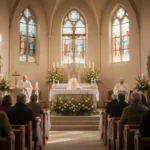
Some churches crown a statue inside the sanctuary, while others use a Marian grotto, side chapel, school altar, or home prayer corner. The image should be treated respectfully and positioned where the congregation can see it without obstructing the altar, ambo, tabernacle, or other important liturgical furnishings.
Before decorating, ask whether the church has rules about candles, floral arrangements, adhesives, water, and placement. Fresh flowers can leak, shed petals, or trigger allergies. A simple arrangement often looks more dignified and creates fewer practical problems.
Prayers and Scripture themes for May Crowning
A May Crowning can include familiar Marian prayers such as the Hail Mary, the Angelus, the Regina Caeli during the Easter season, or a decade of the Rosary. The choice should match the participants’ age and the amount of time available. If children are involved, explain unfamiliar prayers before the ceremony rather than expecting them to follow automatically.
Scripture readings should show why Mary is honored within Christian faith. Appropriate themes include the Annunciation, Mary’s visit to Elizabeth, her presence at Cana, and her prayerful presence with the disciples. References such as Luke 1:26–38, Luke 1:39–56, and John 2:1–12 can support these themes without requiring a long reading.
The Magnificat, found in Luke 1:46–55, is especially suitable for reflection because it presents Mary praising God and recognizing God’s care for the humble. A leader can summarize its message in original words: Mary gives glory to God, remembers divine mercy, and trusts that God lifts up those who are lowly.
Another useful theme is Mary’s attentiveness. At Cana, she notices a practical human need and brings it to Jesus. That example can lead to prayers for families who are struggling, people who feel overlooked, and communities called to respond with compassion.
Keep the focus clear: Marian devotion should lead people closer to Jesus, the Gospel, and faithful Christian living. Use the crowning as an opportunity to pray for Mary’s virtues—trust, courage, humility, and charity—not merely to admire a decorated statue.
Planning a parish or school May Crowning
Begin planning several weeks before the selected date. A small team can coordinate the liturgy, music, decorations, children’s roles, communication, and cleanup. Assign one person to make final decisions so that details do not become confusing as the ceremony approaches.
For a parish celebration, coordinate with the pastor, liturgy coordinator, music minister, sacristan, ushers, and religious education staff. For a school celebration, include the principal, teachers, families, and anyone responsible for student safety. A shared checklist prevents important responsibilities from being assumed but never assigned.
Children should receive roles that match their age and comfort level. One child might carry the crown, while others carry flowers or read short petitions. Avoid choosing only the most confident students; quiet participation, paired roles, and group responses allow more children to take part without unnecessary pressure.
Rehearse the procession and crowning at least once in the actual space. Practice where participants will stand, how they will approach the statue, who will hold the crown, and how everyone will return to their seats. If a child is placing the crown, have an adult nearby to provide discreet assistance.
A practical preparation checklist
Confirm the date, time, location, and approval from parish or school leadership.
Check the liturgical calendar and avoid conflicts with major parish events.
Select the Marian image and verify that the crown will fit securely.
Choose readings, prayers, music, and a reflection appropriate for the group.
Assign roles for readers, singers, servers, flower bearers, and the crowning participant.
Prepare large-print materials or spoken instructions for children and visitors.
Arrange flowers, a stand, protective materials, and any needed microphones.
Rehearse the procession, crowning, readings, and transitions.
Plan accessibility for people using wheelchairs, walkers, or other mobility aids.
Communicate arrival times, clothing expectations, and supervision arrangements to families.
Assign cleanup duties and decide what will happen to the flowers afterward.
Common May Crowning mistakes to avoid
Most problems come from unclear planning rather than from the devotion itself. A ceremony can remain beautiful and reverent without being complicated. These common mistakes are easy to prevent.
Assuming May 31 is always the correct date: The last day of May may conflict with a Sunday liturgy or another important celebration. Confirm the calendar first.
Making the crown too heavy: A large arrangement can be unsafe for a child and unstable on a statue. Test its weight before the ceremony.
Overloading the service: Too many songs, speeches, and readings can weaken the prayerful focus. Choose a few meaningful elements.
Using unfamiliar language without explanation: Briefly define words such as intercession, devotion, and coronation for children and visitors.
Treating children as performers: Their participation should be prayerful and voluntary, not a competition for attention or costumes.
Ignoring accessibility: Make sure the route, seating, microphone, and presentation area work for the whole community.
Forgetting the church’s rules: Candles, flowers, music, photography, and movement in the sanctuary may require approval.
Failing to connect Mary with Christ: Explain that honoring Mary points to God’s work in her life and to her example of following Jesus.
Photography also deserves advance attention. Some families may want pictures, while others may prefer privacy. Decide where photographers can stand, avoid blocking the congregation, and follow the parish or school’s policies concerning children’s images.
Simple May Crowning ideas for families at home
A family does not need a parish statue or a large gathering to observe May Crowning. A small image of Mary, a vase of flowers, and a few minutes of prayer are enough. Place the image in a safe location, add flowers from a garden or grocery store, and invite each family member to name a prayer intention.
Children can make a paper crown, draw a picture of Mary, or choose one virtue to practice during the week. The activity should lead to prayer rather than become a craft project by itself. For example, a family might connect blue flowers with Mary’s trust and then pray for courage in a difficult situation.
A simple home service might include a Sign of the Cross, a short reading from Luke 1, one decade of the Rosary, a Marian prayer, and a closing prayer for the family. The family can place the crown on the image together, with an adult explaining that the gesture expresses honor and love.
Families can also visit a parish grotto, attend a May Mass, pray the Rosary with neighbors, or bring flowers to someone who is sick or isolated. These acts extend Marian devotion into care for other people, which is more important than the decoration itself.
Music and participation for different age groups
Music should be familiar enough for people to join without extensive rehearsal. Traditional Marian hymns may work well for a parish congregation, while a school group may prefer a shorter refrain, a spoken response, or a song already used in religious education.
Preschool children can carry a single flower with an adult or join a simple spoken prayer. Elementary-age children can present flowers, read short petitions, or lead a repeated response. Older students can serve as readers, musicians, ushers, or ceremony guides.
Adults should provide calm direction rather than correcting every small movement. Children may be nervous, forget a line, or walk at different speeds. A supportive atmosphere helps them understand that the ceremony is an act of prayer, not a test of public performance.
If the congregation includes people from different cultural backgrounds, consider inviting families to suggest Marian prayers, hymns, or customs that are part of their tradition. Keep the service coherent, but allow the community’s genuine Catholic diversity to be visible.
What to say when explaining May Crowning to children
Children often ask why Catholics crown a statue. A clear answer is that the crown is a symbol of honor. Catholics are not treating the statue as a living person or as a god; they are using a visible sign to remember Mary and to thank God for her faithful response.
You can explain that Mary was Jesus’ mother, that she listened to God, and that she cared for others. Her life included uncertainty and suffering, so honoring her does not mean pretending that faith makes every problem easy. It means remembering a person who trusted God and remained close to Jesus.
It also helps to explain that Mary is not a replacement for prayer to God. Catholics ask Mary to pray with them and for them, much as they might ask a trusted Christian friend to pray for a need. Every Marian devotion should ultimately encourage love of God, love of neighbor, and attention to the Gospel.
For a school or parish handout, use one or two simple sentences instead of a long theological explanation. Children usually understand the meaning best when they can connect the symbol with a concrete action, such as praying for someone, helping at home, or showing patience.
Ways to carry the devotion beyond May 2026
May Crowning does not need to remain an isolated annual event. A parish can invite families to continue praying the Rosary, learning about Marian feasts, serving people in need, or reflecting on one of Mary’s virtues each week. The follow-up should be modest enough that families can actually sustain it.
A school might display a prayer board with intentions for the month, organize a service project, or invite students to write a brief reflection on trust and courage. A parish could offer a weekly Rosary, a Marian hymn at a regular gathering, or a family prayer resource.
The crown eventually fades or is stored away, but the devotion can continue through ordinary choices. When people practice generosity, attentiveness, humility, and trust, they give the ceremony a lasting purpose. The most meaningful May Crowning is one that helps participants live those virtues after the flowers are gone.
Frequently asked questions
Is May Crowning always held on May 31?
No. May Crowning can take place on any suitable day in May. Many parishes choose a Sunday, but a weekday Mass, school service, or family gathering may work better. In 2026, May 31 is a Sunday, but its suitability depends on the parish’s liturgical calendar and other scheduled celebrations.
Who should crown the statue of Mary?
A child, family representative, pastor, teacher, religious sister, or another member of the community may place the crown. The choice is a local decision. Select someone who can perform the gesture safely and explain that the role represents the community’s honor and prayer, not personal status.
What kind of crown is appropriate for May Crowning?
A crown may be made from fresh flowers, artificial flowers, greenery, or a simple purchased arrangement. It should be lightweight, stable, and sized for the statue. Blue and white are common choices, but no particular color or flower is required. Confirm that the design follows the church’s decoration policies.
Can May Crowning be celebrated at home?
Yes. A family can place a Marian image in a prayer space, add flowers, read a short passage from Luke, pray a decade of the Rosary, and offer intentions. The crown may be handmade or symbolic. The purpose is to honor Mary and ask for her prayers while directing the family’s attention to Jesus and Christian service.











Leave a Reply