Saint Isidore: patron saint of farmers and workers
Saint Isidore: patron saint of farmers and workers
Saint Isidore the Farmer is best known as the patron saint of farmers, agricultural workers, and rural communities.
The name Saint Isidore can refer to more than one Christian saint. In the United States and many Spanish-speaking Catholic communities, it usually means Isidore the Farmer, a laborer from medieval Madrid remembered for his prayer, generosity, and trust in God. The name can also refer to Saint Isidore of Seville, a bishop and scholar whose writings helped preserve knowledge in early medieval Europe.
Knowing which Isidore you are asking about makes the history easier to understand. The farmer is associated with fields, livestock, daily labor, and care for the poor. Isidore of Seville is associated with learning, writing, teaching, and the Church’s effort to organize knowledge.
Isidore the Farmer was born in Madrid, probably around the late 11th century, when the city was under Muslim rule. The exact details of his early life are not known, but Christian tradition remembers him as a poor farm laborer who worked for landowners near Madrid. He married María de la Cabeza, who is also honored as a saint, and the couple lived a deeply religious life.
Isidore did not belong to a religious order, hold a position of public authority, or write influential books. His holiness was associated with ordinary responsibilities: rising for work, tending animals, cultivating fields, attending prayer, and sharing what he had with people in need. That makes his story especially meaningful to people whose faith is expressed through steady work rather than public recognition.
Tradition says Isidore attended church before beginning his daily labor. Some coworkers accused him of arriving late because of his prayers. In response, his employer is said to have discovered that the fields were still being worked while Isidore was at prayer, with angels helping guide the plow. This story is a legend of divine assistance, not a farming technique or a historical report, but it expresses the saint’s reputation for putting God at the center of his life.
Other stories describe Isidore sharing food with birds or giving part of his meal to a hungry beggar. These accounts emphasize his compassion for people and animals. His generosity did not depend on having a large surplus. Instead, the stories present him as someone who trusted that sharing was part of faithful living.
Essential distinction: When people ask for Saint Isidore’s intercession for crops, farmers, rain, or rural work, they usually mean Isidore the Farmer of Madrid, not Isidore of Seville.
Isidore died around 1130, according to traditional accounts. His remains were later associated with miracles and were moved to the Church of Saint Andrew in Madrid, where he had been buried. He was canonized in 1622 by Pope Gregory XV along with several other major Catholic saints, including Ignatius of Loyola, Francis Xavier, Teresa of Ávila, and Philip Neri.
Why Saint Isidore is the patron saint of farmers
Saint Isidore became a patron of farmers because his life connects faith with physical labor. He did not treat agricultural work as separate from prayer or moral responsibility. Plowing, planting, caring for animals, and supporting a household could all become expressions of service when done honestly and with concern for others.
His patronage also reflects the uncertainty built into farming. A farmer can prepare soil carefully and still face drought, flooding, frost, disease, pests, or poor market conditions. Isidore represents a prayerful relationship with the land: people work diligently, use practical judgment, and recognize that the harvest depends on conditions they cannot fully control.
Good weather and relief from drought, destructive storms, or frost.
Healthy crops, fertile soil, and protection from pests and disease.
Livestock, farm animals, and the people responsible for their care.
Farm families facing financial pressure, illness, or difficult decisions.
Fair treatment for agricultural laborers and people whose work feeds their communities.
Wisdom and patience during planting, harvest, and periods of uncertainty.
His patronage extends beyond large farms and commercial agriculture. Gardeners, ranchers, farmhands, rural households, community gardens, and people who grow food for their neighbors may all find meaning in his example. The central idea is not the size of the operation. It is faithful care for creation and for the people who depend on the land.
Saint Isidore’s example does not encourage passivity. Prayer does not replace soil preparation, water conservation, veterinary care, safety procedures, or sound financial planning. His story suggests that responsible work and dependence on God belong together.
Saint Isidore’s lessons about work, prayer, and generosity
The strongest lesson in Isidore’s story is that ordinary work can be holy. A person does not need a famous vocation or a public platform to live with integrity. Work becomes morally meaningful when it is performed with care, honesty, perseverance, and respect for other people.
For Isidore, prayer was not an escape from responsibility. It shaped the way he approached responsibility. He is remembered as someone who prayed before work, treated his employer fairly, and remained attentive to the needs of the poor. His example challenges the idea that religious devotion and practical labor belong in separate parts of life.
His life also gives dignity to work that is often overlooked. Agricultural labor can be physically demanding and economically uncertain, yet much of it happens outside public view. By honoring a farm worker as a saint, the Church recognizes that feeding communities is valuable service, even when the laborer receives little praise.
What his example says about honest labor
Saint Isidore is often invoked by people who want to work faithfully without allowing work to become an excuse for greed or neglect. The traditional stories portray him as diligent, but not selfish. He worked for his household while remaining generous to the poor and attentive to prayer.
That balance can be applied to many occupations. A teacher, nurse, mechanic, parent, builder, or office worker can ask similar questions: Am I doing my work honestly? Do I treat coworkers fairly? Does my work serve anyone beyond myself? Have I allowed exhaustion or ambition to push aside family, worship, or compassion?
What his generosity says about sharing food
Food is central to Isidore’s symbolism because farming connects labor, nourishment, and community. A harvest is never only a private achievement. It supports families, neighbors, workers, markets, and people who may never see the fields where their food was grown.
His stories about feeding birds and sharing with beggars point toward a broader principle: resources should be used with mercy. This can mean donating to a food pantry, supporting local growers, paying workers fairly, reducing waste, or helping a neighbor with a garden or livestock. Small acts of sharing fit the practical character associated with Isidore.
How Saint Isidore is honored on his feast day
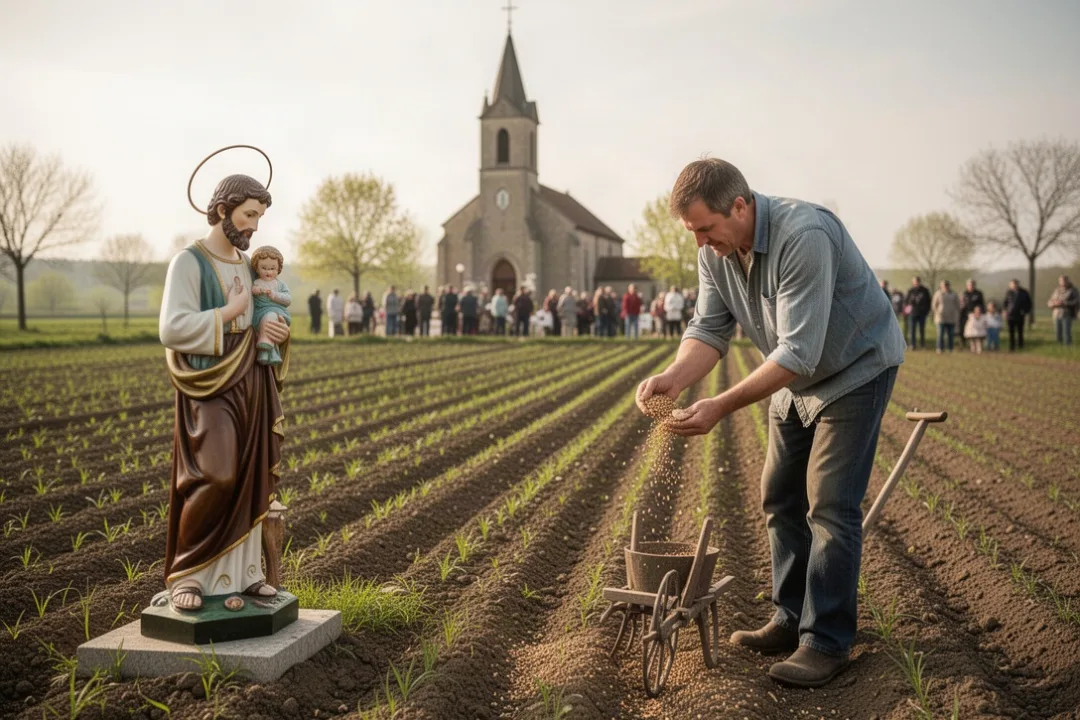
The feast of Saint Isidore the Farmer is celebrated on May 15. Customs differ from one place to another, but many celebrations include Mass, prayers for farmers, processions, blessings of fields, and the blessing of animals. In communities with strong agricultural traditions, the feast may also include public meals, music, dances, or local festivals.
Field blessings commonly ask God to protect the soil, crops, animals, and people who work on the land. A priest may bless seeds, farm equipment, gardens, or the boundaries of a field. These ceremonies do not guarantee a particular harvest. They express gratitude for creation and ask for strength, wisdom, and favorable conditions.
Some communities carry an image or statue of Isidore through the streets or into the countryside. He may be shown wearing a simple farmer’s clothing, holding a hoe or plow, or standing beside oxen. A representation of his wife, María de la Cabeza, may appear with him, especially in Spain and communities influenced by Spanish Catholic tradition.
Common ways to observe the feast include:
Attend worship and pray for agricultural workers, food producers, and rural families.
Bless a garden or field, asking for responsible stewardship and protection from severe conditions.
Share food with neighbors, a shelter, a food pantry, or someone facing hardship.
Thank farm workers whose labor supports the local community.
Care for animals responsibly and review their food, shelter, and medical needs.
Plant something as a practical reminder of patience, dependence, and renewal.
In the Philippines, Latin America, Spain, and parts of the United States, the feast may be connected with local agricultural festivals. The details vary by region because devotion develops through local customs. Some communities have a formal parish celebration, while others honor Isidore quietly at home or on the farm.
A blessing associated with Saint Isidore should be understood as a prayer of trust rather than a substitute for responsible action. Farmers still need to monitor weather, maintain equipment, protect water supplies, and follow animal-care and workplace-safety practices. Faith and practical wisdom support each other.
Saint Isidore of Seville and the other saints named Isidore
Saint Isidore of Seville is a different person from Isidore the Farmer. He was born in the sixth century and became archbishop of Seville in Spain. He died in 636 and is remembered as a bishop, teacher, author, and compiler of knowledge during a period when political and cultural institutions were changing across Western Europe.
His best-known work is the Etymologies, a large reference work that gathered information about language, history, religion, science, medicine, law, geography, and other subjects. It was not an encyclopedia in the modern sense, and some of its information reflects the limitations of the ancient and medieval sources available to him. Still, the work became highly influential because it preserved and organized material for later readers.
Isidore of Seville also wrote works on Christian doctrine, Church practice, history, and education. He supported learning among clergy and helped establish standards for teaching. Because of this intellectual legacy, he is associated with scholars, libraries, writers, teachers, and the preservation of knowledge.
The Catholic Church recognizes both Isidore the Farmer and Isidore of Seville, but their feast days and identities are different:
Isidore the Farmer: a lay worker from Madrid, honored especially on May 15 as a patron of farmers and agricultural communities.
Isidore of Seville: a bishop and author from the early medieval period, honored on April 4 and associated with learning and teaching.
Several other saints named Isidore are honored in Christian history, including martyrs and monastics. If a parish, school, icon, or book uses only the name “Saint Isidore,” the surrounding details usually reveal which one is intended. A plow, oxen, seeds, or a field points to Isidore the Farmer. A book, bishop’s clothing, or scholarly setting points to Isidore of Seville.
Practical clue: Look at the symbol, feast date, and setting. A rural blessing on May 15 almost certainly concerns Isidore the Farmer; a library or school honoring a patron of learning may be referring to Isidore of Seville.
Symbols, prayers, and ways to ask for Saint Isidore’s intercession
Images of Saint Isidore the Farmer often include a plow, oxen, a shovel, wheat, a field, or a bundle of grain. These symbols connect him to agricultural labor and the dependence of human life on the land. He may also be shown kneeling in prayer, reflecting the tradition that he placed worship before his workday.
Another common image includes angels working with the plow while Isidore prays. This comes from the traditional account of supernatural help in the fields. It should be read as a symbolic expression of God’s providence, not as a claim that farmers should neglect their duties.
A simple prayer to Saint Isidore can mention the specific needs of the people and land involved. You might pray for protection during dangerous work, adequate rain, relief from extreme weather, fair prices, healthy animals, or strength for someone facing a failed crop. You can also pray in thanksgiving after a successful harvest.
A personal prayer may follow this pattern:
Name the person, farm, garden, or community you are placing before God.
Give thanks for food, soil, water, labor, and the people who make nourishment possible.
Ask for protection, wisdom, patience, and conditions that support healthy growth.
Remember workers who are underpaid, injured, displaced, or unable to afford food.
Commit yourself to one practical act of stewardship or generosity.
People sometimes use a medal, statue, holy card, or small image of Saint Isidore as a reminder to pray. These objects are not magical protections. In Catholic practice, they point the person toward faith, gratitude, responsible work, and intercession.
Saint Isidore can also be a meaningful patron for anyone trying to combine work with spiritual life. His story directs attention away from status and toward faithfulness: do the work in front of you well, care for those who depend on it, remain generous, and remember that no harvest is produced by human effort alone.
Frequently asked questions
Is Saint Isidore the patron saint of farmers?
Yes. Saint Isidore the Farmer of Madrid is widely honored as the patron saint of farmers, farm workers, ranchers, gardeners, agricultural communities, and rural families. People commonly ask for his intercession for crops, livestock, weather, food production, and those who work in difficult agricultural conditions. His feast day is May 15.
What is Saint Isidore known for?
Saint Isidore the Farmer is known for combining prayer, hard work, and generosity. Traditional stories describe him as a farm laborer who attended church, cared for animals, helped the poor, and trusted God while carrying out ordinary duties. He is especially remembered for treating agricultural labor as meaningful service rather than merely a means of earning money.
Is Saint Isidore the same as Saint Isidore of Seville?
No. They were different people. Isidore the Farmer was a lay worker associated with medieval Madrid and farming. Isidore of Seville was a bishop, author, and teacher who died in 636. The first is honored especially by agricultural communities, while the second is associated with education, writing, libraries, and the preservation of knowledge.
When is Saint Isidore’s feast day?
Saint Isidore the Farmer’s feast day is May 15. Saint Isidore of Seville’s feast day is April 4. If a celebration involves the blessing of fields, animals, seeds, or farm equipment, it is usually honoring Isidore the Farmer. Local calendars and parish traditions may include additional observances.















Leave a Reply