Saint Isadore, more commonly spelled Saint Isidore the Farmer, was a Christian farm laborer from medieval Madrid who became known for his devotion, generosity, and trust in God. He is honored as the patron saint of farmers, agricultural workers, rural communities, and Madrid.
His feast day is May 15. People traditionally ask for his intercession for good harvests, rain, healthy animals, and the dignity of those whose work provides food. His story is especially meaningful because he was not a monk, priest, or wealthy landowner: he served God while working the soil and caring for his family.
The name Isadore is an English spelling variant of Isidore. When people say “Saint Isadore” in connection with farming, they usually mean Saint Isidore the Farmer, known in Spanish as San Isidro Labrador.
Isidore was born in Madrid, Spain, probably around the late 11th century. He worked as a farm laborer for a landowner named Juan de Vargas. Accounts of his life describe him as deeply prayerful, generous to the poor, respectful toward animals, and faithful to his daily responsibilities.
He married Maria Torribia, who is commonly called Maria de la Cabeza. She is also honored as a saint, particularly in connection with Madrid and rural devotion. The couple lived simply, worked hard, and shared a strong religious life.
The central lesson: Saint Isadore’s holiness was expressed through ordinary work, family responsibility, prayer, compassion, and care for creation—not through withdrawal from everyday life.
Why Saint Isadore is called the farmer saint
Saint Isadore’s title comes from the kind of work he performed. The word labrador refers to a person who works the land, especially through plowing and cultivation. He was not remembered as a landowner or agricultural theorist. He was remembered as someone who labored in the fields and treated that work as part of his life with God.
His example speaks to people whose work depends on conditions they cannot fully control. Farmers must prepare the soil, plant carefully, tend crops, and make prudent decisions, yet weather, disease, pests, and market conditions can alter the result. Isadore’s devotion reflects both human effort and dependence on providence.
That combination explains why farmers have continued to seek his prayers. Devotion to him does not mean expecting a harvest without work. Instead, it recognizes that agricultural work involves patience, humility, cooperation with nature, and gratitude for gifts no person can produce alone.
Saint Isadore’s life and character, step by step
Traditions about Saint Isadore focus less on political influence or intellectual achievement and more on the steady choices of a working person. His life can be understood through several connected qualities:
He worked faithfully. Isadore earned his living through agricultural labor and carried out demanding physical tasks with persistence.
He prayed regularly. Stories portray him as someone who made time for prayer and worship, even while living a busy working life.
He shared with people in need. His generosity toward the poor is one of the most consistent features of his traditional biography.
He cared for animals. Accounts of his life connect his compassion with the animals that depended on him and participated in farm work.
He remained devoted to family life. His marriage to Maria de la Cabeza forms an important part of his witness.
He trusted God with the results. The stories associated with him emphasize humility rather than personal credit.
These qualities help explain why his devotion crosses the boundary between religious and agricultural communities. A farmer may ask for protection over a field, while a nonfarmer may look to Isadore as a model of faithful work and practical charity.
What the stories about Saint Isadore mean
Several stories about Saint Isadore have been passed down through Christian tradition. They are best read as accounts shaped by devotion rather than as modern agricultural reports. Their purpose is to show the values associated with him: prayer, justice, generosity, and confidence in God.
The angels who helped with the plowing
The most famous legend says that Isadore’s employer noticed he was arriving late to work because he stopped to pray. When the employer investigated, he supposedly saw angels helping Isadore plow the fields, allowing the work to continue.
In some versions, the angels are joined by Saint Isadore himself or are described as guiding the oxen. The detail varies, but the meaning is consistent: prayer did not make work unimportant, and work did not make prayer impossible. The story presents divine help as a response to a faithful life, not as an excuse for laziness.
The grain shared with hungry birds
Another tradition says that Isadore gave some of his grain to hungry birds during a harsh winter. When his master later examined the grain supply, there was supposedly enough remaining to fill the measure. This story highlights his concern for living creatures and his willingness to share even when resources seemed limited.
The account also reflects a broader Christian idea: generosity should not be limited to people who can repay you. Isadore is portrayed as someone who noticed need and responded without calculating his advantage.
The meal for the poor
Traditions also describe Isadore bringing food to people who were hungry. On one occasion, the food seemed insufficient for everyone, yet all were fed. Like the other stories, this account should not be separated from his daily character. The point is not simply that food multiplied; it is that hospitality and mercy belonged at the center of his religious practice.
The well and his son
One story connected with Isadore and Maria de la Cabeza concerns their young son, Illán. According to tradition, the child fell into a well while his parents were away or distracted. After the parents prayed, the water rose and brought the child safely back to the surface.
This account is associated with a well in Madrid and became part of the local devotion surrounding the saint. It expresses a parent’s fear, a community’s memory, and trust in divine care. It also helps explain why Saint Isadore is sometimes invoked by parents and families, even though his principal patronage concerns farming.
Use discernment with miracle stories: Church traditions may preserve these accounts as signs of holiness, but the stories should not be treated as guarantees that every farmer will avoid hardship or receive a particular outcome.
Saint Isadore’s family and marriage
Saint Isadore is unusual among widely known agricultural patrons because his religious example includes married life. He and Maria de la Cabeza are remembered as a devout couple whose relationship was shaped by prayer, work, service, and perseverance.
Maria’s traditional biography includes her own acts of charity and devotion. Some accounts say she cared for a small chapel and helped travelers or people in need. Local traditions about the couple vary, and not every detail can be confirmed with the same certainty. Still, their shared memory presents holiness as something that can grow within a household.
Their story can be meaningful for couples who want to connect faith with practical responsibilities. Caring for children, maintaining a home, supporting one another through financial uncertainty, and serving neighbors can all become expressions of love. Saint Isadore’s example does not place religious devotion in opposition to family duties.
How Saint Isadore became a recognized saint
Devotion to Isidore developed first through local veneration, especially in Madrid. People remembered his life, visited places associated with him, and sought his prayers. As that devotion continued, the Church formally recognized him as a saint.
Saint Isadore was canonized in 1622 by Pope Gregory XV. He was canonized in the same year as several other major Catholic saints, including Ignatius of Loyola, Teresa of Ávila, Francis Xavier, and Philip Neri. His canonization confirmed the importance of his witness for a wider Christian community.
His body is associated with the Royal Collegiate Church of Saint Isidore in Madrid. The church became an important place of pilgrimage and devotion. Madrid’s celebrations of San Isidro remain particularly significant, with religious observances and cultural traditions connected to the city’s patron.
When Saint Isadore’s feast day is celebrated
Saint Isadore’s feast day is May 15. The date is observed by Catholics in many countries, with especially strong traditions in Spain, Latin America, and farming communities elsewhere.
Celebrations may include Mass, processions, blessings of fields or animals, community meals, and prayers for rain and a fruitful growing season. Local customs differ widely. Some communities emphasize solemn worship, while others combine religious observance with agricultural fairs, traditional clothing, music, or public festivals.
A feast day does not need to be elaborate to be meaningful. A family might attend worship, thank farm workers, prepare a meal from local produce, or pray for people facing drought and crop loss. The focus remains gratitude, responsibility, and solidarity.
What people ask Saint Isadore to pray for
Because of his life and patronage, people commonly ask Saint Isadore to intercede for needs connected with land, food, labor, and family. These intentions may include:
Rain during a serious dry period.
Protection from destructive storms, frost, fire, pests, and crop disease.
Healthy livestock and safe working conditions.
Wisdom when making decisions about planting, harvesting, or managing land.
Fair treatment and stable livelihoods for farm workers.
Relief for communities affected by drought, floods, hunger, or rising food costs.
Patience and strength during a difficult growing season.
Gratitude for food and for the people whose labor makes it available.
Prayer to a saint is understood as asking the saint to pray with and for the person, not as treating the saint as a replacement for God. For many believers, this practice creates a personal connection with someone whose life reflects the same concerns they bring to prayer.
How to pray with Saint Isadore
You do not need a special location or formal wording to pray with Saint Isadore. A short prayer can begin with a specific concern and end with a commitment to act responsibly. The following pattern can help:
Name the need. Mention the field, animals, family, workers, or community that needs help.
Give thanks. Recognize the food, soil, water, tools, knowledge, and people already supporting life.
Ask for intercession. Ask Saint Isadore to pray for protection, wisdom, rain, healing, or endurance.
Accept your responsibilities. Consider one practical action, such as conserving water, helping a neighbor, paying workers fairly, or reducing food waste.
Leave room for trust. Pray for the strength to respond faithfully even when the result cannot be controlled.
A simple prayer might say: Saint Isadore, faithful worker and servant of God, pray for those who cultivate the land, care for animals, and provide food. Ask God to give them wisdom, safety, fair treatment, and strength through every season. Help us receive food with gratitude and share with those who are hungry.
Saint Isadore and the dignity of agricultural work
One of the strongest reasons people still remember Saint Isadore is that he represents the dignity of necessary physical labor. Food production depends on many skills that are often overlooked: planting, irrigation, equipment maintenance, animal care, harvesting, packing, transportation, and seasonal planning.
Isadore’s example challenges the idea that only prestigious or highly visible work has spiritual value. His holiness is associated with consistency, not status. He did not need to become famous during his lifetime in order for his work and character to matter.
For this reason, devotion to him can lead to practical reflection. Are workers paid fairly? Are farm laborers protected from unsafe conditions? Do consumers understand how much effort lies behind an inexpensive meal? Honoring Saint Isadore should encourage respect for the people who cultivate, harvest, and distribute food.
Saint Isadore, creation, and responsible farming
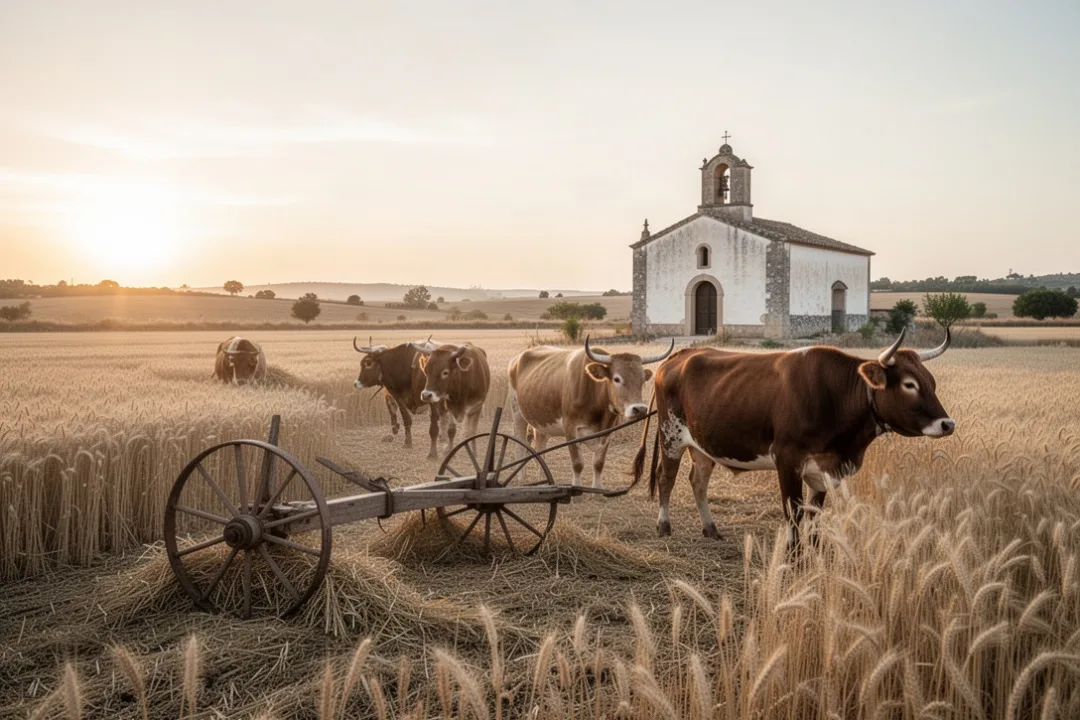
Saint Isadore lived long before modern environmental language, yet his traditional image connects him with the land, animals, water, and seasonal rhythms. He is often shown with oxen, a plow, a staff, or grain. These symbols point to a relationship with nature based on work and care rather than possession alone.
His example can support responsible habits such as protecting soil, avoiding unnecessary waste, caring properly for animals, and using water thoughtfully. These practices do not require ideal circumstances or perfect solutions. They begin with recognizing that land and food are gifts entrusted to human care.
For a farm family, this might mean improving soil health or protecting a stream. For someone living in a city, it might mean supporting local growers, learning where food comes from, volunteering at a community garden, or sharing groceries with a neighbor. The connection to Saint Isadore is the same: care for what sustains life.
Symbols associated with Saint Isadore
Religious art commonly portrays Saint Isadore in the clothing of a farm worker or in simple rural dress. His most recognizable symbols include:
A plow or oxen: These represent his labor and his patronage of farmers.
Wheat or grain: These symbolize food, harvest, and dependence on the land.
A staff: This may suggest his identity as a worker and guide.
Angels: They refer to the tradition that heavenly help continued the plowing while he prayed.
A shovel or farming tools: These emphasize practical service through manual work.
A rosary or prayer posture: These connect his physical labor with his devotional life.
Water or a well: This may recall the tradition involving his son or the need for rain and irrigation.
When these symbols appear together, they communicate a balanced picture. Saint Isadore was neither portrayed as someone who worked without prayer nor as someone who prayed while ignoring his duties. His identity joins faith, labor, family, and care for creation.
How Saint Isadore differs from Saint Isidore of Seville
The name can cause confusion because Saint Isidore of Seville is another important Christian saint. Isidore of Seville was a bishop, writer, and scholar from the early medieval period. He is known for his learning and is often associated with education, books, and knowledge.
Saint Isidore the Farmer, by contrast, was a lay agricultural worker from Madrid. If a prayer card, church, or article mentions farming, plowing, crops, animals, or Madrid, it is referring to the farmer saint. If it emphasizes scholarship, writing, or Seville, it is referring to Isidore of Seville.
Both names may be spelled Isidore or, less commonly in English, Isadore. The spelling alone does not identify which saint is meant; the surrounding symbols and patronage provide the clearest answer.
Ways to honor Saint Isadore today
Honoring Saint Isadore can involve prayer, but it can also include actions that reflect his values. You might observe his feast day by:
Praying for farmers, farm workers, truck drivers, grocers, and food-service workers.
Buying from a local farm or farmers market when practical.
Donating food or money to a reliable hunger-relief organization.
Learning about the people and processes behind a staple food you regularly eat.
Growing herbs, vegetables, or flowers with care for soil and water.
Thanking agricultural workers directly and supporting fair labor practices.
Sharing a meal with someone who is isolated or experiencing hardship.
Bringing an animal, field, garden, or farm tool into a blessing or prayer service.
These practices keep devotion connected to real life. Saint Isadore’s legacy is not limited to asking for a successful harvest; it also includes becoming more grateful, generous, responsible, and attentive to the work that feeds a community.
A short prayer for farmers and food workers
God of creation, thank you for the soil, water, sunlight, animals, seeds, and human hands that sustain us. Through the prayers of Saint Isadore, protect farmers and agricultural workers, give them wisdom and safety, and strengthen communities facing drought, storms, hunger, or unfair conditions.
Help us respect the people who grow and prepare our food. Teach us to use resources responsibly, share what we have, and receive each meal with gratitude. Saint Isadore, faithful servant and worker, pray for us and for all who depend on the land. Amen.
Frequently asked questions
Is Saint Isadore the same as Saint Isidore the Farmer?
Yes. “Saint Isadore” is a variant spelling of “Saint Isidore,” and the farming patron is formally known as Saint Isidore the Farmer. He is also called San Isidro Labrador, especially in Spanish-speaking communities. This saint should not be confused with Saint Isidore of Seville, the bishop and scholar.
What is Saint Isadore’s feast day?
Saint Isadore the Farmer’s feast day is May 15. The day is especially observed in Madrid and in farming communities around the world. Customs can include church services, processions, blessings of fields or animals, prayers for rain, community meals, and celebrations that honor agricultural labor.
What is Saint Isadore the patron saint of?
Saint Isadore is the patron saint of farmers, farm laborers, agricultural workers, rural communities, and Madrid. People also ask for his prayers for crops, rain, livestock, safe work, food security, and those affected by drought or other agricultural hardships.
What can Saint Isadore teach people who are not farmers?
His life can teach anyone to value steady work, family responsibilities, generosity, prayer, and care for creation. His example also encourages gratitude for food and respect for the workers who produce and distribute it. A person can honor him by sharing food, supporting local growers, reducing waste, or praying for agricultural communities.












Leave a Reply