St. Isidore the Farmer: Life, Feast Day, and Patronage
St. Isidore the Farmer: Life, Feast Day, and Patronage
St. Isidore the Farmer is the patron saint of farmers, farmworkers, and rural communities. He was a medieval laborer from Madrid, Spain, remembered for combining demanding agricultural work with prayer, generosity, and deep trust in God.
The Catholic Church celebrates his feast day on May 15. People honor him by attending Mass, blessing fields, caring for animals, sharing food, and asking for help with honest work, favorable growing conditions, and the needs of rural families.
St. Isidore was born in Madrid around the late 11th century, when the city and surrounding region were shaped by changing political and religious communities. His family was poor, and he earned his living through agricultural labor rather than wealth, education, or public office.
As a young man, Isidore worked for a landowner traditionally identified as Juan de Vargas. He cultivated fields, cared for animals, and performed the ordinary tasks required on a working farm. His sanctity was not separated from his occupation; the fields were the setting in which he practiced faithfulness, patience, and charity.
Tradition says that Isidore married a woman named María de la Cabeza, who is also honored in Spain for her holiness. The couple lived simply and were known for prayer, hospitality, and concern for people who had less than they did. Their son, often identified as Illán, is connected with a well-known family story about divine protection.
Isidore died around 1130, according to traditional accounts. His reputation for holiness continued after his death, and devotion to him spread from Madrid through Spain and eventually to farming communities in many countries.
The central lesson: St. Isidore’s example does not treat manual labor as an obstacle to holiness. It presents ordinary work, done honestly and offered to God, as a real place for prayer and service.
Why St. Isidore is called the farmer
Many saints are associated with a profession because they practiced Christian virtue within that work. St. Isidore is especially connected with farming because agriculture shaped his entire daily life. He sowed and harvested crops, worked with animals, and depended on weather and soil—realities that reminded him of human limits.
His title distinguishes him from other saints named Isidore, including St. Isidore of Seville, the seventh-century bishop and scholar. In English, he may be called St. Isidore the Farmer, St. Isidore the Laborer, or St. Isidore the Husbandman. In Spanish, he is widely known as San Isidro Labrador.
The word labrador refers to a farmer or agricultural worker. It should not be confused with the name of the Labrador dog breed. St. Isidore’s title points to his occupation and to the dignity of work done with responsibility, not to an aristocratic or academic position.
St. Isidore’s life in practical points
Place: Madrid and the surrounding agricultural lands in medieval Spain.
Occupation: Farm laborer who cultivated land and cared for animals.
Family: Traditionally married to María de la Cabeza and associated with a son named Illán.
Spiritual reputation: Known for prayer, generosity, humility, and trust in God.
Patronage: Farmers, farmworkers, gardeners, rural communities, and people who depend on the land.
Feast day: May 15 in the Catholic calendar.
Common symbols: A farmer’s clothing, a staff, a plow, oxen, grain, and a bundle of wheat.
These points summarize the traditional devotion, but they should not be read as a complete modern biography. Much of what is popularly told about Isidore comes from local tradition, devotional accounts, and legends preserved by generations of believers.
What the legends of St. Isidore mean
The best-known story says that Isidore sometimes arrived late to work because he stopped to pray. His employer supposedly discovered that angels, or in some versions oxen guided by angels, were helping with the plowing while Isidore prayed. The story is often shown in art with a heavenly figure directing the animals.
The point of the story is not that farm duties can be ignored. Instead, it expresses the belief that prayer and work belong together. Isidore’s devotion did not make him careless; traditional accounts present him as a dependable worker whose prayer shaped the way he served.
Another story tells of Isidore sharing food with hungry people. When the meal seemed insufficient, the pot or food supply was said to provide enough for everyone. This legend reflects his reputation for generosity toward the poor and the Christian conviction that hospitality matters even when resources appear limited.
A further tradition concerns his son falling into a well. Through prayer, the water level reportedly rose until the child could be rescued. Like many saintly legends, this story teaches trust in divine mercy while also showing the importance of a father’s love and responsibility.
These accounts are not agricultural instructions or scientific explanations. They are devotional stories that use familiar farm images—oxen, grain, food, water, and work—to express truths about faithfulness, providence, and compassion.
How St. Isidore understood work
St. Isidore is a strong patron for people whose labor is physical, repetitive, seasonal, or often overlooked. Farming requires planning, endurance, skill, and cooperation with conditions no person can fully control. A grower may prepare the soil carefully and still face drought, excessive rain, disease, frost, pests, or market uncertainty.
His example recognizes both sides of agricultural work. Human beings must prepare, plant, tend, repair, harvest, and steward resources. At the same time, the result depends on forces beyond individual control. This balance encourages responsible effort without the illusion of total control.
For Christians, the idea also connects with the biblical image of sowing and harvest. In Matthew 13, Jesus uses seeds and soil to describe how people receive and respond to God’s word. In 1 Corinthians 3, Paul distinguishes between planting, watering, and the growth that God gives. These passages can be read as reminders that faithful work matters even when its full results appear later.
St. Isidore’s spirituality does not glorify exhaustion for its own sake. Honest work has value, but so do rest, family duties, worship, and care for the body. His example supports a rhythm in which labor serves life rather than becoming an excuse to neglect people or treat the land carelessly.
How farmers and families celebrate his feast day
Celebrations for May 15 vary by parish, country, and local custom. In Madrid, the feast has long been associated with public devotion, processions, water from places connected with the saint, traditional dress, and prayers for the countryside. Rural parishes in other places may adapt the day to local planting or harvest seasons.
A parish or family celebration may include several of the following practices:
Attend Mass or another prayer service on or near May 15.
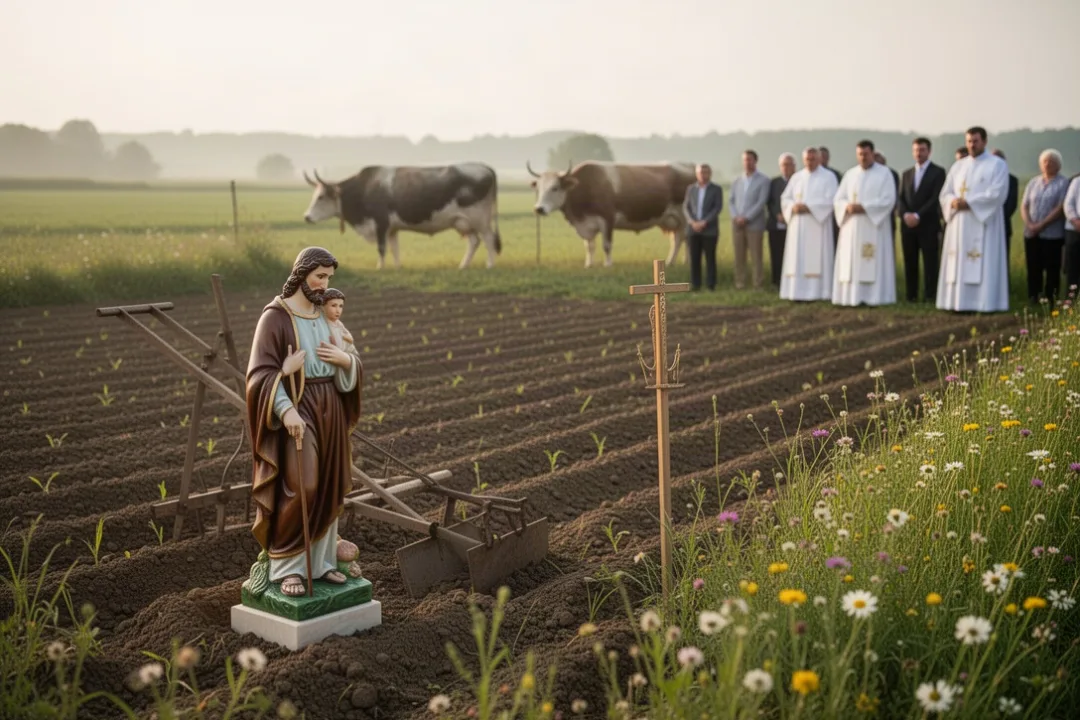
Ask a priest to bless fields, gardens, tools, livestock, or farm equipment.
Carry an image or statue of the saint in a local procession.
Pray for rain, protection from destructive weather, and a safe harvest.
Share a meal with farmworkers, neighbors, or families facing hardship.
Donate food, seeds, money, or practical supplies to a food pantry or rural ministry.
Teach children about farming, gratitude for food, and care for creation.
A celebration does not need to be elaborate. A household with a garden could mark the day by praying before planting, thanking the people who grow and transport food, and sharing part of the garden’s produce. A farm family could invite workers to a meal or set aside time to pray for everyone whose livelihood depends on the season.
How to pray with St. Isidore the Farmer
There is no single prayer that every Catholic must use when asking for St. Isidore’s intercession. You can speak plainly about a specific need, use a parish prayer service, or pray a traditional novena. The prayer should direct worship to God while asking the saint to pray with and for you.
A simple prayer can follow this pattern:
Address God: Thank God for the land, food, work, and people who make a harvest possible.
Name the need: Mention drought, storms, debt, illness, equipment problems, family conflict, or another concern.
Ask for intercession: Ask St. Isidore to pray for your household, workers, animals, crops, or community.
Commit to a virtue: Offer to practice patience, generosity, careful stewardship, or service.
End with trust: Place the outcome in God’s care while continuing the practical work required.
For example, you might pray: “God of creation, receive our gratitude for the land and for those who work it. Through the prayers of St. Isidore, protect this farm, strengthen all who labor here, and help us use its gifts with justice and care.” You can add the names of particular people, animals, fields, or concerns.
People sometimes ask St. Isidore to intercede for rain and favorable weather, but prayer is not a guarantee that every season will produce the desired result. Prayer can also ask for wisdom in making decisions, courage during loss, solidarity among neighbors, and help for families affected by poor conditions.
St. Isidore’s connection with animals and the land
Art frequently shows St. Isidore with oxen because plowing animals are central to the traditional story of his life. The image emphasizes cooperation between the worker, the animals, the soil, and God’s providence. It also reflects the reality that medieval farming depended heavily on animal power.
His patronage can therefore include prayers for livestock, working animals, pets, crops, gardens, and natural resources. A blessing of animals or fields should not replace veterinary care, sound farm management, or environmental responsibility. Religious devotion and practical stewardship can support one another.
Respect for the land is a natural part of this devotion. Soil needs care, water should be used responsibly, animals deserve humane treatment, and workers deserve safe conditions and fair treatment. Asking St. Isidore’s help can prompt a community to consider whether its farming practices protect both creation and the people who depend on it.
The biblical account of creation in Genesis presents the earth as a gift entrusted to human care. Psalm 65 celebrates God’s provision for the land, while Deuteronomy 24 includes protections for the poor during harvest. These references provide a broader framework for understanding why a farming saint is associated not only with productivity, but also with gratitude and justice.
What St. Isidore teaches about poverty and generosity
Isidore’s traditional biography presents him as poor in material wealth but rich in generosity. He is remembered as someone who shared food and did not measure kindness only by what was convenient. That emphasis is especially meaningful in agricultural communities, where the value of a harvest affects workers, families, animals, customers, and neighbors.
His example invites practical questions. Are seasonal workers treated with dignity? Do vulnerable neighbors have access to food? Are surplus crops shared rather than wasted? Can a parish support a food pantry, community garden, or farmworker assistance program?
Generosity does not have to mean giving away what a family needs to survive. It can mean offering time, knowledge, a meal, transportation, equipment, or a small portion of a harvest. The important point is to see food and land as responsibilities as well as possessions.
A practical observance: On May 15, choose one concrete act connected with St. Isidore’s values—share food, help a farmworker, support a local producer, care for an animal, or pray for a struggling agricultural family.
St. Isidore and María de la Cabeza
Devotion to St. Isidore is often linked with his wife, María de la Cabeza. Traditional accounts describe her as a woman of prayer who lived near Madrid and served others. She is particularly associated with a chapel and a hermitage near the Jarama River, although local traditions about her life vary.
Her presence in the story matters because holiness is not portrayed as a solitary achievement. Farming households depend on shared labor, and marriage brings its own responsibilities of patience, fidelity, care, and sacrifice. Remembering María alongside Isidore broadens the focus from one worker to a household shaped by mutual service.
When praying for a farm family, you can ask for the intercession of both spouses as a way of recognizing the many forms of work that sustain rural life. Child care, cooking, household management, animal care, bookkeeping, transportation, and emotional support may be less visible than fieldwork but remain essential.
How St. Isidore became a widely honored saint
Local devotion to Isidore developed over many generations in Madrid and beyond. His connection with the city, working people, and agriculture made him a natural focus for prayers during planting and harvest seasons. As communities carried his devotion to new places, his feast acquired local customs and regional expressions.
Pope Gregory XV canonized St. Isidore in 1622, during a period when several important Catholic figures were formally declared saints. His canonization helped establish the wider recognition of a man whose holiness was associated not with scholarship or political influence, but with ordinary work and daily fidelity.
Church recognition does not mean every detail in a popular story has the same historical certainty. The broad devotional picture is clear: Isidore was a Christian agricultural worker from the Madrid region whose reputation for prayer and charity endured. The colorful stories surrounding him should be understood within that tradition.
How to display or identify St. Isidore in religious art
Images of St. Isidore often make his identity easy to recognize. He may wear a simple farmer’s outfit and hold a staff, sickle, or plow. Oxen frequently appear nearby, sometimes with an angel or other heavenly figure. Wheat, grain, a field, or a water source may also be included.
Some statues show him beside María de la Cabeza. In Spanish churches, he may appear in a procession surrounded by flowers, agricultural tools, or offerings from local growers. The artistic details vary, but the message remains consistent: God’s grace can be represented through the ordinary material world of work and food.
If you are choosing an image for a home, parish, farm office, or garden, select one that helps people remember the values associated with him. A small statue near a garden can prompt prayer, while a picture in a kitchen can encourage gratitude for growers and farmworkers.
What St. Isidore can mean for people who are not farmers
You do not need to own farmland to learn from St. Isidore. Everyone depends on agriculture, even when food arrives through a supermarket or restaurant. His feast can become an opportunity to recognize the labor behind bread, produce, meat, dairy products, coffee, and other foods.
His example also speaks to people in construction, maintenance, delivery, caregiving, manufacturing, hospitality, and other forms of practical work. He represents workers who may not receive public recognition but whose effort keeps families and communities functioning.
For students and office workers, the connection may be less direct but still meaningful. St. Isidore’s life suggests that prayer is not reserved for a church building or a quiet retreat. It can accompany preparation, repetition, decision-making, service, and the way you treat people while completing ordinary responsibilities.
Ways to honor St. Isidore throughout the year
May 15 is the principal feast day, but his values can shape habits in every season. Consider choosing practices that connect faith with food, labor, and responsible care:
Buy from local farms when possible and learn how the food was produced.
Thank farmworkers and food-service workers directly and respectfully.
Reduce food waste by planning meals and sharing safe surplus food.
Volunteer with a food pantry, community garden, or rural outreach program.
Pray before planting, during difficult weather, and after a harvest.
Support policies and organizations that promote safe working conditions and fair treatment.
Teach children that food comes from living systems and human labor, not simply from store shelves.
Set aside regular time for rest so that work remains ordered toward human well-being.
These practices express the heart of devotion more clearly than decorative customs alone. A field blessing is meaningful when it is joined to care for the people who work the field. A prayer for a harvest is stronger when it leads to gratitude, restraint, and generosity when food is abundant.
Why St. Isidore remains relevant to rural communities
Agricultural life has changed greatly since medieval Madrid, but its basic uncertainties remain. Farmers still depend on weather, soil, animals, labor, markets, and careful timing. Many rural families also face isolation, financial pressure, equipment costs, changing regulations, and the strain of passing a farm to the next generation.
St. Isidore gives these concerns a spiritual language. He stands for faithful labor without self-importance, prayer that remains connected to practical duties, and generosity that recognizes the needs of neighbors. He also reminds communities that food production is a shared responsibility, not merely a private business concern.
Honoring him does not require pretending that hardship is easy or that every loss has an obvious explanation. It allows people to bring real concerns—failed crops, illness, debt, conflict, grief, and uncertainty—into prayer while continuing to seek wise and practical help.
For that reason, St. Isidore the Farmer is more than a figure from a farming legend. He is a patron of people who work with their hands, depend on the land, and try to serve others through ordinary responsibilities. His feast on May 15 offers a clear invitation: give thanks for food, respect labor, care for creation, and place daily work in God’s hands.
Frequently asked questions
What is St. Isidore the Farmer the patron saint of?
St. Isidore is chiefly the patron saint of farmers, farmworkers, agricultural communities, and rural laborers. People also ask for his intercession for gardens, crops, livestock, working animals, favorable weather, and the needs of farming families. His patronage extends more broadly to anyone seeking to unite honest work with prayer, generosity, humility, and responsible care for the land.
When is the feast day of St. Isidore the Farmer?
The feast day of St. Isidore the Farmer is May 15. Parishes may celebrate it with Mass, a procession, field or animal blessings, traditional foods, and prayers for farmers and the growing season. Local observances can take place on the nearest weekend or another convenient date, especially where agricultural calendars differ.
Is St. Isidore the Farmer the same as St. Isidore of Seville?
No. They are different saints. St. Isidore the Farmer was a medieval agricultural worker associated with Madrid and is honored as a patron of farmers. St. Isidore of Seville was a bishop and scholar from an earlier period, known particularly for his writings and learning. Their shared first name sometimes causes confusion.
What can I pray to St. Isidore the Farmer for?
You can ask St. Isidore to pray for crops, livestock, gardens, farm equipment, workers, families, and communities affected by difficult weather or financial pressure. You may also seek help with patience, generosity, faithful work, and wise decisions. Catholic prayer treats the saint as an intercessor, while worship and ultimate trust belong to God.
















Leave a Reply