The Annunciation of the Lord is the Christian event in which the angel Gabriel announces to Mary that she will become the mother of Jesus, the Son of God. Mary accepts this calling, and Christians understand her conception of Jesus as the beginning of the Incarnation, when God takes human nature in Christ.
The account appears in Luke 1:26-38. The feast is usually celebrated on March 25, nine months before Christmas. Its focus is not only on an angelic message, but also on Mary’s faith, her freedom to respond, and God’s entrance into human history.
According to Luke, God sends the angel Gabriel to Nazareth in Galilee, a town where Mary lives. She is a young woman who is engaged to Joseph, a descendant of David. Gabriel greets her as one who has received God’s favor and tells her that she will conceive and give birth to a son.
Gabriel identifies the child as Jesus and gives him titles associated with Israel’s expected Messiah. He says that Jesus will be called the Son of the Most High and will receive the throne of David. For Christians, these details connect Jesus with the promises made to Israel and establish his unique relationship with God.
Mary asks how this can happen because she has not been with a man. Gabriel explains that the Holy Spirit will come upon her and that the power of the Most High will overshadow her. The child will therefore be holy and called the Son of God.
Mary then responds with humility and consent. Luke presents her as the servant of the Lord who accepts God’s word. Her response is often called her fiat, a Latin word meaning “let it be done.” It expresses her willingness to participate in God’s purpose, even though she cannot see everything that lies ahead.
The central answer: The Annunciation is the announcement of Jesus’ conception and the moment when Mary freely accepts her role in God’s plan. Christians see it as the beginning of the Incarnation.
The passage ends by showing that nothing is impossible for God and by recording Mary’s acceptance. Luke then moves to the story of Mary visiting Elizabeth, who recognizes the importance of Mary’s unborn child. These connected scenes show that the Annunciation is not an isolated event; it begins the series of events leading to Jesus’ birth.
Why the Annunciation is central to Christian belief
The Annunciation matters because it points to the Incarnation. Christian teaching holds that Jesus is truly divine and truly human. He is not merely a prophet receiving a message from God, nor is he simply a remarkable teacher. In the Annunciation, the eternal Son begins his human life in Mary’s womb.
This belief gives the event a significance that reaches beyond Mary’s personal experience. God does not remain distant from human suffering, work, family life, physical weakness, and death. In Jesus, God enters the conditions of human existence in a real and personal way. The Annunciation therefore stands at the beginning of the Christian story of salvation.
The event also fulfills biblical hopes connected with the house of David. Gabriel’s message recalls God’s promises concerning a future king whose reign would endure. Christians read the Annunciation alongside passages such as Isaiah 7:14 and 2 Samuel 7, while recognizing that different Christian traditions interpret those texts in somewhat different ways.
Mary’s role is equally important. She is not presented as a passive object in the story. She listens, asks a question, receives an explanation, and then gives her consent. Her response demonstrates faith seeking understanding: she does not pretend to know every detail, but she trusts God enough to accept a demanding vocation.
Many Christians call Mary the Mother of God, especially in Catholic, Eastern Orthodox, and Oriental Orthodox tradition. This title does not mean that Mary existed before God or caused Jesus’ divinity. It means that the child she bore is one person, Jesus Christ, who is both fully human and fully divine. The title protects Christian teaching about who Jesus is.
Mary is also sometimes called the new Eve. In this comparison, Eve’s disobedience in Genesis is set against Mary’s faithful response to God. The comparison does not erase Mary’s humanity or suggest that she accomplished salvation independently. Rather, it highlights the importance of her obedient cooperation with God’s grace.
Jesus’ identity: The message reveals that Jesus is the Son of God and the promised Messiah.
God’s nearness: The Incarnation shows God entering human life rather than remaining remote from it.
Mary’s faith: Her consent shows that trust can involve courage, questions, and costly commitment.
Human cooperation: The story presents God’s work alongside Mary’s free and personal response.
The Annunciation also has an important connection with human dignity. Since the Son of God takes human flesh, Christian theology treats embodied human life as profoundly valuable. The event is therefore often discussed in relation to the sanctity of life, the dignity of motherhood, and the responsibilities of caring for vulnerable people.
How Luke’s account portrays Mary and Gabriel
Gabriel’s role is that of a messenger. In the Bible, angels serve God and deliver messages, but they do not replace God. Gabriel does not demand worship for himself. He directs attention to what God is doing and explains the child’s identity and conception.
Mary’s first reaction is troubled uncertainty. Luke says that she is deeply affected by Gabriel’s greeting and considers what it means. This detail makes the scene more human. Mary is not portrayed as careless or instantly comfortable with a life-changing announcement. She takes the message seriously.
Her question is also different from disbelief. Earlier in Luke’s Gospel, Zechariah questions Gabriel’s announcement that his wife Elizabeth will have a child in old age. Mary asks about the manner of the conception, while remaining open to God’s word. The text presents her question as part of a faithful search for understanding.
Gabriel’s explanation includes the news that Elizabeth, Mary’s relative, is also expecting a child despite her advanced age. This gives Mary a concrete sign of God’s power and connects her story with the birth of John the Baptist. Gabriel’s statement that nothing is impossible with God points to divine action rather than human ability.
Mary’s final response is brief but powerful. She identifies herself as the Lord’s servant and accepts what has been announced. Christian prayer often returns to this response because it expresses trust without control. Mary does not receive a complete schedule, guarantee, or explanation of every consequence. She receives a calling and entrusts herself to God.
The Annunciation does not mean that Mary’s later life will be easy. The Gospels show her facing uncertainty, giving birth away from home, fleeing danger with Joseph and Jesus, and witnessing Jesus’ suffering. Her “yes” is therefore not a single emotional moment detached from daily life. It becomes a continuing pattern of faithfulness.
What Mary’s response can mean for believers
Christians often reflect on Mary’s response as an example of active obedience. Obedience here does not mean abandoning reason or accepting every human demand without question. Mary asks, listens, discerns, and then responds to God. Her example encourages believers to bring honest questions into prayer rather than treating uncertainty as a failure of faith.
Her response can also be understood through the idea of vocation. A vocation is a calling that shapes how a person serves God and other people. Mary’s vocation is unique, but the pattern of attentive listening and faithful action can apply to ordinary responsibilities such as caring for family, serving a congregation, helping a neighbor, or pursuing work that benefits others.
At the same time, Mary’s story should not be used to pressure people into accepting abuse, coercion, or unjust treatment. The Annunciation concerns a response to God, not a command to tolerate harm from another person. Faithful discernment includes seeking wise counsel, recognizing boundaries, and acting with truth and dignity.
The Feast of the Annunciation is traditionally observed on March 25. The date falls nine months before December 25, the day many Christians celebrate Jesus’ birth. This calendar relationship reflects the connection between Jesus’ conception and his birth.
March 25 can sometimes be transferred to another day. In the Roman Catholic calendar, the feast is moved when it conflicts with a more important celebration, especially during Holy Week or the Easter octave. Exact observance can vary according to the church calendar and local practice.
The feast is especially prominent in Catholic and Eastern Orthodox Christianity, although Christians from many traditions study and honor the biblical event. Churches may mark the day with a special service, Scripture readings, hymns, prayers, or teaching about the Incarnation.
The date has also been associated in Christian tradition with the beginning of creation and with the death of certain biblical figures. Those associations helped give March 25 symbolic importance in some historical calendars, but the most direct reason for the feast is its relationship to Jesus’ conception and Christmas.
In the Roman Catholic tradition, the Annunciation is a solemnity, a high-ranking celebration in the liturgical year. It may include the recitation or singing of the Angelus, a prayer traditionally associated with the angel’s message to Mary. The event is also remembered in the Joyful Mysteries of the Rosary.
Read or listen to Luke 1:26-38 slowly.
Consider what Gabriel’s message says about Jesus’ identity.
Reflect on Mary’s question and her eventual consent.
Pray for the grace to recognize and answer God’s call faithfully.
Look for a practical way to serve another person that day.
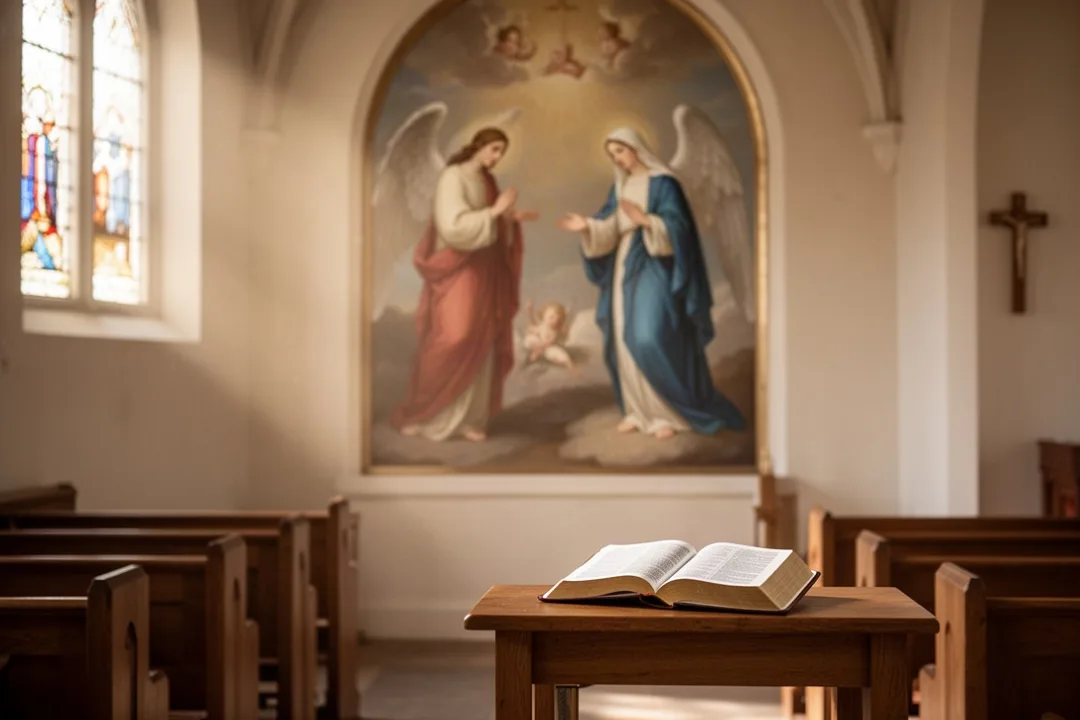
Some churches and households display an image of Gabriel approaching Mary, while others use icons or stained-glass art. These visual traditions help worshipers remember that the feast is about more than a scene from the past. It celebrates God’s action in Christ and invites a response of faith in the present.
How the Annunciation appears in prayer and Christian art
The Annunciation has inspired centuries of Christian art, architecture, music, and prayer. Artists commonly show Mary reading Scripture, seated or standing in a simple room, while Gabriel approaches from one side. A lily may symbolize purity, and a dove may represent the Holy Spirit, although details vary across cultures and periods.
Many images include an open book or scroll to suggest Mary’s knowledge of Israel’s Scriptures. Others show a ray of light directed toward Mary, symbolizing divine action. These elements are artistic interpretations rather than details specifically listed in Luke’s account.
In Catholic devotion, the Annunciation is remembered in the Hail Mary, which draws its opening words from Gabriel’s greeting and Elizabeth’s later greeting to Mary in Luke 1. The prayer then asks Mary to pray for believers. The Angelus also recalls the angel’s announcement, Mary’s consent, and the Word becoming flesh.
Eastern Christian iconography often places the Annunciation in a prominent position because it marks the beginning of the Incarnation. Icons may use symbolic perspective, color, and posture to communicate theological meaning rather than aiming for a naturalistic scene. Mary may hold thread or sit near a temple-like setting, reflecting traditional interpretations and symbolism.
These traditions differ in style and emphasis, but they share several themes:
Listening: Mary is shown receiving a message rather than seeking attention for herself.
Presence: Gabriel represents God’s message entering an ordinary human setting.
Embodiment: The scene points toward the Word becoming flesh in Jesus.
Consent: Mary’s posture and expression often communicate acceptance and humility.
When you look at an Annunciation image, it can help to distinguish between what the Bible says and what the artist adds to express meaning. The Gospel gives the message, Mary’s question, Gabriel’s explanation, and Mary’s consent. Architecture, flowers, books, colors, and gestures often come from later devotional and artistic traditions.
What the Annunciation can mean in daily Christian life
The Annunciation invites Christians to reflect on how God may work through ordinary places and people. Nazareth is not presented as a center of political power, and Mary is not introduced as someone seeking public influence. The story begins in a home and with a conversation, showing that sacred purpose can appear in quiet circumstances.
It also teaches that faith does not require pretending to have no questions. Mary asks how the promise will be fulfilled. A mature response to God can include honest uncertainty, careful listening, and a willingness to act once a path becomes clear.
The event encourages patience with gradual understanding. Mary receives the announcement before she knows how Joseph, her family, or the wider community will respond. The Gospel does not describe her possessing complete knowledge of Jesus’ future. She moves forward with the light she has been given.
A practical reflection: Read Luke 1:26-38, name one question or responsibility you are carrying, and ask for wisdom to respond with truth, courage, and compassion rather than fear.
The Annunciation can also shape how Christians view service. Mary’s consent leads not to self-promotion but to a life of care: carrying Jesus, giving birth, protecting him, and remaining connected to his mission. Christian service often looks similarly ordinary, involving repeated acts of attention that other people may never see.
For Catholics, the feast offers a natural time to pray the Angelus or one decade of the Rosary and to meditate on the mystery of the Incarnation. For Christians who do not use these devotions, reading the Gospel passage, attending worship, or spending a few quiet minutes in prayer can serve the same purpose of remembering the event.
The Annunciation ultimately directs attention to Jesus Christ. Mary’s importance in the story is inseparable from the child she receives. The feast celebrates her faith, but its central claim is that God has acted to bring salvation into the world through the Son who becomes human.
Frequently asked questions
Is the Annunciation the same as Jesus’ birth?
No. The Annunciation is the announcement and conception of Jesus, described in Luke 1:26-38. Jesus’ birth is celebrated at Christmas and described in passages including Luke 2:1-20 and Matthew 1:18-25. The Annunciation is traditionally observed on March 25, exactly nine months before December 25.
Why is the Annunciation celebrated on March 25?
March 25 is nine months before the traditional date of Christmas. The calendar places Jesus’ conception and birth in direct relationship, emphasizing that the Incarnation begins with his conception in Mary’s womb, not only with his birth in Bethlehem.
What does Mary’s “yes” mean in the Annunciation?
Mary’s response means that she accepts God’s call to become the mother of Jesus. It is commonly called her fiat, from the Latin for “let it be done.” Her answer is understood as a free act of faith and trust, not as proof that she already understood every consequence of the calling.
Do all Christians celebrate the Feast of the Annunciation?
Christians widely recognize the biblical account, but churches differ in how prominently they celebrate it. Catholic and Eastern Orthodox churches give the feast a formal place in their liturgical calendars. Other Christian communities may observe it through preaching, Scripture reading, prayer, or Christmas-related teaching without using the same liturgical title.














Leave a Reply