John 9:1-41 shows that Jesus gives more than physical sight: he reveals the truth about himself while exposing the blindness of proud religious judgment.
As Jesus and his disciples pass by, they see a man who has been blind since birth. The disciples ask whether his blindness resulted from his own sin or his parents’ sin. Their question reflects a common assumption that severe suffering must be a direct punishment for a particular wrongdoing.
Jesus rejects that explanation. He does not treat the man’s condition as evidence of personal guilt, nor does he identify the parents as responsible. Instead, he directs attention toward the work of God that will be displayed through the situation. His answer does not explain every cause of suffering, but it refuses to reduce a suffering person to a moral lesson.
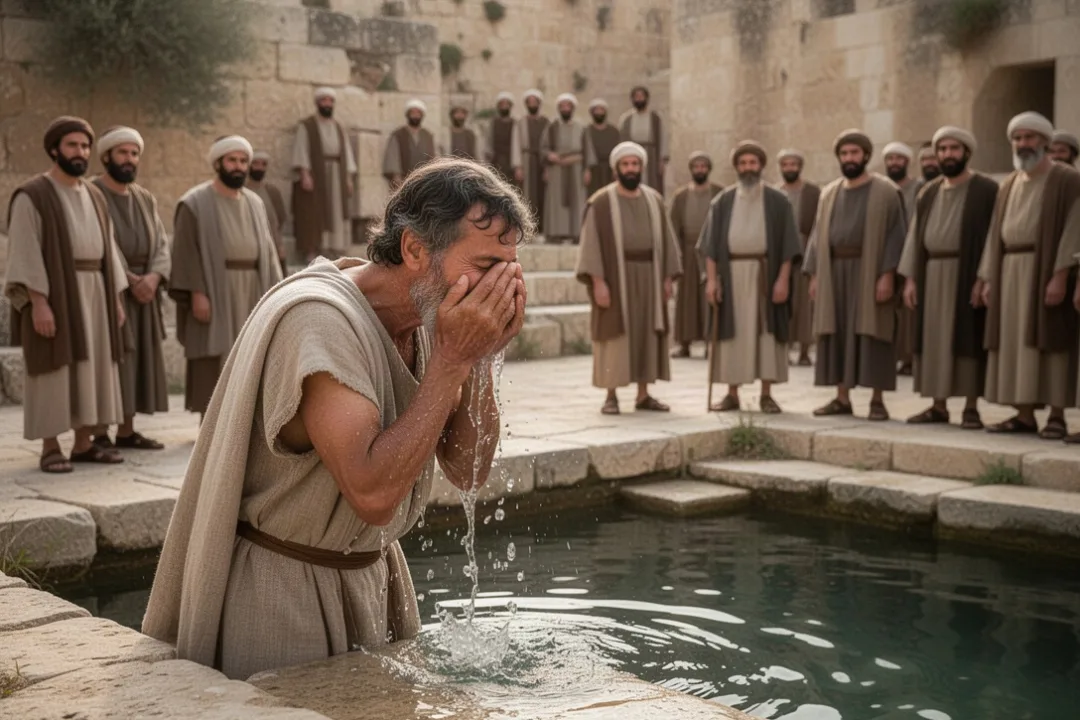
Jesus then makes mud with saliva, applies it to the man’s eyes, and tells him to wash in the Pool of Siloam. The man obeys and returns able to see. John presents the healing as an unmistakable act of Jesus, but the event quickly becomes controversial because it happens on the Sabbath.
The neighbors are uncertain about the healed man’s identity. Some recognize him as the person who used to sit and beg, while others think he only resembles that person. The man settles the question by identifying himself and explaining what Jesus did. At this stage, his understanding is limited but clear: he was blind, Jesus acted, and now he can see.
The neighbors bring him to the Pharisees, who question him about the healing. The man repeats the basic facts. The religious leaders are divided because some regard Jesus as a sinner for breaking their understanding of Sabbath regulations, while others ask how a sinful man could perform such signs.
The investigation continues with the man’s parents. They confirm that he is their son and that he was born blind, but they avoid explaining how he received his sight. John says they are afraid of being expelled from the synagogue because the authorities have threatened to exclude anyone who acknowledges Jesus as the Messiah.
The healed man is questioned again. He becomes increasingly direct, pointing out the obvious contradiction: the leaders want to know where Jesus came from, yet Jesus has opened his eyes. When they insult him and cast him out, Jesus finds him and leads him toward a fuller understanding of who he is.
The man responds with faith and worship. Jesus then speaks about judgment, explaining that his coming brings sight to those who recognize their need and exposes the blindness of those who insist they already see. The Pharisees ask whether they are blind, and Jesus answers that their guilt remains because they claim to see while refusing the truth placed before them.
The central movement of the passage: the man’s physical sight is restored immediately, but his spiritual understanding develops through questioning, opposition, and a personal encounter with Jesus.
Why Jesus rejects the assumption that suffering always reveals personal sin
The disciples’ question in John 9:2 is understandable within the religious ideas of their time, but it is also deeply personal. They see a disabled man and begin by asking whose fault it is. The man himself is not initially treated as a person with a story, dignity, and hope. He becomes the subject of a theological debate.
Jesus changes the direction of the conversation. He does not answer by assigning blame. His response makes clear that the man’s blindness should not be used as proof that he or his parents committed a particular sin. This principle matters whenever people are tempted to explain another person’s hardship too quickly.
John 9 does not claim that sin never causes harm or that all suffering is unrelated to human choices. Scripture addresses moral responsibility in many places. The specific point here is narrower and essential: a person’s disability is not reliable evidence of personal guilt, and suffering should not be used to condemn someone whose circumstances we do not understand.
Jesus’ answer also protects the man from being defined by his condition. He is not merely “the blind man” in the sense of a label that erases his identity. He is a human being whom Jesus sees, addresses, and heals. The miracle restores his ability to participate more fully in ordinary community life, but his worth did not begin when his sight returned.
When Jesus speaks of God’s works being revealed, he is not suggesting that God created the man blind simply to produce a dramatic scene. The passage emphasizes what God is doing in the present moment. Jesus sees an opportunity to bring healing and to reveal his identity through that healing.
The language about working while it is day also gives the scene urgency. Jesus’ ministry has a limited period of public activity, and he acts decisively. The image of light fits the miracle: the man receives sight, and Jesus identifies himself as the light of the world. In John’s Gospel, light represents revelation, life, and truth that overcome darkness.
Do not assume guilt merely from a person’s illness, disability, poverty, or hardship.
Ask what compassionate action is possible instead of turning someone’s suffering into speculation.
See the person before the problem, as Jesus does in this encounter.
Allow mystery to remain when Scripture does not provide a complete explanation for suffering.
How the healing at Siloam reveals Jesus’ identity
Jesus’ method is unusual. He makes mud, places it on the man’s eyes, and tells him to wash at Siloam. The healing does not depend on a technique that others can reproduce. The action points to Jesus’ authority and to the man’s willingness to obey a command whose outcome he cannot yet see.
The Pool of Siloam is connected with the meaning “sent,” a detail John specifically highlights. The man is sent by Jesus to wash, and Jesus himself has been sent by the Father. That pattern links the man’s obedient movement to the larger mission of Christ. The healed man goes where Jesus directs him and returns with sight.
The miracle also recalls the creation imagery found earlier in the Gospel. John begins with the Word through whom all things came to be, and Jesus’ actions in chapter 9 resemble a creative act. He does not merely diagnose or encourage the man; he gives what the man has never possessed. The healing therefore functions as a sign, not only as an act of compassion.
John’s Gospel uses signs to reveal who Jesus is. The physical result is visible and verifiable, but the deeper meaning is spiritual. Jesus is not only a healer among other healers. He is the one who brings divine light into a world characterized by darkness and confusion.
Jesus also performs the healing on the Sabbath, which becomes the source of conflict. The leaders focus on the apparent violation of their Sabbath rules, especially because making mud could be classified as work under their interpretations. The controversy exposes a difference in priorities. Jesus sees a person restored; his opponents see a disputed procedure.
The Sabbath itself was intended as a gift and a sign of God’s covenant care, not as a reason to prevent mercy. Jesus’ action challenges interpretations that protect regulations while ignoring human restoration. The dispute is not simply about whether rules matter. It asks whether religious obedience can be separated from compassion and from recognition of God’s work.
“I was blind, and now I see” summarizes the man’s testimony without requiring him to explain every mystery about Jesus.
That testimony is powerful because it is modest and concrete. The man does not begin with a complete theological system. He reports what happened to him. His physical healing gives him a firm starting point, and his understanding grows as the authorities press him with questions.
How the healed man grows in courage and understanding
The man’s responses form one of the clearest progressions in John 9. At first, he calls Jesus simply “the man” who healed him. When asked where Jesus is, he says he does not know. His knowledge is real, but incomplete.
As the interrogation continues, he identifies Jesus as a prophet. This is a significant step because a prophet is a person through whom God speaks and acts. The man is beginning to understand that the healing cannot be explained as an ordinary event, even though he has not yet openly confessed Jesus as the Messiah or Son of God.
His courage becomes more visible when he challenges the leaders’ assumptions. They have already decided that Jesus is a sinner, but the healed man notices that their conclusion does not fit the evidence. He asks how a sinner could perform such a sign. His question is not a polished argument, but it exposes the weakness of their position.
The man’s reasoning becomes almost sharp enough to irritate his interrogators. He asks whether they want to become Jesus’ disciples, and they respond with insults. Their reaction reveals that the conflict is no longer a neutral investigation. They are defending their authority and inherited certainty against a witness they cannot easily dismiss.
The man then makes a simple theological observation: God does not ordinarily answer the requests of people who reject him, yet God has acted through Jesus in an extraordinary way. He also points out that no one has ever heard of someone born blind receiving sight. His conclusion is that Jesus must have come from God.
This conclusion costs him something. The leaders expel him from the synagogue, an act that means exclusion from a central place of worship and community belonging. The man’s faith is therefore not presented as an easy private decision. His testimony places him in conflict with people who possess social and religious power.
Jesus seeks him after hearing that he has been cast out. This detail is easy to overlook, but it reveals Jesus’ pastoral care. The man is not abandoned after the miracle or left alone to face the consequences of speaking honestly. Jesus finds him, clarifies the object of his faith, and leads him into a deeper confession.
When Jesus identifies himself as the Son of Man, the man asks to know who he is so that he can believe. Jesus explains that he is the one speaking with him. The man responds in worship. His journey has moved from knowing only the healer’s action to recognizing the healer’s identity.
A practical pattern of faith: the man speaks truthfully about what he knows, refuses to deny what happened, remains open to further understanding, and responds to Jesus when Jesus reveals himself more fully.
What spiritual blindness means in John 9
The sharpest irony in the passage is that the man who was physically blind gradually comes to see who Jesus is, while the religious leaders who possess education, status, and confidence refuse to recognize him. John uses this contrast to describe spiritual blindness: not a lack of information, but a refusal to receive truth when it challenges pride or control.
Jesus does not condemn honest uncertainty. The healed man begins with limited understanding, asks questions, and learns. His movement toward faith is welcomed. The problem is not that he does not know everything at first. The problem among the leaders is that they claim certainty while resisting the evidence before them.
After the leaders ask whether they are blind, Jesus says that their responsibility remains because they claim to see. Their guilt is connected to their posture. If they recognized their need and admitted uncertainty, they could receive light. By insisting that they already possess the correct judgment, they close themselves to correction.
This warning applies beyond the specific controversy in John 9. Religious knowledge can become a barrier when it produces contempt for people, unwillingness to listen, or confidence that leaves no room for God to act in unexpected ways. A person may know religious language and still fail to recognize mercy, truth, and the work of Christ.
The passage also challenges simplistic ideas about who is spiritually strong. The healed man has no formal authority and no advanced training. Yet he possesses honesty, courage, and receptiveness. The leaders have institutional influence, but their certainty makes them unable to celebrate a clear act of restoration.
John does not suggest that every disagreement proves spiritual blindness. The issue is whether a person’s judgment is shaped by humility and truth or by fear and self-protection. The man is willing to revise his understanding as he encounters Jesus. The leaders are unwilling to revise theirs, even when their explanation cannot account for the miracle.
Physical sight and spiritual sight are related but not identical. A person can see outwardly and still resist truth.
Spiritual understanding often develops over time. The healed man’s first statement is not his final confession.
Humility keeps faith responsive. Admitting what you do not know can be part of genuine belief.
Pride can turn evidence into an inconvenience. The leaders protect their conclusions instead of examining them.
How John 9:1-41 speaks to faith, suffering, and community
The passage offers comfort to people who have been blamed for their suffering. Jesus does not begin by asking what the man did wrong. He sees him as someone worthy of attention and healing. That response provides a model for pastoral care, medical compassion, and ordinary human relationships.
It also gives a realistic picture of what can happen after a life-changing encounter. The man receives healing, but the community does not immediately celebrate with him. His neighbors question his identity, the religious authorities interrogate him, and his parents distance themselves out of fear. Restoration can expose social tensions rather than removing them at once.
The parents’ fear is especially sobering. They know that their son has been healed, but they do not feel free to speak openly about it. Their silence does not necessarily mean they reject Jesus; it shows the pressure created by threatened exclusion. John includes this detail to show how fear can shape public testimony.
The healed man responds differently. He cannot control the authorities’ reaction, but he can tell the truth about what happened. His example does not require every believer to speak in the same way or face the same danger. It does show the value of honest testimony that does not exaggerate, conceal, or pretend to know more than it does.
For Christian readers, the story also points to Jesus’ care for people who become isolated because of their association with him. Jesus seeks the man after his expulsion. The church is called to reflect that care by welcoming people whose testimony, background, disability, or social position might make them vulnerable to rejection.
John 9 further warns against using religion to preserve status at the expense of mercy. The leaders’ concern with Sabbath boundaries becomes destructive because it prevents them from rejoicing in restoration. Faithfulness to God cannot be measured only by visible rule-keeping. It must include a willingness to recognize God’s work and treat people with dignity.
The chapter can shape personal reflection through questions such as these:
Do I assume that another person’s hardship must have a simple moral explanation?
Am I more concerned with defending my interpretation than with recognizing mercy?
Can I state honestly what I know without pretending to understand everything?
Where might fear of rejection be limiting my willingness to speak truthfully?
Am I becoming more receptive to Jesus as I learn, or more resistant when my assumptions are challenged?
The final exchange leaves the reader with a choice. Jesus brings light, but light can be welcomed or resisted. John 9:1-41 asks you to look beyond the visible miracle and consider whether you are willing to recognize Jesus, receive his correction, and worship him with the humility of someone who knows that true sight is a gift.
Frequently asked questions
Why did Jesus heal the man on the Sabbath?
The Sabbath setting highlights the conflict between Jesus’ life-giving mission and restrictive interpretations of religious law. The healing demonstrates that compassion and restoration belong at the heart of faithful obedience. John uses the dispute to show that Jesus has authority to reveal God’s purposes, even when religious leaders accuse him of wrongdoing.
Does John 9 teach that all disability comes from God’s purpose?
No. Jesus specifically rejects the assumption that the man’s blindness proves personal or parental sin. The passage focuses on what God does through this encounter, not on assigning a universal explanation for disability. It supports compassion, dignity, and humility rather than speculation about why a particular person suffers.
What does the Pool of Siloam represent?
Siloam is associated with the idea of being sent, and the man is sent there by Jesus to wash. John may also be connecting this detail with Jesus’ own mission from the Father. The pool is the place where the man obeys Jesus’ command, but the healing’s source is Jesus rather than the water itself.
Why were the man’s parents afraid to answer the religious leaders?
They feared exclusion from the synagogue, which represented a serious loss of religious and social community. They confirm their son’s identity and lifelong blindness but avoid discussing the healing’s cause. Their response illustrates how institutional pressure can make people cautious even when they know important facts.












Leave a Reply