The woman at the well: Meaning and lessons from John 4
The woman at the well: Meaning and lessons from John 4
The woman at the well is the Samaritan woman Jesus meets near the town of Sychar in John 4. Their conversation begins with a request for water and develops into a discussion about living water, worship, the Messiah, and personal transformation.
Jesus treats her with unusual dignity for the culture and setting of the time. After speaking openly with him, she leaves her water jar, tells people in her town about Jesus, and many Samaritans begin to believe because of her testimony. The passage is not simply about a woman with a complicated past; it is about how Jesus crosses religious, ethnic, gender, and social boundaries to offer life and truth.
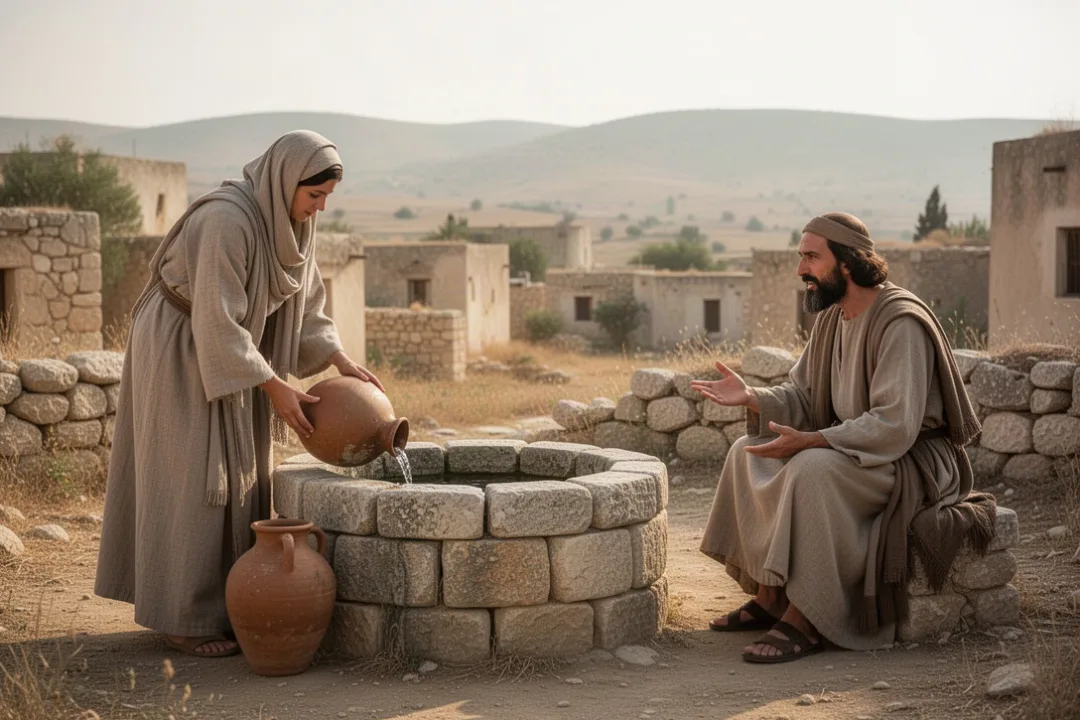
The story is recorded in John 4:1–42. Jesus is traveling from Judea toward Galilee and passes through Samaria. He stops near a Samaritan town called Sychar, close to land associated with Jacob, and sits beside Jacob’s well while his disciples go into town to buy food.
A Samaritan woman arrives to draw water. Jesus asks her for a drink, which surprises her because Jews and Samaritans had a long history of religious and social conflict. John explains the tension directly: Jews and Samaritans generally did not share ordinary social relationships, and Jesus’ request challenges the assumptions surrounding both groups.
The woman is not identified by name in the Gospel of John. Later Christian tradition gives her names, including Photina, but those names are not part of the biblical account. The text focuses instead on her encounter with Jesus and on the way her response affects the wider community.
Keep the setting in view: The account does not say that the woman came to the well at noon to avoid everyone because of shame. John mentions that she came around the sixth hour, commonly understood as about noon, but the reason for that timing is not explained.
Why the conversation at the well was socially significant
The meeting crosses several boundaries at once. Jesus is a Jewish man speaking publicly with a Samaritan woman, and the conversation becomes personal and theological. Each part of that exchange would have carried social weight for the original audience.
Jewish and Samaritan divisions: The two communities shared some elements of Israel’s history but disagreed about worship, authority, and sacred geography.
Gender expectations: A public religious conversation between an unfamiliar man and woman could attract attention, which helps explain the disciples’ surprise when they return.
Religious disagreement: Jesus does not avoid the woman’s questions simply because they come from a Samaritan perspective.
Personal vulnerability: The discussion moves from water to the woman’s relationships, yet Jesus speaks with directness rather than contempt.
Jesus’ first request is also significant because he receives something from her. He does not begin by giving a speech, correcting her ethnicity, or presenting himself as superior. He asks for a drink, creating a genuine exchange. The woman’s questions then show that she recognizes the unusual nature of the encounter.
The story presents conversation as part of revelation. Jesus listens, answers, corrects, and discloses his identity gradually. His approach does not erase truth in the name of politeness, but neither does he use truth as a weapon to humiliate her.
What “living water” means in the conversation
When Jesus speaks about living water, the woman first understands his words in their ordinary sense. She knows that he has no bucket and that the well is deep. Her practical question exposes the difference between the physical water she came to collect and the deeper gift Jesus is offering.
In the conversation, living water represents life that comes from God and continues to satisfy at a level ordinary water cannot. Jesus connects it with an inner source that leads to eternal life. He is not promising that the woman will never need physical water again; he is using water as an image for spiritual renewal and dependence on God.
The image makes sense in the setting. Water is essential, and drawing it from a well requires effort and repetition. By contrast, Jesus describes God’s gift as something that becomes a continuing source within the person who receives it. The contrast is between temporary relief and lasting spiritual life.
Water is also a recurring biblical image. It can represent cleansing, blessing, preservation, wisdom, and the Spirit’s work. John’s Gospel uses physical objects and ordinary experiences—water, bread, light, birth, and shepherding—to lead readers toward spiritual realities. The woman at the well is one of the clearest examples of this pattern.
Jesus turns an ordinary request for drinking water into an invitation to receive life from God.
How Jesus addresses the woman’s personal history
Jesus tells the woman to call her husband. She replies that she has no husband, and Jesus responds by recognizing the truth of her statement while also revealing that he knows about her previous relationships. John does not give a full biography, and the passage does not explain why each relationship ended.
That missing information matters. The text says the woman has had five husbands and that the man she currently has is not her husband, but it does not say that she was personally responsible for every separation. In the ancient world, widows, divorcees, and women abandoned by husbands could face severe insecurity. It is possible to read the passage as involving sin, suffering, or both, but the details do not justify confident speculation.
Jesus’ knowledge of her life is not presented as gossip or public exposure. He brings hidden reality into the open so that the conversation can move toward truth. The woman does not respond by fleeing. Instead, she recognizes that Jesus is a prophet and raises a serious question about worship.
This scene offers a careful picture of conviction without degradation. Jesus neither pretends that her circumstances do not matter nor reduces her to them. Her relationship history is part of the conversation, but it is not the final definition of who she is.
Read the passage carefully: Avoid calling the woman a prostitute or assuming she was an outcast solely because she came to the well at midday. Neither claim is stated in John 4.
What the woman asks about worship
After Jesus reveals his knowledge of her personal life, the woman shifts the conversation to a major dispute between Samaritans and Jews. Samaritans worshiped at Mount Gerizim, while Jewish worship was centered in Jerusalem. Her question is not a meaningless change of subject; it raises the religious issue at the heart of the division between their communities.
Jesus answers that a time is coming when worship will not be defined by access to one mountain or one city. He says that true worshipers will worship the Father in spirit and truth. He also affirms the Jewish context of salvation history while pointing beyond a purely geographical argument.
“In spirit and truth” does not mean that place, doctrine, or communal worship no longer matters. In John’s Gospel, truth is closely connected with Jesus’ revelation of God, and the Spirit is associated with life from God. The phrase describes worship that is genuine, spiritually alive, and aligned with what God has made known.
The woman’s question shows that she is not merely seeking a miracle or a convenient answer. She is willing to discuss the most contested question between her people and the Jews. Jesus meets her at that level and tells her that the Father seeks people who worship in this way.
How Jesus reveals that he is the Messiah
The woman says she knows that the Messiah is coming and that he will explain everything. Jesus then identifies himself in a direct way. John presents this as one of the clearest moments in which Jesus speaks about his identity during a private conversation.
The revelation is striking because Jesus gives it to a Samaritan woman whose community is viewed with suspicion by many Jews. The passage does not portray her ethnicity or gender as a barrier to receiving important truth. Her questions and circumstances do not disqualify her from being addressed seriously.
Jesus’ disclosure also develops the central themes of John’s Gospel. He is not only a teacher who possesses unusual knowledge. He is the one who brings God’s life, reveals the Father, and fulfills the hope associated with the Messiah. The woman moves from seeing him as a Jewish man, to recognizing him as a prophet, and then toward understanding him as the promised Christ.
The conversation demonstrates that revelation can lead to responsibility. The woman is not given knowledge merely for private comfort. What she learns becomes the basis for speaking to others in her town.
Why the disciples’ reaction matters
When the disciples return, they are surprised to find Jesus speaking with the woman. John does not say that they openly challenge him, but their reaction confirms that the encounter has crossed ordinary expectations. Their concern is practical as well: they urge Jesus to eat the food they have brought.
Jesus answers by speaking about food they do not understand. His nourishment is to do the will of the Father and complete the work he was sent to do. This response shifts attention from physical appetite to mission, just as the earlier conversation shifted from well water to spiritual life.
The disciples then look at the fields and hear Jesus describe the harvest. In the immediate setting, townspeople are coming toward him because of the woman’s testimony. The agricultural image therefore connects with a mission already unfolding before them.
The disciples’ silence is meaningful. Jesus does not pause his work until every social assumption has been settled. He engages the woman fully, and the disciples must learn to see a Samaritan town as a field ready to receive the message about him.
How the woman becomes a witness to her town
After speaking with Jesus, the woman leaves her water jar and goes back into the town. John includes the abandoned jar as a small but memorable detail. It suggests that the purpose of her visit has been overtaken by a more urgent discovery: she has encountered someone who knows her life and may be the Christ.
Her message is concise and invitational. She asks the townspeople whether this could be the man who told her everything she had done. She does not present herself as a scholar or claim that she has solved every theological question. She shares what happened and directs others toward Jesus.
Her testimony has credibility because it is personal and specific. She does not say only that Jesus performed a sign. She speaks about an encounter in which he addressed the truth of her life. The people respond by leaving the town and going to see him.
Many Samaritans believe because of the woman’s testimony, and then more believe after hearing Jesus for themselves. John preserves both parts of the process: one person’s witness can open a door, but faith is not meant to remain dependent on secondhand excitement. The townspeople move from hearing about Jesus to encountering his teaching directly.
The text later records that the Samaritans call Jesus the Savior of the world. This title reaches beyond the boundaries of one ethnic group or religious community. The woman’s conversation at a well becomes part of John’s larger presentation of Jesus as the source of life for the world.
What the passage teaches about dignity and inclusion
The story does not erase differences between people. Jesus acknowledges the historical and theological context of the Jewish-Samaritan conflict. Yet he refuses to let that conflict prevent a truthful, life-giving conversation.
His treatment of the woman reveals dignity before agreement. She does not have to adopt a Jewish identity before Jesus speaks with her. She is not required to prove that her past is uncomplicated. Jesus addresses her as a person capable of understanding, questioning, responding, and bearing witness.
The account also challenges the habit of defining people by their most vulnerable circumstances. Readers often remember the woman’s relationships before remembering her theological insight, her courage, or her role in bringing a community to Jesus. John’s narrative gives her a voice in a substantial theological exchange and presents her testimony as effective.
Inclusion in this passage does not mean avoiding difficult subjects. Jesus knows the truth about the woman and speaks plainly. The model is neither harsh exposure nor vague acceptance; it is a relationship in which truth and mercy remain together.
Practical ways to read and apply John 4 accurately
The story can shape personal faith, church life, Bible study, and conversations across social divisions. These applications are strongest when they arise from what the passage actually says rather than from assumptions added to it.
Begin with the text’s stated facts. Identify what John explicitly records about the woman, Jesus, the town, and the conversation before drawing conclusions about motives or character.
Separate cultural context from modern assumptions. The conflict between Jews and Samaritans, along with ancient marriage customs, cannot be interpreted simply through present-day categories.
Let personal questions coexist with theological questions. The woman’s relationships and her question about worship are both part of the exchange. Neither should be ignored.
Practice truthful compassion. Speak honestly about harmful choices and painful circumstances without turning someone’s history into a permanent label.
Listen to people affected by social boundaries. The passage does not show Jesus demanding that the woman remain silent while others explain her situation. Her own voice matters.
Share personal testimony responsibly. Like the woman, you can describe what you have experienced without exaggerating, inventing details, or claiming authority you do not have.
Point beyond yourself. The woman invites people to meet Jesus, and the townspeople then listen to him directly. Christian witness should direct attention to Christ rather than build dependence on the messenger.
Common mistakes when interpreting the woman at the well
Several popular interpretations go beyond the evidence in John 4. Avoiding these mistakes leads to a more accurate and compassionate reading.
Calling her a prostitute: The passage does not use that description. Having had five husbands and living with a man who is not her husband does not provide enough information to assign a profession or explain every relationship.
Assuming noon proves she was shunned: The time of day may have significance, but John does not state that she came then to avoid the town. Heat, routine, or other practical reasons are possible.
Reducing the story to a lesson about water: Water is the starting image, but the conversation also concerns identity, worship, revelation, community, and mission.
Ignoring Samaritan theology: Her question about Mount Gerizim is a serious religious question, not a distraction designed to escape personal accountability.
Treating her as a passive listener: She asks questions, recognizes Jesus’ authority, speaks with her neighbors, and contributes to the town’s response.
Assuming the town believed only because of her personality: John says they first respond to her testimony and then believe because they hear Jesus themselves.
Using the passage to excuse prejudice: Jesus’ interaction with her confronts social hostility rather than validating it.
What the woman at the well means for prayer and worship
The conversation invites you to bring your whole life into prayer. The woman does not present a polished version of herself before discussing God. Her questions arise in the middle of a complicated personal history, and Jesus continues to engage her.
That does not make prayer a substitute for repentance or responsible action. Instead, it shows that honesty before God is part of genuine worship. You do not need to hide difficult circumstances before seeking God’s truth, and you should not use religious language to avoid facing them.
The passage also broadens the meaning of worship. Worship is not limited to a particular location, mood, or musical style. It involves approaching God through the truth revealed by Jesus and receiving the life God gives through the Spirit. Gathered worship remains important for Christian communities, but no building can contain the reality Jesus describes.
The woman’s response further shows that worship and witness belong together. She does not keep the encounter private as though spiritual life were only an inward experience. Her changed priorities lead her back to the people who know her, where she speaks honestly about what she has discovered.
How the story speaks to people who feel disqualified
Many readers identify with the woman because they carry a history they would rather not discuss. Others connect with her because they belong to a community treated as suspicious, inferior, or outside the boundaries of religious respectability. John 4 speaks to both experiences without pretending that pain and wrongdoing are the same thing.
Jesus sees the woman clearly, including the parts of her life that are difficult to explain. Yet being fully known does not end the conversation. It becomes the setting in which she receives truth, asks theological questions, and discovers a role in her community.
Her story therefore resists two harmful ideas: that a person’s past makes meaningful service impossible, and that acceptance requires ignoring reality. Jesus offers neither condemnation as an identity nor approval without truth. He offers a new relationship with God grounded in revelation and life.
The passage also encourages churches to examine whom they expect to speak. The person others might dismiss as morally complicated, socially inconvenient, or religiously unfamiliar may become the one who helps a community recognize Jesus. The woman’s witness does not depend on a prestigious title; it begins with what she encountered and what she was willing to share.
Why the story remains central to John’s Gospel
John 4 brings together several major themes that appear throughout the Gospel. Jesus gives life, reveals God, knows what is hidden, crosses human boundaries, and gathers people into faith. The story also shows that his mission extends beyond the expected center of religious respectability.
The movement of the passage is carefully shaped. Jesus begins with a basic need, introduces living water, addresses the woman’s personal history, answers her question about worship, reveals his identity, and then receives a response that reaches an entire town. Each stage prepares for the next.
The result is more than a private conversation. A woman who came to draw water becomes a witness. A divided town becomes a place where people listen. A dispute about sacred geography gives way to a recognition of the Savior. The well remains the physical setting, but the meaning of the encounter expands far beyond it.
For readers today, the central invitation is clear: receive the life Jesus offers, approach God in spirit and truth, and allow honest encounters with Christ to reshape how you see people who stand outside your usual boundaries.
Frequently asked questions
Was the woman at the well a prostitute?
The Bible does not call her a prostitute. John 4 says she had five husbands and was living with a man who was not her husband, but it gives no complete explanation of those relationships. Some may have involved divorce, widowhood, abandonment, or personal wrongdoing. A responsible reading avoids assigning a label that the passage itself does not provide.
What was the name of the woman at the well?
John’s Gospel does not give her a personal name. Later Christian traditions identify her as Photina, but that name is not found in the biblical text. The Gospel emphasizes her encounter with Jesus, her questions about worship, and her testimony to the people in her Samaritan town rather than her biographical identity.
Why did Jesus speak with a Samaritan woman?
Jesus spoke with her because his mission crossed the social and religious boundaries that divided Jews and Samaritans. He treated her as someone capable of receiving revelation, asking serious questions, and sharing testimony. The encounter also reveals that God’s life and salvation are not restricted to one ethnicity, location, or socially approved group.
What does the water symbolize in John 4?
The physical water represents an everyday human need, while Jesus’ living water represents spiritual life from God. Its continuing-source image points to renewal that ordinary resources cannot provide. The symbolism also connects with John’s wider use of physical realities to explain spiritual truth, including the themes of eternal life, the Spirit, and dependence on Jesus.















Leave a Reply