Foot washing by Jesus: meaning and lessons from John 13
Foot washing by Jesus: meaning and lessons from John 13
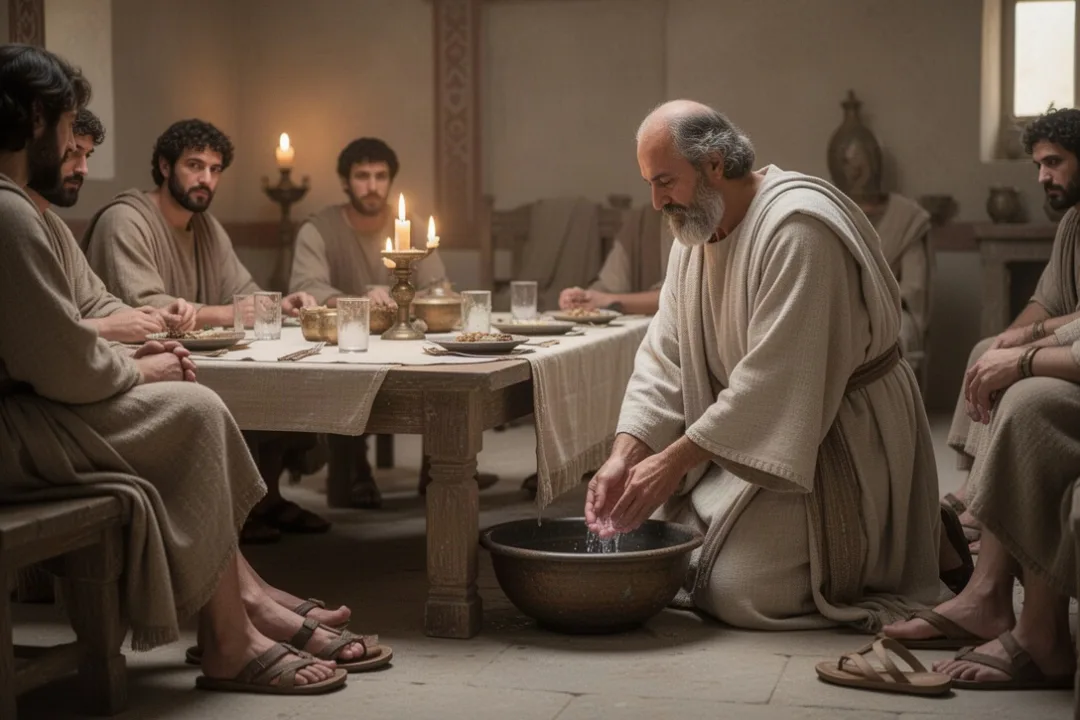
Foot washing by Jesus refers to the scene in John 13:1–20, where Jesus washes the feet of his disciples during their final meal together before his crucifixion. He takes the role of a household servant, kneels before his followers, and dries their feet with a towel.
The act teaches that greatness in God’s kingdom is expressed through humble service. Jesus also connects the washing with spiritual cleansing, love, and the responsibility of his disciples to serve one another rather than seek status.
What happened when Jesus washed the disciples’ feet
According to John 13, Jesus and his disciples were gathered for a meal. The Gospel presents this as a deeply significant moment: Jesus knew that his death was near, that he was returning to the Father, and that one of his disciples would betray him.
During the meal, Jesus rose, set aside his outer clothing, tied a towel around himself, and poured water into a basin. He then began washing the disciples’ feet and drying them with the towel. John gives unusual attention to these physical details because the action itself carries the message.
In the ancient setting, foot washing was a practical act of hospitality. People commonly walked on dusty roads in sandals, so washing a guest’s feet could make a meal more comfortable. The task was normally performed by a servant, by a person of lower social standing, or sometimes by the guest himself.
Jesus was the teacher and leader of the group. The disciples called him Lord and Master, so they would not have expected him to take the servant’s position. His action reverses the usual social order: the one with authority serves the people who follow him.
The account does not describe the disciples taking turns washing one another’s feet before Jesus acts. Jesus initiates the service himself. That detail matters because he is not simply participating in a familiar custom; he is giving the custom a deeper meaning.
Why Peter objected to having his feet washed
When Jesus came to Peter, Peter resisted. He was uncomfortable with the idea of his Lord performing such a lowly task. His response shows both respect for Jesus and a misunderstanding of what Jesus was doing.
Jesus told Peter that he did not yet understand the significance of the action but would understand it later. Peter then swung from refusal to an excessive request, asking that his hands and head be washed as well. Jesus answered by explaining that a person who has bathed does not need a complete bath, but only the washing of the feet in the immediate situation.
Jesus’ response suggests a distinction between belonging to him and needing ongoing cleansing in daily life. The exact theological meaning of the bathing image has been discussed by Christian interpreters, but the passage clearly emphasizes that Peter must receive Jesus’ service rather than control the terms of it.
Peter’s resistance can also represent a common spiritual problem: people may find it easier to serve than to accept help. Serving allows you to remain in control, while receiving care can make you feel exposed, dependent, or indebted. Jesus’ example includes both giving humble care and allowing others to care for you.
Central idea: Peter had to let Jesus wash his feet before he could understand the kind of relationship Jesus was establishing. Christian service begins with receiving Christ’s grace, not with proving your own worth.
What the foot washing reveals about Jesus’ humility
The most immediate lesson is humility expressed through action. Jesus does not merely tell his disciples to be humble. He performs a task that would normally be assigned to someone beneath him, making the lesson visible and personal.
His humility is not self-contempt or weakness. Jesus knows who he is and where he comes from. John presents him as the one who has authority and a unique relationship with the Father, yet he chooses to kneel and serve. The contrast shows that secure identity and humble service are compatible.
Jesus’ action also challenges the assumption that leadership should always look impressive. A leader may teach, make decisions, protect others, or carry responsibility, but Jesus adds a further mark of leadership: willingness to perform unglamorous work for another person’s good.
The towel and basin become symbols of a different kind of authority. Jesus does not abandon leadership when he serves. Instead, he demonstrates that authority is meant to benefit others rather than elevate the person who holds it.
This does not mean every person must copy the exact physical ceremony in every setting. The deeper principle is to notice needs, accept inconvenience, and use your position to care for people who cannot increase your reputation or repay you.
How foot washing connects with Jesus’ command to love
John places the foot washing within the final teaching Jesus gives his disciples before his death. The act is part of a larger pattern of love: Jesus loves his own, serves them, prepares them for his departure, and teaches them how to live together after he is gone.
The washing demonstrates that love is concrete rather than merely verbal. Jesus does not describe love as a feeling detached from behavior. He puts love into practice through water, touch, attention, and time.
His disciples are not asked to admire the example from a distance. Jesus tells them that they should do for one another what he has done for them. The instruction points beyond a ritual to a community shaped by mutual service.
That service includes ordinary needs. It may involve preparing a meal, visiting someone who is sick, helping with transportation, listening patiently, doing difficult household work, or supporting a person through grief. The task itself may look small, but the attitude behind it reflects Jesus’ teaching.
Love also means serving people who are difficult to understand or appreciate. The foot washing takes place in the presence of the whole group, including Judas, whom John identifies as the betrayer. Jesus knows what Judas intends to do, yet he does not use that knowledge as an excuse to avoid serving.
This detail should not be used to justify remaining in abusive or dangerous relationships. Humble service does not require you to ignore serious wrongdoing, surrender healthy boundaries, or protect someone from accountability. Jesus’ example calls for self-giving love, not passive acceptance of harm.
Why Judas matters in the foot washing account
John’s account deliberately places the washing alongside the announcement of betrayal. Jesus knows that one of those present will hand him over, and yet the act of service is not reserved for the loyal or grateful disciples.
That setting makes the gesture more demanding. It is easy to serve people who affirm you, thank you, or share your goals. It is harder to act with integrity when another person has disappointed you or plans to harm your interests.
Jesus’ conduct does not mean that trust should be restored without evidence or that betrayal has no consequences. Instead, it shows that another person’s failure does not have to determine your character. You can act with love while still recognizing truth, setting boundaries, and allowing justice to address wrongdoing.
The presence of Judas also keeps the passage from becoming a lesson about deservingness. The disciples do not earn the washing by demonstrating perfect loyalty. Jesus serves them within their weakness, confusion, and impending failure.
What “washing” means spiritually in John 13
The scene has a physical meaning and a spiritual meaning. On the physical level, Jesus cleans dusty feet. On the spiritual level, he speaks about being clean and about the relationship between cleansing and belonging to him.
John’s Gospel frequently uses physical images to communicate spiritual realities. Water can suggest cleansing, new life, and God’s work within a person. In this passage, the image points to the need for Jesus’ cleansing rather than self-reliance.
The statement that the disciples are clean, with an exception, is connected to the betrayal that John has already identified. It should not be turned into a simplistic claim that every physical act of washing automatically removes sin. The passage presents cleansing as a matter of relationship with Jesus and openness to his transforming work.
Many Christians understand the foot washing as symbolizing the ongoing need for forgiveness and renewal. A person may belong to Christ yet still need regular confession, correction, and restoration in the course of daily life. The image fits the experience of walking through a dusty world and repeatedly needing to be made clean.
Other Christians place greater emphasis on the passage’s teaching about humility and mutual service. These interpretations do not have to compete. The chapter brings together cleansing received from Jesus and service offered to others.
How different Christian traditions practice foot washing
Christian communities have responded to Jesus’ example in different ways. Some churches practice foot washing as an ordinance or symbolic ceremony. It may take place during Holy Week, around Communion, at a retreat, or during a service focused on discipleship and humility.
In some traditions, leaders wash the feet of members to illustrate servant leadership. In others, participants wash one another’s feet in pairs or small groups. Some communities practice it regularly, while others view the passage primarily as a command to adopt a servant-hearted way of life.
These differences reflect varying understandings of how Jesus’ instruction should be applied. Christians should avoid treating one custom as proof that everyone else lacks faith. The central concern is whether the practice or daily behavior reflects humility, love, repentance, and care for others.
A foot-washing service can be meaningful when it is voluntary, explained carefully, and handled with sensitivity. It can become unhelpful when people are pressured, embarrassed, photographed without consent, or made to feel spiritually inferior for declining physical contact.
As a ceremony: foot washing can provide a tangible reminder of Jesus’ service.
As discipleship: it can train a church to notice hidden needs and share responsibility.
As pastoral care: it can express tenderness during seasons of grief, illness, or renewal.
As a daily principle: it can remind believers to choose helpful service over status.
Practical ways to live out Jesus’ example today
You do not need to organize a formal foot-washing ceremony to apply the teaching. Begin by looking for tasks that support another person but are often ignored because they are inconvenient, repetitive, or unseen.
In a family, that might mean handling an unpleasant chore without demanding recognition. In a church, it might mean setting up chairs, cleaning afterward, welcoming someone who feels isolated, or helping a new member understand an unfamiliar process.
At work, servant leadership may include sharing credit, making a confusing task easier for a colleague, mentoring someone without using the relationship for personal advantage, or addressing a problem that affects people with less influence.
In your neighborhood, it may involve checking on an older resident, preparing food for a family under stress, clearing a walkway, or offering practical help instead of only saying that you are thinking about someone.
Healthy service remains attentive to consent and capacity. A person who is sick may want assistance but not physical touch. Someone who has experienced trauma may find foot washing distressing. Love asks what kind of help is welcome rather than assuming that a dramatic gesture is always best.
Common mistakes when applying the foot-washing lesson
Confusing humility with humiliation: Jesus serves without degrading himself or the disciples. Service should protect dignity rather than create shame.
Performing service for attention: A public act can be sincere, but seeking praise turns service into self-promotion.
Using the passage to excuse abuse: Forgiveness and service do not cancel the need for safety, boundaries, or accountability.
Focusing only on the ritual: Washing feet once does not replace a continuing pattern of mercy and practical care.
Ignoring the person’s preferences: Ask permission before touching someone, washing their feet, or involving them in a ceremony.
Serving only people who can repay you: Jesus’ example challenges relationships based entirely on advantage or recognition.
Refusing to receive help: Pride can appear as independence. Accepting appropriate care can also be an act of humility.
The goal is not to create a performance of lowliness. The goal is to become the kind of person who notices what love requires and is willing to do it, even when the task is ordinary and no one applauds.
Practical question: Ask, “What need is directly in front of me, and what useful part of meeting it am I avoiding because it feels too small, messy, or beneath me?”
How foot washing relates to the cross
John places the foot washing immediately before the events leading to Jesus’ death. The act therefore points beyond a lesson in good manners. Jesus’ willingness to kneel reflects the self-giving love that will define the cross.
He serves before he suffers, and he teaches his disciples to serve before they face opposition and fear. The basin and towel offer a visible picture of the same pattern: Jesus gives himself for the good of others rather than using his authority to protect his status.
The foot washing does not replace the meaning of the crucifixion. Instead, it helps interpret it. Jesus’ death is not presented as an accidental defeat but as an expression of purposeful love, obedience, and self-giving.
For Christians, this connection means that service is not merely a technique for building a successful community. It is a response to the character of Jesus. People serve because they have received love from him and are called to reflect that love in relationships with others.
What the disciples were meant to remember
Jesus asks his disciples to remember the relationship between his position and his action. If their Lord and Teacher has served them, they should not consider service beneath them. Rank, knowledge, spiritual gifts, and responsibility do not exempt anyone from caring for others.
The lesson is especially relevant wherever people compete for influence. Churches, families, workplaces, and volunteer groups can all drift toward status-seeking. The foot washing confronts that tendency by placing the leader beside the basin instead of above the people.
It also calls for mutuality. The disciples are not told that one special person must do every menial task forever. They are taught to serve one another. A healthy community distributes care so that no individual becomes permanently invisible, exhausted, or taken for granted.
The lasting question is not simply, “Would I wash someone’s feet?” It is, “Am I willing to use my time, authority, and resources for another person’s good?” That question reaches into everyday choices: how you listen, share responsibility, apologize, forgive, receive help, and respond to people who cannot advance your interests.
Where to read the account of Jesus washing feet
The full account appears in John 13:1–20. The surrounding chapters continue Jesus’ teaching to his disciples before his arrest and crucifixion, so reading the wider section helps place the foot washing within his final instructions.
The other three Gospels describe the final meal but do not include this foot-washing scene in the same way. John’s presentation gives special attention to Jesus’ symbolic actions and to the meaning of love within the disciple community.
When reading the passage, notice several details: Jesus knows what is coming, he takes the servant’s position, Peter resists, Judas is present, Jesus explains the example, and the disciples are expected to practice humble service. Together, these details show that foot washing by Jesus is both a sign of spiritual cleansing and a model for a life shaped by love.
Frequently asked questions
Did Jesus wash the feet of all twelve disciples?
John 13 presents Jesus washing the disciples’ feet as a group, and Judas is included in the scene before his betrayal is carried out. The passage does not provide a separate description of each person’s response. Its emphasis is on Jesus serving the gathered disciples, including one who would soon betray him.
Is foot washing required for Christians today?
Christian traditions answer this differently. Some practice foot washing as a continuing ordinance or church ceremony, while others understand Jesus’ instruction as a command to live with humility and serve others. The passage clearly requires servant-hearted love, but churches differ on whether the physical practice itself is mandatory.
What does Jesus mean when he says the disciples are clean?
The statement uses washing as a spiritual image. Jesus distinguishes between someone who has been cleansed and the need to wash dusty feet, suggesting an ongoing need for renewal. John also connects the statement with the presence of a betrayer, so the passage should be interpreted in its relationship-focused context rather than as a general claim about physical cleanliness.
Why did Peter first refuse and then ask Jesus to wash more than his feet?
Peter reacted strongly because he thought Jesus’ action was beneath Jesus’ position. After Jesus explained that Peter could not share in the relationship without receiving the washing, Peter overcorrected and asked for a complete washing. His responses show both resistance to dependence and a desire to belong fully to Jesus.

















Leave a Reply