The book of Ruth in the Bible: Story, meaning, and themes
The book of Ruth in the Bible: Story, meaning, and themes
When a family faces grief, financial hardship, or an uncertain future, where can hope come from? The book of Ruth in the Bible answers through a short story about two widows, a foreign woman, and a community that makes room for restoration. Set during the troubled period of the judges, Ruth follows Naomi, Ruth, and Boaz from famine and loss toward belonging, marriage, and a new family line.
Ruth contains only four chapters, but its story connects personal faithfulness with Israel’s larger history. Ruth becomes the great-grandmother of King David, placing her within the ancestry that leads to Israel’s royal line. The book also gives sustained attention to a Moabite woman, showing that courageous loyalty and trust can matter more than nationality, status, or a painful past.
The story begins with a famine in Bethlehem. Because Bethlehem’s name is associated with food or bread, the famine creates an especially striking setting. Elimelech leaves Judah with his wife Naomi and their two sons, Mahlon and Chilion, and the family settles in Moab. After Elimelech dies, the sons marry Moabite women named Ruth and Orpah.
Tragedy continues when Mahlon and Chilion also die. Naomi is left without her husband or sons, and Ruth and Orpah are widows as well. Naomi hears that the food shortage in Judah has ended, so she decides to return to Bethlehem. She urges both younger women to remain in Moab, where they may have a better chance of rebuilding their lives.
Orpah eventually returns to her people, but Ruth refuses to leave Naomi. Ruth’s pledge expresses a commitment to share Naomi’s people, homeland, and faith. Rather than seeking the easier path, Ruth travels with Naomi to Bethlehem, arriving as the barley harvest begins.
The story’s turning point: Ruth does not solve Naomi’s problems with a single dramatic act. She begins by staying, traveling, working, and caring for her mother-in-law when both women have very little security.
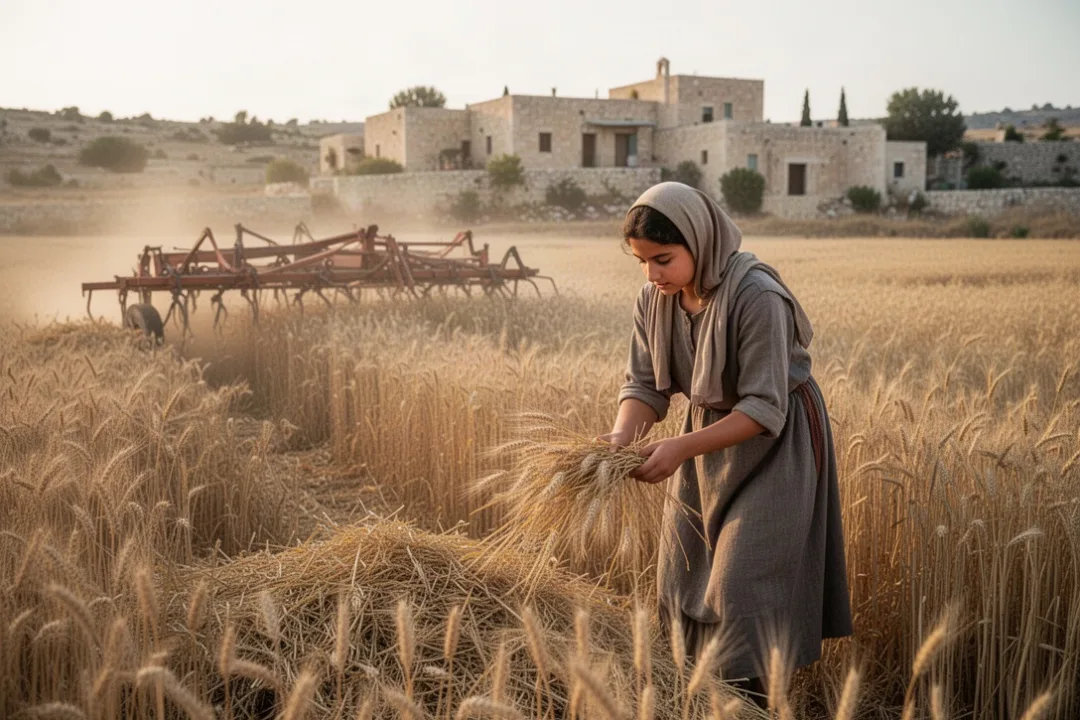
Ruth goes to glean in the fields so that she and Naomi can obtain food. She happens to work in a field belonging to Boaz, a prosperous relative of Naomi’s late husband. Boaz notices Ruth, hears about her loyalty to Naomi, and tells his workers to protect her. He also instructs them to leave extra grain for her.
Naomi recognizes that Boaz may be able to help the family. She explains that he is a kinsman-redeemer, a relative with a possible role in protecting family property and continuing the family’s future. At Naomi’s direction, Ruth approaches Boaz at the threshing floor and asks him to take responsibility for her and Naomi’s family situation.
Boaz responds with respect and generosity, but he explains that another relative is closer in the family line and therefore has the first opportunity to act. At the town gate, Boaz meets this unnamed man before community witnesses. The nearer relative declines the responsibility, and Boaz legally confirms his own role.
Boaz marries Ruth, and they have a son named Obed. The women of Bethlehem celebrate Naomi’s restored family life. Obed becomes the father of Jesse and the grandfather of David, linking Ruth’s household to the future history of Israel.
How Ruth’s four chapters develop the story
Chapter 1: Loss, return, and Ruth’s loyalty
Chapter 1 establishes the book’s movement from emptiness toward fullness. Naomi leaves Bethlehem with a husband and two sons, but she returns with only Ruth. Naomi describes herself as bitter because she believes her suffering has come under God’s hand, yet the narrative quietly shows that Ruth’s presence is already a form of care and hope.
Ruth’s decision to stay is more than emotional support. She gives up the security of her own community and enters an unfamiliar land as a Moabite widow. Her choice places her alongside Naomi even though she cannot know how their needs will be met.
The chapter also introduces a recurring contrast between what people can see and what the story is doing beneath the surface. Naomi sees death, poverty, and an empty future. The reader sees Ruth’s steadfastness and the beginning of a chain of events that will eventually lead to David.
Chapter 2 shows how Ruth finds food through gleaning, the practice of gathering grain left behind after reapers worked a field. Israel’s law instructed landowners to leave portions of crops for people who were poor, widowed, or living as foreigners. Gleaning was not effortless charity; it required vulnerable people to work in exposed conditions and depend on the landowner’s fairness.
Boaz stands out because he treats Ruth with unusual care. He tells her to remain with his female workers, orders the men not to harass her, and gives her access to water. He also makes sure she can gather more grain than she might otherwise find. His generosity protects Ruth’s dignity as well as her physical safety.
Boaz has heard how Ruth left Moab and cared for Naomi. He describes her decision as taking refuge under the God of Israel’s wings, using an image of protection and shelter. Ruth responds with humility, aware that she is a foreigner who has received kindness from a man with greater social standing.
When Ruth returns home with an unusually large amount of grain and leftover food, Naomi realizes that someone has treated her well. Learning that the field belongs to Boaz changes her outlook. She blesses him and identifies him as a relative who may help preserve the family’s future.
Chapter 3: Ruth’s request at the threshing floor
Naomi wants Ruth to find security and a permanent home. She tells Ruth to wash, dress, and go to the threshing floor after Boaz has finished eating and drinking. Ruth is to wait until he lies down, then make her presence known and ask him to spread his garment over her.
The scene can seem unfamiliar to modern readers, but the request is best understood within the book’s cultural setting. Ruth is asking Boaz to accept a responsibility toward her and Naomi’s family. The language of covering can carry the sense of protection, marriage, and covenant commitment rather than simply a request for personal affection.
Boaz praises Ruth for not pursuing a younger man and promises to act honorably. He confirms that a closer relative has a prior claim, so he cannot proceed until that matter is settled. Boaz sends Ruth home with grain for Naomi, providing a practical sign that he intends to address the situation.
Chapter 4: Public redemption and David’s family line
Boaz goes to the town gate, a place where legal and civic matters were publicly handled. He gathers the nearer relative and elders as witnesses. The relative initially agrees to redeem Naomi’s land, but he withdraws when he understands that the arrangement also involves marrying Ruth and preserving the deceased man’s family line.
The text records a customary sandal exchange connected with the transaction. Boaz then takes responsibility for the property associated with Elimelech’s family and marries Ruth. Their son Obed becomes the focus of the closing blessing, which celebrates the child’s role in restoring Naomi’s family.
The book ends with a genealogy from Perez through several generations to David. This ending shows that Ruth is not merely a private romance or a story about surviving poverty. Her faithfulness becomes part of Israel’s royal history, and a woman from Moab becomes an ancestor of David.
What the book of Ruth teaches about loyalty and redemption
Loyalty is the book’s most visible virtue. Ruth remains with Naomi when there is no obvious advantage in doing so. Her commitment is demonstrated through ordinary actions: traveling to Bethlehem, gathering grain, accepting difficult work, and caring for a grieving older woman.
Naomi also shows a complicated form of faithfulness. Her grief makes her honest about pain, and she does not pretend that everything is fine. Yet she continues to guide Ruth, recognize Boaz’s role, and participate in the steps that lead to restoration. The book allows sorrow and hope to exist together.
Boaz expresses loyalty through responsible action. He does not exploit Ruth’s vulnerable position at the threshing floor. Instead, he protects her reputation, follows the proper public process, and accepts obligations that may involve sacrifice. His integrity is shown not only by what he feels but by how he behaves when no easy solution is available.
The idea of redemption in Ruth involves more than an individual being rescued from danger. It includes restoring a family’s future, protecting property connected with the deceased, and providing security for a widow. The Hebrew Scriptures describe several family and community responsibilities that helped prevent vulnerable households from disappearing entirely.
Boaz is called a redeemer because he is a relative who can act on behalf of Naomi’s family. The nearer relative’s decision shows that redemption carries a cost. Boaz’s willingness to accept both the property matter and the family responsibility makes his action generous, but it is also presented as a public duty carried out with integrity.
Ruth’s loyalty gives Naomi companionship when Naomi has lost her immediate family.
Boaz’s protection gives Ruth safety and fair access to food.
Public accountability protects the rights of the people involved.
The birth of Obed restores a family line that appeared to have ended.
The story also challenges narrow assumptions about who belongs among God’s people. Ruth is repeatedly identified as a Moabite, yet she becomes known for her loyalty to Naomi and her commitment to Israel’s God. The book does not erase her foreign identity; instead, it places that identity within the center of the story.
A practical reading of Ruth: Look for the people who are exposed, overlooked, or carrying grief. The book presents faithful care as something expressed through protection, work, generosity, honest speech, and responsible decisions.
Why Ruth’s setting and customs matter
The book assumes a social world in which widows could face serious economic insecurity. Without a husband or adult sons, Naomi and Ruth have limited protection and no obvious source of income. Their circumstances explain why gleaning, family responsibility, land, and marriage are central to the plot.
Gleaning laws appear elsewhere in the Torah, including instructions connected with harvests. Landowners were expected not to harvest every last portion of their fields, leaving some for the poor and the foreigner. Ruth’s work in Boaz’s field therefore reflects both a legal provision and the character of the person who applies it generously.
The book’s use of the term kinsman-redeemer should not be reduced to a simple modern equivalent. The role can involve family property, protection, and the continuation of a household’s name. Ruth also includes marriage and offspring, making its situation more complex than one isolated legal rule.
The nearer relative’s anonymity is significant. He is identified only as “a certain man” in the narrative’s description, while Boaz is named repeatedly. The text does not need to explain his motives in detail, but his refusal contrasts with Boaz’s willingness to accept the broader responsibility.
The threshing floor scene also requires care. Boaz and Ruth are not presented as ignoring all boundaries. Ruth makes a bold request, but Boaz answers by promising honorable action and by recognizing the nearer relative’s claim. The next step takes place publicly at the town gate, where witnesses can confirm the agreement.
Names and locations add meaning to the story. Bethlehem is Naomi’s home and the place where the famine has ended. Moab is Ruth’s homeland and the place where Naomi’s family experienced loss. The movement from Moab to Bethlehem is therefore both a physical return and a change in the women’s prospects.
Ruth is also set “in the days when the judges ruled,” a period often portrayed elsewhere in the Bible as marked by disorder and instability. Against that broad background, Ruth highlights everyday acts of goodness. Its characters do not lead armies or perform public miracles; they make decisions that preserve life and honor.
How Ruth fits into the Bible’s larger story
Ruth’s final genealogy connects a small family story to King David. The book identifies Obed as Jesse’s father and David’s grandfather. This connection explains why the narrative matters beyond the lives of Ruth, Naomi, and Boaz: their household becomes part of the line associated with Israel’s monarchy.
The genealogy also changes how readers understand Ruth’s arrival in Bethlehem. At first, she appears to be a poor foreign widow gathering leftover grain. By the end, she is named in the ancestry of Israel’s most celebrated king. The narrative creates this reversal without denying the hardship that came before it.
In the Christian Bible, Ruth also appears in the genealogy of Jesus in Matthew 1. Matthew names Ruth among the women connected with Jesus’ ancestry. This reinforces themes already visible in Ruth itself: God’s purposes can work through outsiders, unexpected family situations, and people whose place in history is not obvious at first.
Different biblical traditions arrange Ruth differently. In the Hebrew Bible, it belongs among the Writings and is associated with the festival of Shavuot in Jewish tradition. In many Christian Bibles, Ruth appears after Judges and before 1 Samuel, which fits its setting before David’s rise.
Readers should avoid treating the book as a promise that every painful situation will end in the same way. Ruth does not offer a formula in which loyalty automatically produces wealth, marriage, or public honor. It tells one particular story of restoration while also preserving the reality of grief, vulnerability, and uncertainty.
Its lasting message is more grounded. People who seem powerless can act with courage. Communities can protect or neglect those at their margins. Faithfulness may begin with one person making a costly decision, and the significance of that decision may become visible only much later.
Questions to consider when reading Ruth
Ruth rewards a slow reading because the narrative often communicates through small details. Notice when characters speak about food, home, refuge, family, or a name. These words trace the movement from famine to harvest, exile to belonging, and bereavement to a renewed family.
Pay attention to how each character uses power. Naomi has limited social power but gives wise direction. Ruth has little economic security but shows initiative and courage. Boaz has land, workers, and status, yet the story presents his character through how he treats people who cannot repay him.
It is also useful to ask what changes and what remains unresolved. Naomi receives a child into her household, but the deaths that shaped her life are not undone. Ruth gains belonging, but she remains a Moabite woman whose identity is part of the story. The restoration is real without pretending that the past never happened.
Read all four chapters in one sitting to follow the movement from famine to harvest.
Compare the women’s choices, especially Naomi’s return and Ruth’s decision to stay.
Observe Boaz’s actions toward Ruth, his workers, and the nearer relative.
Study the ending to see why the genealogy is essential to the book’s purpose.
Reflect on belonging and how the story treats a foreign woman within Israel.
At its heart, the book of Ruth in the Bible is about faithful love expressed through concrete responsibility. Ruth’s devotion, Naomi’s perseverance, and Boaz’s integrity work together within ordinary circumstances. The story begins with hunger and bereavement, but it ends with a restored household and a place in the history that leads to David.
Frequently asked questions
Is Ruth a true story in the Bible?
Ruth is presented as a historical narrative set during the period of the judges, and it names real places, family relationships, and David’s ancestry. The text itself does not discuss its method of composition or provide independent historical evidence. Readers generally approach it as Scripture’s account of Ruth, Naomi, and Boaz, while also recognizing its carefully shaped storytelling and theological purpose.
What is the main message of the book of Ruth?
The book emphasizes loyal love, responsible care for vulnerable people, and God’s work through ordinary decisions. Ruth remains with Naomi, Boaz protects Ruth and honors family obligations, and the community witnesses a restored household. The story also shows that a foreign woman can become part of Israel’s story through faithfulness and belonging.
Why did Ruth go to Boaz at the threshing floor?
Ruth went there because Naomi instructed her to ask Boaz to act as a family redeemer. Her request for him to spread his garment over her symbolized protection and responsibility, including the possibility of marriage. Boaz treated the request honorably, acknowledged the nearer relative’s prior claim, and resolved the matter publicly at the town gate.
How is Ruth connected to King David?
Ruth and Boaz became the parents of Obed. Obed was the father of Jesse, and Jesse was the father of David. The genealogy at the end of Ruth makes this connection explicit. Ruth’s place in David’s ancestry explains why the book’s family story has significance for Israel’s royal history and, in Christian tradition, for Jesus’ genealogy as well.














Leave a Reply