Mark 10: Jesus’ teaching on marriage, wealth, and service
Mark 10: Jesus’ teaching on marriage, wealth, and service
Mark 10 presents discipleship as wholehearted trust in God expressed through faithful relationships, humble service, and willingness to follow Jesus at personal cost.
The chapter moves through several encounters that seem unrelated at first: a debate about divorce, a blessing for children, a wealthy man’s question about eternal life, a prediction of suffering, an argument about status, and the healing of a blind beggar. Together, these scenes show what Jesus values in people who want to follow him.
Jesus repeatedly redirects attention away from status, possessions, control, and public recognition. He points instead to faithfulness, dependence on God, compassion for vulnerable people, and service to others. Mark 10 is therefore not merely a collection of moral teachings. It is a sustained challenge to the assumptions that often shape religious life and human ambition.
Why Mark 10 begins with Jesus’ teaching about marriage and divorce
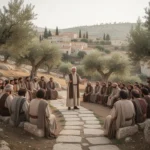
Mark 10 opens with Jesus teaching in the region of Judea. Some Pharisees approach him with a question about whether a man may divorce his wife. The Gospel says they are testing him, which suggests that the question is not simply a private request for guidance. It is also connected to public controversy and competing interpretations of Jewish law.
Jesus first asks what Moses commanded. They refer to the permission given in the law for a man to write a certificate of divorce and send his wife away. Jesus explains that this provision existed because of human hardness of heart. He then directs attention to God’s intention in creation: marriage joins two people in a profound union, and human beings should not casually tear that union apart.
The teaching challenges a legalistic approach that asks only, “What is permitted?” Jesus moves the discussion toward faithfulness, covenant, and the well-being of the people involved. Instead of treating divorce as a technical escape from responsibility, he emphasizes the seriousness of the commitment marriage represents.
When the disciples ask about the matter privately, Jesus applies the teaching to both husband and wife. In the social setting of the ancient world, this was significant because divorce was often discussed primarily in terms of a man’s rights. Jesus holds both spouses morally responsible for the marriage relationship rather than presenting one gender as the only active decision-maker.
Mark 10 should not be used as a weapon against people who have experienced divorce, abandonment, abuse, or other profound marital harm. Jesus’ words address the misuse of divorce and the hardness that can destroy a covenant; they do not erase the need for safety, justice, pastoral care, or wise legal protection. A careful reading must hold together the chapter’s serious view of marriage and its wider concern for people who are vulnerable.
Important distinction: Jesus’ teaching confronts the selfish dismissal of a spouse, but it should never be used to pressure someone to remain in danger or to excuse abuse.
The opening scene also establishes a pattern that continues through the chapter. People bring Jesus a question framed around rules, rank, or personal advantage. Jesus answers by revealing the deeper posture God seeks: integrity rather than loopholes, covenant faithfulness rather than self-protection, and love that takes another person seriously.
What Jesus means when he welcomes children in Mark 10
People bring young children to Jesus so that he may touch and bless them. The disciples try to stop them, apparently assuming that the children are unimportant interruptions. Jesus becomes indignant and tells the disciples to let the children come to him rather than preventing them.
He then says that God’s kingdom belongs to people who receive it like children. This does not mean that children are morally flawless or that Christian faith requires childish thinking. The comparison points to dependence, openness, humility, and lack of social power. Children in that setting could not claim status or influence. They received what others offered rather than presenting themselves as accomplished or self-sufficient.
Jesus takes the children in his arms and blesses them. The physical tenderness of the scene matters. He does not speak about children as an abstract example while ignoring the actual children in front of him. He gives them attention and dignity, showing that the kingdom’s values include welcoming those whom society may regard as insignificant.
This scene corrects the disciples’ idea that access to Jesus should be managed according to importance. The people who seem least impressive may be precisely the people Jesus insists must be welcomed. Kingdom belonging is received, not achieved, and dependence on God cannot be replaced by reputation, education, wealth, or religious performance.
The passage also offers a practical test for communities of faith. A church, family, or ministry may speak about welcoming children while treating them as distractions. Mark 10 presses beyond words by asking whether children are genuinely protected, heard, included, and valued.
Receive God’s kingdom: come with trust rather than a claim of deservingness.
Welcome the vulnerable: do not measure people by influence, income, age, or usefulness.
Practice humility: recognize that dependence is part of faithful life, not a defect to hide.
Why the wealthy man struggles to follow Jesus
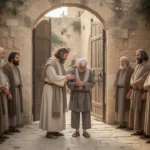
A man approaches Jesus and asks what he must do to inherit eternal life. He appears sincere, respectful, and morally serious. He says he has kept the commandments from his youth, and Mark adds that Jesus looks at him and loves him.
Jesus then identifies the obstacle that the man has not yet faced: he must sell what he owns, give to the poor, and follow Jesus. The man leaves grieving because he has many possessions. The problem is not presented as a lack of religious knowledge. He understands the command, but he cannot release his wealth.
Jesus uses the moment to warn his disciples about the danger riches can pose to entering God’s kingdom. The disciples are astonished because wealth was often viewed as a sign of blessing or divine favor. Jesus intensifies the warning with an image involving a camel and a needle, emphasizing that humanly impossible achievement cannot secure entry into God’s kingdom.
The disciples ask who, then, can be saved. Jesus responds that salvation is impossible by human effort but possible with God. The point is not that wealthy people are automatically condemned or that poverty itself earns salvation. The issue is the power possessions can exercise over the heart. Wealth can create the illusion of independence, making it difficult to receive life as a gift and to recognize obligations toward the poor.
Mark 10 does not give every reader an identical financial instruction. Jesus’ command to this man exposes his particular attachment. For another person, the controlling obstacle might be prestige, resentment, sexual sin, fear, career ambition, or the desire to control every outcome. The central question is: What are you unwilling to place under Jesus’ authority?
The chapter also makes clear that generosity is not merely a private spiritual exercise. Jesus connects the man’s possessions with the poor. Discipleship has economic consequences because love of neighbor requires attention to how resources are held and used. A person cannot claim wholehearted devotion while treating material abundance as a possession entirely detached from other people’s needs.
Peter reminds Jesus that the disciples have left everything to follow him. Jesus promises that those who give up homes, family relationships, or resources for his sake and for the gospel will receive far more within the community of believers, along with persecution and eternal life. This is not a promise of uncomplicated prosperity. The inclusion of persecution prevents a simplistic reading in which sacrifice becomes a transaction guaranteeing comfort.
The promised return includes relationships and belonging, but Jesus does not erase the cost of discipleship. Followers gain a new family and a new community, yet they also enter a path marked by opposition. The passage holds together God’s generous provision and the real losses that faithfulness may involve.
For personal reflection: Mark 10 does not ask only how much you own. It asks whether your possessions own you, whether your resources serve love, and whether you trust God beyond what money can secure.
How Jesus connects suffering with faithful discipleship
As the group travels toward Jerusalem, Jesus tells the Twelve what will happen to him. He will be handed over, condemned, mocked, beaten, killed, and raised after three days. This is the third prediction of his suffering recorded in this section of Mark, and it is more detailed than the earlier predictions.
The announcement creates a sharp contrast with the disciples’ expectations. Jesus is moving toward rejection and death, while the disciples are still thinking about position and honor. The chapter does not present suffering as an unfortunate surprise that interrupts Jesus’ mission. It presents his suffering, death, and resurrection as central to what he has come to accomplish.
James and John then ask Jesus for places of honor when he comes in glory. Their request shows that they have heard the prediction but have not fully understood its meaning. They imagine the kingdom in terms of rank and proximity to power. Jesus asks whether they can share his cup and baptism, using images of suffering and identification with his mission.
They answer that they can. Jesus tells them that they will indeed share in suffering, but he does not grant the places they request. Those positions belong to those for whom they have been prepared. His answer rejects both entitlement and the idea that spiritual commitment gives someone the right to control honor.
The other disciples become angry when they hear the request. Their anger may reflect genuine disapproval, but it may also reveal disappointment that James and John asked first. Jesus uses the conflict to contrast ordinary political leadership with leadership in his community.
Among earthly rulers, powerful people often make their authority felt over others. Jesus says his followers must not lead that way. Greatness among them will be measured by service, and whoever wants to be first must become a servant of all. Jesus grounds this teaching in his own mission: he came not to be served but to serve and to give his life for others.
This is more than a general appeal to be nice. Servant leadership changes the meaning of power. Authority is not proved by how many people obey you, how visible your platform becomes, or how effectively you protect your status. It is shown through sacrifice, responsibility, truthfulness, and sustained attention to the good of people who cannot repay you.
Do not confuse proximity to religious activity with spiritual maturity. The disciples were close to Jesus and still misunderstood his mission.
Do not use service to gain admiration. Service becomes another form of ambition when recognition is its hidden reward.
Accept that faithful leadership may involve cost. Jesus connects authority with suffering rather than insulation from hardship.
Measure influence by whom it helps. The vulnerable, overlooked, and powerless should benefit from responsible leadership.
The order of these scenes is revealing. Jesus teaches about receiving the kingdom like a child, confronting the grip of wealth, accepting the path of suffering, and serving rather than ruling over others. Each scene challenges self-sufficiency. The disciple must receive, release, follow, and serve.
What Bartimaeus teaches about faith and following Jesus
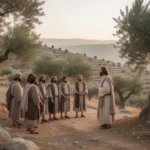
Near Jericho, a blind beggar named Bartimaeus hears that Jesus is passing by. He calls out for mercy, identifying Jesus as the Son of David. People around him try to silence him, but he cries out even more insistently.
Bartimaeus has no social position that can make Jesus stop. He cannot see the approaching crowd, and he depends on begging to survive. Yet he recognizes something about Jesus that many better-connected people fail to recognize. His repeated appeal is not a demand based on merit. It is a plea for mercy.
Jesus stops and tells the crowd to call him. The same people who tried to silence Bartimaeus now tell him to take courage and get up. Bartimaeus throws aside his cloak, rises, and comes to Jesus. The cloak may have been connected with his identity and livelihood as a beggar, so leaving it behind vividly portrays his readiness to respond.
Jesus asks what he wants. The question gives Bartimaeus an opportunity to speak clearly rather than allowing others to define his need. He asks to see. Jesus tells him that his faith has made him well, and immediately he receives his sight and follows Jesus along the road.
The final detail is crucial: Bartimaeus does not simply receive a miracle and disappear. He follows Jesus on the road. In Mark, “the way” is associated with the path toward Jerusalem, where Jesus will suffer and die. The healed man becomes a model disciple just after the Twelve have struggled to understand the road Jesus is taking.
Bartimaeus contrasts with the wealthy man in several ways. The wealthy man can approach Jesus with social respectability and material security, but he leaves unable to surrender his possessions. Bartimaeus approaches as a marginalized beggar, asks for mercy, receives sight, and follows. The contrast does not mean that poverty automatically makes someone faithful. It shows that need can become an opening to trust, while abundance can become an obstacle when it produces self-reliance.
His story also speaks to communities that silence people in need. The crowd initially treats his cry as an interruption. Jesus treats him as a person worthy of attention. Faithful communities should therefore make room for urgent voices, especially when those voices come from people who lack status or social power.
Mark 10 ends with movement rather than stillness. Bartimaeus follows Jesus on the road, and the road leads toward Jerusalem. The chapter’s central question is not merely whether someone understands Jesus’ teaching. It is whether that person will respond with trust, surrender, courage, and active following.
How to read Mark 10 as a guide for Christian practice
Mark 10 brings together teachings that can shape daily decisions and community life. Its message is demanding, but it is not designed to produce despair. When the disciples ask who can be saved, Jesus points them toward God’s power rather than their ability to meet the standard through willpower alone.
A practical response begins with honest self-examination. You can ask what kind of question you are bringing to Jesus. Are you seeking a loophole, defending your position, protecting your possessions, competing for recognition, or genuinely asking how to follow?
The chapter also encourages specific habits:
Practice covenant faithfulness. Treat commitments as responsibilities involving real people, not merely as obligations that can be escaped through technicalities.
Make space for people with little power. Include children, the poor, people with disabilities, and those who are easily dismissed in decisions that affect them.
Examine your relationship with money. Give generously, resist status-driven consumption, and consider whether your financial choices reflect concern for neighbors.
Redefine leadership as service. Use authority to protect, equip, and strengthen others rather than to secure admiration or control.
Ask for mercy with persistence. Bartimaeus shows that a dismissed prayer is not necessarily a reason to stop calling on Jesus.
Follow after receiving help. God’s gifts are not merely private benefits; they draw people into a life of obedience and participation.
Read as a whole, Mark 10 exposes several false measures of spiritual success. Marriage is not a place for selfish escape. Childhood is not a condition to outgrow in every respect. Wealth is not proof of God’s approval. Leadership is not domination. Physical healing is not the end of discipleship.
The chapter instead presents a demanding but coherent vision: receive God’s kingdom with humility, honor commitments with integrity, loosen your grip on possessions, accept the cost of following Jesus, serve rather than dominate, and keep calling for mercy when others tell you to be quiet.
Frequently asked questions
What is the main message of Mark 10?
Mark 10 teaches that following Jesus requires more than religious respectability or outward rule-keeping. It calls people to receive God’s kingdom with humility, treat marriage and other commitments seriously, hold possessions loosely, welcome the vulnerable, serve rather than seek status, and continue following Jesus through difficulty. The chapter emphasizes that salvation depends on God’s power, not human achievement.
Does Mark 10 say that every Christian must give away all possessions?
Jesus specifically tells the wealthy man to sell his possessions and give to the poor because wealth is his particular obstacle. The passage does not present an identical financial command for every believer, but it does require honest examination of money’s control. Christian discipleship includes generosity, concern for the poor, and willingness to surrender anything that competes with loyalty to Jesus.
Why does Jesus use children as an example of receiving God’s kingdom?
Children represent dependence, openness, and limited social status in the setting of Mark 10. Jesus is not praising ignorance or claiming children are morally perfect. He is challenging self-sufficiency and status-seeking. God’s kingdom is received as a gift rather than earned through influence, achievement, wealth, or a claim that one deserves special treatment.
Who was Bartimaeus in Mark 10?
Bartimaeus was a blind beggar near Jericho who called out to Jesus for mercy. Although people tried to silence him, he persisted. Jesus restored his sight, and Bartimaeus immediately followed Jesus on the road. His story presents faith as persistent trust and shows that receiving healing leads into active discipleship rather than ending with a private benefit.















Leave a Reply