Leavened bread and unleavened bread: What is the difference?
Leavened bread and unleavened bread: What is the difference?
When a recipe says “unleavened bread,” you may wonder whether it simply means bread without yeast, or whether the term carries a deeper religious meaning. The short answer is that leavened bread rises through a fermenting agent, while unleavened bread is made without a rising agent. In the Bible, however, the difference also connects with Passover, worship, haste, purity, remembrance, and Christian interpretations of the Last Supper.
Leavened bread can be soft, airy, and chewy because yeast or another leavening agent produces gas inside the dough. Unleavened bread is usually flatter and denser because the dough is baked before it has time to rise. The distinction is practical in the kitchen, but its religious meaning depends on the passage, tradition, and ceremony being discussed.
How leavened and unleavened bread differ in baking
Leavened bread contains an ingredient or process that makes dough expand. The most familiar leaven is baker’s yeast, a living microorganism that feeds on sugars and releases carbon dioxide during fermentation. The gas becomes trapped in the developing gluten structure, creating the holes and volume associated with ordinary loaves.
Bread can also rise through other methods. Commercial baking powder and baking soda produce gas through chemical reactions, while beaten egg whites can add air to some batters. In everyday religious discussions, though, “leavened” most often refers to dough that has been allowed to ferment with yeast or a retained portion of fermented dough.
Unleavened bread is prepared without yeast or another intentional rising agent. The dough may contain flour, water, salt, oil, or other ingredients, but it is mixed and baked before fermentation creates noticeable expansion. Tortillas, crackers, matzo, and some forms of flatbread are familiar examples, although not every flatbread follows exactly the same religious or culinary rules.
Leavened bread: usually rises, develops a lighter texture, and often has a fermented flavor.
Unleavened bread: remains flat or compact and can be baked quickly after mixing.
Yeast: a biological leaven that ferments sugars and releases carbon dioxide.
Chemical leaveners: substances such as baking powder that create gas without the same fermentation process.
The word “leaven” can refer to more than a packet of yeast. In ancient baking, a small piece of dough from an earlier batch could be kept and mixed into a new batch. That portion carried fermentation into the fresh dough. This is similar in principle to a sourdough starter, although ancient methods and modern starters are not necessarily identical.
Fermentation also affects taste and texture. A longer rise may produce a more developed flavor and a chewier crumb, while unleavened dough tends to emphasize the flavor of the grain and any added oil or seasoning. Unleavened bread is not automatically healthier, less processed, or lower in calories; those qualities depend on the recipe and portion.
Practical distinction: “Unleavened” does not simply mean “flat.” A bread may be flat because it was rolled thin, pressed, or cooked quickly, while the religious use of “unleavened” usually concerns whether a rising agent or fermentation was permitted.
Why unleavened bread matters in the Bible
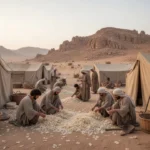
The central biblical setting for unleavened bread is Passover and the Feast of Unleavened Bread. In Exodus, the Israelites are told to prepare bread without leaven as they leave Egypt. The account presents their departure as urgent: there was not enough time for dough to rise through the usual process of fermentation.
Exodus 12 connects the bread with the night of Israel’s deliverance. The people are instructed to eat the Passover meal with unleavened bread, and later generations are commanded to remember the event through an appointed festival. The bread therefore functions as more than a convenient food. It becomes a physical reminder of haste, departure, and rescue.
Exodus 12 and Deuteronomy 16 describe the observance in slightly different contexts, but both connect the festival with leaving Egypt and remembering God’s deliverance. The biblical commands also involve removing leaven from homes during the festival period. This removal turns an ordinary kitchen ingredient into part of a household-wide act of remembrance.
The Hebrew Bible uses related terms for unleavened bread and leavened or fermented material. English translations may render these terms in slightly different ways, so a particular verse may say “unleavened bread,” “bread made without yeast,” or simply “leaven.” The basic contrast remains: one kind has not undergone the rising process, while the other has.
Unleavened bread appears in other biblical settings as well. In Genesis 19, visitors to Lot are served unleavened bread, apparently in the context of a hurried meal. Judges 6 describes Gideon presenting unleavened cakes in an offering scene. These passages show that unleavened bread was not used only for Passover, even though Passover gives it its most recognizable religious association.
Leaven is also restricted in some offerings described in Leviticus. Leviticus 2 prohibits leaven and honey in a particular grain offering brought to the altar, while the same chapter permits leavened loaves in a separate firstfruits offering described later. This detail matters because it prevents an overly simple rule such as “leaven is always forbidden in biblical worship.” Its meaning depends on the offering and context.
Some biblical passages use leaven as an image rather than an ingredient. Because a small amount of leaven spreads through an entire batch, it can represent influence that gradually affects everything around it. Jesus uses leaven positively in Matthew 13 when describing the growth of the kingdom of heaven. In other passages, including warnings in the Gospels and Paul’s letters, leaven represents corrupting influence, pride, or harmful teaching.
“A little leaven leavens the whole lump” is a biblical image of small influence spreading through the whole community.
That image does not mean that yeast is morally bad. The metaphor draws on a familiar physical process: a small amount can transform a large quantity of dough. Depending on the passage, the transformation may illustrate growth or warn about the spread of wrongdoing.
How Passover uses unleavened bread
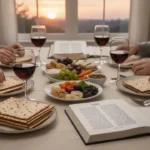
During Passover and the associated Feast of Unleavened Bread, Jewish practice centers on remembering the Exodus. The exact customs vary among Jewish communities, but a common feature is the avoidance of chametz, broadly referring to certain leavened grain foods that have undergone fermentation or rising.
Passover restrictions are more specific than simply avoiding a slice of yeast bread. Traditional Jewish law examines which grains are involved, how they were handled, and whether they came into contact with water long enough to ferment. The details can differ by community, so a general explanation should not be treated as a complete guide to observance.
Matzo, also spelled matzah or matzoh, is the best-known Passover bread. It is made from eligible grain and water and baked quickly to prevent ordinary fermentation. Its plain, crisp form recalls the biblical account of the Israelites leaving Egypt before their dough could rise.
Many Jewish families prepare for Passover by cleaning the home and removing or selling prohibited leavened foods. Some traditions include a formal search for remaining chametz, followed by its removal or disposal. These practices turn the household into part of the remembrance rather than limiting the observance to a single meal.
Passover matzo may be eaten as part of the ceremonial meal, but matzo is not merely a symbol of hurry. It also reflects the broader festival command to eat unleavened bread and avoid chametz. Some Jewish interpretations connect the plain bread with humility, simplicity, or freedom from inflated self-importance, while the historical remembrance of the Exodus remains central.
Passover remembrance: unleavened bread recalls the Israelites’ departure from Egypt.
Household preparation: families may remove chametz before the festival begins.
Matzo: quickly baked bread made without ordinary fermentation.
Community variation: details of permitted foods and preparation differ among Jewish traditions.
The phrase “bread of affliction,” associated with Deuteronomy 16, is often used in discussions of matzo. It can point to the hardship of slavery, the simplicity of the food, or the experience of ancestors who left Egypt in haste. The phrase should be understood within the larger Passover story rather than reduced to one modern definition.
Important distinction: Passover rules concern a religious category of leavened grain products, not just whether a food looks puffy. A packaged food that appears flat may still require examination under the customs of a particular Jewish community.
What leavened and unleavened bread mean in Christian Communion
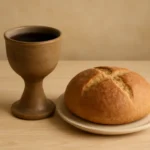
Christian churches do not all use the same type of bread for Communion, also called the Eucharist or the Lord’s Supper. The choice is shaped by how a tradition understands the Last Supper, its relationship to Passover, and the continuity between biblical worship and Christian sacramental practice.
In the Synoptic Gospels, Jesus shares a final meal with his disciples in a setting associated with Passover. Matthew 26, Mark 14, and Luke 22 describe the bread and cup within that meal. The Gospels do not provide a detailed recipe for the bread. They identify its role in the meal and in Jesus’ instruction to his followers.
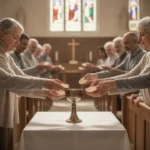
Because the meal is associated with Passover, many Western churches use unleavened bread, often in the form of a thin wafer. The Roman Catholic Church uses unleavened bread for the Eucharist in the Latin tradition. Many Protestant churches also use wafers or unleavened crackers, although Protestant practice varies considerably from one denomination or congregation to another.
Eastern Orthodox churches use leavened bread, commonly called prosphora when prepared for the Divine Liturgy. Eastern Catholic churches generally follow their own Byzantine or other Eastern traditions and may also use leavened bread. These churches connect the bread with the risen Christ and with their understanding of the Eucharist as a living participation in Christ.
The difference is not usually a disagreement about whether one side values Scripture. It reflects different interpretations of the historical meal, different liturgical traditions, and different theological symbols. Churches may also have rules about the ingredients, shape, preparation, and handling of Communion bread.
Why churches choose different breads
Churches that use unleavened bread often emphasize the Passover setting of the Last Supper and the biblical association between that meal and bread without leaven. The plain wafer can also support practical needs: it is easy to portion, store, and distribute during a service.
Churches that use leavened bread may emphasize that the Eucharist celebrates Christ’s resurrection and the fullness of new life. The risen loaf can represent life, transformation, and the gathered body of the church. In some Eastern traditions, the bread’s ingredients and preparation are treated as part of a carefully inherited liturgical practice.
Neither choice by itself determines whether a church is Christian or whether a Communion service is sincere. The meaning comes from the church’s theology and worship, not from assuming that one texture has a universal meaning. If you are visiting a congregation, the church’s practice may be explained in its service materials or by a pastor, priest, or worship leader.
Some Christian communities permit a range of breads, while others require a specific form. Certain churches accommodate people with allergies or dietary restrictions through a separate portion, although policies differ. Gluten-free products may also raise sacramental questions in traditions that require wheat bread, so the safest approach is to ask the congregation before the service.
How the symbolism changes with the biblical context
It is tempting to assign one fixed meaning to each type of bread: unleavened bread as purity and leavened bread as sin. The Bible does not support such a simple formula. Both foods appear in settings that are positive, ordinary, restricted, or symbolic.
Unleavened bread can represent the hurried departure from Egypt, but it can also be ordinary food served during an urgent situation. Its lack of fermentation may support ideas of simplicity or readiness, yet those ideas should not be imposed on every reference.
Leaven can symbolize corruption in one passage and growth in another. Jesus’ comparison in Matthew 13 presents leaven as a small influence that spreads through the dough, illustrating the expansive work of the kingdom of heaven. Paul’s warnings in 1 Corinthians 5 and Galatians 5 use leaven differently, connecting it with behavior or teaching that can affect a wider community.
Read the surrounding passage. The same ingredient may carry different imagery in different settings.
Identify the event. Passover, a grain offering, a household meal, and Communion are not interchangeable contexts.
Consider the audience. Ancient Israelites, Jesus’ disciples, a Corinthian congregation, and modern worshipers may hear different associations.
Separate food from metaphor. A warning about leaven in a letter does not mean all fermented food is forbidden.
Respect tradition. Jewish and Christian communities may preserve practices that cannot be reduced to a single symbol.
The broader lesson is that biblical food references often combine practical, historical, and theological meanings. Bread is a daily staple, so it naturally becomes a powerful way to communicate dependence, hospitality, memory, sacrifice, community, and God’s provision.
How to choose or make each type of bread
For a basic leavened loaf, combine flour, water, yeast, and salt, then allow the dough time to ferment and rise. Kneading develops gluten, and a second rise may improve the loaf’s texture. The exact timing depends on the yeast, temperature, hydration, flour, and desired flavor.
For a simple unleavened flatbread, mix flour and water with salt and, if desired, a small amount of oil. Roll or press the dough thinly and bake it soon after mixing. The result may be crisp if rolled very thin or soft and pliable if made somewhat thicker and cooked briefly on a hot surface.
Use yeast for fermentation: choose this when you want a risen loaf with a developed crumb.
Use baking powder: choose this for quick breads that rise through a chemical reaction rather than yeast fermentation.
Skip the leavener: choose this for crackers, matzo-style bread, or quick flatbreads.
Check religious requirements: follow the rules of the tradition if the bread is being prepared for Passover or Communion.
Do not assume that “no yeast” answers every religious question. A recipe may contain baking powder, sourdough, fermented dairy, or another ingredient that a particular observance treats differently. Likewise, a church may require wheat bread even if a gluten-free substitute would be more comfortable for one worshiper.
Storage also differs. Unleavened crackers and matzo are generally shelf-stable when kept dry, while fresh leavened bread can stale quickly and may develop mold if stored improperly. Freezing is often a practical way to preserve a yeast loaf, but it does not change whether the bread was leavened when it was made.
For everyday eating, the choice comes down to texture, flavor, preparation time, and dietary needs. For religious use, the most reliable answer comes from the specific observance or congregation involved. The central distinction remains clear: leavened bread rises through fermentation or another leavening process, while unleavened bread is made without that rise.
Frequently asked questions
Is sourdough bread leavened bread?
Yes. Sourdough is leavened because a starter contains microorganisms that ferment the dough and produce gases that make it rise. Even when no commercial yeast is added, the fermentation process creates a risen loaf. Whether sourdough is permitted during a religious observance depends on that observance’s rules, not merely on the label used for the bread.
Is unleavened bread the same as gluten-free bread?
No. Unleavened bread describes how the dough rises, while gluten-free bread describes which grains or proteins it contains. Matzo made from wheat is generally unleavened but contains gluten. A gluten-free loaf may still be leavened with yeast, baking powder, or another rising method.
Did Jesus definitely eat unleavened bread at the Last Supper?
The Synoptic Gospels place the meal in a Passover setting, which leads many Christians to understand the bread as unleavened. The Gospel accounts do not provide a detailed recipe, and the relationship between the Gospel timelines has been discussed by scholars. Christian traditions therefore differ in how they apply the connection.
Can Christians use either kind of bread for Communion?
That depends on the church. Some denominations require unleavened bread, while Eastern Orthodox and many Eastern Catholic traditions use leavened bread. Other congregations allow practical variations, including wafers or crackers. If you are attending a specific church, its minister or published Communion guidelines can explain what is permitted.












Leave a Reply