Jewish feasts are sacred times set apart for worship, remembrance, repentance, thanksgiving, and community life. The main biblical feasts are Passover, Unleavened Bread, Firstfruits, Weeks, Trumpets, the Day of Atonement, and Booths, described especially in Leviticus 23.
These festivals follow the Hebrew lunisolar calendar, so their dates move from year to year on the Gregorian calendar. Some last one day, while others extend for a week or more. Jewish communities may also observe later holidays such as Hanukkah, Purim, and the fast of Tisha B’Av, which are meaningful but are not among the seven appointed feasts listed in Leviticus 23.
The Hebrew Bible presents the principal festivals as appointed times for Israel. They were connected with the agricultural year, the Exodus from Egypt, the covenant relationship with God, and the worship conducted at the Jerusalem Temple.
Three festivals were traditionally pilgrimage festivals, when adult Israelite men were instructed to appear before God at the central sanctuary: Passover and Unleavened Bread, Weeks, and Booths. Deuteronomy 16 connects these occasions with communal worship, offerings, generosity, and rejoicing.
After the destruction of the Second Temple in 70 CE, Jewish religious life developed around synagogues, homes, prayer, study, meals, and other practices rather than Temple sacrifices. The festivals retained their biblical themes while their observance adapted to life without the Temple.
Calendar note: Jewish holidays begin at sunset and continue through the following day or days. Their Gregorian dates change annually because the Hebrew calendar combines lunar months with adjustments that keep the festivals in their proper seasons.
The seven biblical Jewish feasts in order
Leviticus 23 gives a structured list of sacred occasions. The order below follows the biblical calendar, beginning in the month of Nisan and moving through the agricultural and religious year.
Passover, or Pesach: observed on the 14th day of Nisan, remembering Israel’s deliverance from slavery in Egypt.
Unleavened Bread: observed from the 15th through the 21st of Nisan, emphasizing the hurried departure from Egypt and the removal of leaven.
Firstfruits: connected with presenting the first portion of the barley harvest to God.
Weeks, or Shavuot: held seven weeks after the offering associated with Firstfruits and connected with the wheat harvest.
Trumpets, or Yom Teruah: observed on the first day of the seventh month, with trumpet or shofar blasts.
The Day of Atonement, or Yom Kippur: observed on the 10th day of the seventh month as a solemn day of repentance and atonement.
Booths, or Sukkot: observed from the 15th through the 21st of the seventh month, with an additional eighth-day assembly in the biblical calendar.
The biblical text also identifies weekly Sabbaths and special Sabbath-like rest days among these sacred times. The festivals should therefore be understood as a connected calendar of worship rather than seven unrelated holidays.
Passover remembers deliverance from Egypt
Passover, called Pesach in Hebrew, centers on the Exodus story. According to Exodus 12, the Israelites marked their homes during the final plague in Egypt, and the judgment “passed over” those households marked according to God’s instructions. The festival therefore became a yearly remembrance of rescue, covenant, and freedom.
In the biblical observance, each household prepared a lamb and ate it with unleavened bread and bitter herbs. The meal was to be eaten in readiness, recalling the Israelites’ urgent departure. Following the destruction of the Temple, the central sacrifice could no longer be offered, so Jewish observance developed around the Passover seder, a structured meal held during the first night or first two nights depending on community practice.
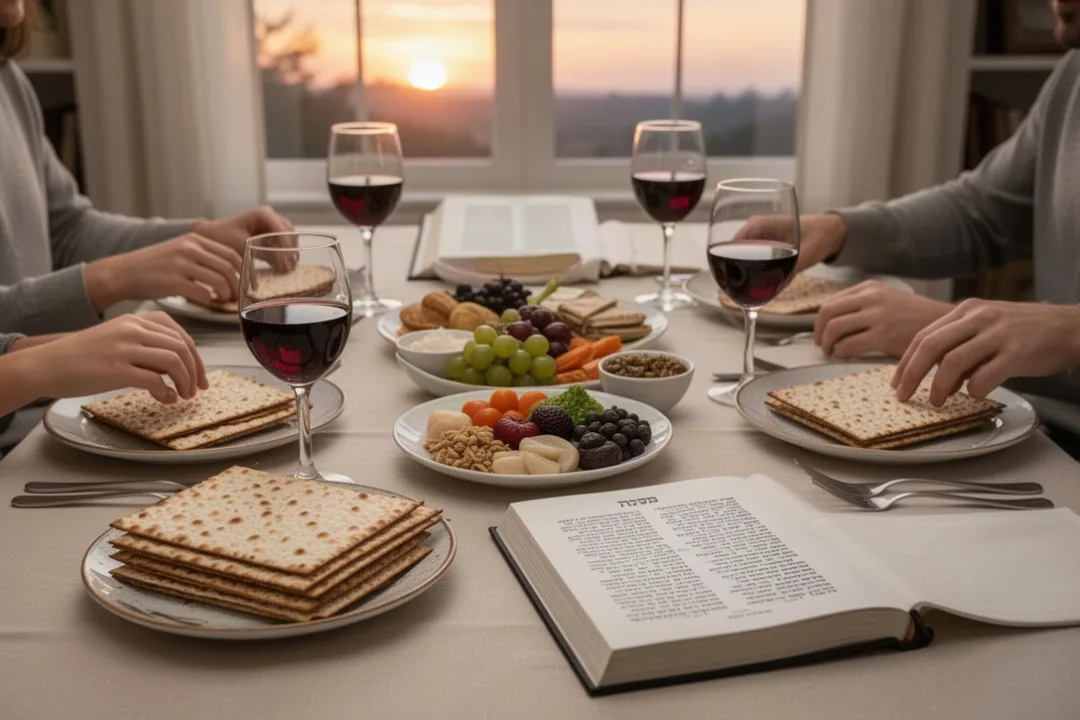
A seder usually includes the retelling of the Exodus, questions from children, symbolic foods, blessings, songs, and four cups of wine or grape juice. The Haggadah provides the order and wording for the service, although its exact form varies among Jewish traditions.
Matzah: unleavened bread associated with the Israelites’ hurried departure.
Maror: bitter herbs representing the bitterness of slavery.
Charoset: a sweet mixture whose texture recalls mortar, while its sweetness can suggest hope and redemption.
Salt water: often associated with tears and suffering.
Roasted foods and wine: included according to the customs of the particular Jewish community.
Passover begins at sunset on the 14th day of Nisan or, in common holiday calculations, the first seder is held on the evening beginning the 15th of Nisan. In Israel, Passover is generally observed for seven days; many Jewish communities outside Israel observe eight days. The first and last days receive especially strong festival status, while intermediate days are known as chol ha-moed, meaning the ordinary or intermediate days of the festival.
Unleavened Bread focuses on simplicity and separation
The Feast of Unleavened Bread follows Passover and lasts seven days, from the 15th through the 21st of Nisan. Its defining practice is abstaining from chametz, foods made from certain grains that have fermented and risen, such as ordinary bread, pasta, and many baked products.
Before Passover, observant Jewish households remove or sell chametz and clean areas where it might be stored. Matzah replaces leavened bread during the festival. The practice is not simply a dietary preference; it creates a physical and household reminder of the Exodus and the speed with which the Israelites left Egypt.
Jewish law distinguishes chametz from kitniyot, a category that can include rice, corn, beans, and similar foods. Ashkenazi and Sephardic communities have traditionally differed over whether kitniyot may be eaten during Passover, and individual practice can vary. Packaged foods also require appropriate kosher certification because ingredients and preparation methods matter.
Unleavened Bread is closely joined to Passover, but the two terms are not identical. Passover refers especially to the sacrifice and meal associated with the Exodus night, while Unleavened Bread describes the following seven-day period and its restrictions.
Firstfruits connects worship with the barley harvest
The Feast of Firstfruits appears in Leviticus 23 as an offering of the first portion of the barley harvest. The priest presented a sheaf before God, and the offering marked the beginning of the harvest season. The people were taught to recognize the harvest as a gift rather than treating it as a possession produced solely by human effort.
Firstfruits is less prominent as a separate home holiday in modern Jewish practice than Passover or Shavuot. Its biblical role is nevertheless important because it establishes a pattern repeated elsewhere in Scripture: the first and best portion is offered in gratitude, and the remainder of the harvest is received with awareness of its source.
The timing of Firstfruits has been interpreted differently by Jewish and Christian traditions. Jewish practice generally counts from the second day of Passover, while some Christian traditions connect Firstfruits with the day after the weekly Sabbath during Passover. These interpretations affect the date of the counting that leads to Shavuot.
Shavuot celebrates harvest and revelation
Shavuot, meaning “weeks,” occurs after seven complete weeks have been counted from the offering associated with Firstfruits. It is also called the Feast of Weeks and Pentecost, the latter name reflecting the Greek term for “fiftieth.” The festival falls in late spring or early summer, in the month of Sivan.
In the Torah, Shavuot is strongly associated with the wheat harvest and the presentation of firstfruits. Later Jewish tradition also connects it with the giving of the Torah at Mount Sinai. These themes combine agricultural gratitude with the responsibilities of covenant life.
Many Jewish communities observe Shavuot through study, prayer, and festive meals. Some keep an all-night study session called Tikkun Leil Shavuot. Synagogues may read the Book of Ruth, which includes harvest scenes and explores loyalty, belonging, and the acceptance of Ruth into the people of Israel.
Shavuot is one of the three pilgrimage festivals in the biblical tradition. Its observance outside Israel commonly lasts two days, while it lasts one day in Israel and in some progressive Jewish communities outside Israel. As with other Jewish holidays, practice depends on denomination, family custom, and local tradition.
Yom Teruah or the Feast of Trumpets begins the seventh month
On the first day of the seventh month, Leviticus 23 calls for a sacred rest and a memorial marked by trumpet blasts. The biblical Hebrew name is commonly rendered Yom Teruah, “day of shouting” or “day of trumpet blasts.” In Jewish tradition, this holiday is known as Rosh Hashanah, the Jewish New Year.
Rosh Hashanah has several layers of meaning. It marks the beginning of the civil year in the Jewish calendar, begins the month of Tishrei, and opens a period of reflection leading toward Yom Kippur. The shofar, usually made from a ram’s horn, calls people to attention and repentance.
Common customs include attending synagogue services, hearing shofar blasts, eating apples with honey, and sharing a festive meal. Apples and honey are associated with hopes for a sweet year, while round challah can symbolize the cycle of the year. Some communities observe Tashlich, a practice involving prayers near moving water and a symbolic casting away of wrongdoing.
Rosh Hashanah is not presented in Leviticus 23 as a New Year celebration in the modern sense, so its later traditions should be distinguished from the brief biblical description. The holiday’s themes developed over time while remaining connected to the sacred seventh-month calendar.
Yom Kippur is a solemn day of repentance and atonement
Yom Kippur, the Day of Atonement, occurs on the 10th day of Tishrei. It is the most solemn day in the Jewish religious calendar. Leviticus 16 describes the Temple rituals associated with atonement, including the high priest’s entrance into the Holy of Holies and rites involving the sins of the people.
Modern Jewish observance no longer includes Temple sacrifices. Instead, the day centers on repentance, prayer, confession, reconciliation, and fasting. Observant adults commonly abstain from food and drink for roughly 25 hours, beginning before sunset and ending after nightfall the next day. People whose health would be endangered by fasting are not expected to risk their well-being.
Yom Kippur services include repeated confessions of wrongdoing, appeals for forgiveness, and prayers for mercy. A traditional confession often uses plural language, acknowledging communal as well as personal failures. The day also emphasizes repairing relationships with other people; seeking forgiveness from God does not replace making amends to someone who has been harmed.
The fast ends with a concluding service called Ne’ilah, followed by the sounding of the shofar in many communities. Families then share a meal after the fast. Yom Kippur is often described as the culmination of the repentance period that begins with Rosh Hashanah.
Health and observance: Fasting customs are religious practices, not a test of physical endurance. Jewish law generally gives priority to preserving life, so people who are pregnant, ill, very young, elderly, or taking necessary medication should follow guidance from a qualified rabbi and health professional.
Sukkot celebrates shelter, harvest, and joy
Sukkot, the Feast of Booths or Tabernacles, begins on the 15th day of Tishrei, five days after Yom Kippur. The Torah gives two related explanations: the festival remembers the temporary dwellings used by the Israelites in the wilderness, and it celebrates the ingathering of the agricultural harvest.
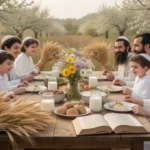
The central symbol is the sukkah, a temporary shelter with a roof made from plant material. The roof must provide shade while leaving enough openness to see the sky. Families may eat meals inside the sukkah, study there, welcome guests, and in some climates sleep there. The structure emphasizes dependence, hospitality, and the temporary character of material security.
Sukkot is also associated with the Four Species: the etrog, lulav, hadas, and aravah. These are traditionally understood as a citron, a palm branch, myrtle branches, and willow branches. They are held together and waved during specified prayers, with customs varying across Jewish communities.
The festival is described as a time of exceptional joy. Its agricultural background explains its older name, the Feast of Ingathering. In ancient Israel, it followed the completion of the major harvest and expressed gratitude for food, rain, and the continuing provision of the land.
The first day, and in many communities the second day, has full festival status. The remaining days are intermediate festival days. After the seven days comes Shemini Atzeret, an additional sacred assembly. In many communities, Simchat Torah is celebrated on Shemini Atzeret in Israel and on the following day outside Israel; it marks the completion and renewal of the annual Torah-reading cycle.
Hanukkah and Purim are important later Jewish holidays
Not every major Jewish holiday belongs to the list in Leviticus 23. Hanukkah and Purim arose from later historical events and are included in the Jewish calendar through traditions recorded after the Torah’s festival legislation.
Hanukkah lasts eight nights and remembers the rededication of the Jerusalem Temple after the Maccabean revolt in the second century BCE. Its most recognizable practice is lighting a hanukkiah, adding one light each night. Other customs include special prayers, festive foods cooked in oil, and games such as dreidel. Hanukkah is not one of the pilgrimage feasts and does not have the same biblical status as Passover or Sukkot.
Purim commemorates the deliverance of the Jewish people in the Persian Empire as told in the Book of Esther. It is observed through reading the Megillah, giving gifts of food, donating to those in need, and sharing a festive meal. Costumes and celebratory gatherings are common in many communities, though the exact style of observance varies.
Other significant dates include Tisha B’Av, a fast mourning the destruction of the First and Second Temples, and several minor fasts connected with periods of national tragedy. These days broaden the Jewish calendar beyond celebration by giving space to grief, memory, and communal reflection.
How the Hebrew calendar determines feast dates
The Hebrew calendar uses lunar months while maintaining a relationship with the solar year. A lunar year is shorter than a solar year, so the calendar periodically adds an extra month. This adjustment keeps Passover in the spring and Sukkot in the autumn rather than allowing the festivals to drift through every season.
Jewish days begin at sunset, based on the biblical pattern of describing evening and morning. This means a holiday listed as occurring on a particular date begins the previous evening in the Gregorian calendar. For example, a festival dated 15 Tishrei begins at sunset at the end of 14 Tishrei.
The exact Gregorian date changes each year. Communities also differ over whether certain festivals last one or two days outside Israel. To find the date for a particular year, use a reliable Jewish calendar and confirm the local observance customs, especially for work restrictions, fasts, and synagogue schedules.
Common practices shared across Jewish feasts
Although each festival has its own history, several practices recur throughout the Jewish calendar. They turn historical memory into embodied, communal worship rather than leaving the festivals as abstract ideas.
Special prayers: Festival liturgy includes additions such as Hallel, a collection of psalms used on many joyous occasions.
Festive meals: Food connects households with memory, gratitude, and hospitality.
Rest from ordinary labor: Major festival days often include restrictions modeled on Sabbath rest.
Torah readings: Synagogues read passages related to the festival and its meaning.
Charity and hospitality: Celebration is traditionally linked with sharing food and resources with guests, strangers, and people in need.
Family education: Stories, questions, songs, and rituals help pass communal memory to children.
Observance is not identical for every Jewish person. Orthodox, Conservative, Reform, Reconstructionist, secular, and unaffiliated Jews may differ in their approach to work, dietary law, synagogue attendance, fasting, gender roles, and holiday length. Sephardic, Mizrahi, Ashkenazi, Ethiopian, and other Jewish communities also preserve distinct melodies, recipes, customs, and interpretations.
How the feasts are understood in Christian readings of the Bible
Christians often study the Jewish feasts because Jesus and the earliest disciples lived within Jewish religious practice. The New Testament places the events surrounding Jesus’ death near Passover, describes Pentecost in relation to Shavuot, and refers to other Jewish festivals. These references make knowledge of the Jewish calendar useful for reading the New Testament in its historical setting.
Christian traditions interpret the feasts in different ways. Some see Passover as illuminating themes in Jesus’ death, Firstfruits as connected with resurrection, and Shavuot or Pentecost as connected with the coming of the Holy Spirit. Others focus primarily on the festivals as Jewish practices and historical context, without treating them as predictions that must be fulfilled in a particular Christian manner.
These interpretations should not erase the festivals’ continuing Jewish meaning. Jewish feasts belong to Jewish covenantal life, community, worship, and history. Christians who study them respectfully should avoid presenting Jewish observance merely as a set of symbols for another religion.
Ways to learn about Jewish feasts respectfully
Reliable learning begins by distinguishing the biblical text from later Jewish interpretation and modern practice. A description of an ancient Temple offering is not the same as a description of what a Jewish family does today.
Start with the primary passages: read Leviticus 23, Exodus 12–13, Numbers 28–29, and Deuteronomy 16 for the biblical framework.
Study the Hebrew names: terms such as Pesach, Shavuot, Yom Kippur, and Sukkot often reveal connections that English labels can hide.
Check the community context: ask whether a practice is Orthodox, Reform, Conservative, Sephardic, Ashkenazi, Israeli, or associated with another tradition.
Use current calendars carefully: verify sunset times, holiday dates, and local customs instead of relying on a fixed Gregorian date.
Learn from Jewish voices: synagogue educational programs, Jewish museums, reputable rabbinic resources, and community events can provide context that a brief summary cannot.
Do not imitate sacred rituals casually: attending an invited seder or educational program is different from treating Jewish worship as a costume, theme, or religious prop.
The Jewish feasts form a yearly pattern of remembrance and response. Passover recalls liberation, Shavuot joins harvest with Torah, the High Holy Days call for repentance, and Sukkot teaches gratitude and humility. Together, these sacred times connect history, worship, land, community, and daily life.
Frequently asked questions
Are Jewish feasts the same as Jewish holidays?
The terms overlap, but “feasts” often refers specifically to the biblical appointed times listed in the Torah, especially Leviticus 23. “Jewish holidays” is broader and includes those festivals as well as later observances such as Hanukkah, Purim, Tisha B’Av, and modern national or commemorative days.
Which Jewish feast is the most important?
There is no single answer for every Jewish context. Passover is central because it remembers the Exodus, Yom Kippur is the most solemn day of repentance, and Sukkot is one of the three biblical pilgrimage festivals. Importance can depend on theology, family tradition, and the particular Jewish denomination.
Why do Jewish holidays change dates every year?
Jewish holidays follow the Hebrew lunisolar calendar rather than the Gregorian calendar. Its months are based on lunar cycles, while periodic calendar adjustments keep festivals in their appropriate agricultural seasons. As a result, a holiday may occur on different Gregorian dates from year to year, although it remains fixed in the Hebrew calendar.
Do Jewish people still offer sacrifices during these feasts?
No. Temple sacrifices ended after the destruction of the Second Temple in 70 CE. Modern Jewish observance expresses the festivals through prayer, Torah reading, meals, fasting, charity, home rituals, and synagogue worship. Different Jewish communities interpret and practice these traditions in distinctive ways.











Leave a Reply