The Festival of Weeks is Shavuot, a Jewish festival celebrated seven weeks after Passover to mark the wheat harvest and, in Jewish tradition, the giving of the Torah at Mount Sinai.
The English name Festival of Weeks comes from the festival’s timing: people counted seven complete weeks from Passover and then observed a sacred festival. The Hebrew name, Shavuot, means “weeks.” In Greek, the festival is called Pentecost, meaning “fiftieth,” because it came on the fiftieth day of the count.
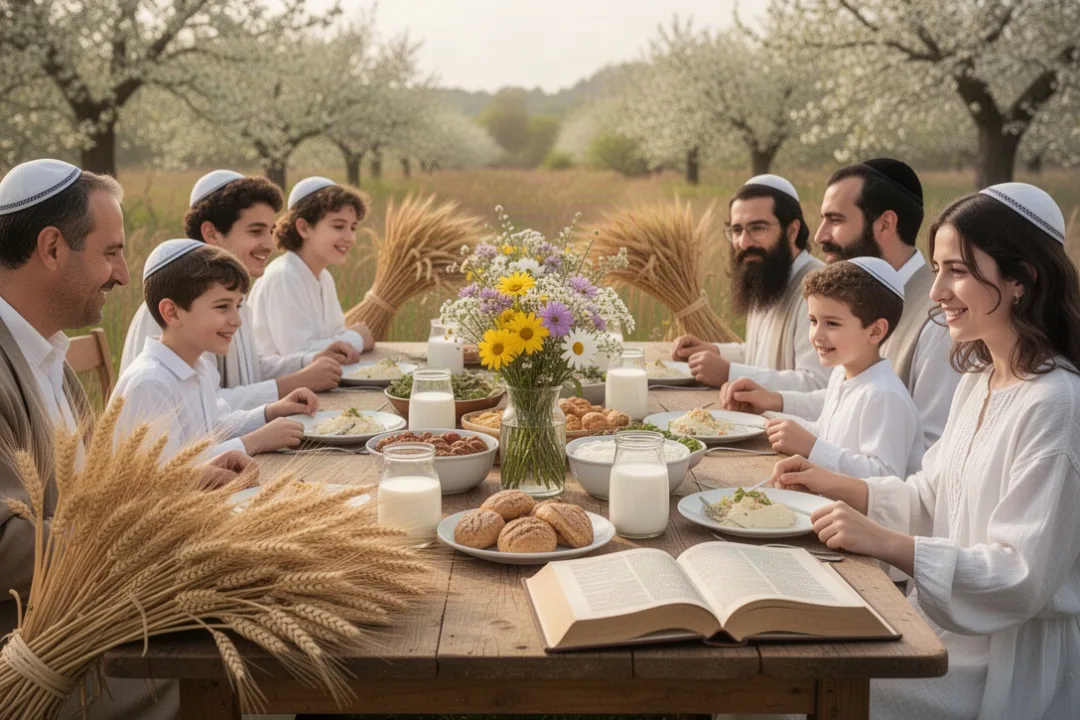
Shavuot has two closely connected meanings. In the biblical calendar, it is an agricultural celebration of the wheat harvest and an offering of first produce to God. In later Jewish tradition, it became especially associated with the revelation of the Torah at Mount Sinai, when the Israelites received God’s commandments after leaving Egypt.
The festival therefore connects physical food with spiritual teaching. The first grain harvest provided bread for the community, while the Torah gave Israel a pattern for worship, ethics, community life, and its relationship with God. Both themes remain central to how Jewish people understand and observe Shavuot.
The central idea: Shavuot celebrates both the harvest that sustains life and the Torah that guides life.
The festival is one of the three major pilgrimage festivals described in the Hebrew Bible. The other two are Passover, which remembers the Israelites’ liberation from Egypt, and Sukkot, which recalls the wilderness journey and celebrates the harvest season. In ancient Israel, these festivals were connected with pilgrimage to the sanctuary, eventually the Temple in Jerusalem.
When the Festival of Weeks takes place
Shavuot follows a period known as the Counting of the Omer. The count begins during Passover and continues for seven weeks, or forty-nine days. The festival is observed on the next day, the fiftieth day. This explains the festival’s Greek name, Pentecost.
The biblical instructions appear in passages including Leviticus 23, Numbers 28, and Deuteronomy 16. These texts describe counting from the time of the early grain offering until the wheat harvest reaches its festival offering. The agricultural timing made Shavuot a seasonal event as well as a religious one.
Jewish communities generally observe Shavuot on Sivan 6 in the Hebrew calendar. In many communities outside Israel, it is observed for two days, on Sivan 6 and 7, following a traditional practice connected with the historical difficulty of communicating the precise date of the new month. In Israel and in many Reform Jewish communities, it is commonly observed for one day.
Because the Hebrew calendar is lunar-based and adjusted to remain aligned with the seasons, Shavuot moves from year to year on the Gregorian calendar. It usually falls in May or June. Its date can also differ from the Christian observance of Pentecost because Jewish and Christian calendars calculate their related festivals differently.
The counting period gives the festival a sense of movement from one major event to another. Passover celebrates freedom from slavery, while Shavuot represents the purpose and responsibility that follow freedom. In this interpretation, leaving Egypt was not the end of Israel’s story; receiving the Torah established a covenant and a way of life.
Why the number fifty matters
The number seven has a strong place in the biblical calendar, often representing a completed cycle. Seven weeks create a full period of preparation after Passover. The fiftieth day comes after those seven weeks and represents the festival itself, with its offerings, sacred assembly, and thanksgiving.
The count also helps connect the two festivals. Passover and Shavuot are not isolated celebrations. The first begins the grain season and remembers deliverance; the second brings the early harvest to its religious fulfillment and remembers the covenant. Counting the days encourages people to keep both events in view.
Passover: remembers liberation from Egypt and begins the counting period.
Seven weeks: mark a period of counting, preparation, and anticipation.
Shavuot: celebrates the wheat harvest, the Torah, and the covenant.
Pentecost: is the Greek name connected with the fiftieth day.
What the Hebrew Bible says about the festival
The Festival of Weeks is named and described in several parts of the Torah. Each passage highlights a somewhat different feature, which helps explain the festival’s rich character.
Exodus 23 places the Festival of Harvest within Israel’s annual cycle of worship. It associates the celebration with the first produce of the crops. The emphasis is on bringing the earliest and best portion of the harvest as an acknowledgment that the land and its produce are gifts from God.
Exodus 34 also refers to the Festival of Weeks in connection with the first fruits of the wheat harvest. This setting reinforces the difference between the spring barley harvest associated with Passover and the later wheat harvest associated with Shavuot.
Leviticus 23 gives more detailed instructions. After counting seven weeks, the Israelites were to bring a new grain offering. The passage describes two loaves baked with leaven and directs the community to present animal offerings as part of the festival worship. The ceremony expressed gratitude for the harvest and recognized God as its source.
Numbers 28 describes the additional offerings connected with the festival. These instructions belong to the sacrificial worship of the ancient sanctuary and Temple. Since the Temple in Jerusalem no longer stands, contemporary Jewish observance does not reproduce those sacrifices.
Deuteronomy 16 emphasizes the festival as a time of rejoicing before God. It specifically includes family members, servants, Levites, foreigners, orphans, and widows among those who should share in the celebration. This gives Shavuot a strong social dimension: gratitude for provision should include people who might otherwise be excluded.
The biblical texts do not present the agricultural meaning and the communal meaning as competing ideas. A successful harvest creates an obligation to share, worship, and remember dependence on God. The festival joins gratitude, generosity, and responsibility.
Historical distinction: The Torah describes Shavuot primarily through its harvest offerings and sacred assembly. The specific association with the giving of the Torah became central in Jewish tradition as the festival’s meaning developed.
How Shavuot became connected with the giving of the Torah
The biblical account of the Israelites arriving at Mount Sinai appears in Exodus 19–20, soon after the exodus from Egypt. The text does not explicitly call that event “Shavuot” or state that it occurred on the fiftieth day. Jewish interpretation later connected the timing of Sinai with the festival that arrives after Passover.
This connection is meaningful because the Torah transforms liberation into a covenant relationship. The Israelites are not only rescued from forced labor; they become a people with shared obligations. The commandments address worship, justice, property, family relationships, treatment of workers, and care for vulnerable people.
In Jewish thought, the Torah can mean more than the first five books of the Hebrew Bible. It may refer specifically to the five books traditionally associated with Moses, or more broadly to Jewish teaching and instruction. On Shavuot, many communities celebrate the Torah as a living source of wisdom and covenant identity.
The tradition of receiving the Torah also explains why Shavuot is sometimes described as the Jewish “birthday” of the covenant community. The comparison is not a biblical title, but it expresses the idea that Israel’s national identity was shaped not only by shared ancestry and liberation but also by a shared sacred teaching.
The account of Sinai includes thunder, lightning, a cloud, a mountain, and a powerful divine presence. Jewish interpretation often focuses less on reconstructing the event as a modern historical scene and more on what revelation means: God’s instruction enters communal life, and the people accept responsibilities that affect every part of society.
One traditional explanation for Shavuot customs is that the Torah should be approached as though it is received anew each year. The annual festival is not simply a commemoration of something finished long ago. It renews a community’s attention to study, practice, and moral responsibility.
Practices vary among Orthodox, Conservative, Reform, and other Jewish communities, as well as among Jewish families with different cultural traditions. Still, several customs are widely associated with Shavuot.
Studying Torah through the night
Many communities hold a Tikkun Leil Shavuot, an evening or all-night program of Torah study. The Hebrew phrase can be understood as a spiritual preparation or “repair” connected with the night before receiving the Torah. Participants may study biblical passages, rabbinic texts, Jewish philosophy, poetry, or other subjects related to Jewish learning.
Some people attend a synagogue study program, while others study with family or friends. The practice is not required for every Jew, and people who do not stay awake all night may observe the holiday in other ways. Its purpose is to express eagerness for learning and respect for the Torah.
Reading the Book of Ruth
The Book of Ruth is traditionally read during Shavuot. Several connections help explain this custom. Ruth’s story takes place during the barley and wheat harvests, placing it in the agricultural world of the festival. It also presents themes of loyalty, generosity, family responsibility, and inclusion.
Ruth is a Moabite woman who joins the people of Israel and becomes part of the family line of King David. Her story highlights the possibility of belonging through faithful action rather than ancestry alone. It also features Boaz’s generous treatment of harvest workers and the poor, echoing the Torah’s concern for sharing agricultural abundance.
Eating dairy foods
Many Jewish communities eat dairy foods on Shavuot, including cheesecake, blintzes, cheese pastries, and other regional dishes. Several explanations for this custom exist. Some connect dairy with the imagery of the Torah as nourishing or with the biblical description of the land as flowing with milk and honey. Others point to practical or symbolic interpretations associated with receiving new dietary laws.
Food customs differ widely by region and family. Sephardic, Mizrahi, Ashkenazi, and other Jewish communities have developed distinctive Shavuot recipes. In some homes, dairy foods are served at one meal and meat at another, reflecting traditional rules about separating meat and dairy.
Decorating with greenery and flowers
Many communities decorate synagogues and homes with greenery, flowers, and branches. One reason is that Shavuot falls during the season when fields and trees are flourishing. Another traditional interpretation connects Mount Sinai with a landscape that became associated with plants and growth.
Some customs also refer to Shavuot as the day on which the world is judged regarding the fruit of trees, although practices and explanations vary. The greenery gives the holiday a visible connection to spring, harvest, and the land.
Bringing children into the celebration
Families may mark Shavuot through special meals, synagogue services, storytelling, crafts, or study activities for children. A child may learn about the harvest, the Ten Commandments, Ruth, or the idea of receiving Torah. The goal is to make the festival’s themes accessible without reducing them to a single story.
At the synagogue, readings and prayers often emphasize the holiday’s sacred assembly and its connection with revelation. Communities may also hold confirmation ceremonies or other educational events around Shavuot, although these practices are not universal.
Attend a synagogue service or community study session.
Read the Book of Ruth and discuss its themes of loyalty and generosity.
Prepare a meal featuring traditional dairy foods from your family’s heritage.
Learn about the Counting of the Omer and the relationship between Passover and Shavuot.
Give food or practical help to someone who may not share in the holiday’s abundance.
How Shavuot relates to Christian Pentecost
Pentecost is the Christian name for the fiftieth day after Easter. It is described in Acts 2, where Jesus’ disciples are gathered in Jerusalem and experience the arrival of the Holy Spirit. The account includes wind, fire-like imagery, and speech understood by people from different places.
The Christian event occurs during the Jewish pilgrimage festival of Shavuot. Acts describes Jerusalem as filled with Jewish visitors from many regions who have come for the feast. This setting is significant because the Christian story presents the disciples’ message going out across language and geographic boundaries.
Christian Pentecost is therefore historically connected to the Jewish Festival of Weeks, but the two observances are not identical. Shavuot remains a Jewish festival centered on harvest, Torah, covenant, and Jewish communal life. Christian Pentecost commemorates the coming of the Holy Spirit and the public beginning of the church’s mission in the Christian tradition.
Some Christians use “Pentecost” to refer to the season or day in the church calendar, while others emphasize the gifts of the Holy Spirit described in the New Testament. Churches may observe it with special worship services, readings from Acts, baptismal celebrations, or the wearing of liturgical colors associated with the feast.
The shared timing should not erase the differences between the traditions. Shavuot belongs to the Jewish calendar and continues as a living Jewish holiday. Pentecost belongs to the Christian calendar and interprets the events of Acts through Christian beliefs about Jesus and the Holy Spirit.
What the Festival of Weeks teaches about harvest and community
Shavuot’s agricultural background gives the festival a practical message. Food does not appear by accident. Harvest depends on land, rain, labor, animals, tools, and the cooperation of many people. The biblical instructions turn that recognition into worship and require the community to share its joy.
The command to include vulnerable people in the celebration is especially important. Deuteronomy connects rejoicing with the Levite, foreigner, orphan, and widow. These groups represented people who might lack land, family protection, or a stable source of income. A festival was not considered complete if its benefits were limited to those who already had security.
That principle can guide contemporary observance without pretending that modern life is the same as ancient agriculture. A family might donate to a food pantry, invite someone who would otherwise be alone, support farmworkers, or make sure a communal meal is accessible to people with different dietary needs.
The festival also teaches that freedom and responsibility belong together. Passover tells the story of release from oppression; Shavuot asks what a liberated people will do with its freedom. The answer includes building a just community, receiving moral instruction, and using abundance for the good of others.
For Jewish people, Shavuot can be a time to reconnect with study and Jewish identity. For Christians studying the New Testament, it provides the historical setting for Pentecost. For anyone learning about biblical festivals, it offers a clear example of how an observance can preserve several layers of meaning: agricultural, historical, spiritual, communal, and ethical.
At its heart, the Festival of Weeks is not only about counting days. It is about recognizing what comes after deliverance: gratitude for provision, commitment to instruction, and responsibility to share the harvest with the whole community.
Frequently asked questions
Is the Festival of Weeks the same as Pentecost?
They are historically related but are not the same observance. The Festival of Weeks is the Jewish holiday Shavuot, celebrated after the counting of seven weeks from Passover. Pentecost is the Christian feast observed fifty days after Easter, commemorating the coming of the Holy Spirit in Acts 2. The Christian feast takes place during the Jewish festival’s historical setting.
Why is Shavuot called the Festival of Weeks?
The name refers to the seven weeks counted after Passover. The festival follows that seven-week period and is associated with the fiftieth day, which explains the Greek name Pentecost. The count also connects Passover’s remembrance of liberation with Shavuot’s themes of harvest, covenant, and receiving the Torah.
What foods are traditionally eaten on Shavuot?
Dairy foods are especially common, including cheesecake, blintzes, cheese pastries, and other regional dishes. Customs differ among Jewish communities, and many families prepare foods reflecting their own cultural background. The practice has several traditional explanations, including associations with nourishment, the land of Israel, and the experience of receiving new religious teachings.
Why is the Book of Ruth read during Shavuot?
Ruth is set during the harvest season, which fits Shavuot’s agricultural origins. Its story also emphasizes loyalty, generosity, inclusion, and responsibility toward people in need. Ruth’s acceptance into the Israelite community and her connection to the family line of David add further significance for Jewish readers during a festival associated with covenant and communal identity.














Leave a Reply