Vatican 2: What the council changed and why it matters
Vatican 2: What the council changed and why it matters
If you have wondered why Catholic Mass looks different from older photographs, why priests often celebrate in the local language, or what people mean when they say “before Vatican II,” the answer begins with the Second Vatican Council. Usually called Vatican II, it was a worldwide meeting of Catholic bishops held in Rome from 1962 to 1965.
Vatican II did not create a new church or reject everything that came before it. It addressed how the Catholic Church could present its enduring faith, worship more meaningfully, and relate to other Christians, other religions, and the modern world. Its sixteen official documents continue to influence Catholic life, even though Catholics disagree about how some reforms were implemented.
The short answer: Vatican II renewed Catholic life by emphasizing the Church as the People of God, encouraging active participation in worship, promoting Scripture and lay responsibility, and improving relationships with other Christians and religions.
Vatican II was an ecumenical council, meaning a formal gathering of Catholic bishops from around the world under the authority of the pope. The council was announced by Pope John XXIII in 1959 and opened on October 11, 1962. John XXIII died in 1963, and Pope Paul VI guided the council through its remaining sessions until it closed on December 8, 1965.
More than 2,000 bishops participated, along with theologians, observers from other Christian communities, and other advisers. The council met in four sessions, generally during the fall of each year. Its documents were approved by the bishops and promulgated by the pope, giving them a central place in modern Catholic teaching.
The council’s purpose was not to define a long list of new doctrines. Instead, it was primarily a council of renewal and pastoral teaching. John XXIII described the need to present Catholic teaching in a way that could be understood by contemporary people while remaining faithful to the Church’s tradition.
The word aggiornamento is often associated with Vatican II. It is commonly translated as “bringing up to date,” but the phrase did not mean discarding the past. The council sought to distinguish between the unchanging core of Christian faith and the forms, practices, and language that could develop over time.
Why the Catholic Church called Vatican II
The council took place after major social and intellectual changes. Two world wars, the Holocaust, nuclear weapons, decolonization, mass communication, scientific developments, and growing religious pluralism had altered the questions people were asking. Many Catholics also experienced a gap between the Church’s official language and their daily lives.
Church leaders were concerned with several related needs:
Renewing Christian faith through Scripture, theology, preaching, and catechesis.
Improving worship so that the faithful could participate more consciously and actively.
Clarifying the Church’s identity and the responsibilities of bishops, priests, religious communities, and laypeople.
Promoting Christian unity after centuries of division among Christian communities.
Responding to religious freedom and human dignity in societies with different beliefs.
Addressing modern social conditions such as war, poverty, economic change, and political life.
These concerns explain why Vatican II addressed both internal Catholic matters and the Church’s relationship with the wider world. The council’s approach was pastoral, but “pastoral” did not mean merely practical or optional. The bishops used pastoral language to apply Catholic teaching to concrete human circumstances.
What the four constitutions taught
The four constitutions are generally regarded as the council’s most important documents. A constitution is a particularly authoritative type of conciliar document. Together, these texts cover the liturgy, the Church, divine revelation, and the Church’s relationship with the modern world.
Sacrosanctum Concilium and the renewal of Catholic worship
Sacrosanctum Concilium, the Constitution on the Sacred Liturgy, was approved in 1963. It called the liturgy the source and summit of Christian life and asked that the faithful participate in worship with greater understanding and engagement.
The constitution led to the reform of the Roman Rite. This reform included changes to the structure of the Mass, expanded use of the vernacular, more Scripture readings, greater congregational participation, and revisions to other sacraments and liturgical rites. The revised Roman Missal was introduced after the council through subsequent work by Church authorities.
Vatican II did not simply say that Latin must disappear. It stated that Latin remained the language of the Roman Rite while allowing the vernacular to be used when beneficial for the people. The council also preserved Gregorian chant as a tradition deserving a distinctive place, even though later parish practice often developed in different directions.
The council emphasized that the liturgy is an action of the whole Church, not a private performance by the priest. That principle helps explain practices such as congregational responses, lay readers, singing, and the distribution of Communion by authorized ministers. These roles are meant to serve the liturgy, not turn the Mass into a collection of unrelated activities.
Lumen Gentium and the Church as the People of God
Lumen Gentium, the Dogmatic Constitution on the Church, was promulgated in 1964. It presents the Church as a mystery rooted in Christ and describes the Church as the People of God, the Body of Christ, and a temple of the Holy Spirit.
One of its most influential teachings is the universal call to holiness. Holiness is not reserved for priests, monks, nuns, or people with unusual religious gifts. Every baptized Christian is called to live faithfully, serve others, practice charity, and grow in union with God within the circumstances of ordinary life.
The document also explains the distinct but connected roles of the pope, bishops, priests, deacons, religious, and laypeople. It affirms the pope’s authority while giving greater attention to the collegiality of bishops—the idea that bishops share responsibility for the Church in communion with the pope.
Lay Catholics are described not as passive recipients of religious instruction but as members with a real vocation and responsibility. Their work in families, neighborhoods, professions, civic life, and culture can be a way of living the Christian mission. This helped encourage parish councils, lay ministries, Catholic social action, and broader participation in Church life.
Dei Verbum and the importance of Scripture
Dei Verbum, the Dogmatic Constitution on Divine Revelation, was promulgated in 1965. It explains how God communicates with humanity through both Scripture and tradition, understood together within the life of the Church.
The document gave fresh emphasis to the Bible in Catholic life. It encouraged bishops, clergy, theologians, and laypeople to read Scripture regularly and stressed that preaching should be nourished by the biblical text. Catholic biblical scholarship was also encouraged, provided it remained attentive to the Church’s faith and the unity of Scripture.
One practical result was the expansion of biblical readings in the liturgy. Catholics hear a much broader selection of the Old and New Testaments at Mass than many worshipers did before the reform. Bible study, Scripture-based prayer, and lectio divina also received renewed attention.
Dei Verbum does not present Scripture and tradition as competing sources where one must be chosen over the other. It describes them as closely connected ways through which the Church receives and hands on the Gospel. The document also teaches that the Church’s teaching office serves the word of God rather than standing above it.
Gaudium et Spes and the Church’s relationship with the modern world
Gaudium et Spes, the Pastoral Constitution on the Church in the Modern World, was promulgated in 1965. It begins with the human person and addresses social realities such as marriage and family life, culture, economic activity, politics, peace, and war.
The document says the joys, hopes, griefs, and anxieties of people—especially those who are poor or suffering—should matter deeply to the Church. This does not mean accepting every modern trend. It means taking human experience seriously and examining social conditions in light of human dignity and the common good.
Gaudium et Spes helped shape later Catholic discussions of social justice, religious involvement in public life, international cooperation, and the moral responsibilities of economic systems. It also reflects Vatican II’s conviction that faith should not be isolated from questions about work, family, education, government, poverty, and peace.
How Vatican II changed the Mass
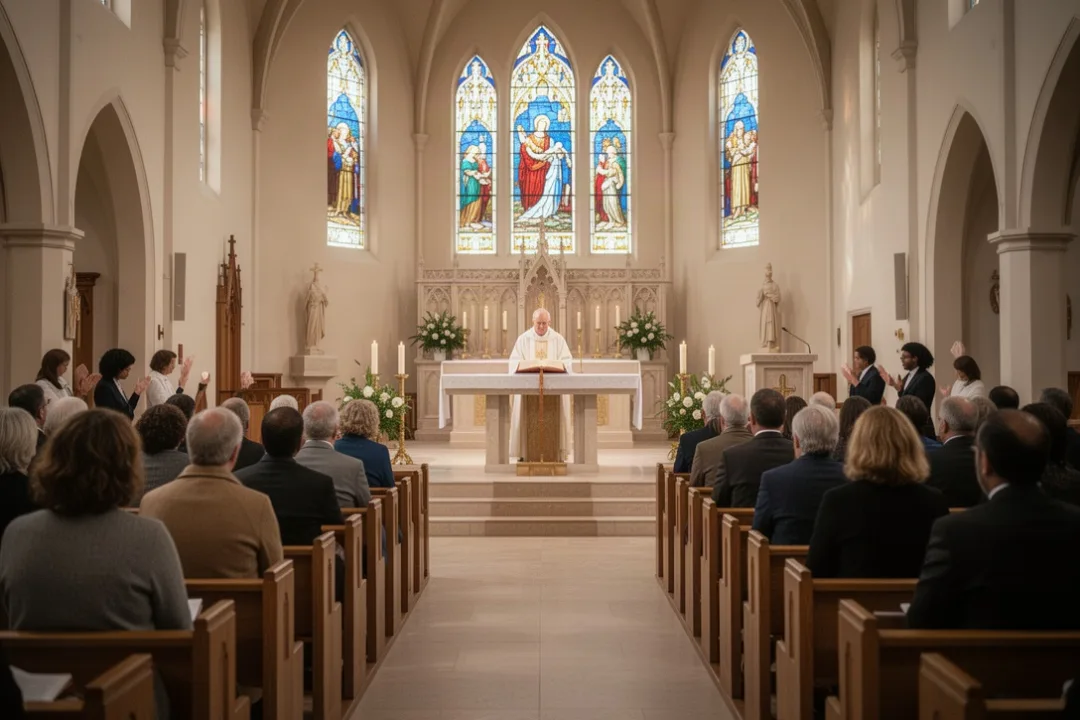
For many Catholics, the most visible effects of Vatican II appear at Mass. The council’s liturgical constitution set principles that were later applied through a substantial revision of the Roman Missal and other rites.
The revised Roman Rite commonly includes:
More use of the local language, although Latin remains an official language of the Roman Rite.
A broader cycle of Scripture readings, with readings from the Old Testament, Psalms, New Testament letters, and Gospels.
More audible and understandable prayers so the congregation can follow the action of the liturgy.
Expanded lay participation through roles such as lector, cantor, server, extraordinary minister of Holy Communion, and music minister.
Greater emphasis on the homily as part of the liturgical celebration.
Revised rites for baptism, marriage, anointing of the sick, funerals, and other sacraments.
Some changes often attributed directly to Vatican II were actually decisions made during the later implementation of the council’s principles. For example, the council called for liturgical reform, but it did not itself publish the current form of the Roman Missal. This distinction matters when evaluating what the council said versus what happened afterward.
Vatican II also did not require every Mass to be celebrated facing the congregation. It called for a liturgy that encouraged participation and permitted certain adaptations. The physical arrangement of churches, the language used, music, and other details developed through later instructions and local practice.
A common misconception: Vatican II did not abolish the Latin language, remove the sacrificial character of the Mass, or declare older Catholic devotions invalid. The council called for renewal while retaining the central reality of the Eucharist and the Church’s sacramental faith.
What Vatican II taught about other Christians and religions
Vatican II significantly changed the tone and framework of Catholic relations with other Christians. The council recognized that Christians separated from full communion with the Catholic Church still possess genuine elements of Christian faith and holiness. These can include baptism, Scripture, prayer, charity, and other gifts of Christian life.
Unitatis Redintegratio, the Decree on Ecumenism, encouraged dialogue, prayer, conversion of heart, and cooperation among Christians. It did not claim that all Christian differences were unimportant. Instead, it sought unity through truth, charity, and a clearer understanding of how division developed.
Nostra Aetate, the Declaration on the Relation of the Church to Non-Christian Religions, addressed the Catholic relationship with Judaism, Islam, Hinduism, Buddhism, and other religious traditions. It encouraged respect and dialogue while affirming the distinctiveness of Christian faith.
The section on Judaism has special importance. It rejects blaming all Jews, past or present, for the death of Jesus and condemns hatred, persecution, and antisemitism. This teaching helped establish a new foundation for Catholic-Jewish relations and encouraged continued theological and historical dialogue.
Vatican II’s approach does not mean that the Catholic Church considers every religion identical or that religious differences no longer matter. It means Catholics are called to recognize truth and goodness wherever they are found, treat people of other faiths with respect, and reject coercion or hostility as ways of presenting Christianity.
What Vatican II taught about religious freedom
Dignitatis Humanae, the Declaration on Religious Freedom, teaches that the human person has a right to religious freedom. People should not be forced to act against their conscience in religious matters, nor should they be prevented from seeking, accepting, and living according to religious truth within appropriate limits of public order.
This teaching rests on the dignity of the human person and the nature of faith. A genuinely religious act must be free rather than compelled. The declaration also recognizes that governments have responsibilities to protect public order and the rights of others, so religious freedom is not a license to harm people or disregard civil law.
The declaration represented a major development in the way the Church articulated its position in relation to modern constitutional societies. It is frequently discussed alongside earlier Catholic statements, with scholars and Church leaders examining how the teaching develops while remaining connected to the Church’s concern for truth and the common good.
How Vatican II affected clergy, religious life, and lay Catholics
Vatican II presented the Church as a community in which every baptized person has a vocation. The council did not erase differences between ordained ministry and lay life. Instead, it emphasized that distinct roles should serve one mission: witnessing to Christ and building up the Church.
For priests, the council highlighted preaching, sacramental ministry, pastoral care, and collaboration with the bishop and lay faithful. The decree Presbyterorum Ordinis describes the priest’s ministry in relation to the Eucharist, the word of God, and the service of the Christian community.
For bishops, Christus Dominus emphasizes their pastoral responsibility, their communion with the pope, and their care for the local churches entrusted to them. The council also encouraged greater cooperation among bishops and the development of structures that could address regional and worldwide concerns.
For religious communities, Perfectae Caritatis called for renewal adapted to changing circumstances while preserving the essential character of religious life. Communities were encouraged to return to the sources of their founding charisms, Scripture, and the Gospel, while examining customs that no longer served their mission.
For laypeople, Apostolicam Actuositatem teaches that apostolic work is not confined to ordained ministers. Lay Catholics can serve the Church and society through family life, professional work, civic responsibility, charitable activity, education, and organized apostolic efforts.
What Vatican II did not change
Vatican II is sometimes described as a complete break with the Catholic past. That interpretation overlooks the council’s own language. Its documents repeatedly appeal to Scripture, earlier councils, the Church Fathers, liturgical tradition, and the ongoing teaching of the Church.
The council did not change the Catholic belief in:
The Trinity: one God in three divine Persons.
The incarnation: Jesus Christ as truly God and truly human.
The sacraments, including baptism and the Eucharist.
The real presence of Christ in the Eucharist.
The authority of Scripture and apostolic tradition.
The role of the pope and bishops in teaching and governing the Church.
The importance of Mary and the saints, understood within worship directed to God.
At the same time, saying that Vatican II changed nothing would also be inaccurate. It changed the Church’s pastoral language, liturgical discipline, ecumenical posture, approach to religious freedom, and understanding of the responsibilities of the baptized. Catholic teaching can preserve its identity while developing its expression and application.
Practical ways to understand Vatican II without common mistakes
Vatican II includes complex documents written in a formal theological style. Reading isolated phrases can produce a distorted picture, especially when a passage is separated from the document’s larger argument or from the council’s historical context.
Start with the document’s subject. Read Sacrosanctum Concilium for the liturgy, Lumen Gentium for the Church, Dei Verbum for revelation, and Gaudium et Spes for the Church’s engagement with the modern world.
Separate the council from later implementation. Ask whether a practice came directly from a conciliar text or from later instructions, revisions, or local decisions.
Read the whole section. A single sentence about vernacular worship, religious freedom, or non-Christian religions may seem different when read alongside the qualifications surrounding it.
Compare old and new practices carefully. A change in language, posture, music, or church architecture does not automatically mean a change in doctrine.
Use reliable Catholic sources. The official council documents, the Catechism of the Catholic Church, and responsible historical scholarship provide better context than slogans about being “for” or “against” Vatican II.
Distinguish legitimate debate from false claims. Catholics may debate liturgical style or the council’s pastoral effectiveness without claiming that the council abolished basic Christian beliefs.
Several mistakes appear frequently in conversations about Vatican II. One is treating the council as if it personally designed every parish practice that appeared afterward. Another is assuming that any post-1965 change must have been required by the council. A third is reducing the council to the liturgy while ignoring its teachings on Scripture, the Church, religious liberty, ecumenism, and social responsibility.
It is also misleading to use “pre-Vatican II” and “post-Vatican II” as if Catholics before 1962 all believed the same things or Catholics afterward all practiced their faith in the same way. Catholic life has always varied by country, parish, religious order, language, and historical period.
Why Catholics still debate Vatican II
Some Catholics believe the council successfully renewed the Church and made its teaching more accessible. They point to stronger biblical formation, wider lay participation, improved ecumenical relationships, clearer teaching on religious freedom, and a richer understanding of the Church’s mission in society.
Other Catholics believe some reforms were implemented too quickly or in ways that weakened reverence, continuity, or Catholic identity. Their concerns may focus on liturgical music, changes in church architecture, declining religious practice, reduced vocations, or confusion about doctrine. These concerns should not automatically be treated as rejection of the council itself.
Some Catholics prefer the older Roman liturgical form, while others prefer the postconciliar form. The Church has permitted and regulated different liturgical practices at various times. Debate over worship can be serious and sincere, but it becomes less productive when the Mass is treated as a symbol of political identity rather than as the Church’s prayer.
The council’s reception also differed around the world. A parish in the United States, a mission community in Africa, and a Catholic community in Europe could experience the reforms in very different ways. Local culture, clergy formation, music, architecture, education, and social conditions all influenced how Vatican II was received.
How Vatican II continues to shape Catholic life
The council’s influence can be seen whenever Catholics hear a broad selection of Scripture at Mass, serve in parish ministries, participate in Bible study, work with other Christians, or discuss faith in relation to public life. Its language about the People of God and the universal call to holiness remains central to Catholic formation.
Vatican II also shapes how Catholic leaders discuss evangelization. The Church is called to proclaim the Gospel clearly, but also to listen, understand the circumstances of people’s lives, and recognize the dignity of every person. That balance affects parish outreach, religious education, social ministries, and Catholic engagement with culture.
The council did not answer every question facing the Church. It did not provide a detailed program for every country or parish, and it did not eliminate disagreement among Catholics. Its documents instead offer principles that subsequent popes, bishops, theologians, clergy, and laypeople continue to interpret and apply.
Understanding Vatican II requires holding two ideas together: the council brought real change, and it intended that change as a renewal of Catholic life within the Church’s continuing faith. That combination explains both its lasting influence and the continuing discussion about how its vision should be lived.
Frequently asked questions
Was Vatican II a new set of Catholic beliefs?
No. Vatican II was a council that clarified and developed the Church’s teaching for its time rather than replacing Christianity with a new belief system. It reaffirmed central Catholic doctrines while changing pastoral approaches, liturgical discipline, language, and the way the Church described its relationship with other Christians, other religions, and modern society.
Did Vatican II ban the Latin Mass?
No. The council preserved Latin as the official language of the Roman Rite while permitting wider use of local languages. Later liturgical reforms introduced a revised Roman Missal, and rules concerning older forms of the Roman Rite have changed under different popes. The council itself did not issue a simple ban on Latin worship.
Did Vatican II say all religions are equally true?
No. Vatican II encouraged respect, dialogue, and cooperation with people of other religions while maintaining the distinct claims of Christian faith. Its teaching recognizes truth and goodness in other religious traditions and rejects coercion and hostility, but it does not say that all religions are identical or interchangeable.
Why do some Catholics criticize Vatican II?
Criticism usually concerns the council’s interpretation or implementation rather than one single issue. Some Catholics believe reforms improved participation and outreach, while others associate postconciliar changes with liturgical disorder, weakened tradition, or doctrinal confusion. The council’s documents, later reforms, and local practices need to be distinguished when evaluating those concerns.











Leave a Reply