Prayers to the Sacred Heart of Jesus can be as simple as a few words of trust or as structured as a nine-day novena. You may pray for mercy, healing, guidance, forgiveness, family needs, or a deeper love for Christ.
The Sacred Heart devotion centers on Jesus’ human and divine love, represented by his heart. As you pray, bring him your actual concerns honestly, ask for the grace you need, and allow the prayer to lead you toward trust, compassion, repentance, and faithful action.
A daily prayer does not need to be long to be sincere. Choose a quiet moment in the morning, during a lunch break, before sleep, or whenever you need to return your attention to God. The following prayers are original devotional forms that you can pray as written or adapt to your circumstances.
A morning prayer to the Sacred Heart
Sacred Heart of Jesus, I place this day in your care. Shape my thoughts, words, and decisions according to your love. Help me recognize the needs of the people I meet, remain patient when plans change, and choose what is good even when it is difficult. Protect me from selfishness and fear. May my work, rest, and relationships honor you. Jesus, I trust in your loving Heart. Amen.
This prayer offers the day before its events unfold. Its requests are practical: patience, moral clarity, attentiveness, and trust. You might add one specific intention, such as an important conversation, a medical appointment, a work responsibility, or a family member who needs support.
A short prayer for trust
Jesus, meek and humble of heart, I give you my worries and receive your peace. Lead me through what I cannot control. Strengthen me to do the next faithful thing, and keep my heart close to yours. Amen.
Repeat this prayer slowly when anxiety makes longer words difficult. The aim is not to force yourself to feel calm immediately. Instead, you are practicing a deliberate movement from fear toward trust and from helplessness toward the next responsible step.
A prayer before sleep
Sacred Heart of Jesus, thank you for the graces of this day. I am sorry for the ways I have failed to love you and other people. Receive my unfinished work, my regrets, and my concerns for tomorrow. Forgive me, protect those I love, and grant me restful sleep. May I wake ready to serve with a more generous heart. Amen.
An evening prayer can include a brief examination of conscience. Recall one blessing, acknowledge one failure, and identify one grace you need tomorrow. This simple pattern helps devotion become honest and steady rather than dependent on a particular mood.
A simple daily practice: Look at an image or crucifix for a moment, take a slow breath, name your intention, and pray one sentence such as “Sacred Heart of Jesus, make my heart more like yours.” Consistency matters more than length.
Traditional themes in Sacred Heart prayer
The Catholic devotion to the Sacred Heart draws attention to Jesus’ real human love and his complete self-giving. The heart is not treated merely as a physical symbol. It points to the person of Christ: his compassion, obedience, suffering, mercy, and love for humanity.
Many prayers associated with the devotion include several recurring themes. Understanding them can help you pray with greater attention instead of repeating words mechanically.
Adoration: praising Jesus for who he is and for his perfect love.
Thanksgiving: recognizing grace, forgiveness, protection, and daily gifts.
Reparation: expressing sorrow for sin and asking for a heart that responds to Christ’s love.
Petition: presenting personal, family, community, and world concerns.
Consecration: placing yourself, your household, or your work under Christ’s loving direction.
Imitation: asking for the patience, humility, courage, and mercy needed to live like a disciple.
These themes can appear together or separately. A prayer of petition is not less faithful than a prayer of praise, and a prayer for a practical need can become an act of trust. The central question is whether your prayer turns you toward Christ’s love and a more faithful way of living.
A prayer of praise and thanksgiving
Sacred Heart of Jesus, I adore you as the source of mercy and the sign of divine love made near to us. Thank you for every grace I have received, including the gifts I have overlooked. Thank you for your patience with my weakness and for calling me back when I wander. Receive my praise, however small, and teach me to notice goodness with a grateful heart. Amen.
Use this prayer when your devotion has become focused only on requests. Write down two or three gifts before praying, or name them aloud. Thanksgiving does not deny hardship; it gives hardship a wider setting in which hope and gratitude can remain present.
A prayer for repentance and mercy
Merciful Jesus, your Sacred Heart knows my failures more completely than I do, yet you do not turn away the person who returns to you. I am sorry for the ways I have chosen pride, dishonesty, resentment, or indifference. Forgive me, heal what sin has damaged, and give me the courage to make amends. Help me receive your mercy and extend it to others. Amen.
This prayer should lead to concrete change when possible. If you have harmed someone, consider a sincere apology or a practical act of repair. For serious sin, Catholics should also consider the Sacrament of Reconciliation; private prayer supports repentance but does not replace the sacraments.
Prayers to the Sacred Heart for specific needs
You can bring any legitimate concern to Jesus: a strained relationship, financial pressure, illness, grief, a difficult decision, or uncertainty about the future. Prayer does not guarantee a particular outcome, but it can place your desire within a larger request for wisdom, strength, healing, and faithfulness.
For healing and strength
Sacred Heart of Jesus, look with compassion on the person who is suffering. Bring healing according to your will, give skill and wisdom to caregivers, and sustain everyone who feels tired or afraid. Where recovery is possible, guide the body toward health. Where pain remains, provide comfort, patience, and loving support. Help us seek appropriate medical care and remain close to you in every uncertainty. Amen.
When praying for illness, include both physical and emotional needs. You may also pray for doctors, nurses, family caregivers, transportation, treatment decisions, and the ability to endure a long period of uncertainty. Asking for healing and asking for grace to face the present are both genuine forms of prayer.
For a family or marriage
Sacred Heart of Jesus, bless our family and make our home a place of truth, patience, and welcome. Heal old resentments, protect us from harsh words, and help us listen before we answer. Give spouses renewed generosity, parents wise guidance, children security and courage, and every member a willingness to forgive. Keep our family united in love and attentive to those who need our help. Amen.
After praying, identify one action that reflects the intention: call someone who is isolated, apologize without excuses, share a household responsibility, or give another person time to speak. Devotion becomes credible when it shapes the way you treat the people closest to you.
For work, money, or a difficult decision
Jesus, source of wisdom and peace, guide me in this decision. Help me seek what is honest, just, and beneficial rather than acting from panic or pride. Provide what my household needs, open the right opportunities, and give me patience when answers are delayed. Show me the counsel I should seek and the responsibilities I should accept. I entrust the outcome to your Sacred Heart. Amen.
Prayer should accompany sound judgment. Gather relevant information, seek trustworthy advice, review your obligations, and consider how your choice affects other people. Asking the Sacred Heart for guidance does not mean waiting passively for a sign; it means making a careful decision with integrity and openness to God.
For someone who has died
Compassionate Heart of Jesus, receive the person I commend to your mercy. Thank you for the love and memories we shared. Forgive every sin, bring the departed into your peace, and comfort those who grieve. Help us honor this person through lives marked by faith, kindness, and hope. Hold us close when absence feels especially painful. Amen.
Praying for the dead can give grief a faithful expression. You may offer this prayer at home, at a graveside, during a parish liturgy, or on an anniversary. Grief does not follow a fixed schedule, and repeated prayer can remain meaningful long after the funeral.
When words fail: Say the person’s name and sit quietly before an image of the Sacred Heart. Silence, tears, and a simple act of presence can be prayer when you are too tired or distressed to form a longer request.
A nine-day novena to the Sacred Heart
A novena is a focused period of prayer traditionally lasting nine days. You can pray this novena before the Solemnity of the Most Sacred Heart of Jesus, before an important decision, during a family crisis, or at any time you want to place an intention before Christ with special attention.
There is no need to treat a novena as a transaction. The purpose is not to pressure God into granting a request. Instead, nine days give you a regular rhythm for perseverance, reflection, and surrender.
Choose one clear intention, while remaining open to God’s wisdom.
Set aside a similar time each day if your schedule allows.
Begin with the Sign of the Cross and a moment of quiet.
Read or recall a short Gospel passage about Jesus’ mercy, compassion, service, or suffering.
Pray the daily prayer below and name your intention.
End by asking for the grace to respond faithfully, whatever the outcome.
The daily novena prayer
Sacred Heart of Jesus, I come before you with confidence in your mercy. You know the intention I carry in my heart: [state your intention]. If this request is good for me and for those affected by it, please grant it in your wisdom and timing. If another path is better, give me the grace to recognize it and follow it. Make my heart faithful in uncertainty, generous in service, and ready to receive your peace. Amen.
After this prayer, remain quiet for a minute or two. Notice what arises: a needed apology, a practical task, a fear you have avoided, or a person whose help you should seek. Such reflections are not automatic messages from God, but they may help you recognize reasonable next steps.
For each day, you can add a theme:
Day one: trust in Christ’s love.
Day two: gratitude for received blessings.
Day three: repentance and the desire to change.
Day four: compassion for people who are suffering.
Day five: patience during delay or uncertainty.
Day six: courage to make a difficult but honest choice.
Day seven: forgiveness within your relationships.
Day eight: service to someone in need.
Day nine: surrender and renewed dedication to Christ.
If you miss a day, simply continue rather than abandoning the practice. A novena is not invalidated by an imperfect schedule. The value lies in returning to prayer with sincerity, not in meeting a standard of flawless performance.
How to pray with a Sacred Heart image or devotion
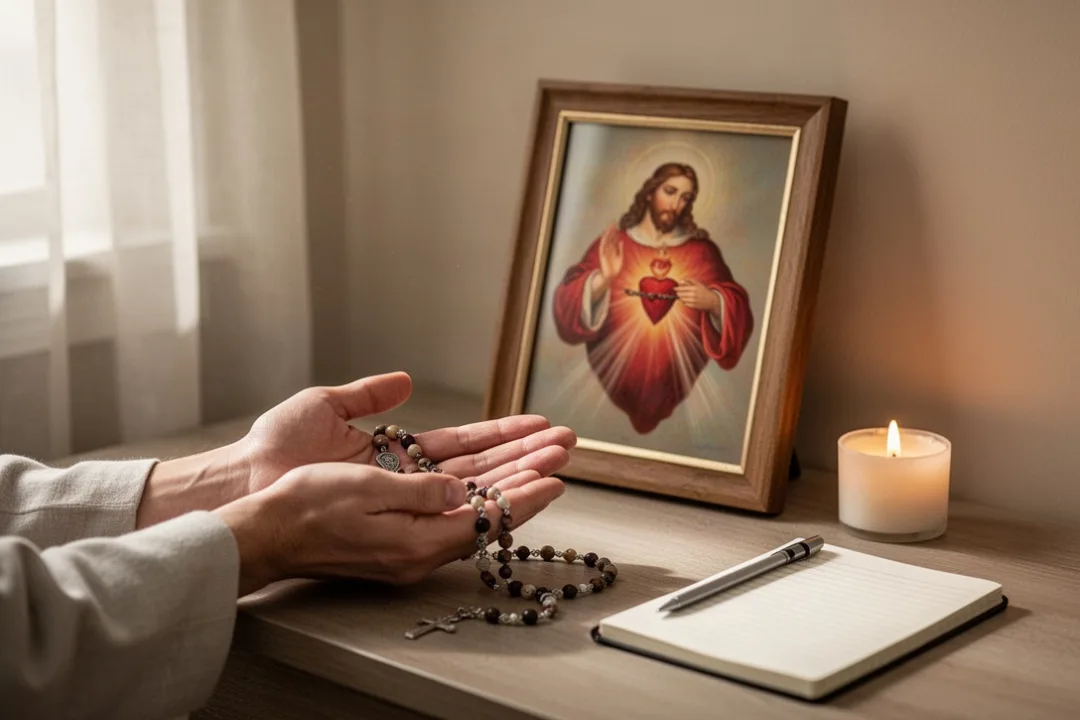
An image of the Sacred Heart can help make prayer more attentive. It may show Jesus with his heart symbolically revealed, often surrounded by signs associated with love, suffering, light, and kingship. The image is not an object to worship; worship belongs to God. It directs your attention to Jesus and to the love represented by his heart.
Begin by placing the image somewhere appropriate and free from unnecessary distraction. Sit comfortably, make the Sign of the Cross, and look at the image without rushing. You might reflect on what the image calls to mind: Christ’s compassion, his sacrifice, his invitation to repentance, or his presence with people who suffer.
Then speak naturally. Tell Jesus what you are grateful for, what frightens you, whom you are worried about, and where you need forgiveness. Finish by asking one question: “How can I respond to your love today?” The answer will usually involve a faithful action rather than a dramatic experience.
Become present: breathe slowly and set aside your phone or other distractions.
Look toward Christ: remember that you are praying to a living person, not reciting words into emptiness.
Receive a truth: repeat a phrase such as “Jesus, I trust in your mercy.”
Speak honestly: offer your intention and your emotional response.
Rest in silence: do not measure the prayer by how strongly you feel something.
Choose a response: identify one action that expresses love, truth, or responsibility.
Distraction is normal. When your attention wanders, return gently to the image, the name of Jesus, or the prayer phrase. A quiet prayer may feel ordinary and still cultivate a lasting change in how you respond to conflict, suffering, and other people.
Living the devotion beyond spoken prayers
Prayers to the Sacred Heart are meant to form your life, not remain separate from it. If you ask for humility but refuse every correction, or ask for compassion while ignoring a neighbor’s need, the words have not yet reached their purpose. The devotion invites you to let Christ’s love influence choices, relationships, habits, and priorities.
That does not require dramatic changes all at once. Choose one practice that is realistic for your circumstances:
Attend Mass regularly and receive the Eucharist according to your Catholic practice.
Return to the Sacrament of Reconciliation when you need forgiveness and a new beginning.
Spend a few minutes with the Gospels, especially passages showing Jesus’ mercy and compassion.
Make a small act of reparation by correcting a wrong, refusing gossip, or serving someone overlooked.
Pray for people who are difficult to understand instead of feeding resentment.
Set aside a weekly period for silence, gratitude, and honest examination.
Offer practical help to someone who is sick, grieving, lonely, or under financial strain.
The devotion also includes a realistic view of suffering. Jesus’ Sacred Heart does not promise that faithful people will avoid illness, loss, injustice, or disappointment. It assures you that suffering can be brought into relationship with Christ, who responds with presence, mercy, and strength rather than indifference.
Keep your prayer connected to responsible action. Seek professional medical help for health concerns, qualified financial advice for serious money decisions, and pastoral or therapeutic support when circumstances exceed what you can manage alone. Faith and practical care belong together.
“Learn from me, for I am gentle and humble in heart.” — Matthew 11:29, paraphrased
This Gospel teaching captures a central purpose of the devotion: not merely to admire the Sacred Heart, but to become more gentle, humble, courageous, and generous in ordinary life. Return to prayer when you fail, begin again when you grow distracted, and let devotion steadily shape the way you love.
Frequently asked questions
What is the best prayer to the Sacred Heart of Jesus?
The best prayer is one you can offer sincerely and regularly. A short prayer such as “Sacred Heart of Jesus, I trust in your mercy and place my needs in your care” is enough for a busy moment. Longer prayers of praise, repentance, petition, or consecration can help when you have more time and want to reflect more deeply.
Can I pray to the Sacred Heart for a specific request?
Yes. You can bring personal, family, health, work, financial, and spiritual needs to Jesus through this devotion. State the request clearly, then add a willingness to accept God’s wisdom and timing. Prayer is not a guarantee of a particular result; it is an act of trust that can also guide your decisions and strengthen you during uncertainty.
When is the best time to pray to the Sacred Heart?
Any time is suitable. Many people choose the morning, bedtime, the first Friday of the month, or the period before the Solemnity of the Most Sacred Heart of Jesus. The most helpful time is one you can keep with reasonable consistency. A brief prayer offered attentively is more useful than a long practice that regularly becomes impossible to maintain.
Is the Sacred Heart devotion only for Catholics?
The Sacred Heart is a specifically Catholic devotion centered on Jesus’ love, mercy, and self-giving. Catholics may practice it through personal prayer, Mass, Reconciliation, Eucharistic devotion, and acts of charity. Christians from other traditions may also find meaning in reflecting on Christ’s compassion, though particular devotional customs and sacramental practices may differ among churches.















Leave a Reply