The Bible contains 66 books in the Protestant canon: 39 in the Old Testament and 27 in the New Testament. Together, they tell the story of creation, Israel, God’s covenant promises, Jesus Christ, the early church, and the hope of restoration.
Each book has its own purpose, setting, and style. Some present history, some offer poetry or wisdom, some record prophetic messages, and others explain Christian faith and practice. The summaries below give you a practical way to understand what each book contributes.
The Bible is not arranged in strict chronological order. It is grouped mainly by literary type, so books from similar categories appear together even when their events overlap. For example, the prophetic books often describe events during the historical period recorded in Kings and Chronicles.
A helpful reading framework is:
Creation and covenant: Genesis begins the story of humanity and God’s promises to Abraham and his descendants.
Israel’s formation: Exodus through Deuteronomy describe Israel’s rescue from Egypt, worship, laws, and preparation for life in the promised land.
Kingdom and exile: Joshua through Esther follow Israel’s settlement, judges, kings, division, defeat, exile, and partial return.
Worship and wisdom: Job through Song of Solomon explore suffering, prayer, justice, love, meaning, and wise living.
Prophetic warning and hope: Isaiah through Malachi call God’s people back to faithfulness and point toward future restoration.
Jesus and the church: Matthew through Revelation describe Jesus’ ministry, death, resurrection, the church’s mission, and the promised renewal of creation.
Canon note: This summary follows the 66-book Protestant Bible. Catholic and Orthodox Bibles include additional books or passages, and their order and numbering differ.
Summary of the Old Testament books
The Old Testament, also called the Hebrew Bible in Jewish contexts, introduces the biblical account of God, humanity, Israel, and the covenant. Its books range from the earliest stories of creation to the return of Jewish communities from exile and the expectation of a coming redeemer.
Genesis: beginnings, family, and covenant promises
Genesis explains the beginnings of the world, human sin, the flood, and the scattering of nations. Its second major section follows Abraham, Isaac, Jacob, and Joseph, showing how God’s covenant promise begins with one family and develops despite conflict, weakness, and displacement.
Exodus: rescue and the formation of Israel
Exodus tells how God delivers the Israelites from slavery in Egypt through Moses. It describes the covenant at Mount Sinai, the Ten Commandments, instructions for worship, and the construction of the tabernacle, where God’s presence is represented among the people.
Leviticus: holiness, worship, and community life
Leviticus gives laws concerning sacrifices, priests, purity, festivals, and ethical relationships. Its central concern is how a people can live near a holy God, combining rules for worship with commands about justice, honesty, compassion, and responsibility toward neighbors.
Numbers: wilderness testing and persistent unbelief
Numbers follows Israel during its years in the wilderness. The book includes censuses, travel accounts, rebellions, military preparations, and failures of trust, while also showing that God continues guiding and preserving the nation despite repeated disobedience.
Deuteronomy: covenant renewal before entering the land
Deuteronomy presents Moses’ final speeches before Israel enters Canaan. Moses reviews the law, urges wholehearted devotion to God, warns against idolatry, and sets before the people the consequences of faithfulness and rebellion.
Joshua: entering and settling the promised land
Joshua describes Israel’s entry into Canaan under Joshua’s leadership. The book recounts the crossing of the Jordan, military campaigns, distribution of territory, and covenant renewal, emphasizing both God’s promise and Israel’s obligation to remain faithful.
Judges: a repeated cycle of rebellion and rescue
Judges records the unstable period before Israel had a king. The people repeatedly turn away from God, experience oppression, cry for help, and receive deliverance through leaders such as Deborah, Gideon, and Samson. The recurring pattern grows increasingly violent and chaotic.
Ruth: loyalty, redemption, and David’s family line
Ruth follows a Moabite widow who remains loyal to her Israelite mother-in-law, Naomi. Through faithfulness, courage, and the help of Boaz, Ruth finds security and becomes part of the family line that leads to King David.
1 Samuel: Samuel, Saul, and the rise of David
1 Samuel covers the transition from the period of judges to the monarchy. Samuel serves as prophet and leader, Saul becomes Israel’s first king, and David emerges as God’s chosen successor while facing danger from Saul.
2 Samuel: David’s reign and its failures
2 Samuel focuses on David’s rule over Israel and Judah. It includes his covenant promise, military successes, establishment of Jerusalem, and serious moral failures involving Bathsheba and Uriah. The book shows both the strength of David’s leadership and the destructive effects of sin.
1 Kings: Solomon’s temple and the divided kingdom
1 Kings begins with Solomon’s reign, wisdom, wealth, and construction of the temple. After his death, the kingdom divides into Israel and Judah. The prophet Elijah confronts idolatry, especially the worship of Baal, during a period of growing national instability.
2 Kings: national decline, exile, and prophetic warnings
2 Kings continues the history of both kingdoms until Israel falls to Assyria and Judah falls to Babylon. Prophets such as Elisha call the people back to God, but persistent injustice and idolatry lead to conquest and exile.
1 Chronicles: David’s reign viewed through worship
1 Chronicles begins with genealogies and then retells the history of David. It gives special attention to the organization of priests, musicians, Levites, and temple worship, presenting David as a central figure in preparing Israel to worship God in Jerusalem.
2 Chronicles: Judah, the temple, and return from exile
2 Chronicles covers Solomon’s reign and the history of Judah. The temple remains central, and the book highlights kings who seek God as well as those who lead the nation into idolatry. It ends with permission for exiles to return and rebuild.
Ezra: restoring worship after exile
Ezra describes the return of Jewish exiles to Jerusalem and the rebuilding of the temple. Ezra, a teacher of the law, later helps restore covenant practices and confronts problems that threaten the community’s identity and faithfulness.
Nehemiah: rebuilding Jerusalem’s walls and community
Nehemiah tells how Nehemiah leads the rebuilding of Jerusalem’s walls despite opposition. The book also describes reforms involving worship, economic fairness, Sabbath observance, and separation from practices that compromise the community’s covenant commitments.
Esther: courage and providence in Persia
Esther follows a Jewish woman who becomes queen of Persia and risks her life to protect her people from an attempted massacre. Although God is not explicitly named, the story emphasizes hidden providence, wise action, courage, and deliverance.
Summary of the Old Testament poetry and wisdom books
These books address questions that historical narratives do not always answer directly. They explore suffering, worship, doubt, work, relationships, wisdom, and the meaning of life. Their poetic language often invites reflection rather than offering simple formulas.
Job: suffering, faith, and the limits of human understanding
Job tells of a righteous man who suffers catastrophic loss. His friends insist that suffering must result from personal sin, but the book challenges that explanation. Through extended dialogue and God’s response, it stresses human limitations without dismissing grief or honest questions.
Psalms: prayers and songs for every season
Psalms is a collection of prayers and songs expressing praise, fear, sorrow, confession, trust, thanksgiving, and hope. Some psalms celebrate God as creator and king; others ask for justice or help. Together they provide language for honest worship in changing circumstances.
Proverbs: practical wisdom for daily life
Proverbs presents short teachings about wisdom, speech, work, money, relationships, discipline, justice, and self-control. It contrasts the wise person, who respects God and accepts correction, with the fool, who rejects instruction and acts recklessly.
Ecclesiastes: meaning, mortality, and life’s apparent absurdity
Ecclesiastes examines the frustration of pursuing pleasure, achievement, wealth, and knowledge in a temporary world. Its speaker recognizes life’s limits and encourages reverence for God, gratitude for ordinary gifts, and humility about what human effort can ultimately accomplish.
Song of Solomon: love, desire, and marital devotion
Song of Solomon is a collection of love poems celebrating attraction, desire, commitment, and mutual delight between a bride and groom. Readers have interpreted it both as a celebration of human love and, by extension, as an image of divine love.
Summary of the Old Testament prophetic books
The prophets spoke into particular political and spiritual crises. They condemned idolatry, exploitation, empty religious ritual, and injustice, while also offering hope for forgiveness, a restored people, a renewed covenant, and God’s future reign.
Isaiah: judgment, comfort, and the coming servant
Isaiah confronts Judah’s sin and warns of judgment while offering powerful promises of comfort and restoration. The book presents themes of a holy God, a remnant, a future righteous king, a suffering servant, and the eventual renewal of God’s people and creation.
Jeremiah: warning before Jerusalem’s fall
Jeremiah ministers during the final years of Judah before Babylon destroys Jerusalem. He condemns false confidence in the temple and calls for repentance, yet he also promises a new covenant in which God’s law will shape the hearts of his people.
Lamentations: grief over Jerusalem’s destruction
Lamentations contains poetic prayers mourning the fall of Jerusalem. The book does not minimize suffering or national guilt. Instead, it brings devastation before God while holding onto the possibility of mercy and renewed hope.
Ezekiel: judgment, responsibility, and restoration
Ezekiel prophesies among Jewish exiles in Babylon. Through vivid visions and symbolic actions, he explains Jerusalem’s judgment, emphasizes personal responsibility, and promises restoration, a renewed heart, a restored temple, and God’s presence among his people.
Daniel: faithful witness under foreign empires
Daniel combines court stories with apocalyptic visions. Daniel and his companions remain faithful while serving foreign rulers, and the visions portray kingdoms rising and falling under God’s ultimate authority. The book encourages endurance when political power appears overwhelming.
Hosea: covenant unfaithfulness and persistent love
Hosea uses the prophet’s troubled marriage as an image of Israel’s unfaithfulness to God. The book condemns idolatry and political dependence while portraying God’s painful but persistent love and desire to restore the covenant relationship.
Joel: disaster, repentance, and the day of the Lord
Joel responds to a devastating plague of locusts and treats it as a warning about the day of the Lord. The prophet calls the people to genuine repentance and promises God’s generous restoration and the outpouring of the Spirit.
Amos: justice for the poor and oppressed
Amos condemns Israel’s wealthy elite for exploiting the poor while maintaining religious ceremonies. He insists that worship cannot replace justice and righteousness, although the book ends with a promise that God will restore David’s fallen house.
Obadiah: judgment against Edom
Obadiah announces judgment against Edom for pride and for taking advantage of Judah during Jerusalem’s disaster. Its short message emphasizes that nations are accountable for violence, betrayal, and arrogant confidence in their own security.
Jonah: mercy beyond Israel
Jonah tells of a reluctant prophet sent to warn Nineveh, an enemy city. Jonah resists because he does not want the city spared. The book exposes narrow ideas about mercy and shows God’s concern for people outside Israel.
Micah: judgment, justice, and a humble way of life
Micah condemns corrupt leaders, dishonest landowners, and religious hypocrisy in Judah and Israel. It also promises a ruler from Bethlehem, restoration for a remnant, and a life shaped by justice, faithful love, and humble fellowship with God.
Nahum: Nineveh’s fall
Nahum announces the downfall of Nineveh, the Assyrian capital. Unlike Jonah, which focuses on Nineveh’s repentance, Nahum emphasizes the city’s later brutality and presents its destruction as relief for peoples oppressed by Assyria.
Habakkuk begins with the prophet asking why God tolerates injustice. When God announces judgment through Babylon, Habakkuk questions that answer as well. The book moves toward trust in God even when circumstances remain painful and unclear.
Zephaniah: judgment and a restored remnant
Zephaniah warns of the day of the Lord, exposing idolatry, corruption, and complacency in Judah and surrounding nations. It also promises that a humble remnant will be purified and that God will rejoice over a restored people.
Haggai: rebuilding the temple
Haggai addresses Jewish communities who have returned from exile but neglected the temple while focusing on their own houses. The prophet calls them to reorder their priorities and assures them that God’s presence and future glory remain with the restored community.
Zechariah: visions of renewal and a coming king
Zechariah encourages the returned exiles as they rebuild Jerusalem and the temple. Its symbolic visions address cleansing, leadership, God’s protection, and future restoration. Later sections describe a humble king and the universal reign of God.
Malachi: covenant faithfulness after the return
Malachi confronts careless worship, corrupt priests, broken marriages, and withholding from God. It calls the community back to covenant faithfulness and anticipates a messenger who will prepare the way for the Lord’s coming.
Summary of the New Testament books
The New Testament centers on Jesus Christ and the significance of his life, death, and resurrection. It then follows the spread of the gospel, explains Christian faith and conduct, and looks forward to Christ’s return and the renewal of all things.
Matthew: Jesus as the promised Messiah and king
Matthew presents Jesus as the fulfillment of Israel’s Scriptures and the promised Messiah. It highlights his teaching about God’s kingdom, including the Sermon on the Mount, and ends with Jesus’ resurrection and commission to make disciples among all nations.
Mark: Jesus the powerful and suffering servant
Mark is a fast-moving account of Jesus’ ministry, miracles, conflict, death, and resurrection. It emphasizes his authority over sickness, demons, nature, and sin while showing that the Messiah’s mission includes suffering and sacrificial service.
Luke: Jesus the Savior for all people
Luke offers an orderly account of Jesus’ life and ministry, emphasizing compassion for outsiders, women, the poor, sinners, and foreigners. It includes distinctive parables and continues into Acts, showing how salvation reaches beyond Israel.
John: Jesus as the divine Word and source of life
John presents Jesus through signs, conversations, and extended teachings. It emphasizes Jesus’ unique relationship with the Father, his identity as the Word made human, and the call to believe in him for eternal life.
Acts: the Holy Spirit and the church’s expanding mission
Acts continues Luke’s story after Jesus’ resurrection and ascension. The Holy Spirit empowers the apostles, the church begins in Jerusalem, and the message spreads through Judea, Samaria, and the Gentile world, especially through Peter and Paul.
Romans: the gospel, faith, and transformed living
Romans explains the universal problem of sin and God’s saving work through Jesus Christ. Paul discusses justification by faith, life in the Spirit, God’s purposes for Israel, and practical Christian conduct within a diverse community.
1 Corinthians: correcting problems in a divided church
1 Corinthians responds to divisions, sexual misconduct, lawsuits, disputes about worship, and confusion over spiritual gifts. Paul emphasizes the cross, love, orderly gatherings, and the central Christian hope of bodily resurrection.
2 Corinthians: weakness, ministry, and reconciliation
2 Corinthians defends Paul’s ministry while explaining how suffering and weakness can accompany genuine service. Paul discusses comfort, generosity, reconciliation, spiritual integrity, and the contrast between outward appearance and inward transformation.
Galatians: freedom from legalism through faith in Christ
Galatians argues that people are accepted by God through faith in Christ rather than through adopting the law’s boundary markers. Paul defends his apostolic calling and describes Christian freedom as a life guided by the Spirit and expressed through love.
Ephesians: unity in Christ and a new way of life
Ephesians describes God’s plan to unite all things in Christ and bring Jews and Gentiles together as one people. It then applies that identity to relationships, holiness, spiritual opposition, and the church’s shared mission.
Philippians: joy, humility, and perseverance
Philippians is a warm letter written from imprisonment. Paul thanks the church for its partnership, urges unity and humility, and presents Jesus’ self-emptying service as the model for believers. He also describes contentment and perseverance amid changing circumstances.
Colossians: the supremacy and sufficiency of Christ
Colossians emphasizes Christ’s authority over creation, the church, and every spiritual power. Because believers share in Christ’s new life, Paul calls them to reject destructive behavior and practice compassion, forgiveness, gratitude, and wisdom.
1 Thessalonians: faithful living and hope in Christ’s return
1 Thessalonians commends a young church for its faith despite persecution. Paul encourages holiness, mutual love, responsible work, and hope concerning believers who have died. The expected return of Jesus should produce alertness and faithful living.
2 Thessalonians: correction about the day of the Lord
2 Thessalonians clarifies confusion about the timing of the Lord’s return. Paul encourages Christians facing persecution, warns against idleness, and teaches that hope in future judgment and restoration should lead to steadiness rather than panic.
1 Timothy: leadership and conduct in the church
1 Timothy gives Paul’s guidance to Timothy concerning false teaching, prayer, public worship, qualifications for leaders, care for widows, and the responsible use of wealth. The letter focuses on preserving sound teaching and a trustworthy church community.
2 Timothy is a personal appeal for courage and perseverance. Paul urges Timothy to guard the gospel, teach reliably, endure hardship, avoid quarrels, and remain faithful to Scripture and his calling even when ministry becomes costly.
Titus: sound teaching and good works
Titus addresses the organization of churches in Crete. It describes qualities for elders, confronts disruptive teaching, and connects sound doctrine with self-controlled, upright conduct. God’s grace is presented as the source of a life devoted to good works.
Philemon: forgiveness and a transformed relationship
Philemon is Paul’s brief appeal to a Christian slave owner concerning Onesimus, who has become a believer. Paul asks Philemon to receive him as a beloved brother, placing reconciliation and Christian identity above the old social relationship.
Hebrews: Jesus as the superior priest and sacrifice
Hebrews presents Jesus as greater than angels, Moses, and the Levitical priesthood. His once-for-all sacrifice and lasting priesthood provide confident access to God. The letter urges believers not to abandon faith but to endure with hope.
James: practical faith shown through action
James teaches that genuine faith becomes visible in conduct. It addresses trials, favoritism, speech, wealth, conflict, patience, prayer, and care for vulnerable people. Wisdom is shown through humility, peace, mercy, and consistent obedience.
1 Peter: hope and holiness during suffering
1 Peter encourages Christians facing social pressure and persecution. It describes them as God’s people with a living hope and calls them to holiness, honorable conduct, mutual service, and patient endurance while following Christ’s example.
2 Peter: growth and resistance to false teachers
2 Peter urges believers to grow in godly character and remember the apostolic message. It warns against teachers who exploit the church and addresses doubts about Christ’s return, affirming that God’s apparent delay reflects patience rather than forgetfulness.
1 John: assurance, truth, and love
1 John helps believers recognize genuine faith through right beliefs about Jesus, obedience, and love for fellow Christians. The letter confronts false claims and reassures readers that they can have confidence in their relationship with God.
2 John: truth and careful hospitality
2 John combines a call to love with a warning against supporting teachers who deny the truth about Jesus. Christian hospitality should be generous, but it should not help destructive teaching spread through the community.
3 John: faithfulness and church leadership
3 John commends Gaius for welcoming traveling Christian workers and criticizes Diotrephes for his pride and refusal to receive fellow believers. The letter encourages support for faithful ministry and imitation of what is good.
Jude: defending the faith against corruption
Jude urges Christians to contend for the faith because immoral teachers have entered the community. It recalls examples of judgment from Israel’s history and calls believers to build themselves up in faith, pray, show mercy, and help those in danger.
Revelation: judgment, perseverance, and renewed creation
Revelation uses visions and symbols to encourage churches facing pressure and compromise. It portrays Christ’s victory over evil, the judgment of oppressive powers, the final defeat of death, and the descent of a renewed holy city where God dwells with his people.
How to read a Bible book responsibly
A short summary helps you locate a book, but understanding improves when you read its parts in context. A proverb, a vision, a song, and a historical narrative should not all be interpreted in exactly the same way.
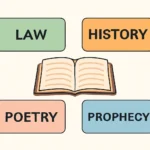
Identify the genre: Ask whether the book is narrative, poetry, wisdom, prophecy, gospel, letter, or apocalyptic writing.
Notice the original audience: Consider what problem, crisis, or question the first readers were facing.
Track repeated themes: Repeated words and ideas often reveal the book’s main emphasis.
Read the whole section: Avoid building a major conclusion from one sentence removed from its surrounding argument.
Place it in the wider story: Ask how the book relates to creation, covenant, Israel, Jesus, the church, and future restoration.
Apply the message carefully: Distinguish between a command given to a particular historical situation and a principle that extends to Christian life today.
Reading tip: Start with Luke and Acts for a connected account of Jesus and the early church, then read Genesis, Exodus, Psalms, John, Romans, and Revelation to see the Bible’s major themes develop across its larger story.
What the Bible’s overall message emphasizes
Across its different genres and historical settings, the Bible repeatedly returns to several major themes. God creates and sustains life, humans rebel and experience the consequences of sin, and God continues to pursue restoration through covenant promises and acts of mercy.
God’s holiness and faithfulness: The biblical writers present God as morally pure, trustworthy, and committed to his promises.
Human dignity and failure: People are made for relationship with God and others, yet repeatedly choose injustice, idolatry, violence, and self-rule.
Covenant and redemption: God forms a people, gives promises, disciplines unfaithfulness, and provides forgiveness and restoration.
Justice and compassion: Worship is consistently connected with honesty, care for the poor, protection of the vulnerable, and responsible community life.
Jesus Christ: The New Testament presents Jesus as the center of God’s saving purposes and the fulfillment of Israel’s hopes.
Future restoration: The biblical story ends with evil judged, death defeated, and creation renewed in God’s presence.
Reading the books individually reveals their distinctive voices; reading them together shows how their themes connect. The result is a unified story told through many authors, generations, literary forms, and historical circumstances.
Frequently asked questions
How many books are in the Bible?
The Protestant Bible has 66 books: 39 in the Old Testament and 27 in the New Testament. Catholic Bibles contain additional books commonly called the Deuterocanonical books, while Orthodox traditions include a somewhat different collection. The number therefore depends on the Christian tradition and canon being used.
What is the best order for reading the Bible?
A chronological reading plan can help you follow the historical storyline, but it may place books in an order different from the Bible itself. Many readers begin with Luke and Acts, then read Genesis, Exodus, selected Psalms, John, Romans, and the remaining books in their canonical order.
What is the shortest book in the Bible?
In the Protestant canon, 2 John is generally considered the shortest book by word count, although exact counts vary by Bible translation. It is a brief letter about truth, love, obedience, and caution toward teachers who deny the Christian message about Jesus.
Why do different Bibles have different numbers of books?
Christian traditions use different canons, or recognized collections of biblical books. Protestant Bibles contain 66 books, while Catholic and Orthodox Bibles include additional writings and passages. Differences also appear in book order, grouping, and the way certain sections are counted.












Leave a Reply