What reading the Bible in a year actually requires
The Bible contains 66 books in the Protestant canon, arranged across different genres, historical periods, and writing styles. Reading the whole Bible in twelve months usually means spending about 15 to 25 minutes a day, depending on your translation, reading speed, and whether you pause to reflect.
The exact daily amount varies because Bible chapters are not the same length. Some chapters contain only a few dozen verses, while others are substantially longer. A plan based only on “three chapters a day” may feel easy on one day and unexpectedly demanding on another, so a schedule with built-in flexibility is often more sustainable.
The purpose is not simply to reach the final page. A yearlong reading plan helps you see the Bible’s major movements: creation, human rebellion, God’s covenant with Israel, the life and ministry of Jesus, the growth of the early church, and the hope described in the final biblical writings.
The central principle: A consistent reading habit matters more than a perfect schedule. Missing a day does not erase the value of the days you have already completed.
You also do not need to understand every passage immediately. The Bible includes poetry, laws, genealogies, prophecy, wisdom literature, letters, and narrative history. Each type of writing asks you to read differently. A difficult passage can still contribute to your understanding even when you need more time, context, or study before its meaning becomes clear.
Before you begin, decide what “reading the Bible” means for you. You might read the assigned text carefully, listen to an audio Bible while following along, or combine a shorter reading with a few minutes of prayer and notes. Choose a routine you can repeat, not an ideal routine that works only under perfect conditions.
How to choose the right one-year Bible reading plan
Different plans arrange the biblical books in different ways. The best choice depends on whether you want to follow the standard order, read events in approximate historical sequence, alternate between sections, or move through the Bible in shorter daily portions.
Read the Bible in its standard order
A standard-order plan begins with Genesis and follows the sequence found in most printed Bibles. This approach is simple because you always know where to turn next. It also lets you experience the traditional arrangement of the Old Testament, the Gospels, Acts, the letters, and Revelation.
This plan works well if you want a straightforward starting point and do not want to manage several reading locations at once. It can become demanding in sections such as Leviticus, Numbers, or the genealogical passages in Chronicles, but those books still provide important information about worship, community life, Israel’s history, and the Bible’s larger themes.
Read the Bible in chronological order
A chronological plan places passages according to the approximate order of the events they describe. For example, readings may group selected Psalms with the life circumstances of David, or place the prophets near the historical periods in which they ministered. The exact arrangement can differ because some dates and relationships are debated.
This approach can make the Bible’s historical development easier to follow. It may also prevent you from treating every book as though it were written in the same setting. On the other hand, you may move back and forth between books, which requires more page-turning or a digital reading plan.
Use a balanced or parallel plan
A balanced plan assigns readings from several sections each day. You might read from the Old Testament, a Gospel or another New Testament book, and Psalms or Proverbs in the same session. The variety can help maintain interest and prevent a difficult section from dominating an entire month.
Parallel plans also let you encounter different biblical genres on the same day. A historical narrative may be followed by a prayerful psalm and then a letter addressing a church community. The contrast can sharpen your awareness of how biblical writers speak about worship, suffering, faith, justice, leadership, and hope.
Follow a shorter daily reading plan
Some plans divide the text into small daily selections and include additional days for catching up. Others schedule six readings each week and leave one day open. These formats are useful if your calendar changes often or if you know that a strict seven-day schedule makes you give up after one missed reading.
When comparing plans, consider these practical questions:
How long is the daily reading likely to take at your normal pace?
Does the plan include catch-up days or rest days?
Are the readings organized by standard order, chronology, or a mixture?
Will you need to use more than one Bible passage location each day?
Does the format work with print, audio, or a Bible app?
Does the plan fit your spiritual tradition and preferred biblical canon?
A plan can be technically excellent and still be a poor personal fit. If the assignments regularly take an hour when you have only twenty minutes, the problem may be the schedule rather than your commitment. Adjusting the plan is not cheating; it is a way to preserve the larger goal of staying engaged with Scripture.
How to build a daily Bible reading routine
Consistency becomes easier when the reading has a reliable place in your day. Choose a time when you are usually alert and a location where interruptions are limited. Some people read before work, school, or household responsibilities begin. Others prefer the evening, especially when they use the reading as a way to slow down before sleep.
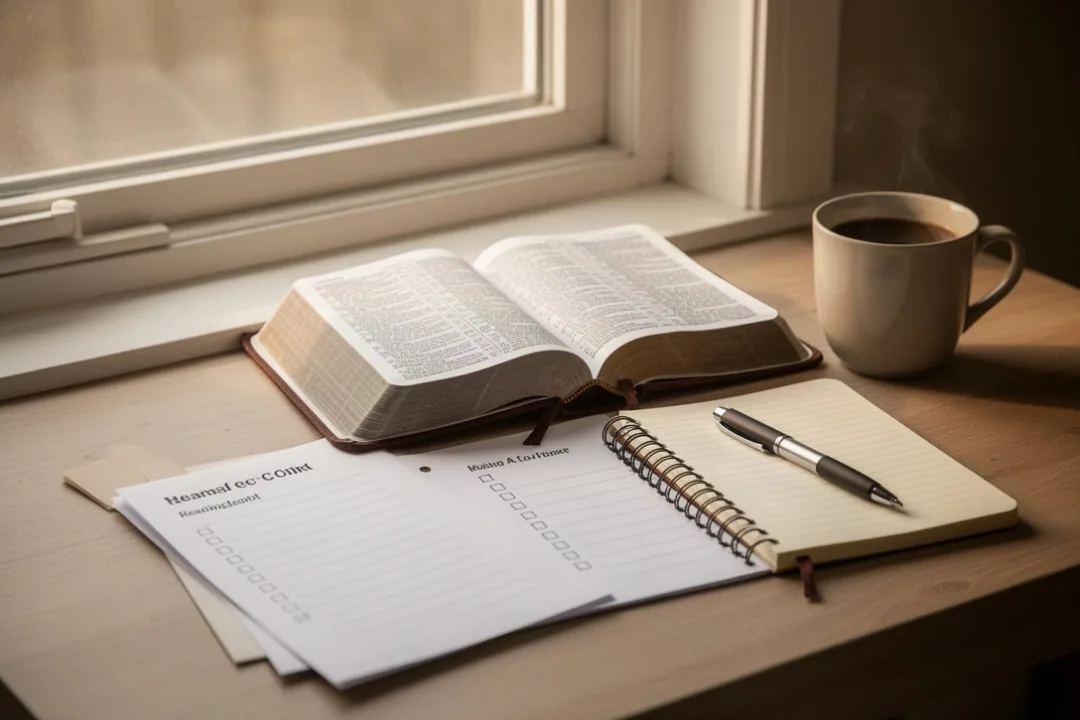
Keep the materials together so you do not have to make several decisions before beginning. A Bible, reading plan, pen, notebook, and optional audio version can stay in one place. If you use a phone or tablet, turn off notifications during the reading period so the device serves the plan rather than competing with it.
A simple session can follow this pattern:
Read the assigned passage without trying to solve every question at once.
Notice the people, actions, repeated words, setting, and apparent purpose of the passage.
Write down one question or observation that deserves further attention.
Reflect on what the passage shows about God, people, faithfulness, failure, wisdom, or hope.
End with a brief prayer or a practical response connected to what you read.
This structure keeps reading from becoming either a rushed box-checking exercise or an open-ended study session that lasts far longer than you intended. Read first, interpret carefully, and apply thoughtfully. Not every passage gives a direct instruction for the next hour of your life, and forcing one can distort the text.
Reading aloud can improve attention, particularly in poetic sections or passages with repeated ideas. Listening to an audio Bible can also help you continue during a commute, walk, or household task. Audio reading should not replace every quiet session, because you may want time to mark observations, but it is a useful way to keep the plan moving when your schedule changes.
Practical tip: Set a minimum you can keep on difficult days, such as one chapter or ten minutes. You can read more when you have time, but a small consistent practice protects the habit.
Use a translation you can understand without constant dictionary work. A more literal translation may help with close study, while a translation using more contemporary language may make extended reading easier. You can compare translations when a passage seems unclear, but avoid switching so often that the reading itself becomes a technical exercise.
Marking every sentence can turn the session into a research project. Instead, use a small set of symbols or note categories. For example, you might mark a repeated theme, a question, a promise, a warning, or a connection to another passage. The goal is to create useful memory cues, not to fill every margin.
How to understand difficult books and passages
A yearlong plan exposes you to parts of the Bible that are often skipped in casual reading. When the material becomes unfamiliar, start by identifying the genre. A psalm uses imagery and parallel lines differently from a historical narrative. Proverbs often presents concise wisdom sayings, while a prophetic book may combine judgment, poetry, symbolic action, and promises of restoration.
Ask basic context questions before drawing a conclusion:
What situation appears to have prompted the passage?
What happens immediately before and after it?
Is the writing narrative, poetry, law, prophecy, wisdom, or a letter?
Which words, images, or ideas are repeated?
What does the passage clearly say, and what are you inferring?
Genealogies may seem repetitive, but they can establish family lines, continuity, leadership, and relationships between biblical characters. Laws may seem distant from modern life, yet they reveal how particular communities understood holiness, justice, worship, responsibility, and care for vulnerable people. Long lists of names can also remind you that the Bible presents its story through real communities rather than only through famous individuals.
When you reach a difficult command or troubling story, do not isolate one paragraph from the rest of the book. Examine the narrative setting, the people involved, the stated purpose, and how later biblical writers refer to the event. Some passages describe actions without approving them. Others reflect covenant arrangements or ancient social conditions that require careful historical and theological interpretation.
The New Testament should also be read in context. The Gospels present Jesus’ life and ministry from distinct perspectives, and the letters address specific communities or questions. A sentence written to a first-century church may contain a principle with lasting significance, but applying it responsibly requires attention to the original situation rather than assuming that every detail maps directly onto modern circumstances.
Cross-references can reveal connections, but they should not replace close reading. If a note points you to another passage, read enough of that passage to understand its own setting. Context prevents isolated interpretations and helps you distinguish an intentional biblical connection from a merely similar word or phrase.
For deeper study, use resources carefully. A study Bible, Bible dictionary, map, commentary, or trusted teaching resource can explain cultural details and interpretive options. You do not need to consult a resource for every verse. Begin with the text, record your question, and research the passages that remain important or genuinely confusing.
It is also acceptable to continue reading when a question cannot be resolved immediately. A one-year plan is a broad reading project, not a demand to master every issue during the first pass. You may return later with better background knowledge, a different translation, or a more focused study plan.
How to stay on schedule after missing Bible readings
Most people who attempt a yearlong reading plan eventually miss a day. Travel, illness, work demands, family responsibilities, and simple fatigue can interrupt even a well-designed routine. The most helpful response is to resume at the next practical opportunity instead of treating the missed day as proof that the plan has failed.
You have several ways to recover:
Continue with today’s reading and accept that the calendar date will shift.
Read one extra section on selected days until you catch up.
Use a planned catch-up day rather than doubling every reading.
Listen to a missed passage while walking or doing a routine task.
Restart the current book instead of restarting the entire Bible.
Reduce note-taking temporarily so the reading itself remains manageable.
Trying to read a week of missed material in one sitting often creates a second problem: exhaustion. A compressed catch-up session may feel productive, but it can make the next several days harder. If you have fallen significantly behind, choose a new finish date or begin again with a plan that better matches your available time.
Keep a record that shows progress without creating guilt. A paper checklist, calendar, or app can help you see where you are, but the record is a tool rather than a measure of spiritual worth. Completion is useful; transformation and understanding matter more.
Some readers benefit from a weekly review. Set aside a few minutes to ask what themes appeared, which passages stood out, and whether the reading raised recurring questions. This review can connect separate readings and prevent each day from feeling like an isolated assignment.
You can also read with another person or a small group. Shared reading provides accountability and exposes you to observations you might miss alone. Keep the arrangement realistic: agree on the plan, decide how often to discuss it, and make space for honest questions rather than expecting everyone to interpret every passage identically.
How to make the most of a complete Bible reading year
A full-year reading plan gives you a wide view of the Bible, but it should not be your only way of reading. After finishing a book, you may want to read it again more slowly, study its historical background, or compare how its themes appear elsewhere. The first pass gives you orientation and familiarity; later passes can offer greater depth.
Pay attention to themes that recur across different books. These may include creation, covenant, worship, justice, wisdom, exile, forgiveness, faithfulness, kingship, sacrifice, resurrection, and hope. Do not force every passage into one theme, but notice how different writers develop related ideas in different forms.
Reading the Bible as a connected collection also means recognizing its variety. The Psalms give voice to celebration, grief, confession, trust, anger, and praise. The wisdom books explore choices, speech, work, suffering, and the search for meaning. The prophetic books challenge injustice and idolatry while also presenting visions of renewal.
The Gospels center on Jesus’ teaching, actions, death, and resurrection, with each Gospel emphasizing its own presentation. Acts follows the expansion of the early Christian movement, while the letters address belief, conduct, leadership, conflict, suffering, and hope. Revelation uses vivid symbolic imagery and should be read with attention to its genre, audience, and pastoral purpose rather than treated as a simple codebook.
Consider keeping a one-page record with four headings:
What happened? Record the main movement of the passage.
What stood out? Note a repeated word, image, conflict, or promise.
What questions remain? Separate genuine questions from assumptions.
What response is appropriate? Consider prayer, worship, repentance, wisdom, patience, justice, or encouragement.
This method keeps reflection grounded in the text. It also makes your notes useful when you revisit a book months later. Avoid turning every observation into a personal lesson; sometimes the most faithful response is to understand what the passage meant in its own setting before deciding how it relates to your life.
Reading with humility matters when you encounter passages that challenge your expectations. You may find unfamiliar customs, theological tensions, difficult stories, or viewpoints that require patient study. Give yourself permission to say, “I do not understand this yet.” Careful reading is strengthened by honesty, prayer, and a willingness to revise a first impression.
At the end of the year, mark what the practice has made possible: a better sense of the Bible’s structure, greater familiarity with less-read books, more awareness of repeated themes, or a stronger habit of reflection. Then choose the next step that fits your needs. You might read one Gospel closely, study a particular biblical character, follow a thematic plan, or repeat the full Bible with a different arrangement.
A year in the Bible is not valuable because a calendar makes the reading sacred. It is valuable because a steady year gives you time to encounter the Bible’s many voices, settings, questions, warnings, promises, and accounts of God’s work. Let the schedule serve the reading, and let the reading lead you toward careful understanding rather than hurried completion.
Frequently asked questions
Is reading the entire Bible in one year realistic?
Yes, for many readers it is realistic with a consistent daily schedule. Most one-year plans require roughly 15 to 25 minutes per day, although the time varies by translation and reading speed. If that pace feels too demanding, choose a plan with six reading days each week, built-in catch-up days, or smaller daily portions.
Should I read the Bible from Genesis to Revelation?
Reading in standard order is a clear and useful option, especially for your first complete reading. A chronological plan may help you follow historical development, while a balanced plan alternates between different sections and genres. The best arrangement is the one you can understand and follow consistently.
What should I do when I do not understand a passage?
First identify the passage’s genre, speaker, audience, and surrounding context. Write down your question and continue reading if you cannot resolve it immediately. A study Bible, Bible dictionary, commentary, or trusted teacher can provide background later. Avoid building a major belief or application on one isolated, unclear sentence.
Is it better to listen to the Bible or read it silently?
Both methods can support a yearlong plan. Silent reading makes it easier to pause, underline, and take notes, while audio can help you continue during a walk, commute, or household task. Many readers use both: quiet reading for focused study and audio for additional exposure when their schedule is crowded.










Leave a Reply