Bible reading plan 2026: a practical yearlong guide
Bible reading plan 2026: a practical yearlong guide
If you have opened your Bible several times this year only to lose your place a week later, you need a plan that fits real life. A useful Bible reading plan for 2026 should tell you what to read, give you room for missed days, and help you understand the larger story rather than turn reading into a race.
The simplest approach is to read through the 66 books of the Bible in a year, moving through roughly three to four chapters each day. Because 2026 has 365 days, you can use a daily schedule, read six days a week with one catch-up day, or divide the year into monthly goals. The best format is the one you can return to after a busy week.
Choose the Bible reading plan that matches your purpose
A one-year plan does not have to follow the Bible from Genesis to Revelation. Different reading orders highlight different aspects of Scripture, so choose a structure that supports the reason you want to read. You may want a complete overview, a clearer sense of historical sequence, or a slower devotional rhythm.
Canonical order: Read from Genesis through Revelation in the order the books commonly appear in printed Bibles. This is the easiest plan to follow and track.
Chronological order: Read events in an approximate historical sequence, such as placing many Psalms alongside the life of David and the prophetic books near the kings and exiles they addressed.
Whole-Bible plan: Read from both the Old and New Testaments throughout the year. This keeps the Gospels, letters, and Old Testament narrative in view at the same time.
Thematic plan: Group readings around subjects such as wisdom, prayer, covenant, worship, discipleship, or the life of Jesus.
Flexible plan: Set a weekly chapter goal instead of assigning a reading to every date. This works well when your schedule changes often.
For a first complete reading, canonical order is usually the least complicated. You will always know where to go next, and you will not need to compare several timelines. A chronological plan can be rewarding, but it sometimes requires moving between books and remembering that its order is an interpretive arrangement rather than the order of the biblical canon.
Think about your available time before choosing a schedule. Reading three chapters may take fifteen minutes in some parts of the Bible and considerably longer in others, especially when a passage contains poetry, lists, laws, or unfamiliar names. A plan that looks modest on paper can still feel demanding if you regularly read at the end of an exhausting day.
Good starting point: Choose a plan you can complete on an ordinary week, not one that only works during a vacation or an unusually quiet season.
You also do not need to finish every reading in one sitting. You might read one chapter with breakfast, one during a lunch break, and one before bed. Breaking the assignment into smaller portions can preserve attention and make difficult sections less intimidating.
Use this month-by-month Bible reading plan for 2026
The following map takes you through the Bible in its familiar canonical order. It is a monthly framework, not a rigid list of dates. Some months contain longer books or more chapters than others, so use the month names as landmarks and adjust the daily pace as needed.
January: Genesis through Deuteronomy. Read the creation accounts, the stories of the patriarchs, the exodus from Egypt, the covenant at Sinai, and the wilderness years. These books establish many of the Bible’s central themes, including promise, worship, holiness, law, and faithfulness.
February: Joshua through 2 Samuel. Follow Israel’s entry into the land, the period of the judges, and the rise of the monarchy. Pay attention to how leadership, obedience, courage, and misuse of power shape the narratives.
March: 1 Kings through Esther. Read the divided kingdom, the ministries of Elijah and Elisha, the exile, and the return. The historical books show how national events affect ordinary families and communities.
April: Job through Song of Solomon. Move from Job’s questions about suffering into Psalms, Proverbs, Ecclesiastes, and Song of Solomon. Read these books slowly enough to notice their different voices, forms, and purposes.
May: Isaiah through Lamentations. These prophetic books address injustice, idolatry, judgment, hope, restoration, and the consequences of national unfaithfulness. Isaiah is especially broad, so leave time to consider repeated themes rather than rushing through it.
June: Ezekiel through Malachi. Finish the Old Testament with the prophets who spoke during exile, after exile, and during the years of rebuilding. Look for calls to return to God, promises of renewal, and warnings about empty religious practice.
July: Matthew through Acts. Read the four Gospels and then follow the growth of the early church in Acts. Comparing the Gospel accounts can help you notice both shared events and distinctive emphases.
August: Romans through 2 Corinthians. These letters explore the gospel, the church, spiritual gifts, reconciliation, suffering, generosity, and Christian maturity. Consider the communities receiving each letter and the problems being addressed.
September: Galatians through Hebrews. Read letters about freedom, unity, Christian conduct, leadership, perseverance, and the significance of Jesus. The books vary greatly in length, so a chapter count alone does not measure the reading load.
October: James through Revelation. Finish the New Testament with practical teaching, encouragement for suffering believers, warnings against false teaching, and the symbolic vision of Revelation.
November: Use the month to revisit passages you marked, finish any delayed readings, or read selected books again. Repetition often reveals connections that are easy to miss on a first pass.
December: Read Luke and Acts again, or select passages about the birth of Jesus, hope, worship, wisdom, and renewal. A reflective December keeps the plan from ending as soon as you reach the last chapter.
This map reaches the final New Testament books in October and deliberately leaves November and December for review. That extra space is useful because the Bible contains 1,189 chapters, and the chapter lengths vary widely. It also prevents a missed week in February from becoming a reason to abandon the entire year.
If you prefer to finish the whole Bible by December 31, treat November and December as normal reading months rather than review months. Continue from the point where you stopped, aiming for about 23 chapters per week. The monthly boundaries are suggestions, not deadlines.
Turn the monthly map into a daily reading schedule
Most people need more than a list of books. They need a repeatable answer to the question, “What should I read today?” Start by setting a weekly target, then divide it into reading days. A standard pace is three chapters on most days, with a fourth chapter on selected days or during shorter books.
Here are three practical ways to distribute the reading:
Daily schedule: Read three to four chapters every day, using Sundays or another chosen day to finish the week’s assignment.
Six-day schedule: Read about four chapters from Monday through Saturday and keep Sunday free for worship, reflection, or catching up.
Five-day schedule: Read four to five chapters on weekdays, leaving weekends open. This suits people who have more predictable workday routines than weekend routines.
A weekly schedule is often more forgiving than a date-by-date schedule. Instead of feeling behind because you missed the assigned reading on March 14, you can simply complete the week’s chapters by Sunday. Mark each completed section with a check, but do not treat an unchecked box as a moral failure.
For a more structured start, begin 2026 with Genesis 1–3 on January 1. Continue in order, reading the next three or four chapters each day. When you reach a short book, finish it and begin the next one rather than trying to force every day to contain the same number of chapters.
Some passages deserve a slower pace. Poetry, prophecy, and letters can contain dense images or closely connected arguments. If you read only one or two chapters on a difficult day, record the stopping point and make a small adjustment later instead of doubling the next assignment.
Use a simple reading note after each session. It does not need to become a detailed journal. Write one sentence answering each of these questions:
What happens or what is being taught?
What does this passage reveal about God, people, wisdom, sin, hope, or relationships?
What question should I carry into further reading?
These questions help you avoid reducing Bible reading to chapter completion. They also make it easier to remember what you read. If a passage raises a question about history, language, or interpretation, mark it and continue. You can study it later without stopping the entire reading plan.
Missed-day rule: Do not automatically double your reading after falling behind. Resume with the next planned passage, then use a weekly catch-up period or extend the plan into November and December.
Read difficult books with context and patience
A yearlong plan will take you through books that differ in genre, audience, and purpose. Genesis is not read in the same way as Proverbs, and neither should be approached like Romans or Revelation. Recognizing the kind of writing in front of you can make challenging sections more understandable.
Adjust your approach to each biblical genre
Narrative books tell stories about people, families, nations, and acts of God. Read beyond the most familiar episodes and notice repeated patterns, turning points, and consequences. A narrative may describe an action without approving it, so ask what the larger passage communicates rather than treating every character as an example to imitate.
Poetry and wisdom books use imagery, repetition, contrast, and memorable statements. Psalms often express worship, grief, confidence, confession, or protest. Proverbs commonly presents concise wisdom rather than an absolute promise for every circumstance. Reading a small portion aloud can help you hear the movement and emphasis.
Prophetic books speak to particular communities facing specific spiritual and political conditions. Before applying a passage directly to your own circumstances, identify its original audience, the problem being confronted, and the hope being offered. A study Bible or reliable commentary can clarify historical references without replacing your own reading.
Letters are best understood as complete arguments. Try to read an entire short letter in one sitting, then return to individual sections. In longer letters, note the transitions between ideas. Words such as “therefore,” “but,” “for,” and “so then” often show how one paragraph connects to the next.
Apocalyptic writing uses vivid symbols and visions. Revelation can be read for its central message of faithful endurance, worship, judgment, and hope without assuming that every symbol has a simple modern equivalent. Avoid building your entire interpretation around an isolated image.
Context tools can support your reading, especially when a book contains unfamiliar names, places, or customs. A Bible dictionary, cross-references, maps, and introductory notes may answer basic questions. Compare interpretations carefully, since sincere readers and traditions do not always agree on every passage.
Reading a second translation occasionally can also help you notice the range of meaning in a difficult sentence. Do not turn comparison into constant switching, though. Pick one primary translation for continuity and use another when a phrase seems unclear.
Stay consistent with your 2026 Bible reading plan
Consistency depends more on preparation than on enthusiasm. Choose a regular time and location, keep your Bible or reading app there, and decide in advance what counts as a completed session. A plan becomes easier to maintain when you remove small decisions from the routine.
Attach reading to an existing habit: Read after coffee, before commuting, after putting children to bed, or before your first evening screen time.
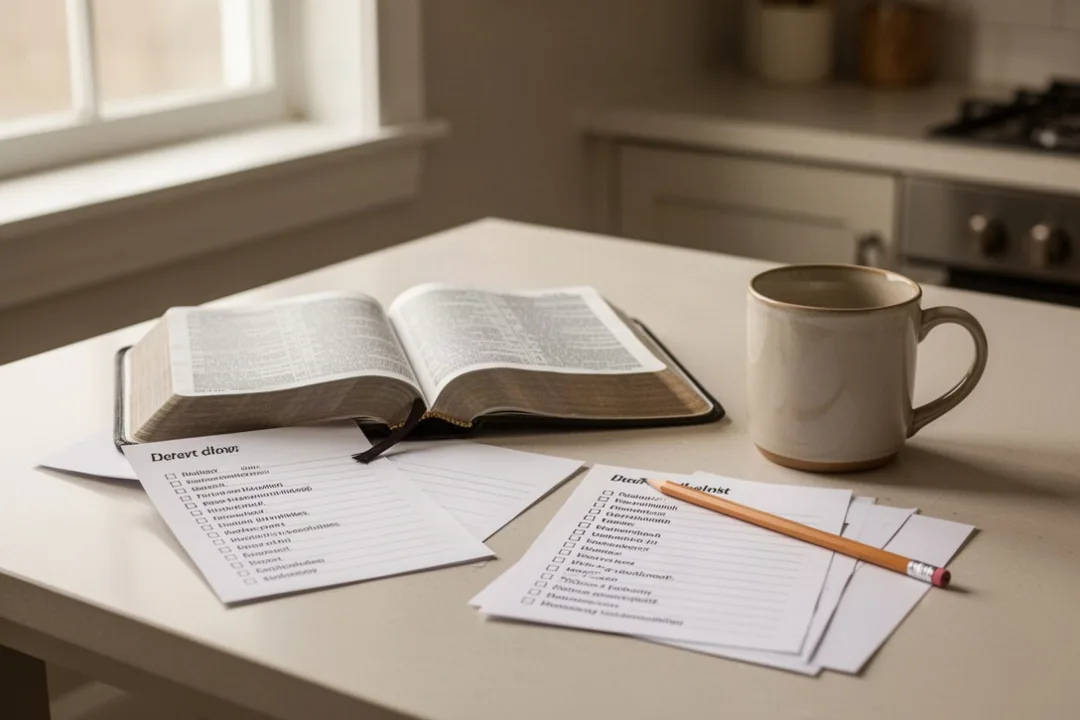
Keep the plan visible: Use a printed checklist, calendar, notebook, or app that shows the current book and passage.
Protect a minimum reading: On a difficult day, read one chapter or a shorter section rather than skipping automatically.
Use audio strategically: Listen during a walk or commute, then read a few verses in print to slow down and reflect.
Share the rhythm: A friend, small group, or family member can provide encouragement without turning the plan into a competition.
Review each month: Ask whether the pace, time, translation, and format are helping you continue.
Do not restart from Genesis every time you miss several days. Restarting can feel orderly, but it often creates a cycle in which you repeatedly read the opening books and rarely reach the rest. Write down where you stopped, return there, and use the next flexible week to repair the gap.
You can also create a two-level plan. Your minimum plan might be one chapter and a brief note. Your full plan might be three chapters with cross-references and prayer. On busy days, the minimum keeps the habit alive; on quieter days, the full plan gives you room to study.
Reading with other people can add useful perspective, but group discussion should not make personal reading impossible. If your group is studying a different book, keep your yearly plan and add the group passage when practical. The goal is sustained engagement with Scripture, not perfect synchronization with every resource.
Make the plan personal without losing its purpose
A successful Bible reading plan for 2026 should be structured enough to guide you and flexible enough to survive ordinary disruptions. Travel, illness, work changes, family responsibilities, and spiritual dryness may all affect your pace. Adaptation is not the same as giving up.
Before January begins, write down three reasons you want to read the Bible this year. Your reasons might include understanding the whole biblical story, becoming more familiar with Jesus’ teachings, developing a habit of prayer, or preparing for group discussion. Keep the list near your reading plan so the schedule remains connected to a purpose.
Choose how you will respond to passages you do not understand. You might underline them, add a question to a notebook, consult a trusted resource, or discuss them with a mature reader. Confusion is a normal part of reading a large and diverse collection of books; it does not mean you are failing.
Build review into the year. At the end of each month, write down:
One passage you remember clearly.
One theme that appeared more than once.
One question you want to investigate.
One change that would make next month’s schedule more realistic.
When you reach the end of a book, pause long enough to identify its main movement. Ask how it begins, what conflict or question it develops, and how it ends. This practice is particularly helpful when moving from one short book to another, because it gives each book a distinct shape in your memory.
Your plan can include prayer, journaling, study, or quiet reflection, but these additions should serve the reading rather than make it impossible to continue. A fifteen-minute session completed regularly may be more fruitful than an elaborate hour-long routine that lasts only a few days.
On December 31, measure success by more than whether every checkbox is marked. Consider which books you encountered, which questions grew clearer, and how your understanding changed through repeated exposure to the biblical story. If you finish all 66 books, that is a significant accomplishment; if you read fewer books with care and consistency, the year has still been worthwhile.
Frequently asked questions
How many chapters should I read each day to finish the Bible in 2026?
The Bible contains about 1,189 chapters, so finishing it in one year requires an average of roughly three to four chapters per day. A weekly target of about 23 chapters is easier to manage than a strict daily number. Some days may require less reading because of dense poetry or prophecy, while other days can include an extra chapter.
Is it better to read the Bible in chronological or canonical order?
Canonical order is simpler because it follows the arrangement in a standard Bible and requires no book switching. Chronological order can clarify the relationship between historical events, prophets, and Psalms, but the sequence is approximate and varies by plan. Choose canonical order for simplicity and chronological order if historical context is your main reason for reading.
What should I do if I fall behind my 2026 reading plan?
Continue from the passage where you stopped instead of restarting at Genesis. Set a manageable weekly target, use an occasional catch-up day, or extend the plan into November and December. Avoid doubling every assignment, since large backlogs can make reading feel punishing and increase the chance that you abandon the schedule.
Can I use a Bible reading app instead of a printed plan?
Yes. An app can provide reminders, audio readings, progress tracking, and multiple translations. A printed plan may be better if screens distract you or you prefer handwritten notes. The format matters less than having a clear sequence, a realistic pace, and a way to resume easily after missed days.












Leave a Reply