New Testament chapters: a complete guide and reading plan
New Testament chapters: a complete guide and reading plan
If you have ever wondered how many chapters are in the New Testament or where to begin reading, the short answer is clear: the New Testament contains 260 chapters in 27 books. These books tell the story of Jesus, explain the meaning of his death and resurrection, describe the growth of the early church, and offer guidance for Christian faith and practice.
The chapters are not arranged in the order they were written. They are grouped by type and purpose, beginning with the four Gospels, followed by Acts, the letters, and Revelation. Knowing that structure makes it easier to choose a starting point, find a passage, and create a reading plan that fits your time.
Quick answer: The New Testament has 27 books and 260 chapters. The shortest book by chapter count is 2 John, with one chapter; the longest is Matthew, with 28 chapters.
The New Testament is divided into five broad groups: the Gospels, the historical book of Acts, the letters attributed to Paul, the general letters, and Revelation. This arrangement helps readers move from Jesus’ ministry to the life and teaching of the early Christian communities.
The first four books—Matthew, Mark, Luke, and John—are called the Gospels. They each present the life, ministry, death, and resurrection of Jesus, but they emphasize different details and audiences. Matthew has 28 chapters, Mark 16, Luke 24, and John 21, for a total of 89 Gospel chapters.
Acts has 28 chapters and continues the story after Jesus’ resurrection. It describes the coming of the Holy Spirit, the preaching of the apostles, the formation of Christian communities, and the spread of the message from Jerusalem toward the wider Roman world. Acts is closely connected with Luke because both books are traditionally associated with the same author.
Paul’s letters contain 87 chapters. They address specific churches and individuals, explaining Christian beliefs and responding to practical questions about worship, leadership, relationships, suffering, spiritual gifts, and daily conduct. The general letters contain 34 chapters and were addressed more broadly to Christians or groups of churches.
Revelation is the final New Testament book and has 22 chapters. It uses highly symbolic visions to address perseverance, judgment, evil, worship, and hope. Because its imagery is complex, it is usually best read with attention to its historical setting and its repeated themes rather than treated as a simple timeline of future events.
New Testament books and their chapter counts
The complete list below follows the standard Protestant arrangement of the New Testament. The chapter numbers are the same across major English Christian Bible editions, although wording, headings, footnotes, and verse numbering can vary slightly between translations.
Matthew — 28 chapters: Presents Jesus as the promised Messiah and emphasizes his teaching, kingdom, and fulfillment of Israel’s Scriptures.
Mark — 16 chapters: A concise Gospel that moves quickly through Jesus’ actions, miracles, suffering, death, and resurrection.
Luke — 24 chapters: Highlights Jesus’ compassion, prayer, concern for outsiders, and the universal reach of his saving work.
John — 21 chapters: Focuses on Jesus’ identity, signs, conversations, death, and resurrection through distinctive theological themes.
Acts — 28 chapters: Describes the Holy Spirit’s work and the expansion of the early church from Jerusalem to the wider Mediterranean world.
Romans — 16 chapters: Explains the gospel, sin, grace, faith, new life, Israel, and practical Christian living.
1 Corinthians — 16 chapters: Addresses divisions, sexual ethics, worship, spiritual gifts, resurrection, and love within a troubled church.
2 Corinthians — 13 chapters: Explores Christian ministry, suffering, generosity, reconciliation, and Paul’s relationship with the Corinthian believers.
Galatians — 6 chapters: Defends salvation by faith in Christ and explains freedom from relying on circumcision or law observance for acceptance by God.
Ephesians — 6 chapters: Describes unity in Christ, the church, spiritual maturity, and conduct shaped by the gospel.
Philippians — 4 chapters: Encourages joy, humility, perseverance, and partnership in Christian service despite hardship.
Colossians — 4 chapters: Emphasizes Christ’s supremacy and calls believers to live out their new identity.
1 Thessalonians — 5 chapters: Encourages a young church in faithfulness, holiness, mutual care, and hope concerning Jesus’ return.
2 Thessalonians — 3 chapters: Clarifies teaching about the day of the Lord and urges steady, responsible living.
1 Timothy — 6 chapters: Gives guidance about church leadership, worship, teaching, widows, wealth, and personal example.
2 Timothy — 4 chapters: Encourages endurance, faithful teaching, Scripture-shaped ministry, and courage in difficult circumstances.
Titus — 3 chapters: Connects sound teaching with good character, responsible leadership, and useful service.
Philemon — 1 chapter: Appeals for reconciliation and a transformed relationship between a Christian master and an enslaved man who had become a believer.
Hebrews — 13 chapters: Presents Jesus as superior and explores perseverance, faith, priesthood, sacrifice, covenant, and worship.
James — 5 chapters: Connects genuine faith with practical obedience, wise speech, impartiality, patience, and care for people in need.
1 Peter — 5 chapters: Encourages believers facing suffering to live with holiness, hope, humility, and faithful witness.
2 Peter — 3 chapters: Warns against false teachers and calls Christians to spiritual growth and readiness for the Lord’s day.
1 John — 5 chapters: Addresses assurance, truth about Jesus, obedience, love, and discernment regarding misleading teaching.
2 John — 1 chapter: Combines a call to love with a warning to remain faithful to the truth about Christ.
3 John — 1 chapter: Commends hospitality and faithfulness while criticizing domineering behavior in a church leader.
Jude — 1 chapter: Urges believers to contend for the faith and resist corrupt teaching and conduct.
Revelation — 22 chapters: Uses visions and symbols to encourage faithful endurance and proclaim God’s ultimate victory.
Adding the chapters in each group produces the full total: 89 chapters in the Gospels, 28 in Acts, 87 in Paul’s letters, 34 in the general letters, and 22 in Revelation. The total is therefore 260 chapters.
What each part of the New Testament helps you understand
Reading the New Testament only as a list of chapters can make it feel like a long assignment. Reading it as a collection of related books gives each section a clearer purpose and helps you recognize how the ideas develop from one book to the next.
The Gospels show who Jesus is and what he did
Matthew, Mark, Luke, and John are not four unrelated biographies. They overlap in their central account of Jesus while presenting different selections, emphases, and arrangements. All four lead toward the cross and resurrection, which form the central turning point of the New Testament story.
Matthew is a helpful choice if you want to trace connections between Jesus and the Hebrew Scriptures. It includes substantial teaching sections, including the Sermon on the Mount in chapters 5–7, and repeatedly presents Jesus as the fulfillment of God’s promises.
Mark is often suitable when you want a shorter, fast-moving first Gospel. Its 16 chapters emphasize Jesus’ authority and activity, but they also give significant attention to misunderstanding, suffering, and the cost of following him.
Luke provides a broad narrative with memorable accounts of mercy, prayer, repentance, and concern for the poor and marginalized. It also prepares you for Acts, which continues the story of God’s work through the early Christian movement.
John differs in style and selection from the other three Gospels. It develops themes such as life, light, truth, belief, love, and Jesus’ relationship with the Father. It can be read on its own or after one of the other Gospels.
Acts connects Jesus’ ministry with the church’s mission
Acts explains how the movement centered on Jesus became a network of communities across different cultures and cities. Its chapters include speeches, travel narratives, conflicts, conversions, imprisonments, and decisions about how Jewish and non-Jewish believers would live together.
Acts is especially useful when read alongside the letters because it supplies background for several people and churches mentioned in those letters. It does not answer every historical question, but it helps you see the geographic and social settings behind the early Christian writings.
The letters address belief, behavior, and community life
The letters are not arranged as a single continuous story. Most were written to respond to real situations, so readers benefit from asking what problem, question, or pastoral need each letter addresses. The advice may concern doctrine, but it nearly always leads toward a changed way of living.
Romans offers an extended explanation of the gospel and its implications. First and Second Corinthians deal with conflict and disorder in a church community. Galatians defends freedom in Christ, while Ephesians and Colossians focus on identity, unity, and the significance of Christ.
The shorter letters are not automatically less important or less difficult. Philemon raises questions about reconciliation and social relationships. James uses direct practical instruction, while Hebrews develops a sustained argument about Jesus, perseverance, and worship. The letters of Peter, John, and Jude address suffering, false teaching, moral conduct, and faithfulness.
Revelation uses symbolic visions to encourage perseverance
Revelation can be challenging because it combines letters, worship scenes, prophetic warnings, heavenly visions, and symbolic numbers and creatures. Its original readers would have recognized many images as part of biblical prophetic language, so careful reading requires patience and attention to repeated patterns.
The book’s main pastoral force is a call to remain faithful when evil appears powerful. Rather than assuming every symbol has one simple modern equivalent, notice the broad themes: worship belongs to God, injustice will not have the last word, believers are called to endurance, and God’s purposes reach their intended fulfillment.
How to choose a starting point among the chapters
The best starting point depends on what you want from your reading. A person seeking the basic story of Jesus might begin with Mark or Luke. Someone interested in Christian belief may prefer John or Romans, while a reader studying the first churches will benefit from Acts and selected letters.
For the life and teaching of Jesus: Start with Luke, then read Acts to continue the story.
For a concise first reading: Read Mark, followed by Philippians and James.
For Jesus’ identity and theological themes: Read John, then Colossians and Hebrews.
For the early church: Read Acts and pair it with Romans, 1 Corinthians, Galatians, or Philippians.
For practical Christian conduct: Read James, Ephesians, 1 Peter, and 1 John.
For encouragement during suffering: Consider John, Philippians, 1 Peter, Hebrews, and selected chapters of Revelation.
You do not have to begin at Matthew and continue mechanically to Revelation. A traditional cover-to-cover reading can be rewarding, but a focused route may help you understand the material more clearly. If you start with a Gospel, you will have a central reference point for the letters that follow.
Reading tip: Before starting a book, read its entire introduction or opening chapter in one sitting if possible. Note the apparent audience, repeated words, major concerns, and changes in setting before concentrating on individual verses.
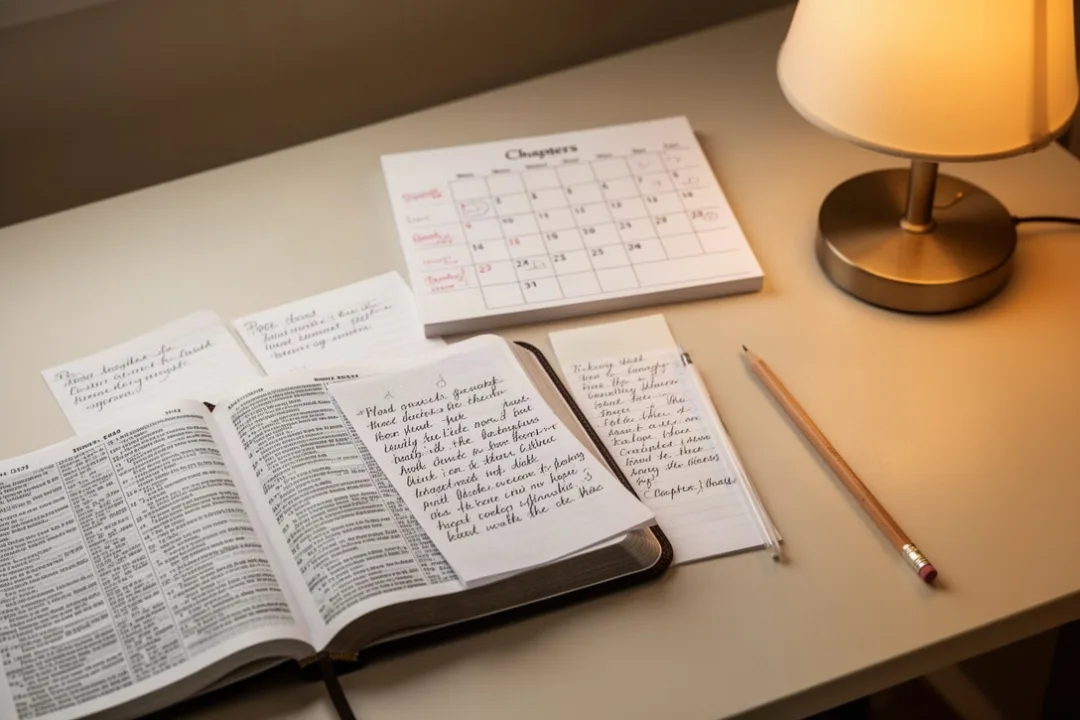
Keep a simple record of what you read. Write down the book, chapter, central idea, questions, and one connection to another passage. This prevents the chapters from becoming isolated pieces and makes it easier to see recurring themes such as faith, grace, holiness, love, hope, and the kingdom of God.
Practical reading plans for all 260 chapters
A reading plan works best when its daily target is realistic. The New Testament is short enough to read steadily but substantial enough to benefit from reflection. You can divide the 260 chapters by the number of days you have, then adjust for weekends, travel, study, or missed readings.
A 90-day plan
Reading the entire New Testament in 90 days requires an average of about three chapters per day. Some days will include two chapters and others four, depending on the length of the books and the schedule you choose.
Read Matthew through Acts during the first month, averaging about three chapters daily.
Read Romans through Philemon during the second month, adjusting the pace for shorter letters.
Read Hebrews through Revelation during the final month, allowing extra time for Hebrews and Revelation.
Use one day each week to review notes or catch up rather than treating a missed day as failure.
This pace is suitable for gaining a broad sense of the whole New Testament. It is less suited to detailed word study because three or more chapters can require considerable time if you are comparing translations or consulting historical background.
A six-month plan
A six-month plan usually means reading one to two chapters per day, with occasional readings of three chapters. This slower approach gives you more room to observe repeated ideas, compare related passages, and write questions.
You might assign one month to the Gospels and Acts, three months to Paul’s letters, one month to the general letters and Hebrews, and one month to Revelation with review. Another approach is to read one Gospel alongside a related group of letters, then return to Acts before finishing the remaining books.
A one-year plan
For a relaxed schedule, read five chapters each week, with one additional chapter on selected weeks. This averages roughly half a chapter per day and leaves room for rereading, devotional reflection, group discussion, or more detailed study.
A one-year plan is especially useful if you want to read each chapter carefully. You can divide longer chapters across several days, read parallel Gospel accounts together, or set aside time to examine the historical situation behind a letter.
How to read a chapter carefully
Before reading, identify the book and its likely purpose. During the reading, look for repeated words, contrasts, commands, promises, questions, and changes in speaker or location. Afterward, describe the chapter’s main point in one or two sentences without copying a study note.
Ask what the chapter says about God, Jesus, the Holy Spirit, people, or the church.
Separate what the text directly states from what you infer from it.
Compare similar accounts without assuming that every difference is a contradiction.
Notice who is speaking and who is being addressed.
Read difficult passages in the context of the whole book.
Record questions for later research instead of forcing an immediate answer.
Chapter numbers are helpful for locating passages, but they were added long after the original books were written. A chapter may end in the middle of an argument, story, prayer, or letter section. When a passage seems incomplete, read the surrounding chapter or section rather than treating the chapter boundary as a natural stopping point.
How chapter numbers, verses, and translations affect your reading
The chapter divisions in modern Bibles are navigation tools, not part of the original manuscripts. Verse numbers function the same way. They make it easy to find a reference such as Romans 8 or John 3:16, but they can also encourage readers to treat a single line as independent from the argument around it.
Read at least a few verses before and after a familiar passage. For a letter, reading the whole chapter may still be insufficient because the writer’s reasoning can stretch across several chapters. For a Gospel narrative, notice how one event leads to the next and how the author builds toward a larger purpose.
Different translations may use different wording, paragraph breaks, headings, or punctuation. The chapter count remains stable, but the reading experience can change. A more literal translation may preserve the structure of the original language more closely, while a thought-for-thought translation may express the meaning in more contemporary English.
When comparing translations, focus on meaningful differences rather than searching for a version that confirms a preferred interpretation. A study Bible can provide notes about manuscripts, cultural background, and difficult terms, but its notes represent editorial judgments and should not be confused with the biblical text itself.
Cross-references can also help, especially when the New Testament echoes earlier Scripture. Matthew, Romans, Hebrews, and Revelation contain many such connections, but a cross-reference list is not a complete explanation. Read the referenced passage in its own setting before deciding how it contributes to the New Testament passage.
For group study, agree on which translation will be read aloud and identify chapter numbers before discussion begins. When quoting a passage in conversation or writing, include the book, chapter, and verse so others can check the context for themselves.
Ways to retain what you read from the New Testament
Remembering 260 chapters does not require memorizing every detail. Retention improves when you connect each book with its purpose, setting, major themes, and distinctive contribution. A brief review after each reading is often more effective than rushing through a large number of chapters.
Create a one-page outline for each book. Include its chapter count, broad structure, major people or issues, and two or three themes. For example, an outline of Philippians might mark encouragement in hardship, humility, partnership, joy, and the hope of Christ’s return.
Use the following review method after finishing a book:
Recall: Write what you remember before looking at notes.
Organize: Divide the book into its major movements or arguments.
Connect: Link its message to a Gospel, Acts, or another letter.
Apply carefully: Ask how its teaching shapes belief, character, relationships, or action.
Revisit: Return to the book after several weeks and update your outline.
Discussion can reveal details that solitary reading misses. Ask another reader what they saw as the central concern of a chapter, where the argument changed direction, and which questions remained unresolved. Healthy discussion allows disagreement while keeping attention on the text’s context rather than on isolated phrases.
Most of all, let the reading pace serve understanding. The goal is not merely to report that you finished all 260 New Testament chapters. A sound reading plan helps you recognize the movement from Jesus’ ministry to the church’s witness and to live with a clearer grasp of the faith these books communicate.
Frequently asked questions
How many chapters are in the New Testament?
The New Testament contains 260 chapters in 27 books. The four Gospels account for 89 chapters, Acts has 28, Paul’s letters have 87, the general letters have 34, and Revelation has 22. Chapter and verse divisions are modern reference tools, so a chapter does not always mark a complete literary or argumentative unit.
Which New Testament book has the most chapters?
Matthew has the most chapters, with 28. Acts also has 28 chapters, so the two books are tied for the highest chapter count. Matthew presents Jesus’ life and teaching, while Acts follows the early church’s growth and missionary expansion after Jesus’ resurrection.
What is the shortest book in the New Testament?
Several New Testament books have only one chapter: Philemon, 2 John, 3 John, and Jude. Their brevity does not mean they lack depth. Each addresses a focused issue, including reconciliation, faithful teaching, hospitality, leadership, false teaching, and perseverance in the faith.
How long does it take to read the entire New Testament?
The time depends on your reading speed and how much study you include. Reading about three chapters daily can cover the New Testament in roughly 90 days. A slower six-month or one-year plan may work better if you want to take notes, compare translations, discuss passages, or reread difficult sections.















Leave a Reply