You may have heard the name Saint Melangell connected with a hare, a small Welsh church, or prayers for people who need protection. The short answer is that Melangell is a medieval Welsh saint traditionally remembered as an Irish-born woman who established a life of prayer in the Tanat Valley of Powys. Her story centers on mercy toward a hunted animal, hospitality, and the creation of a peaceful refuge at Pennant Melangell.
Much of what is known about her comes through local tradition and a medieval saint’s life rather than contemporary records. That means some details, including her exact dates and the historical identity of figures in the story, remain uncertain. Even so, her memory is unusually strong: the church at St Melangell’s Shrine still stands in a remote Welsh valley, and her name remains closely associated with sanctuary, courage, and care for the vulnerable.
Who Saint Melangell was and where her story comes from
Saint Melangell is generally described as a woman of Irish birth who lived in Wales during the early medieval period. Her traditional dates are often placed in the sixth or seventh century, but the evidence does not allow historians to establish a precise birth date or a complete biography. She is also known by the name Monacella, particularly in Latin or later ecclesiastical forms.
According to her traditional life, Melangell was the daughter of a noble or royal family in Ireland. Her father wanted her to marry, but she did not accept the marriage arranged for her. She left Ireland and traveled to Wales, seeking a life devoted to prayer rather than the social expectations placed upon her.
The story presents this decision as an act of religious conviction, not simply an escape from family pressure. Melangell is portrayed as choosing solitude, chastity, and service. In the landscape where she settled, she found a cave or remote place and lived there for many years, gradually becoming known as a holy woman.
The main written account of her life is usually associated with a medieval Vita, or saint’s biography. Such texts were written to preserve a saint’s memory and explain the spiritual meaning of a place. They can contain historical information, but they also use symbolism, dramatic encounters, and traditional storytelling. Melangell’s biography should therefore be read with care: it reflects both a remembered person and the faith of the community that honored her.
A useful distinction: Melangell’s life belongs to the period of early Welsh Christianity, but the surviving written accounts were produced later. The broad tradition is old, while individual details should not be treated as certain modern biography.
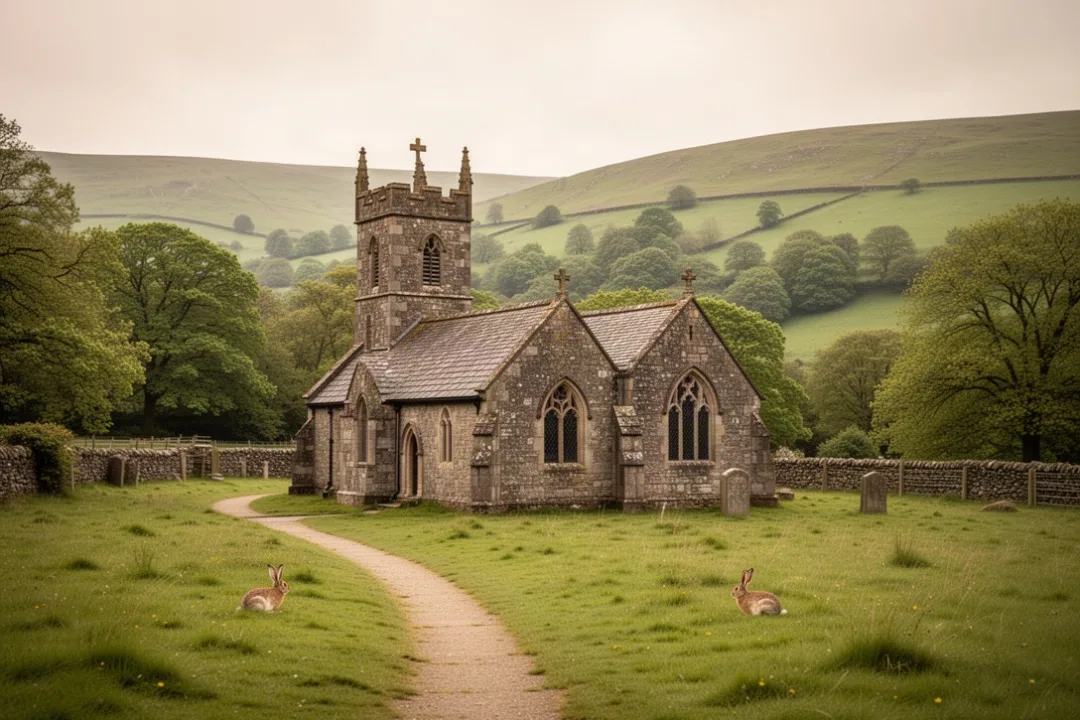
Her connection with Pennant is the central feature of her identity. The name Pennant Melangell refers to the valley and settlement in Powys, in mid-Wales, where the church and shrine associated with her are located. The setting matters because her story is not preserved only in a book. It is attached to a particular landscape of hills, woodland, streams, and open country.
What the story of the hare means
The best-known episode begins with a hunting party. A local ruler, traditionally named Brochwel Ysgithrog, was hunting in the valley when a hare fled toward Melangell. The animal took shelter beneath her clothing, or close against her body, while the hunting dogs stopped and could not reach it.
When the ruler discovered what had happened, he demanded an explanation. Melangell refused to give up the hare. In some versions, she explained that the animal had come under her protection and that no one should harm it within the place where she lived. Her courage impressed the ruler, and the encounter led to an agreement that allowed her to remain at Pennant.
The story is sometimes retold as a simple miracle involving a saint and a wild animal. Its meaning is broader. Melangell places herself between power and vulnerability. The hunted hare is defenseless, while the hunting party has weapons, dogs, status, and authority. Her protection of it becomes an image of hospitality: a creature that reaches her refuge is not handed back to danger.
The hare also carries several layers of symbolism. It is a fast and elusive animal, closely associated with the countryside where Melangell lived. In the story, however, speed alone does not save it. The hare survives because a human being recognizes its need and acts on its behalf.
For many modern visitors, this is the part of Melangell’s story that feels most immediate. You do not need to accept every legendary detail literally to understand the ethical question it raises: What do you do when a vulnerable creature or person comes to you for safety? Melangell’s answer is firm. Protection is not genuine if it ends when the powerful person demands the return of the one seeking help.
The tale also challenges the idea that holiness is confined to formal religious activity. Melangell’s act is practical and public. She does not merely pray for the hare; she uses her position, voice, and physical presence to defend it. The story makes compassion concrete.
Because of this tradition, the hare has become the most recognizable symbol associated with Saint Melangell. It appears in artwork, carvings, local interpretation, and devotional material connected with the shrine. The symbol should not be reduced to a decorative logo. It represents a place of refuge and the responsibility to extend mercy beyond one’s own group.
How Melangell became connected with Pennant
After the encounter with the hunting party, tradition says that Melangell was given land at Pennant. She remained there as a solitary woman and later gathered other people around her. The accounts differ in how they describe her community, but she is generally remembered as the founder or spiritual mother of a religious settlement.
That settlement may have included women living a dedicated religious life, though the surviving evidence does not provide a complete organizational picture. It is safer to say that Melangell became the center of a local Christian community than to impose a modern idea of a convent or monastery on a period whose institutions varied considerably.
The tradition gives her an important role as a founder of sacred space. She did not simply pass through the valley. Her prayer, hospitality, and memory shaped the identity of the place for generations. The church that now stands there continues to connect worship with the landscape that frames the story.
Pennant’s remoteness is part of its appeal, but it should not be romanticized as complete isolation. People lived, traveled, farmed, worshiped, and exchanged stories across the Welsh valleys. A remote religious settlement could still have meaningful relationships with local communities and patrons. Melangell’s story survives precisely because people continued to remember and retell it.
Her name appears in more than one form. Melangell is the Welsh form most commonly used today, while Monacella appears in ecclesiastical and historical references. Different spellings can make research confusing, especially when older sources use Latinized names or variations in transcription.
Her traditional feast day is commonly observed on May 27. Feast-day customs can vary between churches and communities, so anyone planning a service or pilgrimage should check the current schedule of the church or tradition they are following. The date is a day for remembering her life, not a substitute for the wider story of her vocation and witness.
What can be treated as history and what belongs to tradition
There is a real distinction between the existence of the shrine tradition and the historical certainty of every event in the saint’s biography. The church and its association with Melangell are tangible parts of Welsh religious heritage. The details of her family, journey from Ireland, and meeting with Brochwel come through later accounts and local tradition.
This does not make the story worthless or meaningless. Medieval communities preserved identity through narrative, and a saint’s life often communicates values through scenes that are memorable precisely because they are dramatic. A careful reader can honor the tradition while recognizing the limits of the evidence.
Historically secure in the broad sense: Melangell is an old Welsh saint associated with Pennant in Powys.
Strongly preserved by tradition: her Irish origin, her choice of a religious life, and her protection of a hare.
Less certain in detail: exact dates, family relationships, and the precise historical role of figures named in later accounts.
Still visible today: the church, shrine, landscape, devotional memory, and continuing connection with sanctuary.
What to see at Saint Melangell’s Church and shrine
Visitors to Pennant Melangell come to a small historic church set in the Tanat Valley. The building is valued for its connection with the saint, its traditional atmosphere, and its relationship to the surrounding landscape. It is not a grand urban cathedral. Its power lies in the sense that worship, local memory, and countryside remain closely joined.
The church contains the shrine associated with Saint Melangell. The shrine is traditionally understood as the place where her relics or memory were honored, although the history of the remains and the structure has been shaped by centuries of change. Visitors should follow the site’s current guidance about prayer, photography, access, and services.
Architectural features at the church reflect the long development of the site rather than a single moment. Parts of the present building are medieval, and later repairs and restorations have also influenced what visitors see. The church’s age is significant, but its value does not depend on pretending that every stone has remained untouched.
Many people visit because they want a quiet place to pray. Others come for Welsh history, medieval Christianity, architecture, walking, or the story of the hare. These reasons can coexist. A respectful visit allows the church to remain both a place of worship and an important heritage site.
If you are planning to visit, practical preparation makes the experience more meaningful. The location is rural, and services, opening arrangements, parking, walking conditions, and public transportation may vary. Check current information before traveling rather than assuming that a remote church is open at all times.
Confirm access: check opening hours, services, parking arrangements, and any seasonal changes.
Allow quiet time: set aside time inside the church instead of treating it only as a quick sightseeing stop.
Learn the setting: read about Pennant, the Tanat Valley, and the saint before arriving.
Respect the site: keep voices low, follow instructions, and avoid touching historic features or devotional objects.
Walk carefully: rural paths can be uneven or wet, so wear suitable footwear and check local conditions.
For a thoughtful visit: approach the shrine as a living place of prayer as well as a historic monument. If you are not familiar with church customs, quiet observation and respect are enough.
The landscape adds an important dimension to the visit. Melangell’s tradition is not set against an abstract backdrop; it is tied to a valley where animals, weather, water, and human settlement remain visible. Standing there can help you understand why the story focuses so strongly on refuge. The valley itself suggests distance from violence and a place where ordinary life can be held within a sacred setting.
Why Saint Melangell matters to people today
Saint Melangell speaks to several concerns that remain recognizable. Her story addresses the protection of the vulnerable, the dignity of animals, the rights of a woman to choose her vocation, and the need for places where people can step away from threat. These themes do not require a reader to share every assumption of medieval religious culture.
Her refusal to surrender the hare can be understood as a model of moral courage. She is not powerful in the conventional sense. She has no army, office, or legal institution behind her. Her authority comes from the clarity of her commitment and the sacred reputation she develops through a life of prayer.
She also represents a form of leadership that is often overlooked. Melangell does not lead through conquest or public ambition. She creates a community by making a place dependable. People know what her refuge means: those who enter it will not be treated as prey.
That idea can shape personal prayer and reflection. Someone might remember Melangell when protecting a child, caring for an injured animal, supporting a person escaping abuse, or trying to make a home safer for others. The saint’s symbolism is most faithful to its source when it leads to practical compassion, not merely admiration.
Her story can also be approached through environmental ethics. The hare is not presented as a resource to be claimed or a nuisance to be removed. It is a living creature whose fear calls for a response. The tradition does not provide a modern environmental policy, but it does encourage attentiveness to the moral significance of how humans treat animals and the places they inhabit.
For Welsh identity and local heritage, Melangell provides a link between language, landscape, worship, and storytelling. Her name has remained attached to a specific valley, while the traditions around her have traveled beyond it. That combination makes her relevant both to local community memory and to visitors from elsewhere.
Ways to remember Saint Melangell in prayer
You do not need a specialized prayer book to reflect on Melangell. A short period of silence can be enough. You might picture the hunted hare reaching safety, then consider where you are being asked to offer protection rather than indifference.
Some people use her as an intercessor for animals, people in danger, refugees, victims of violence, or anyone searching for a safe home. Others pray for courage when compassion places them in conflict with stronger people. The focus should remain on the values associated with her: mercy, steadfastness, hospitality, and peace.
Pray for wisdom to recognize who is vulnerable in your care.
Ask for courage to oppose cruelty without creating more harm.
Give thanks for people and places that have offered you safety.
Consider one practical act of care for an animal, neighbor, or community.
A simple prayer might use your own words: remember Saint Melangell, ask for protection for those in danger, and commit yourself to making one part of your surroundings more merciful. If you belong to a particular church, you can also ask a priest or minister about local prayers or services connected with her feast day.
Common questions about Saint Melangell’s legacy
Saint Melangell’s legacy is not limited to a single miracle story. It rests on the continuing relationship between a holy woman, a Welsh valley, a historic church, and a moral vision of sanctuary. The hare gives that vision a memorable form, while the shrine gives it a physical home.
Her story invites both faith and careful inquiry. You can appreciate the spiritual meaning of the tradition while distinguishing medieval narrative from independently verified biography. That balance allows Melangell to remain more than a romantic figure from the past: she becomes a reminder that protection is a responsibility exercised in real places, toward real living beings.
Frequently asked questions
Is Saint Melangell the patron saint of hares?
She is widely associated with hares and is often described informally as their patron, especially because of the story in which she protects a hunted hare. Formal patronage titles can vary by church and tradition, so it is more precise to say that she is a saint strongly linked with hares, sanctuary, animals, and protection.
Where is Saint Melangell’s shrine?
The shrine is at St Melangell’s Church in Pennant Melangell, in the Tanat Valley of Powys, Wales. The site is rural, so visitors should check current directions, opening arrangements, worship times, and accessibility before traveling. The church is both an active place of Christian prayer and an important historic site connected with Welsh religious tradition.
What is Saint Melangell’s feast day?
Saint Melangell’s feast day is commonly observed on May 27. Practices can differ between denominations and local communities, and some churches may mark the occasion with a special service or pilgrimage. Checking with the church or community organizing the observance is the best way to confirm details for a particular year.
Did Saint Melangell really come from Ireland?
Her Irish origin is part of the traditional account of her life, which also describes her leaving an unwanted marriage and settling in Wales. Because the surviving biography was written later, historians cannot verify every detail independently. Ireland, Wales, and her life at Pennant remain central to the way her story has been preserved.















Leave a Reply