St. Benedict Joseph Labre: life, faith, and legacy
St. Benedict Joseph Labre: life, faith, and legacy
St. Benedict Joseph Labre is remembered as the patron saint of homeless people because he chose a life of pilgrimage, poverty, and service among society’s forgotten.
Born in France in 1748, he spent much of his adult life walking between European shrines, sleeping wherever he could, accepting food from others, and giving away what little he received. He was not a priest, monk, or parish official. His distinctive vocation was that of a penitent pilgrim who lived outside ordinary social structures while remaining deeply devoted to the Catholic faith.
Labre’s story can be misunderstood if it is reduced to admiration for extreme hardship. His life was not a recommendation that everyone abandon home, work, health care, or community. Rather, it raises questions about radical trust in God, the dignity of people living in poverty, and the ways holiness may appear beyond familiar institutions.
Benedict Joseph Labre was born on March 26, 1748, in Amettes, a village in northern France. He was the first of many children in a Catholic family, and his early life included ordinary responsibilities, religious instruction, and schooling connected with the clergy. His family hoped he might find a stable place in the Church.
As a young man, he felt drawn toward monastic life. He tried to enter more than one religious community, including communities known for strict discipline and prayer. These attempts did not work out. At times he lacked the health, temperament, or practical suitability required for monastic observance, and he was not accepted as a lasting member.
Those disappointments shaped his discernment. Labre did not simply give up on religious commitment after being turned away. He continued to pray, seek spiritual direction, and search for the form of life he believed God was asking of him. Eventually, he came to understand his calling as a wandering Christian pilgrim.
He traveled through parts of France, Switzerland, Germany, Italy, and Spain, visiting churches and major pilgrimage sites. Rome became the center of his life. There, he attended Mass, visited holy places, prayed before the Blessed Sacrament, and lived among beggars and other people with little social standing.
The central point: Labre’s holiness was not based on having a conventional religious career. It was associated with a life of prayer, voluntary poverty, pilgrimage, and compassion for people who were easily ignored.
Why Labre left ordinary religious life behind
Many accounts of Labre focus on the fact that he tried to join religious orders and was unable to stay. That detail matters because it shows that his vocation developed through discernment and failure, not through a straightforward plan. He wanted a life given entirely to God, but the forms he first considered were not the forms in which he ultimately lived.
He was attracted to communities that emphasized silence, fasting, manual labor, and separation from the world. Yet a monastery requires more than personal devotion. It also requires a person to live under a rule, cooperate with a community, maintain discipline, and meet the practical expectations of that institution.
Labre’s inability to enter those communities should not be treated as proof that religious rules were unimportant. Nor should it be used to suggest that institutions automatically prevent holiness. His story shows something more specific: vocation must be discerned honestly, and a sincere desire for holiness does not always fit the first path a person imagines.
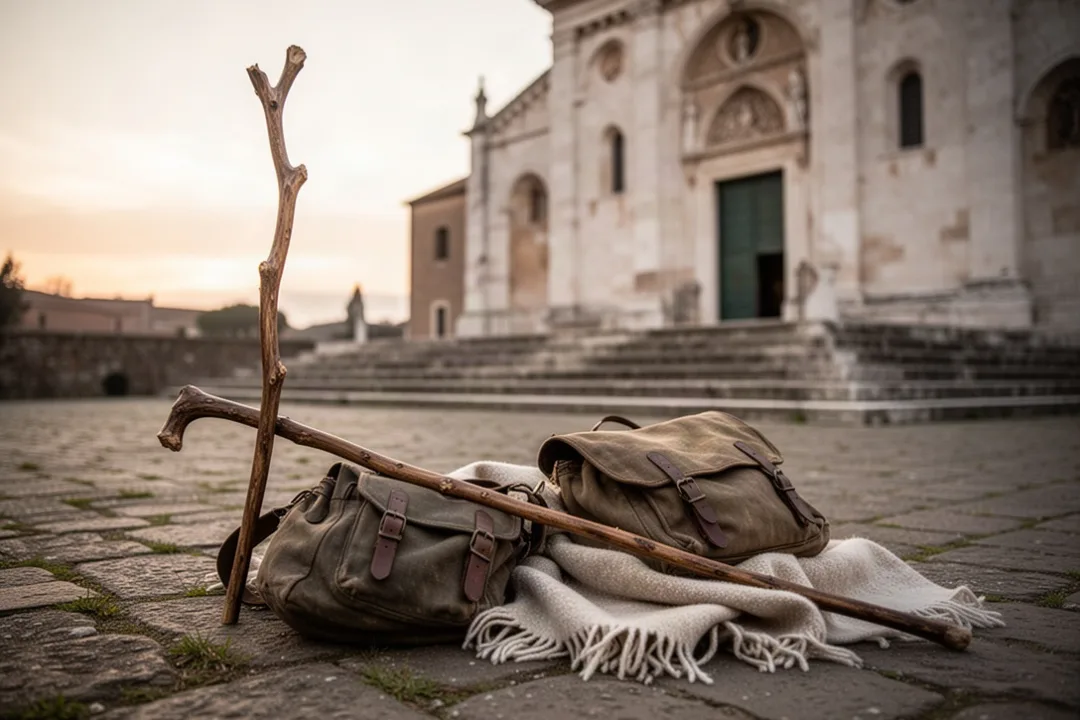
After leaving the prospect of monastic life, he became increasingly committed to pilgrimage. He carried very few possessions and depended on charity. His journeys were not tourism or casual travel. They involved long walks, uncertainty, physical discomfort, and a deliberate willingness to receive help from others.
For Labre, accepting alms was part of his spiritual practice. He placed himself in the position of someone who could not control how others responded to him. That dependence was uncomfortable, but it also connected him with the poor and made him a visible reminder that every person depends on gifts received from God and from other people.
How St. Benedict Joseph Labre practiced his faith
Labre’s spirituality centered on the Eucharist, prayer, confession, and devotion to Mary. He spent long periods in churches, especially in Rome, and was known for remaining near the Blessed Sacrament. He prayed the Rosary and practiced other Catholic devotions common in his era.
His faith was not confined to private religious feeling. He attended to people around him, especially those who were poor or isolated. Accounts describe him sharing food and money when he could, even though he owned very little. His generosity was striking because he did not wait until he had an abundance before giving.
He also belonged to the Third Order of St. Francis, a form of association that allowed laypeople to follow Franciscan spirituality without becoming friars. This connection helped express his commitment to humility, poverty, and service while he continued living outside a monastery.
Labre’s days had a recognizable rhythm. Prayer, visits to churches, pilgrimage, receiving food, giving assistance, and rest in public or improvised places filled his time. He was often dirty, poorly dressed, and physically exhausted. His appearance made some people dismiss him, but others recognized a seriousness and gentleness beneath his outward condition.
His approach to prayer was strongly embodied. He walked for miles, knelt for long periods, fasted, and accepted discomfort. Such practices made sense within his personal vocation, but they should not be separated from his charity. Physical austerity was not the whole of his holiness; it was joined to worship, humility, and concern for others.
Labre’s life among the poor in Rome
Rome offered Labre a place where pilgrimage, poverty, and public religious life intersected. The city contained major basilicas, shrines, confraternities, and large numbers of travelers and people without stable housing. He could pray at important churches while remaining close to those who lived on the margins.
He did not establish a shelter or organize a formal movement. His witness was more personal and immediate. He lived as one of the poor, asked for food, and shared what he had. People came to know him as a man who was constantly praying and who showed patience toward those around him.
This is one reason his story still speaks to discussions about homelessness. Labre was not an outside observer who briefly helped poor people before returning to comfort. He chose a life marked by dependence, insecurity, and public vulnerability. He knew what it meant to be judged by clothing, smell, health, and social status.
At the same time, modern readers should avoid romanticizing homelessness. Labre’s voluntary poverty was connected with a particular religious vocation and historical setting. Many people without housing today are there because of high living costs, illness, disability, family violence, addiction, unemployment, discrimination, or failures in social systems. Their situations cannot simply be compared with Labre’s chosen way of life.
A necessary distinction: Honoring Labre does not mean treating homelessness as desirable or ignoring practical needs. His example calls for respect, direct compassion, and responsible help for people who lack safe housing.
What happened during his final illness and death
Years of hunger, exposure, walking, and poor health weakened Labre. In 1783, when he was about thirty-five years old, he collapsed near a church in Rome. A nearby resident took him in, and he received care during his final days.
He died on April 16, 1783. News of his death spread quickly among people who had seen him praying and begging in Rome. Many regarded him as holy before any official Church process had established his status.
He was buried at the church of Santa Maria ai Monti in Rome. His burial place became associated with prayer and pilgrimage, and devotion to him continued to grow. Reports of favors and miracles attributed to his intercession contributed to the process that led to his canonization.
Labre was canonized by Pope Leo XIII in 1881. His liturgical feast is generally celebrated on April 16, the anniversary of his death. He is commonly invoked by people experiencing homelessness, travelers and pilgrims, and those seeking help with poverty and social isolation.
What makes St. Benedict Joseph Labre a patron of homeless people
Labre is sometimes described as the “beggar of Rome,” a title that reflects both his public condition and the way people remembered him. He did not merely give donations to those in poverty; he placed himself among them. That shared experience distinguishes his witness from a charity performed entirely from a position of security.
His patronage also reflects the fact that he was treated as an outsider. He had no permanent household, career, institutional office, or recognized social rank. His value was not obvious in the ways society often measures value. His life therefore challenges the habit of judging people by productivity, appearance, address, or possessions.
For people who are homeless, his story can offer a saint who understands displacement and dependence. It does not erase the pain of homelessness, and it should never be used to pressure someone into accepting unsafe conditions. But it can affirm that a person’s spiritual dignity remains intact even when housing, employment, health, or social support have been lost.
For people who have homes, Labre’s example creates a different responsibility. It asks whether they see unhoused neighbors as individuals rather than as nuisances or anonymous problems. Prayer for Labre’s intercession is most faithful to his example when it is joined with practical respect and concrete assistance.
How to honor St. Benedict Joseph Labre responsibly
There are many ways to remember Labre without copying every outward feature of his life. His particular vocation involved extreme poverty and pilgrimage, but most people are called to serve God through family life, work, parish membership, religious life, or other forms of stable community.
Pray for people without housing, asking for safety, health, dignity, and supportive relationships.
Offer practical help through a reputable shelter, food pantry, outreach team, or organization serving unhoused neighbors.
Speak respectfully to people who ask for assistance, even when you cannot provide money.
Give useful supplies, such as water, socks, hygiene products, weather-appropriate clothing, or transit assistance, according to local guidance.
Learn local resources so that you can share accurate information about shelters, medical care, transportation, and emergency services.
Protect personal boundaries while helping; generosity does not require you to enter unsafe situations or ignore professional advice.
A parish might mark his feast day with a Mass, a prayer service, or a collection for a local housing ministry. A family could learn about his life and then prepare care kits. A person praying alone might spend time before the Blessed Sacrament and ask how to become more attentive to people who are overlooked.
The best response depends on the real needs of the community. Some organizations need money, while others need volunteers, transportation, food, winter supplies, or advocacy. Before donating items, check what a local service provider can actually distribute safely and efficiently.
Common mistakes when learning about or imitating Labre
Labre’s unusual life can attract exaggerated stories and unrealistic interpretations. A careful approach keeps his spiritual witness meaningful while respecting the difference between his vocation and the circumstances of people who are poor today.
Do not treat homelessness as automatically holy. Labre chose poverty for religious reasons; involuntary homelessness is a serious hardship that deserves protection and support.
Do not imitate dangerous deprivation. Severe fasting, exposure, untreated illness, or sleeping outdoors can cause real harm and are not required for Christian devotion.
Do not assume every unhoused person shares Labre’s beliefs. Service should be offered without making assistance dependent on religious agreement.
Do not reduce him to a strange historical curiosity. His prayer, humility, charity, and perseverance matter more than sensational details about his appearance.
Do not confuse failed monastic attempts with failure as a person. Labre’s path developed through uncertainty, and discernment often includes closed doors.
Do not use his story to criticize people with ordinary responsibilities. Stable housing, work, family care, treatment, and community support can all be honorable forms of Christian service.
These cautions make devotion more—not less—faithful. Labre’s life calls people to recognize God’s presence in the poor, but recognition should lead to respectful action rather than sentimental admiration.
What St. Benedict Joseph Labre teaches about vocation
One of the most useful lessons in Labre’s story is that vocation may take time to become clear. He had a genuine desire for religious dedication, yet several doors closed before he found the way he would live. The process involved disappointment, self-knowledge, and patience.
His example can encourage people who feel they have not followed a straightforward path. A rejected application, a change in career, a failed relationship, or an unexpected limitation does not by itself determine a person’s worth. Discernment involves asking what responsibilities, abilities, and circumstances are actually present rather than forcing an idealized identity.
Labre also demonstrates that vocation is not simply a private preference. His life affected other people. He depended on their generosity, accepted their care, and shared what he received. A vocation, even an unusual one, should be evaluated by its relationship to truth, charity, community, and human dignity.
His life is therefore not an argument for individualism. Although he lived outside ordinary institutions, he remained connected to the Church through prayer, worship, confession, spiritual relationships, and the sacraments. His independence from a monastery did not mean independence from every form of accountability.
Ways to pray with St. Benedict Joseph Labre
People commonly ask Labre’s intercession for those without homes, those struggling with poverty, pilgrims, and people who feel rejected or forgotten. A prayer can be simple and direct. You may ask him to pray for a person by name, for a shelter or outreach worker, or for greater compassion in your own community.
A short devotion might include a reading about his life, a period of quiet prayer, and a specific act of mercy. You could pray before a meal and remember those who do not know where their next meal will come from. You could visit a church, walk quietly, and offer the time for someone experiencing loneliness.
Those who pray the Rosary may include unhoused people and caregivers in their intentions. Those who attend Mass can connect the feast of April 16 with a concrete offering to a local service organization. The purpose is not to make charity a transaction but to let prayer reshape attention and behavior.
“The poor you will always have with you.” — John 12:8, cited by reference and paraphrased rather than quoted from a particular translation
That Gospel passage is sometimes used too passively, as though poverty were unavoidable and therefore nothing should be done. In context, Christian reflection on the poor should move toward presence, mercy, and responsibility. Labre’s witness points in that direction: see the person, honor the person, and respond with love.
Why St. Benedict Joseph Labre still matters
St. Benedict Joseph Labre remains relevant because he unsettles easy assumptions about who deserves attention. He had little money, no conventional profession, and no permanent home, yet people eventually recognized a profound spiritual life in him. His memory challenges the belief that dignity must be earned through success, comfort, or social usefulness.
He also reminds the Church that prayer and service belong together. Labre spent hours in worship, but he did not treat devotion as a reason to ignore people around him. His poverty was personal and voluntary, while the poverty of many people he encountered was not. Holding those facts together prevents both romanticism and indifference.
For Catholics, his feast day offers an opportunity to pray for the homeless and to examine how parish life welcomes people who have little money or stability. For anyone interested in Christian spirituality, his story presents a demanding picture of humility, dependence, perseverance, and mercy.
Remembering Labre well means more than knowing that he was canonized in 1881 or that his feast is April 16. It means allowing his life to sharpen your awareness of people who are overlooked, while responding in ways that are safe, practical, and respectful. His legacy is strongest when the person asking for help is treated not as a symbol, but as a neighbor.
Frequently asked questions
What is St. Benedict Joseph Labre the patron saint of?
St. Benedict Joseph Labre is especially associated with people experiencing homelessness, poverty, and social exclusion. He is also connected with pilgrims and travelers because he spent much of his life walking to religious shrines. His patronage comes from his personal experience as a mendicant pilgrim who depended on charity and lived among people who had little security or social status.
When is St. Benedict Joseph Labre’s feast day?
His feast day is generally observed on April 16, the date of his death in 1783. Local calendars and communities may commemorate him differently, but April 16 is the date most commonly connected with his liturgical remembrance. It can be marked with prayer, Mass, or practical support for a local organization serving people without housing.
Did St. Benedict Joseph Labre belong to a religious order?
Labre tried to enter several strict religious communities but was not able to remain in them. He later became associated with the Third Order of St. Francis, which allowed laypeople to follow Franciscan spirituality without becoming friars. His mature vocation was that of a wandering pilgrim and penitent rather than a monk living under a monastery’s rule.
How can someone honor St. Benedict Joseph Labre today?
You can honor him by praying for people without housing, treating unhoused neighbors with respect, and supporting reliable local services. Donations, volunteering, useful supplies, and learning where people can find shelter or medical assistance are practical choices. Avoid copying extreme deprivation; Labre’s particular vocation was unusual, while safe housing and professional support remain essential for people facing homelessness.















Leave a Reply