Miguel Pro was a Mexican Jesuit priest who was executed in 1927 during religious persecution and later recognized as a Catholic martyr.
Known formally as Blessed Miguel Agustín Pro Juárez, he served Catholics when public worship and priestly ministry were severely restricted in Mexico. He celebrated the sacraments secretly, moved from place to place in disguise, and used his intelligence and warmth to support people living under fear. His life ended when government officials accused him of involvement in an attempted assassination, even though the evidence did not establish that he had planned or carried out the attack.
Miguel Pro’s story is remembered not only because of the manner of his death, but also because of the way he lived: with practical compassion, spiritual discipline, and confidence in Christ. His example continues to speak to Catholics interested in courage, religious freedom, service, and faithful witness under pressure.
Miguel Agustín Pro Juárez was born on January 13, 1891, in Guadalupe, in the Mexican state of Zacatecas. He was one of several children in a devout Catholic family. His father worked in the mining industry, and the family moved during Miguel’s youth. People who knew him often remembered his lively personality, quick humor, and ability to connect with people from different backgrounds.
As a young man, Pro initially struggled to identify his vocation. He entered the Society of Jesus in 1911, beginning the long formation expected of a Jesuit. His religious training took place largely outside Mexico because the country’s political conditions made open Catholic institutional life increasingly difficult. He studied in places including California, Spain, and Belgium, and was ordained a priest in 1925.
His health was fragile for much of his life. He suffered from serious stomach problems and underwent medical treatment, but illness did not remove his desire to return to Mexico. After ordination, he hoped to serve his people directly. That wish became especially urgent as the Mexican government enforced laws that restricted the Catholic Church and placed priests under close surveillance.
Pro’s significance comes from the combination of ordinary priestly work and extraordinary danger. He was not a military leader or a political organizer. His central work was hearing confessions, celebrating Mass, bringing Communion to the sick, baptizing children, and encouraging families who had little access to public religious life.
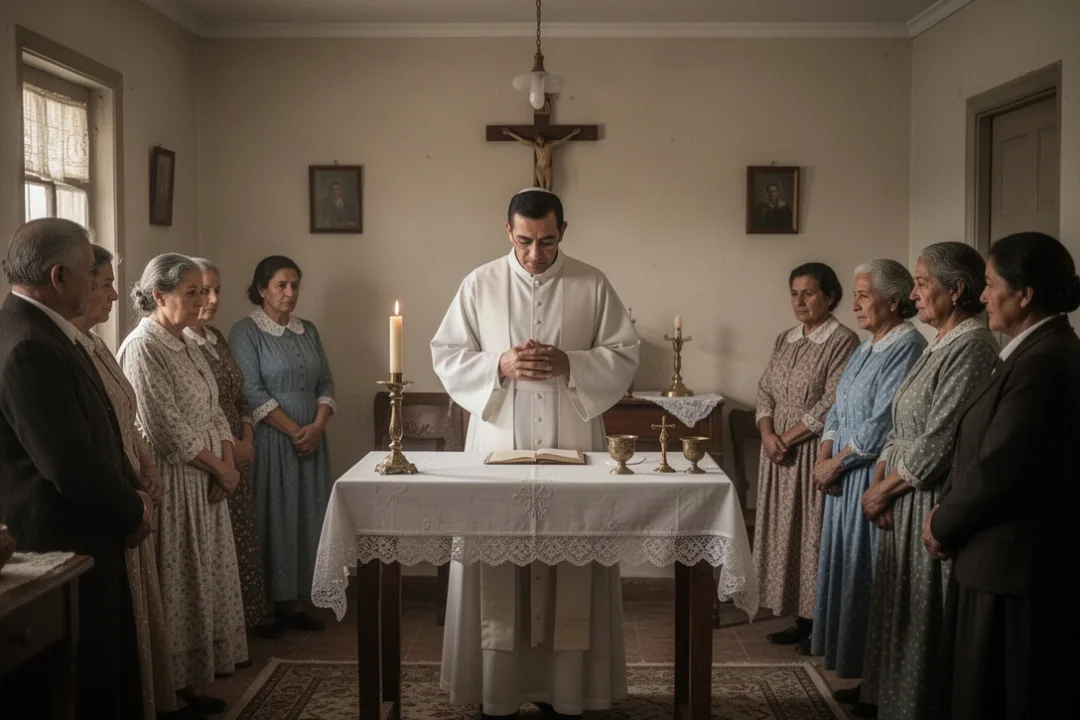
Because official church activity was restricted, a priest could not always work openly. Pro therefore relied on trusted laypeople, temporary homes, concealed chapels, and carefully arranged meetings. His ministry demanded planning and discretion, but those practical measures served a pastoral purpose: helping Catholics remain connected to the sacraments and to one another.
The central fact about Miguel Pro: his ministry was primarily sacramental and pastoral. The danger surrounding him came from serving Catholics under persecution, not from seeking political power.
How Mexico’s religious persecution shaped Miguel Pro’s ministry
To understand Miguel Pro, you need to understand the conflict between the Mexican government and the Catholic Church during his lifetime. The Mexican Revolution and its aftermath produced a political order that sought to reduce the Church’s public influence. The Constitution of 1917 included provisions limiting ecclesiastical property, religious education, clerical activity, and the institutional role of churches.
Some of these restrictions were enforced unevenly at first. Under President Plutarco Elías Calles, however, enforcement became more aggressive in the 1920s. The government required priests to register, limited the number of clergy allowed to minister in particular areas, and imposed rules that many Catholics regarded as an attempt to place the Church under state control.
Church leaders responded in different ways. Some negotiated, while others resisted publicly. In 1926, the Mexican bishops suspended public worship in response to the enforcement of the so-called Calles Law. The suspension did not mean that Catholics abandoned their faith. Instead, priests and laypeople developed hidden networks so that baptisms, confessions, marriages, and Eucharistic celebrations could continue.
Miguel Pro returned to Mexico in 1926, just as this crisis intensified. He could not operate as a parish priest in the usual way. Instead, he worked secretly, often changing locations and disguising himself to avoid arrest. He might appear as a laborer, a businessman, or another ordinary traveler. Such disguises were not intended to deceive people for personal gain; they allowed him to reach Catholics without immediately exposing the households that sheltered him.
Celebrating Mass in private homes for small groups of Catholics.
Hearing confessions and offering spiritual direction to people unable to visit a church.
Bringing Holy Communion to the sick and to people who requested the sacraments.
Organizing practical aid for families affected by political violence and poverty.
Encouraging lay Catholics to sustain prayer and religious education within their homes.
Pro’s approach was notably personal. Accounts of his life describe a priest who could be serious about his responsibilities without becoming harsh or distant. He used humor, conversation, and attentive listening to make people feel less isolated. Those qualities mattered in a society where fear could make every religious gathering seem dangerous.
He also understood that secrecy could create moral and emotional strain. A hidden Catholic community needed more than instructions about avoiding arrest. It needed trust, courage, and a sense that Christian life remained possible even when churches were closed and priests were hunted. Pro tried to strengthen that confidence through prayer, the sacraments, and direct human companionship.
What happened to Miguel Pro before his execution
On November 13, 1927, an attempted assassination targeted Álvaro Obregón, a former president of Mexico who was seeking to return to office. A bomb was thrown at Obregón’s automobile in Mexico City. He survived the attack, and the authorities arrested several people connected in some way with the alleged plot.
Miguel Pro was arrested because his brother Humberto had links to individuals suspected of involvement. The priest was not accused of personally throwing the bomb, and the available historical record does not show that he organized the attack. Nevertheless, the government treated him as a dangerous figure. His public reputation as a priest working secretly made him useful as a political target.
Pro was arrested along with his brothers Humberto and Roberto. The brothers were later released, but Miguel remained in custody. The government decided to execute him without a normal judicial process. His death was meant not only to punish an alleged enemy but also to intimidate Catholics and demonstrate the state’s power.
The execution took place on November 23, 1927, at the Military Police headquarters in Mexico City. Government officials arranged for photographers to document the event. The resulting images show Pro kneeling in prayer, standing before the firing squad, and extending his arms in a gesture associated with Christ’s crucifixion. The photographs were circulated widely and became an important part of how the public remembered his death.
Before the firing squad shot him, Pro forgave those responsible and prayed. He is widely associated with the words “¡Viva Cristo Rey!”, meaning “Long live Christ the King.” This cry became a defining expression of the Mexican Catholic resistance, especially during the religious conflict. It was not a call for violence. It expressed his belief that allegiance to Christ took priority over the claims of a government attempting to control religious life.
“¡Viva Cristo Rey!”
The execution caused outrage among many Catholics because Pro had not received a conventional trial. The government’s decision to publicize the killing appears to have been intended as a warning, but the photographs produced the opposite effect among many believers. They became images of prayerful resistance and martyrdom, and Pro became one of the best-known Catholic figures associated with the persecution in Mexico.
Historical caution: Miguel Pro should not be described as the planner of the 1927 bombing attempt. He was executed after being connected to suspects, but the circumstances did not establish that he carried out the attack.
What Miguel Pro’s spirituality reveals about his character
Miguel Pro’s spirituality was shaped by the Jesuit tradition, which emphasizes prayer, discernment, disciplined service, and finding ways to help people in concrete circumstances. His religious life was not limited to private devotion. He understood prayer as preparation for loving action, especially when serving others required personal risk.
Several characteristics stand out in accounts of his life and ministry.
He treated the sacraments as sources of strength
For Pro, the Eucharist, confession, and anointing were not optional extras for Catholics living through a crisis. They were central means by which people encountered God and received strength. His willingness to celebrate Mass secretly and travel to the sick shows how seriously he took that responsibility.
This sacramental focus also explains why he accepted danger. He was not seeking dramatic experiences. He was trying to provide the ordinary ministry of a priest when ordinary access had been taken away. The risk came from the circumstances, not from a desire to make himself famous.
He combined courage with prudence
Courage in Pro’s life did not mean acting recklessly. He changed locations, used disguises, relied on communication networks, and took precautions to protect the people who helped him. His example presents courage as faithful action guided by judgment, rather than as a refusal to recognize danger.
That distinction remains useful. Religious conviction does not require ignoring practical responsibilities or placing other people in unnecessary danger. Pro’s ministry depended on careful decisions made for the sake of a larger pastoral purpose.
He served people as individuals
Pro is often remembered through photographs and dramatic historical events, but his work consisted largely of quiet encounters. He listened to people confess their sins, visited the sick, encouraged families, and helped Catholics approach the sacraments. These actions required patience and emotional attention.
His reported sense of humor also had a spiritual purpose. It helped people endure fear without denying the seriousness of their situation. A priest who could speak naturally with workers, families, students, and fellow religious could build trust across social boundaries.
He separated Christian witness from revenge
Pro’s final actions are remembered for forgiveness rather than retaliation. He did not use his death to encourage hatred of his executioners. His witness was based on fidelity to Christ, concern for the Church, and confidence in eternal life. For Catholics, this is a major reason his martyrdom has spiritual importance beyond the political history of Mexico.
His life can be reduced too easily to a heroic image of a priest facing a firing squad. A fuller understanding includes the less dramatic disciplines that prepared him: prayer, study, illness, obedience, pastoral planning, and repeated acts of service. Martyrdom was the final event, but his vocation was formed through years of ordinary faithfulness.
How the Catholic Church recognizes Miguel Pro
The Catholic Church beatified Miguel Pro on September 25, 1988, during the pontificate of Pope John Paul II. Beatification recognizes that a person is in heaven and permits a limited public devotion, generally within a particular region, religious community, or approved context. In Pro’s case, the Church recognized him as a martyr who gave his life because of hatred toward the Catholic faith.
His liturgical memorial is observed on November 23, the anniversary of his execution. Catholics may remember him through Mass where permitted, private prayer, devotional reading, or reflection on his witness. He is especially associated with Mexico, the Society of Jesus, persecuted Christians, priests, and people seeking courage in difficult circumstances.
Beatification is different from canonization. A blessed person is not automatically a saint for universal veneration throughout the worldwide Catholic Church. Miguel Pro remains widely honored as Blessed Miguel Pro, but he should not be casually described as a canonized saint unless the Church has formally declared that status.
Devotion to Pro has spread through holy cards, biographies, parish groups, schools, and Jesuit communities. Many people are drawn to him because he appears approachable. His photographs do not show a remote religious figure detached from everyday life. They show a man who prayed, worked under pressure, and maintained his human warmth while facing death.
When Catholics pray with Miguel Pro’s example in mind, they may focus on specific intentions:
Strength for people facing religious persecution or discrimination.
Wisdom for clergy and lay leaders serving under difficult conditions.
Faithfulness in ordinary responsibilities, especially when recognition is unlikely.
Peace for families affected by political violence and social conflict.
Grace to forgive without excusing injustice or abandoning the search for truth.
Remembering a martyr does not require romanticizing violence or treating suffering as valuable for its own sake. Pro’s story points instead to the dignity of conscience, the importance of religious freedom, and the responsibility to protect human life. His witness can be honored while still recognizing the tragic cost of political repression.
Miguel Pro’s historical setting was specific, but several parts of his example remain relevant. He shows how religious faith can continue through small, organized acts when public institutions are weakened. He also illustrates the role of laypeople, whose homes, trust, transportation, and practical assistance made his hidden ministry possible.
His life challenges the idea that courage always looks dramatic. Most of his courage involved showing up for people who needed him, despite uncertainty about arrest or betrayal. A person serving in a hospital, shelter, parish, prison ministry, or persecuted community may recognize that same pattern: the work is often repetitive, personal, and unseen, but it matters deeply to those receiving it.
Pro also offers a model for holding conviction and humanity together. He did not need to become cold in order to be serious. His humor and warmth did not make his faith shallow. Instead, they helped him meet people as people, not merely as members of a cause.
His story also calls for careful thinking about religious freedom. Freedom of religion is not only the right to hold private beliefs. It includes the ability of communities to worship, educate children, care for the sick, form institutions, and serve the public without unjust government control. The restrictions faced by Mexican Catholics demonstrate how quickly a government can turn religious practice into a matter of political permission.
At the same time, Pro’s life should not be used to justify contempt for every government or disagreement with every public policy. His witness was directed against coercive persecution and the denial of conscience. Applying his example responsibly means defending human dignity, rejecting violence, and supporting peaceful freedom for people of different beliefs.
For someone beginning to learn about him, a useful approach is to consider three questions:
What responsibility has faith given me? Pro understood priesthood as service, not status.
How can I act wisely under pressure? His ministry combined courage with careful protection of others.
Can I remain compassionate when treated unjustly? His final witness joined resistance to wrongdoing with forgiveness.
Miguel Pro remains a compelling figure because his life joins the personal and the historical. He was a priest who cared for individuals, yet his execution became part of a national struggle over faith and authority. He worked quietly, but his death was photographed and remembered around the world. He faced an unjust sentence, yet his most lasting message was not revenge.
Blessed Miguel Pro’s legacy is the courage to serve faithfully, intelligently, and compassionately when doing what is right carries a real cost.
Frequently asked questions
Was Miguel Pro involved in the bombing attempt against Álvaro Obregón?
Miguel Pro was arrested because of his connection to people suspected of involvement in the November 1927 attack, but he was not shown to have planned or carried out the bombing. The government executed him without a conventional trial. Historical accounts therefore describe him as a political and religious target rather than as the proven perpetrator of the attack.
Why did Miguel Pro use disguises?
Pro used disguises and secret meeting places because Mexican authorities were restricting Catholic ministry and arresting priests who served without government approval. His disguises helped him celebrate Mass, hear confessions, visit the sick, and bring Communion while reducing the immediate danger to himself and the families who assisted him.
Is Miguel Pro a canonized saint?
Miguel Pro was beatified by Pope John Paul II in 1988 and is formally known as Blessed Miguel Agustín Pro. Beatification allows approved public devotion in certain settings, but it is not the same as universal canonization. He is therefore best described as a blessed Catholic martyr unless the Church formally changes his status.
When is Miguel Pro’s feast day?
Miguel Pro is commemorated on November 23, the date of his execution in 1927. The day is especially observed by Catholics in Mexico and by members of the Society of Jesus. Devotions commonly focus on his priestly service, courage under persecution, concern for the sick, and final witness to Christ.












Leave a Reply