Justin the Martyr was a second-century Christian philosopher, teacher, and defender of the faith. Born in the early second century and executed in Rome around 165 CE, he is best known for explaining Christianity to the Roman world through reason, Scripture, and moral evidence.
His surviving works, especially the First Apology, the Second Apology, and the Dialogue with Trypho, offer some of the earliest detailed descriptions of Christian worship and belief outside the New Testament. Justin argued that Christians were not enemies of society, but people devoted to the true God, ethical living, and the teachings of Jesus Christ.
Justin was probably born around 100 CE in Flavia Neapolis, a Roman city in Samaria built near the ancient site of Shechem. He grew up in a world shaped by Greek philosophy, Roman political power, Jewish tradition, and the expanding Christian movement.
He described himself as a lover of philosophy before becoming a Christian. His search led him through several schools of thought, including Stoicism, Aristotelian philosophy, Pythagorean ideas, and Platonism. He did not present this search as an academic exercise alone. He was looking for an account of reality that could explain God, the human soul, truth, and the purpose of life.
According to his own account, an elderly Christian introduced him to the Hebrew prophets and to the courage of Christians who faced death without abandoning their beliefs. Justin came to regard Christianity as the true philosophy, not because it rejected reason, but because he believed it fulfilled the deepest search for truth.
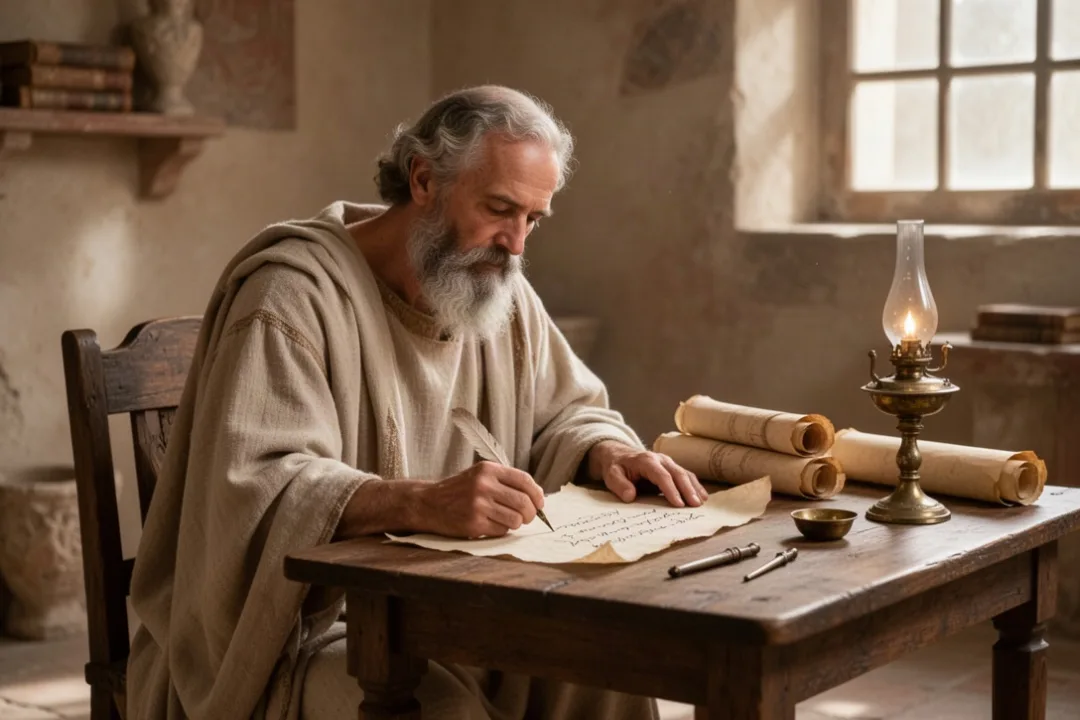
After becoming a Christian, Justin continued to wear the cloak associated with a philosopher and taught publicly. He eventually established a school in Rome. His public role made him one of the earliest Christian writers to address pagan intellectuals, Roman officials, and Jewish critics in sustained argument.
Quick answer: Justin was both a Christian teacher and an apologist. In his writings, “apologist” means a person who gives a reasoned defense of the faith, not someone who merely says sorry.
Justin’s life and ministry in chronological points
Birth and education: Justin was likely born near the beginning of the second century in Samaria and received a broad education in Greek philosophy and religious thought.
Philosophical search: He explored multiple philosophical traditions while seeking an explanation of God, truth, the soul, and the good life.
Conversion to Christianity: He became convinced that the Hebrew prophets and Jesus offered the fullest revelation of divine truth.
Teaching: He traveled and taught as a Christian philosopher, eventually working in Rome and gathering students.
Christian defense: He wrote to explain Christian beliefs and challenge false accusations, especially claims that Christians were atheists, immoral, or politically dangerous.
Conflict with authority: Justin’s public Christian teaching brought him into conflict with the philosopher Crescens, according to later testimony associated with his death.
Trial and execution: He and several companions were examined by the Roman prefect Junius Rusticus and executed, probably around 165 CE.
Why Justin was called “the Martyr”
The title “the Martyr” refers to Justin’s death because of his Christian confession. The word martyr originally carried the sense of a witness. In Christian usage, it came to describe someone whose testimony was confirmed by suffering and death rather than abandoned under pressure.
The surviving account known as the Acts of Justin presents a legal examination before Rusticus. Justin is asked about his beliefs and refuses to sacrifice to the Roman gods. When questioned about Christian gatherings, he identifies Christians as people who meet for worship and prayer, though he also indicates that not every Christian community gathers in exactly the same place.
The account portrays Justin and his companions as accepting the consequences of their confession. It should be read as an early Christian martyr narrative, with attention to its religious purpose and literary form. Even so, it preserves a clear memory of Justin as a teacher who regarded loyalty to Christ as more important than protecting his life.
His martyrdom did not mean that he sought death for its own sake. In his apologies, Justin repeatedly explains that Christians want to live peacefully and obey lawful authorities. His central claim was that Christians could not worship false gods or deny the God they believed had revealed himself through Jesus.
What Justin wrote and which works survive
Justin wrote several works, but only a small group has survived. His writings were addressed to different audiences and use different methods. Some defend Christianity before Roman readers; others debate Jewish interpretations of the Hebrew Scriptures.
First Apology: A formal defense of Christians addressed to the emperor Antoninus Pius, his sons, and Roman authorities. Justin challenges legal and popular hostility toward Christians.
Second Apology: A shorter defense responding to injustice against Christians and criticizing the irrational treatment of people simply because they bear the Christian name.
Dialogue with Trypho: A long conversation, presented as a debate with a Jewish interlocutor, about the Hebrew Scriptures, Jesus, the covenant, and the identity of God’s people.
Fragments and disputed writings: Other works were attributed to Justin in later centuries, but not all have the same level of support. His most securely recognized writings are the three works above.
The First Apology is particularly valuable because it combines theology, moral defense, descriptions of worship, and an appeal to Roman justice. Justin does not merely say that Christians are misunderstood. He explains what they believe, how they live, and why the state should not punish them without examining individual conduct.
The Dialogue with Trypho has a different tone. It presents Christian interpretation of Israel’s Scriptures and argues that Jesus is the promised Messiah. The work reflects the complex relationship between Christians and Jews in the second century, and it should not be used carelessly to justify hostility toward Jewish people. Its arguments belong to a particular historical debate and include language that modern readers must handle with accuracy and moral care.
How Justin defended Christians against Roman accusations
Christians in Justin’s time could be accused of several serious offenses. Because they did not participate in traditional sacrifices to the Roman gods, critics could call them atheists. Their private gatherings also encouraged rumors about sexual immorality, secret crimes, and ritual cannibalism.
Justin answers these charges directly. He explains that Christians reject idols because they worship the Creator, not because they deny the existence of the divine. He presents Christian moral teaching as strict rather than permissive, including sexual self-control, honesty, care for the vulnerable, and refusal to seek revenge.
He also addresses the accusation of cannibalism by explaining Christian teaching about the Eucharist. Justin says that Christians receive bread and wine in connection with Jesus Christ and that the practice is not ordinary food or a secret criminal ceremony. His account is one of the earliest detailed descriptions of Christian worship after the New Testament.
Justin’s legal argument is also significant. He objects to the practice of punishing people simply because they are called Christians. A person should be judged for a proven crime, he argues, not for an unexamined label. This concern with fair procedure and evidence gives his apologies a practical as well as theological purpose.
Historical caution: Justin’s descriptions are important early evidence, but they do not prove that every Christian community worshiped in precisely the same way. His writings show what he knew and taught, especially in the communities connected with his ministry.
What Justin taught about Christian worship
Justin’s account of Sunday worship is one of his most frequently discussed passages. He describes Christians gathering on Sunday because it was associated with both the first day of creation and the resurrection of Jesus. The community reads the writings of the apostles and the prophets, listens to an exhortation, prays, and shares bread, wine, and water.
After the prayers, Justin describes the Eucharistic elements being distributed, with deacons taking them to people who cannot attend. He also mentions collections for orphans, widows, prisoners, travelers, and others in need. This connects worship with organized care for the community and its neighbors.
His description can be broken into several recognizable elements:
Gathering: Christians meet together on the day associated with Jesus’ resurrection.
Reading: Texts from the prophets and apostolic writings are read publicly.
Teaching: A leader gives an exhortation aimed at faithful living.
Prayer: The congregation prays together, including prayers connected with baptism and the Eucharist.
Communion: Bread and a mixed cup are received in a sacred meal associated with Christ.
Service: Members contribute resources for people facing poverty, illness, imprisonment, or other hardship.
Justin’s description does not provide a complete worship manual, but it shows several features already established in at least some second-century Christian settings. Public reading, teaching, common prayer, baptism, the Eucharist, and financial support for those in need appear together as parts of Christian life.
Justin’s explanation of baptism and Christian initiation
Justin describes baptism as a serious act of Christian initiation rather than a casual public symbol. Those who are persuaded of Christian teaching and commit themselves to live accordingly are instructed to pray and fast. They are then brought to water and baptized in the name of the Father, the Son, and the Holy Spirit.
He connects baptism with forgiveness and a new way of life. His explanation assumes that candidates receive instruction before baptism and that Christian belief involves both faith and moral transformation. Baptism is not presented as an isolated ritual detached from repentance, learning, prayer, or ethical conduct.
Justin also mentions that baptism may be administered when ordinary water is unavailable. This detail suggests practical flexibility while preserving the central meaning of the rite. His account helps historians see that second-century Christianity had recognizable patterns of preparation and initiation, even though practices could vary by region.
What Justin meant by the Logos
One of Justin’s most influential ideas is his use of the Greek term Logos. The word can refer to speech, reason, rational principle, or meaningful order. Justin connects it with the divine Word revealed fully in Jesus Christ.
He argues that the Logos is not merely an abstract principle inside the universe. The Logos is personally connected with God and has been made known in Christ. Justin uses this language to explain how Christianity can affirm both the one God and the distinctive identity of Jesus.
Justin also says that human beings can share in reason because the Logos gives light to humanity. On this basis, he can recognize partial truths in Greek philosophers and writers. Thinkers who expressed genuine insight possessed something related to the Logos, even though Justin believed the fullness of truth appeared in Christ.
This idea allowed Justin to engage philosophy without treating every non-Christian thinker as wholly ignorant. He could praise certain moral insights while arguing that philosophy alone did not provide the complete revelation, salvation, or historical fulfillment found in Jesus.
His position should not be reduced to the claim that Christianity is simply another philosophy. Justin presents Christianity as the fulfillment of truth, grounded in God’s action in history, the prophetic Scriptures, the life of Jesus, and the transformed conduct of believers.
How Justin viewed Greek philosophy
Justin did not reject Greek philosophy across the board. He respected the search for wisdom and believed philosophers could recognize important truths about virtue, God, and the human person. At the same time, he criticized philosophical schools for disagreement and for failing to provide a complete answer to humanity’s moral and spiritual condition.
His own conversion story includes a conversation with an older Christian who directs him away from exclusive reliance on philosophical systems and toward the prophets. Justin concludes that the prophets spoke through divine inspiration and that their message reaches its fulfillment in Christ.
Justin’s use of philosophy served several purposes:
Defending intellectual credibility: He showed educated Roman readers that Christian faith could be argued and explained.
Clarifying Christian doctrine: Philosophical vocabulary helped him discuss God, reason, creation, and the identity of Christ.
Connecting truth: He argued that genuine insights found outside Christianity could be related to the universal work of the Logos.
Critiquing moral failure: He contrasted Christian discipline with the immoral behavior he believed could be found among some critics of the faith.
Modern readers should remember that Justin was not writing a neutral history of Greek philosophy. He was a Christian teacher making a case for the superiority and fulfillment of Christian revelation. His references are shaped by his apologetic purpose.
Justin’s teaching about Jesus Christ
Justin presents Jesus as the Christ, the preexistent divine Word, the teacher of truth, the promised Messiah, and the one who suffered, died, and rose again. He draws heavily on the Hebrew Scriptures to argue that Jesus’ life and death belong within the story of God’s dealings with Israel and humanity.
He also refers to Jesus’ teachings in ways that show the importance of traditions later preserved in the written Gospels. Justin emphasizes commandments concerning truthfulness, purity, generosity, love of enemies, and nonretaliation. He uses Jesus’ teachings to demonstrate that Christians possess a demanding moral code rather than a loose set of private opinions.
In his discussion of the Eucharist, Justin identifies the food with the body and blood of Jesus in a way that shows the sacrament was understood as more than an ordinary memorial meal by his community. He does not give a later technical explanation of every aspect of Eucharistic theology, but his language is significant evidence for early Christian belief.
Justin also stresses the resurrection. Christian hope is not presented as escape from the body into a purely spiritual existence. He argues for God’s power to restore human life, a belief that he connects with the biblical story of creation and the resurrection of Christ.
Justin’s relationship with Judaism and the Hebrew Scriptures
The Dialogue with Trypho portrays a conversation between Justin and a Jewish man named Trypho. Scholars debate how closely the dialogue reflects an actual conversation and how much it is a literary construction. Either way, it shows the kinds of biblical and theological questions Christians were debating with Jewish interlocutors.
Justin argues that Jesus is the Messiah anticipated by the prophets. He interprets passages from the Hebrew Scriptures as pointing toward Christ, the inclusion of the nations, and the significance of Jesus’ suffering. He also argues that Christian worship of Jesus does not abandon the one God but reveals God’s purpose more fully.
Some of Justin’s arguments reflect the tension between Christian and Jewish communities during a period when both traditions were defining their identities. His language can be sharply polemical. Responsible reading requires recognizing that later Christian misuse of such passages contributed to anti-Jewish attitudes, even though historical interpretation must distinguish Justin’s second-century setting from later developments.
Justin’s work remains useful for studying early Christian interpretation of Scripture, but it should be read alongside Jewish perspectives, the biblical texts themselves, and other early Christian sources.
Why Justin matters to historians of early Christianity
Justin is important because he stands between the apostolic period and the later development of formal Christian theology. He provides evidence for how Christians in the mid-second century understood worship, baptism, Scripture, Jesus, resurrection, moral behavior, and the relationship between faith and philosophy.
His writings also show that Christianity was not a single isolated movement with no intellectual vocabulary. Christians were explaining their beliefs in the language of the wider Greco-Roman world while maintaining distinctive practices and claims about Jesus.
Worship history: His Sunday gathering account offers early evidence about readings, preaching, prayer, Eucharist, and care for the poor.
Christian apologetics: He models a reasoned defense aimed at public authorities and educated outsiders.
Christology: His Logos language contributes to the developing explanation of Jesus’ relationship to God.
Scripture interpretation: His dialogue shows how Christians used Israel’s Scriptures to explain Jesus.
Social history: His descriptions of charity, baptismal preparation, and Christian moral expectations reveal the community’s daily ideals.
Persecution studies: His trial and writings show the legal and social pressures faced by Christians who refused traditional sacrifice.
Justin should not be treated as a representative voice for every Christian group of his era. The second century included diverse communities, teachers, liturgies, and theological approaches. His evidence is strongest when used carefully, in conversation with other sources rather than as a complete description of all early Christianity.
How to read Justin the Martyr today
Justin’s works are best read with three questions in mind: Who is he addressing?What problem is he answering? And what kind of evidence is he providing? A legal defense before Roman authorities will sound different from a theological debate with a Jewish interlocutor.
His writings combine personal testimony, biblical interpretation, philosophical argument, ethical exhortation, and rhetorical persuasion. A modern reader should avoid extracting a sentence from one setting and treating it as a complete statement of Justin’s entire theology.
A practical reading sequence can help:
Begin with the First Apology to see how Justin explains Christian worship, ethics, baptism, and the Eucharist.
Read the Second Apology for a shorter example of his response to injustice and public misunderstanding.
Turn to the Dialogue with Trypho for his interpretation of Scripture and his understanding of Jesus as Messiah.
Compare his claims with the New Testament and with other second-century Christian writers.
Separate historical description from theological persuasion so that you can appreciate both the evidence and the purpose of the texts.
Justin’s lasting contribution is not simply that he was an early Christian author or a martyr. He represents a Christian attempt to speak clearly within a pluralistic intellectual culture, defend vulnerable communities against unfair accusations, and connect philosophical questions with the person of Jesus Christ.
What Justin the Martyr left to later Christianity
Justin helped establish a pattern that became central to Christian intellectual history: faith could be presented as publicly meaningful, morally serious, and intellectually defensible. He did not believe Christians had to choose between loyalty to Christ and careful reasoning.
His descriptions of worship influenced later understanding of early Christian practice. His Logos theology contributed to later discussions about Christ’s divine identity. His martyr story preserved the image of a teacher whose commitment to truth continued through legal pressure and death.
At the same time, Justin’s writings belong to their own period. They contain arguments shaped by second-century debates, assumptions about philosophy and society, and polemical language that requires historical care. Reading him well means valuing his evidence without turning him into a spokesman for every later Christian doctrine or practice.
For that reason, Justin remains a major source for anyone studying how Christianity explained itself during the Roman era. He shows a movement rooted in Jewish Scripture, centered on Jesus, marked by distinctive worship, and increasingly engaged with the intellectual and legal structures of the wider Mediterranean world.
Frequently asked questions
Was Justin the Martyr a Roman Catholic saint?
Justin is honored as a saint and martyr in several historic Christian traditions, including Roman Catholic, Eastern Orthodox, Anglican, and other communities. The title reflects his witness to Christian faith and his execution under Roman authority. His commemoration is commonly associated with June 1 in Western calendars, though observances and calendar details can vary among churches.
Did Justin the Martyr write the first Christian description of worship?
Justin gave one of the earliest surviving detailed descriptions of Christian worship after the New Testament. In the First Apology, he discusses Sunday gatherings, Scripture readings, preaching, prayer, baptism, the Eucharist, and financial support for people in need. He was not necessarily describing every congregation, but his account is extremely valuable historical evidence.
What does Justin mean when he calls Christianity the true philosophy?
Justin means that Christianity provides the fullest account of God, truth, morality, and human destiny. He respected certain insights from Greek philosophers but believed those insights were incomplete. For Justin, the divine Logos was fully revealed in Jesus Christ, making Christianity the fulfillment rather than simply another competing school of philosophy.
Where should someone start reading Justin’s writings?
The First Apology is usually the best starting point because it presents his defense of Christianity and includes his account of worship and baptism. The Second Apology is shorter and focuses on injustice toward Christians. The Dialogue with Trypho is longer and more demanding, with extended arguments about Jesus and the Hebrew Scriptures.














Leave a Reply