If you want to go to a Catholic church confessional, you usually do not need an appointment: check the parish schedule, enter the confessional or reconciliation room, and wait your turn. When you meet the priest, make the Sign of the Cross, say how long it has been since your last confession, confess your sins honestly, listen to his guidance, pray an act of contrition, and complete the penance he gives you.
The priest is there to celebrate the Sacrament of Reconciliation, not to test your memory or criticize your life. You may confess anonymously behind a screen or face-to-face, depending on the setup and your preference. If you are nervous, simply say so; the priest can guide you through the necessary words and steps.
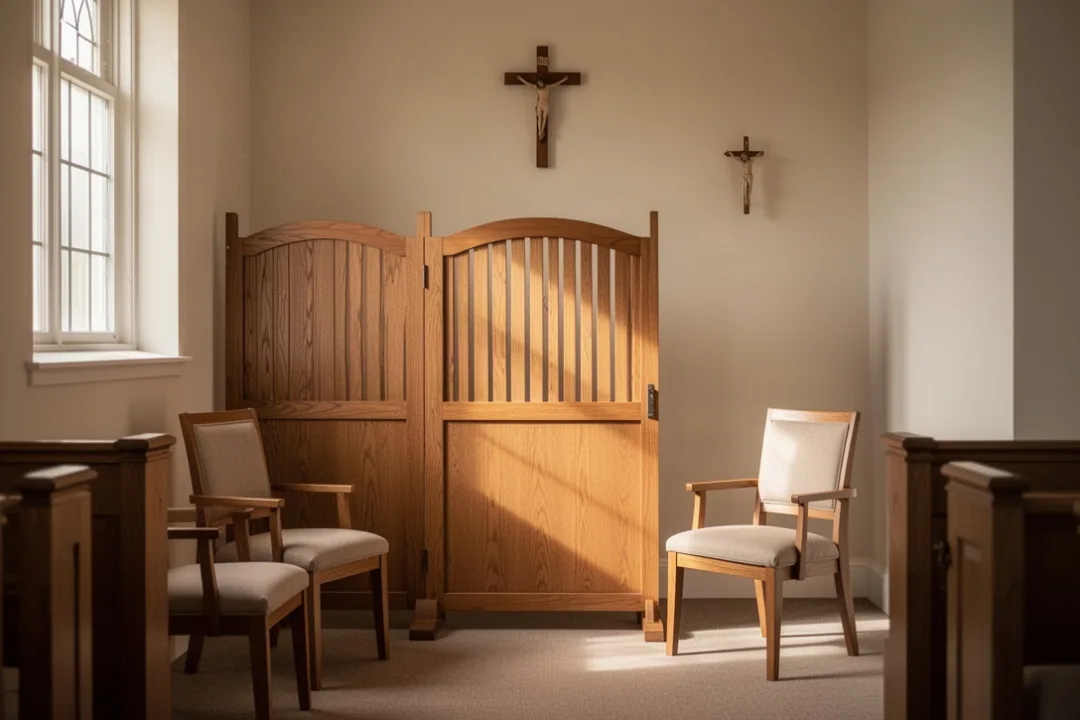
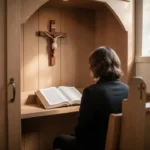
A confessional is a designated place where a priest hears a person’s confession and celebrates the sacrament in which God offers forgiveness and reconciliation. Traditional confessionals often have a small room or booth with a screen separating the priest and the person confessing. Many parishes now also use a reconciliation room with two chairs, a door, and the option of sitting across from the priest.
The physical arrangement may differ, but the sacrament is the same. You are not required to kneel, use a particular type of confessional, or memorize a long speech. What matters is honest confession, sincere sorrow for sin, and a genuine willingness to turn back toward God.
In Catholic teaching, the sacrament normally includes several connected actions: examining your conscience, confessing sins to a priest, receiving a penance, expressing contrition, and receiving absolution. The priest’s prayer of absolution is the sacramental moment in which the Church announces God’s forgiveness.
If you are unsure what to do: Begin with “Bless me, Father, for I have sinned. It has been ___ since my last confession, and I am not sure how to proceed.” The priest can take it from there.
Where to find confession at a Catholic church
Most parishes publish confession times on their website, bulletin, app, or front-door noticeboard. Common times include a period before Saturday evening Mass, a weekday evening, or a scheduled block during the week. Some churches offer confession by appointment, especially when the parish has one priest or serves a large area.
Look for signs near the confessional, the parish office, or the entrance to the church. If the schedule is unclear, call the parish office and ask, “When is confession available, and do I need to make an appointment?” You can also ask whether the priest hears confessions in a traditional booth, a reconciliation room, or another designated area.
Check the published schedule before traveling, since times can change for holidays, retreats, or emergencies.
Arrive a few minutes early so you can settle down and examine your conscience.
Ask about accessibility if kneeling, using stairs, or entering a small booth is difficult.
Respect the line by preparing quietly and keeping your confession focused.
A parish may not be able to offer confession immediately before every Mass. The priest may need time to prepare for Mass or attend to another pastoral duty. A scheduled confession time is the most reliable option, although a priest may be able to hear your confession at another time if you contact him in advance.
How to go to confession step by step
The following sequence is common in Catholic parishes in the United States. Words and customs vary slightly, so do not worry if the priest uses a different form or gives you a short prompt.
Prepare before entering. Spend a few minutes asking God for honesty and peace. Review your actions, choices, relationships, duties, and habits since your last confession.
Enter when invited. Choose the screen or face-to-face option if both are available. Sit or kneel in the way the room allows.
Begin the confession. Make the Sign of the Cross and greet the priest. You may say, “Bless me, Father, for I have sinned.”
State the time since your last confession. For example, say, “My last confession was about three months ago.” If this is your first confession, say so.
Confess your sins clearly. Name what you did, without unnecessary details or a long explanation meant to excuse it. Include the kind and approximate frequency of serious sins as best you can.
Say when you are finished. You can use, “For these and all my sins, I am sorry.” This lets the priest know that you have completed your confession.
Listen to the priest. He may offer advice, ask a brief clarifying question, or suggest a practical way to resist the same sin.
Receive your penance. Make sure you understand what prayer or action he assigns. If you are unsure, ask him to repeat it.
Pray an act of contrition. You may use a memorized prayer or speak sincerely in your own words if the priest permits it.
Receive absolution. The priest extends the Church’s prayer of forgiveness. Respond “Amen” when appropriate and depart quietly.
If you forget a step, nothing has gone wrong. The priest has heard many first-time and returning penitents, and he can prompt you with a question such as, “When was your last confession?” or “Is there anything else you would like to confess?”
What to say inside the confessional
A simple opening is enough: “Bless me, Father, for I have sinned.” Then give the approximate time since your last confession. If you have never gone to confession, say, “This is my first confession,” or explain that you have not been in many years.
When naming sins, be direct and specific enough for the priest to understand the moral issue. “I was impatient with my family several times” is more useful than a vague statement such as “I was bad.” You do not need to describe every conversation or provide identifying details about other people.
Serious sins should be confessed by kind and approximate number when you can do so. If you do not know the number, give your best estimate, such as “several times a week for about a month.” If an exact count is impossible, say that plainly rather than inventing precision.
Try not to turn the confession into a defense of your actions, a complaint about another person, or a full account of every circumstance. Context can matter, and the priest may ask about it, but confession is not a courtroom argument. The purpose is to bring the truth into God’s mercy and seek a real change of heart.
How to prepare before visiting the confessional
Preparation does not require a perfect spiritual inventory. Begin by asking yourself where you have failed in love of God, neighbor, and yourself. Think about your responsibilities at home, work, school, church, and in the wider community. Consider both actions you committed and good responsibilities you knowingly neglected.
A printed examination of conscience can help, especially if you have not been to confession for a long time. Many Catholics reflect on the Ten Commandments, the Beatitudes, or questions about honesty, anger, sexuality, possessions, prayer, relationships, and care for vulnerable people. Use such a guide as a prompt, not as a reason to become trapped in anxious self-analysis.
Where have you chosen selfishness, dishonesty, cruelty, or contempt?
Have you deliberately neglected important duties or refused reasonable responsibility?
Have your words damaged another person through gossip, harassment, manipulation, or needless anger?
Have you treated people, money, sex, alcohol, technology, or authority in a way that harmed yourself or others?
Have you resisted opportunities to repair damage, apologize, forgive, or make restitution?
What specific change could you make after confession?
Contrition means more than feeling embarrassed. It is sorrow for sin together with a desire to reject it and live differently. You may still feel tempted, emotionally unsettled, or uncertain about your ability to change. Sincere repentance does not require a promise that you will never struggle again; it requires a real intention not to choose the sin and a willingness to take practical steps.
What happens after you confess your sins
After listening, the priest may offer a brief reflection or ask a question. He might suggest that you apologize, return something you took, end an occasion of sin, seek professional help, repair a relationship, or establish a regular prayer practice. His advice should be connected to your situation and may be very short when other people are waiting.
The priest then assigns a penance. This is usually a prayer, a Scripture passage, an act of service, or another constructive action. Penance is not a price paid for forgiveness. It is a concrete response that helps express sorrow, repair what can be repaired, and begin living the change you have asked for.
If you cannot complete the assigned penance exactly as described, do not assume the confession was wasted. Complete what you reasonably can, or contact the parish and ask what to do. If you realize you forgot the penance later, ask the priest at your next opportunity or perform an appropriate prayer while you seek clarification.
You then pray an act of contrition. Some parishes provide the words on a card, and some priests invite you to express sorrow in your own words. A simple prayer can acknowledge your sin, express regret, ask for mercy, and state your intention to avoid sin and occasions that lead you toward it.
An act of contrition does not have to sound polished; it needs to express genuine sorrow and a sincere desire to return to God.
Anonymous confession and face-to-face confession
A traditional screen can make confession feel safer, especially when you are ashamed, returning after many years, or discussing a sensitive matter. You may choose anonymity if the confessional provides it. The priest does not need your name to hear the sacrament.
Face-to-face confession can make conversation easier for some people, particularly when they need help understanding a moral issue or are making a first confession. You are still entitled to a respectful and private setting. If you do not feel comfortable with the available arrangement, ask whether another option is possible or request an appointment.
The Church’s sacramental seal protects what you confess. A priest may not disclose the sins revealed in confession or use that knowledge against you. This protection is absolute within the sacrament. It does not mean every conversation with a priest has the same sacramental status, so if you need confidential pastoral advice outside confession, ask whether you are making a confession or having a separate conversation.
What if you cannot remember every sin?
Forgetfulness is different from deliberately concealing a sin. If you honestly forget something, confess what you remember and mention that you may have forgotten other matters. A sincere confession is not invalid because your memory is incomplete.
If you remember a serious sin after leaving, bring it to your next confession. Do not panic or repeat the entire previous confession solely because one detail came to mind. If you intentionally withheld a serious sin, speak with a priest about it at your next confession and explain what happened honestly.
People who struggle with scrupulosity may feel compelled to confess the same uncertain matter repeatedly or demand absolute certainty about every detail. That pattern can make the sacrament distressing rather than healing. A trusted priest can give consistent guidance, such as following one examination method and accepting reasonable answers instead of repeatedly rechecking your conscience.
For a long absence: Tell the priest at the start that it has been many years or that you are unsure of the format. You can ask him to slow down and help you make a complete, peaceful confession.
Who can receive the sacrament of confession
Baptized Catholics who are properly disposed may receive the sacrament from a priest with the necessary authority. Catholics commonly go to confession before receiving Communion when they are conscious of serious sin, and the Church also encourages confession as a regular means of spiritual growth even when no serious sin is present.
A person does not need to be emotionally calm or spiritually accomplished before going. The sacrament is for people who recognize their need for mercy. You should, however, be honest about your intention: confession is not a ritual to complete while knowingly planning to continue a serious wrongdoing without any willingness to change.
Someone who is not Catholic may attend a parish and speak with a priest, but reception of Catholic sacramental confession depends on the person’s baptismal and ecclesial situation. If you are not Catholic and want to understand what you may receive, ask the priest privately before entering the confessional. He can explain the appropriate form of pastoral care without embarrassing you in front of others.
How children, teenagers, and families use confession
Children usually learn the basic pattern through parish religious education or preparation for First Reconciliation. Parents can help by describing confession as a meeting with God’s mercy rather than a frightening interrogation. Avoid demanding details about what a child said in confession; children deserve the privacy and dignity of the sacrament.
Teenagers may hesitate because they fear being judged or believe their problems are too ordinary to mention. The priest can help them distinguish between a normal struggle, an unwise choice, and a serious moral matter. A young person can ask for practical guidance about peer pressure, online behavior, anger, relationships, substance use, or family conflict.
Families may attend a parish reconciliation service in which Scripture, quiet reflection, and communal prayers come before individual confession. The group portion is not a replacement for personal confession. Each person still meets privately with a priest, and no one is expected to announce sins publicly.
What confession can and cannot do
Confession offers sacramental forgiveness and a place to tell the truth before God. It can restore a person’s relationship with God and the Church, provide wise spiritual direction in a limited form, and mark a concrete decision to change. Many people also experience relief because shame becomes something they can address rather than hide.
Confession is not a substitute for medical care, mental health treatment, legal advice, or protection from abuse. A priest may encourage you to contact a counselor, physician, social worker, or emergency service when those forms of help are needed. If someone is in immediate danger, seek emergency assistance rather than relying only on a sacramental conversation.
A priest should not pressure you to reveal unnecessary identifying details about another person. He also should not use confession to exploit you, solicit money, or impose advice unrelated to the sacrament. If an interaction concerns you, speak with the pastor, diocesan office, or another trusted church leader, while recognizing that experiences and parish procedures can differ.
Common concerns about visiting a confessional
“I am embarrassed by what I did.”
Embarrassment is common, but priests regularly hear human failures involving anger, dishonesty, addiction, family conflict, sexuality, neglect, and resentment. You can state the matter plainly without graphic or identifying details. The priest’s role is to help you face sin truthfully and receive mercy, not to reward or punish your ability to sound impressive.
“I do not know whether something is a sin.”
Say that directly. You can describe the action and ask how the Church understands it. The priest may ask about your knowledge, freedom, intention, and circumstances. Those factors can affect moral responsibility, so avoid assigning yourself a severe label before you have explained what happened.
You may bring that struggle honestly, including disappointment, doubt, grief, or anger. The priest may distinguish emotional pain from a deliberate moral choice and may suggest a separate pastoral conversation if the issue needs more time. You do not have to pretend that you feel spiritually strong.
“The priest might not understand me.”
Use ordinary language and give the central facts. If a language barrier or disability makes communication difficult, ask the parish about interpretation or accommodations before your appointment. You may also request another priest if a particular situation requires expertise or if you need to feel safe enough to speak honestly.
How often Catholics go to confession
The frequency depends on your circumstances, spiritual needs, and parish practice. Catholics conscious of serious sin should seek reconciliation before receiving Communion, unless a recognized serious reason prevents confession and the person follows the Church’s guidance. The Church also requires Catholics to confess serious sins at least once a year, while many people choose a monthly or seasonal rhythm.
Regular confession can make self-examination more practical because you do not wait until every failure feels overwhelming. A recurring schedule also gives you an opportunity to work on one pattern at a time. The goal is not to collect appointments or measure holiness by frequency; it is to receive mercy and grow in the habits that support love of God and neighbor.
After confession, identify one realistic next step. That might be returning property, setting a boundary, deleting a harmful app, asking forgiveness, arranging counseling, changing a routine, or praying briefly each morning. Concrete action gives your contrition a direction beyond the confessional door.
What to bring and what to leave outside
You do not need a special book, certificate, or written list. A small examination-of-conscience guide can help, and writing a few discreet reminders may be useful if you are worried about forgetting. Destroy or secure any personal notes afterward so that another person does not read sensitive information.
Leave behind the expectation that you must tell a perfect story. Bring honesty, humility, and willingness to receive guidance. You can ask the priest to repeat the penance, explain a term, or help you understand how to begin again after a long absence.
The confessional is a place for truth spoken in privacy and received within the Church’s ministry of mercy. Once you have received absolution, complete your penance, thank God in your own words, and take one practical step toward repairing the harm or avoiding the pattern you confessed.
Frequently asked questions
Do I need an appointment to go to a Catholic church confessional?
Usually, no. Parishes commonly publish regular confession hours, and you may join the line during those times. An appointment is useful if you need extra time, have accessibility needs, want to confess outside the posted schedule, or have not been to confession for many years. Call the parish office to confirm availability before making a special trip.
Can a priest refuse to hear my confession?
A priest may need to postpone confession if he lacks the authority required, is preparing for Mass, is ill, or believes a different setting is necessary. He should explain the practical reason and help you find another opportunity. If he is unsure how to handle a complex situation, he may seek guidance without disclosing your identity or violating the sacramental seal.
Is confession still valid if I forget the act of contrition?
Forgetting the exact wording does not normally prevent a sincere confession. Tell the priest that you do not remember the prayer, and he can provide a form or invite you to express sorrow in your own words. The essential issue is genuine contrition, not reciting a particular version perfectly or using every traditional phrase.
Can I confess the same sin more than once?
You may mention a recurring sin at later confessions, especially when it remains a pattern or you want help overcoming it. Repeating a matter is not necessary merely because you feel anxious that the earlier confession was inadequate. If you deliberately concealed a serious sin, explain that honestly at your next confession and ask the priest for guidance.












Leave a Reply