Ferdinand III of Castile: king, conqueror, and saint
Ferdinand III of Castile: king, conqueror, and saint
When you see Ferdinand III described as both king of Castile and king of León, you may wonder whether these were two separate reigns or simply different titles. The answer is that Ferdinand inherited Castile in 1217 and León in 1230, creating a lasting political union between the two kingdoms. His reign transformed the balance of power in the Iberian Peninsula and made him one of the most influential Christian rulers of medieval Spain.
Ferdinand is remembered for more than military victories. He strengthened royal administration, worked closely with the Church, encouraged the rebuilding of conquered cities, and presented his campaigns as part of a Christian kingship. After his death in Seville in 1252, his reputation grew until the Catholic Church canonized him as Saint Ferdinand III in 1671.
Ferdinand III’s family and early claim to the throne
Ferdinand was born around 1199 to Alfonso IX of León and Berengaria of Castile. His parents’ marriage was later annulled because of their close family relationship, but Ferdinand remained an important link between two royal dynasties. Berengaria was the daughter of Alfonso VIII of Castile, a major ruler whose victory at Las Navas de Tolosa in 1212 weakened Almohad power in Iberia.
Ferdinand’s position was unusual because his parents ruled separate kingdoms. His mother belonged to the Castilian royal house, while his father ruled León. That family connection eventually allowed Ferdinand to inherit both realms, although the process was politically sensitive and required negotiation rather than automatic succession.
In 1217, Ferdinand became king of Castile after the death of his young maternal uncle, Henry I of Castile. Henry had succeeded Alfonso VIII but died as a child after an accident. Berengaria briefly received the crown and then transferred it to Ferdinand, allowing him to become king while she continued to exercise considerable political influence.
Ferdinand’s accession was opposed by Alfonso IX, who wanted the Castilian throne for himself or for his own interests. The early years of Ferdinand’s reign therefore involved more than warfare against Muslim states. He also had to establish his authority among Castilian nobles and defend his claim against a rival branch of his own family.
How Ferdinand united Castile and León in 1230
The second stage of Ferdinand’s rise came in 1230, when his father, Alfonso IX of León, died. Alfonso had named his daughters Sancha and Dulce as heirs, but Ferdinand’s claim was supported by important nobles and political leaders. Berengaria and Ferdinand negotiated with the two women, eventually securing their renunciation of the Leonese succession in the agreement known as the Treaty of the Mothers.
Ferdinand then became king of León as well as Castile. The union did not erase the individual identities of the two kingdoms. León and Castile continued to possess their own traditions, institutions, laws, and regional interests. Ferdinand ruled them under one monarch, but not as a completely centralized state in the modern sense.
This distinction matters when describing Ferdinand’s achievement. He did not create a unified country with a single government in the contemporary sense. Instead, he brought two powerful kingdoms under one dynasty, and that dynastic union endured after his death. Later rulers inherited the combined strength of Castile and León, which became the dominant Christian power in much of Iberia.
Useful distinction: Ferdinand III united the crowns of Castile and León, but medieval “union” did not mean that every law, institution, or local custom immediately became identical.
Ferdinand III and the changing balance of power in Iberia
Ferdinand ruled during a period when Muslim political authority in Iberia was becoming more divided. The Almohad empire, which had once controlled large areas of the peninsula, lost influence after military defeats and internal tensions. Independent Muslim rulers, often called taifa rulers, governed many cities and territories with varying degrees of independence.
That fragmentation created opportunities for Castile and León. Ferdinand did not face one united Muslim state across southern Iberia. Instead, he could negotiate with some rulers, demand tribute from others, and attack cities whose rulers were isolated or politically vulnerable.
His campaigns were also shaped by the military capacity of the Christian kingdoms. Castile and León could draw on noble armies, town militias, military orders, foreign knights, and naval support. The expansion was not the work of the king alone. It depended on a broad coalition of aristocratic families, religious institutions, urban communities, and military organizations.
The term Reconquista is often used to describe this long process of Christian expansion. It can be useful, but it should not make the period seem more simple or uniform than it was. Medieval rulers fought for territory, tribute, prestige, strategic access, and religious goals. Alliances frequently crossed religious and political boundaries, and Muslim and Christian rulers sometimes cooperated against rivals from their own communities.
Ferdinand III’s major conquests in southern Iberia
Ferdinand’s military career reached its greatest scale after the union of Castile and León. His campaigns took large territories from Muslim rule and gave his monarchy control over important agricultural regions, river valleys, roads, and ports.
The capture of Córdoba in 1236
Ferdinand captured Córdoba in 1236, a major symbolic and strategic victory. Córdoba had once been the capital of the Umayyad caliphate in Iberia and remained one of the peninsula’s most famous cities. Its conquest gave Ferdinand enormous prestige and placed a significant center of southern Iberia under Christian rule.
The city’s religious landscape changed after the conquest. The Great Mosque of Córdoba was converted for Christian worship, and Christian institutions were established in the city. At the same time, the conquest brought difficult questions about population, property, administration, and the treatment of residents who remained in place.
Córdoba also helped Ferdinand demonstrate that his campaigns were not isolated raids. He aimed to take and hold major urban centers, establish Christian government, and connect conquered territories to the wider Castilian-Leonese monarchy.
The conquest of Jaén in 1246
Jaén became another important Ferdinandine victory. The city was captured after prolonged pressure and negotiations, and its possession strengthened Castile’s position in eastern Andalusia. It also helped prepare the way for Ferdinand’s relationship with the Nasrid ruler of Granada.
In 1246, Muhammad I of Granada acknowledged Ferdinand’s superiority and became his vassal. Granada remained under Muslim rule, but it was required to pay tribute and recognize Castilian authority. This arrangement allowed Ferdinand to concentrate on other targets while Granada preserved its own government for the time being.
The relationship illustrates the practical side of medieval kingship. Religious differences were central to the way rulers described their wars, yet diplomacy, tribute, and political advantage were equally important. Ferdinand’s agreement with Granada created a temporary balance that lasted beyond his lifetime.
The conquest of Seville in 1248
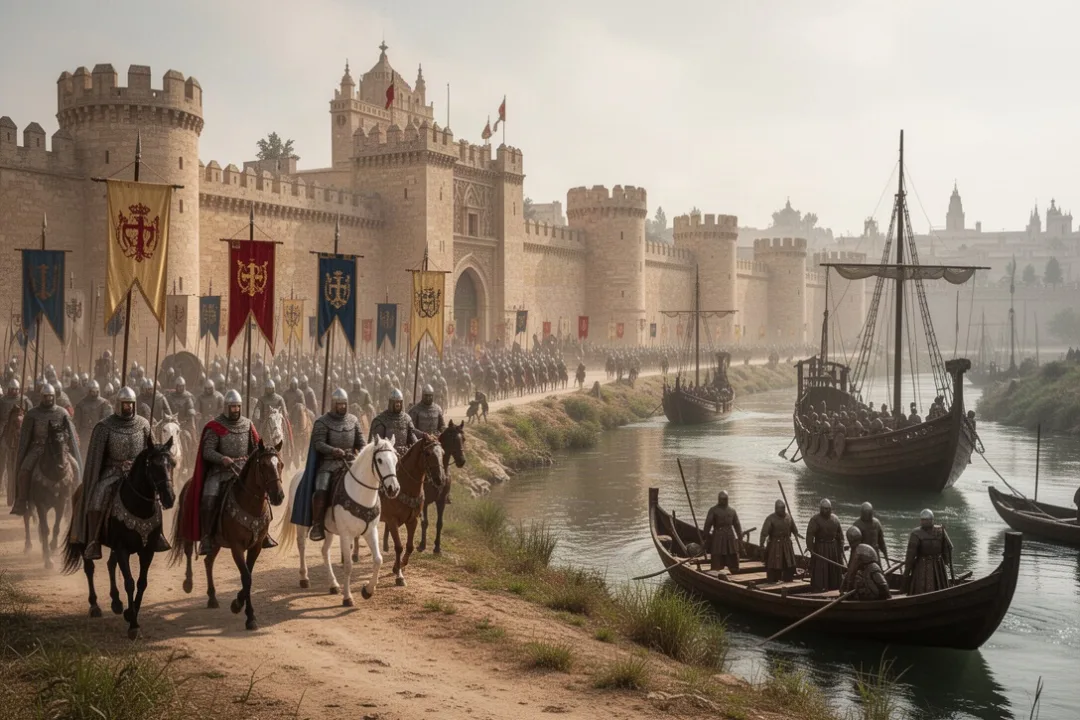
Ferdinand’s most celebrated victory was the conquest of Seville in 1248. Seville was one of the largest and wealthiest cities in al-Andalus, and its position on the Guadalquivir River made it essential to controlling southwestern Iberia.
The campaign lasted for an extended period and required a combination of land and naval operations. Castilian forces besieged the city, while a fleet helped block movement along the river. The naval force was associated with Ramón Bonifaz, whose ships broke the chain protecting Seville’s river access according to later accounts.
Seville surrendered in 1248. Many Muslim residents left the city, while Christian settlers and institutions were introduced. The conquest gave Ferdinand control over a major political and commercial center and marked a decisive reduction in Muslim power in the Guadalquivir valley.
Ferdinand did not complete the conquest of all Muslim-ruled territory in Iberia. Granada survived as a Muslim kingdom under Nasrid rule, and other areas required further campaigns after his death. Even so, his victories changed the political map so thoroughly that later Christian expansion followed a path he had helped establish.
How Ferdinand governed conquered territories
Military victory was only the first step. Ferdinand needed to turn newly conquered cities into functioning parts of his monarchy. This involved dividing land, assigning urban property, organizing dioceses, appointing officials, and attracting settlers who could support Christian institutions and royal authority.
One method was the repartimiento, a process through which land, houses, businesses, and other property were distributed among nobles, soldiers, religious institutions, military orders, and settlers. The details differed from place to place. The system rewarded those who supported the conquest and provided the monarchy with loyal landholders, but it also caused the displacement of many Muslim communities.
Ferdinand’s government relied on existing urban structures whenever they could be adapted to Christian rule. Cities received charters, privileges, and legal arrangements that defined the rights and duties of settlers. These arrangements encouraged migration from northern Iberia and gave towns incentives to defend and develop frontier territories.
The consequences for Muslim and Jewish communities varied. Some Muslims were expelled from major conquered cities, while others remained in rural areas or under negotiated terms. Jewish communities often continued to play important roles in administration, commerce, medicine, and finance, although their position depended on local policies and royal protection.
It is inaccurate to describe Ferdinand’s conquests as either a simple replacement of one population by another or as a peaceful transfer of power. The reality included siege warfare, migration, forced displacement, negotiated surrender, property redistribution, religious conversion, and periods of coexistence.
Ferdinand III’s religious identity and royal image
Ferdinand understood his rule through the language of Christian kingship. His wars were presented as campaigns against Muslim power, and he supported the expansion of dioceses, monasteries, and churches in conquered areas. The Church, in turn, helped legitimize his authority and commemorated his victories as part of a sacred mission.
His image was not based only on battlefield success. Medieval accounts also praised his humility, personal devotion, respect for clergy, and willingness to accept religious discipline. Some stories describe him as a ruler who placed his Christian duties above personal comfort and who treated the capture of cities as a responsibility rather than merely a source of glory.
These accounts were shaped by the ideals of medieval sainthood and should be read as religious biography, not as neutral modern reporting. They reveal the qualities later generations admired in Ferdinand: obedience to God, courage, charity, chastity, and service to the Church.
Ferdinand’s religious reputation continued to grow after his death. He was buried in the cathedral of Seville, where his tomb became a major focus of devotion. His canonization by Pope Clement X in 1671 formally recognized him as a saint. His feast is observed on May 30, the date associated with his death.
Ferdinand’s marriages and royal family
Ferdinand’s family connections were central to medieval diplomacy. His first wife was Beatrice of Swabia, also known as Elisabeth in some traditions. They married in 1219, and their children included Alfonso, who succeeded Ferdinand as Alfonso X of Castile and León, and several daughters whose marriages strengthened royal alliances.
After Beatrice’s death, Ferdinand married Joan of Ponthieu in 1237. This marriage connected him to the French aristocratic world and produced additional children. The royal household therefore linked the Iberian kingdoms with wider European networks of kinship and diplomacy.
His son Alfonso X inherited a powerful but demanding realm. The territories conquered under Ferdinand required defense, resettlement, legal organization, and financial resources. Alfonso also inherited his father’s ambitions, including the effort to expand royal authority and promote Castile as a major intellectual and political center.
Language, law, and institutions during Ferdinand’s reign
Ferdinand ruled at a time when Castilian was gaining importance in royal and administrative life, although Latin remained essential for formal documents and the Church. The growth of Castilian did not happen through a single language policy announced by Ferdinand. It developed through practical use in administration, law, record keeping, and communication with local communities.
The monarchy also had to manage different legal traditions. Castile and León possessed their own customs and institutions, while newly conquered towns received charters and privileges. Ferdinand’s rule depended on maintaining enough continuity to secure cooperation while introducing royal officials and Christian institutions.
Many developments associated with later Castilian legal culture became more visible under Alfonso X, but Ferdinand’s conquests created the territorial and political setting in which those developments could occur. His reign therefore mattered institutionally even when later rulers carried out the most famous reforms.
Ferdinand also supported cathedral foundations and the restoration or construction of major churches. These projects served religious purposes, but they also expressed royal authority. A cathedral in a conquered city showed that the city had entered a new political and spiritual order.
Practical tips for studying Ferdinand III accurately
Ferdinand’s life is easier to understand when you separate his family inheritance, military expansion, religious reputation, and administrative work. Several common mistakes can make his reign appear more straightforward than it was.
Do not call him only king of Castile. He became king of León in 1230, and that second crown was essential to his power.
Do not treat the union as a modern nation-state. Castile and León remained distinct in many legal and institutional respects.
Do not attribute every conquest to Ferdinand personally. Nobles, town militias, military orders, naval forces, and allied rulers all contributed.
Do not say Ferdinand conquered Granada. Granada remained a Muslim kingdom and recognized Castilian superiority through a vassal relationship.
Do not ignore diplomacy. Tribute agreements and negotiated surrenders were as important as sieges.
Do not describe the population changes as entirely voluntary. Conquest led to expulsion, displacement, resettlement, and unequal legal treatment.
Do not confuse later legends with direct evidence. Stories about saintly kings can preserve historical memory while also reflecting later religious ideals.
A helpful timeline is also useful when reviewing his career:
Around 1199: Ferdinand is born to Alfonso IX of León and Berengaria of Castile.
1217: He becomes king of Castile after the death of Henry I.
1230: He inherits León and brings the two crowns together.
1236: Córdoba falls to his forces.
1246: Jaén is conquered, and Granada accepts a vassal relationship.
1248: Seville is captured after a major siege and river blockade.
1252: Ferdinand dies in Seville.
1671: Pope Clement X canonizes him.
Why Ferdinand III remains historically important
Ferdinand’s importance comes from the combination of dynastic union, territorial conquest, and religious authority. A king who ruled only Castile might have been a successful regional monarch. By also acquiring León, Ferdinand gained access to wider resources and a stronger claim to lead Christian expansion in Iberia.
His conquests permanently changed the political geography of the peninsula. Córdoba, Jaén, and Seville became part of the Christian kingdoms, while Granada was pushed into a more limited and dependent position. The expansion also connected Castile to the wealth of southern agriculture, the Guadalquivir valley, and Atlantic-facing commercial routes.
His reign had consequences that were both constructive and destructive. It strengthened royal institutions, founded or restored Christian centers, and created opportunities for new settlements. It also involved violence, dispossession, religious inequality, and the disruption of established Muslim communities. A balanced assessment must hold these outcomes together rather than treating the period as either pure triumph or pure failure.
Ferdinand’s legacy continued through Alfonso X and later Castilian rulers. The union of Castile and León endured, and the territorial gains of his reign became the foundation for further expansion. Centuries later, his memory remained useful to Spanish monarchs and Catholic institutions seeking models of Christian royal leadership.
The central point: Ferdinand III was influential because he connected the crowns of Castile and León with a sustained program of conquest and government, not because of one battle or one title alone.
Ferdinand III’s death and enduring legacy
Ferdinand died in Seville on May 30, 1252. His death occurred after the conquest that had defined the final decades of his reign, but the kingdom still faced the difficult work of governing and defending its expanded territories. His son Alfonso X succeeded him and inherited both the achievements and the unresolved pressures of the enlarged monarchy.
Seville remained the most fitting place for Ferdinand’s burial and memory. The city represented the height of his military success and became closely associated with his saintly image. His tomb in the cathedral continues to connect the medieval king with the city he captured and helped make central to Castilian power.
Today, Ferdinand can be studied as a ruler of several overlapping worlds: a dynastic monarch, a military strategist, a patron of Christian institutions, a negotiator with rivals, and a figure later shaped by devotional tradition. Understanding all of those roles provides a clearer picture than calling him simply a conqueror or simply a saint.
Frequently asked questions
Was Ferdinand III the first king of a united Spain?
No. Ferdinand united the crowns of Castile and León, but Spain did not yet exist as a centralized nation-state. Other Iberian kingdoms, including Aragon, Navarre, and Portugal, remained politically separate. The later union of Castile and Aragon through Isabella I and Ferdinand II created a different stage in the formation of the Spanish monarchy.
Which cities did Ferdinand III conquer?
His most important conquests included Córdoba in 1236, Jaén in 1246, and Seville in 1248. His reign also extended Christian control across large parts of southern Iberia. Granada was not conquered by Ferdinand; its ruler became his vassal and paid tribute while retaining control of the Nasrid kingdom.
Why was Ferdinand III canonized?
Ferdinand was canonized because Church tradition remembered him as a deeply devout ruler who supported Christian institutions, lived according to religious ideals, and led campaigns understood at the time as defense and expansion of Christianity. Pope Clement X canonized him in 1671, and his feast is celebrated on May 30.
Who succeeded Ferdinand III?
His son Alfonso X, known as Alfonso the Wise, succeeded him in 1252. Alfonso inherited the combined crowns of Castile and León, along with the territories Ferdinand had conquered. He became known for his legal, cultural, astronomical, and literary projects, although his reign also faced financial difficulties and political conflict.















Leave a Reply