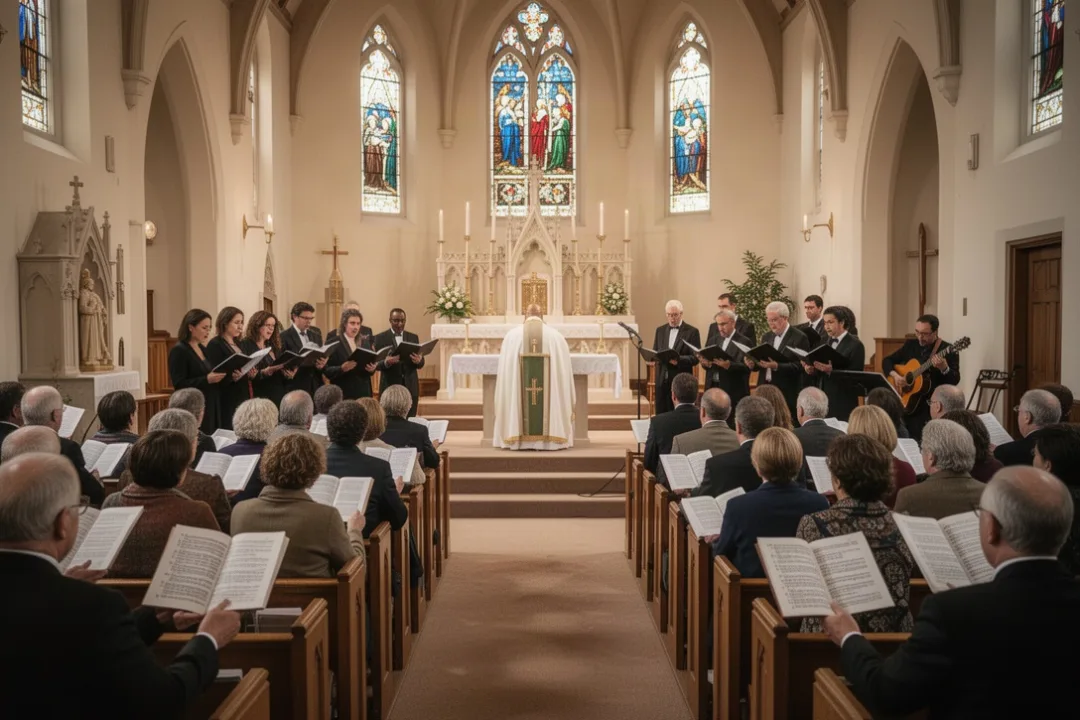
Are you choosing music for Sunday Mass, looking for a hymn to sing at home, or wondering why some familiar church songs fit certain celebrations better than others? Catholic hymns do more than fill pauses in a service. They help the congregation pray together, express the Church’s faith, and mark the movement from gathering to sending forth.
The best hymn depends on the liturgical season, the purpose of the moment, the ability of the assembly to sing, and the words being proclaimed. A strong selection is usually clear, singable, theologically sound, and connected to the Scripture or feast being celebrated.
A Catholic hymn is a sacred song used by Catholics for worship, devotion, teaching, or communal prayer. Some are written for the Mass itself; others are better suited to Eucharistic adoration, a rosary gathering, a funeral, a wedding, or personal prayer. The word “Catholic” describes both the community using the song and the faith expressed through its text.
Many Catholic hymns are based on Scripture, but they are not simply Bible readings set to music. They may also draw on the words of the Mass, the writings of saints, traditional prayers, the mysteries of Christ’s life, or teachings about the Church and the sacraments. A hymn about the Eucharist, for example, may express praise, remembrance, sacrifice, communion, and hope without quoting a biblical passage word for word.
Good Catholic hymn texts usually have several qualities:
They express Christian faith accurately, especially when they refer to the Trinity, Christ’s death and resurrection, the Eucharist, Mary, the saints, or the Church.
They support communal prayer rather than drawing attention mainly to a soloist or performer.
They use language the congregation can understand and sing after hearing it only a few times.
They fit the liturgical action, such as gathering, processing, offering, Communion, or dismissal.
They respect the character of the celebration, including the season, feast, sacrament, and local customs.
A hymn can be beautiful and still be a poor choice for a particular part of Mass. A song about personal comfort may work well at a prayer service but say little about the Eucharistic procession. A highly complex arrangement may sound impressive but leave the congregation silent. Suitability matters as much as beauty.
A practical test: Ask whether the assembly can understand the words, join the melody, and see how the hymn serves the prayer at that moment. If the answer is no, choose a simpler and more focused song.
Catholic worship also distinguishes between a hymn and a liturgical text that happens to be sung. The Gloria, Creed, Sanctus, Memorial Acclamation, Great Amen, and Lamb of God belong to the structure of the Mass and have specific texts or functions. A musical setting of these texts is not interchangeable with any hymn that has a similar theme.
That distinction helps explain why a parish music leader may approve one song for the entrance and decline it as a substitute for the Gloria. The choice is not only about style. It concerns the words, role, and order of the liturgy.
Which Catholic hymns fit each part of Mass?
Music at Mass should follow the movement of the celebration. The same song may be appropriate in one setting and distracting in another, so choosing by liturgical function is more helpful than choosing only by popularity.
Entrance and gathering hymns
The entrance hymn helps the people become one worshipping assembly. It may accompany the procession of the ministers, welcome the congregation, and establish the theme of the day. Songs about gathering, praise, the Church, discipleship, or the feast often work well here.
Examples include “All Are Welcome,” “Gather Us In,” “Gather Us Together,” “Come, Christians, Join to Sing,” and “For the Beauty of the Earth,”** depending on the celebration and the parish’s approved repertoire. A Marian feast, a confirmation, and an ordinary Sunday may each call for a different emphasis.
The entrance song should not be so long that it continues after the opening rites have finished. It also should not begin with an extended instrumental section that leaves the congregation unsure when to join. A clear opening phrase and a manageable refrain can help people participate immediately.
Gloria and other fixed parts of the Mass
The Gloria is a hymn of praise directed to God the Father and to Christ, in the unity of the Holy Spirit. During seasons and celebrations when it is prescribed, it is normally sung or recited using the liturgical text. A parish may use a musical setting with a refrain or a more through-composed form, but the essential text and character remain important.
The same principle applies to the Sanctus, the Memorial Acclamation, the Great Amen, and the Lamb of God. These are not simply optional songs placed near the Eucharistic Prayer. Their words and roles are part of the Mass. Music ministers should use settings authorized for their parish or diocese and avoid replacing these texts with unrelated hymns.
Responsorial Psalm and Gospel acclamation
The Responsorial Psalm is a distinct part of the Liturgy of the Word. It is normally drawn from the psalter and proclaimed with a response from the assembly. A hymn with biblical language may be spiritually appropriate, but it does not automatically function as the appointed psalm.
The Gospel acclamation also has a particular role before the Gospel reading. Its music should make the assembly’s response clear and should reflect the season. During Lent, for example, the acclamation has a different character from the Alleluia used during much of the rest of the liturgical year.
Offertory and preparation of the gifts
During the preparation of the gifts, music may accompany the presentation of bread and wine and the practical movement of the rite. Hymns about offering, service, gratitude, stewardship, or surrender can be suitable, provided they do not confuse the Church’s understanding of the Eucharist with a merely personal gift.
“Take and Eat,” “We Offer You,” “The Summons,” and “We Are an Offering” may be considered in appropriate settings, although the final choice depends on the parish repertoire and the day’s readings. The music should leave room for the rite rather than turning the preparation into a separate concert-like event.
Communion hymns
Communion music should accompany the procession and support prayer before, during, or after reception of the Eucharist. Strong choices often refer to the Body of Christ, the bread of life, unity, thanksgiving, the Paschal Mystery, or abiding in Christ.
Common examples include “One Bread, One Body,” “Gift of Finest Wheat,” “I Am the Bread of Life,” “Taste and See,” and “You Satisfy the Hungry Heart.” Some are especially useful for congregational singing, while others may be better as a meditative song after Communion.
The length of the Communion hymn matters. If the procession ends before the song does, the music may continue softly or give way to silence, depending on local practice. Silence can be an appropriate part of Eucharistic prayer, so a second hymn is not always necessary.
Recessional and sending-forth hymns
The closing song sends the congregation into daily life. Hymns about mission, witness, peace, resurrection, service, and hope can express the movement from worship to action. “Go Make of All Disciples,” “City of God,” “The Church’s One Foundation,” and “Sent Forth by God’s Blessing” may suit different Sundays and seasons.
A recessional hymn does not need to repeat the entrance hymn’s theme. It can respond to the readings or highlight the responsibility of Christian discipleship. For a feast of a saint, a hymn connected to that saint’s witness may be more meaningful than a general song of praise.
Popular Catholic hymns by season and celebration
Liturgical seasons give the congregation a shared musical vocabulary. Repeating a modest number of strong hymns can help people sing confidently, while introducing a few new selections keeps the repertoire connected to the Church’s calendar.
Advent hymns
Advent music holds together waiting, repentance, hope, and the promise of Christ’s coming. Songs such as “O Come, O Come, Emmanuel,” “Come, Thou Long-Expected Jesus,” “The King Shall Come When Morning Dawns,” and “On Jordan’s Bank” can express the season’s expectation.
Advent is not simply a preview of Christmas. Hymns should allow room for the themes of watchfulness and preparation, as well as the hope of Christ’s final coming. A song that is exclusively celebratory may fit Christmas more naturally than early Advent.
Christmas hymns
Christmas hymns proclaim the birth of Christ and the mystery of the Incarnation. Familiar choices include “Hark! The Herald Angels Sing,” “O Come, All Ye Faithful,” “Angels We Have Heard on High,” “What Child Is This,” and “Silent Night.”
When selecting Christmas music for Mass, consider whether the congregation can sing the melody and whether the text points toward worship rather than only describing a familiar scene. A hymn about the Word made flesh or the Savior’s arrival can connect the Christmas celebration to the whole Christian mystery.
Lenten music often emphasizes conversion, mercy, the cross, baptism, and trust in God. Suitable examples may include “Lord, Who Throughout These Forty Days,” “Tree of Life,” “The Glory of These Forty Days,” “Jesus, Remember Me,” and “Were You There.”
Holy Week calls for especially careful choices. Palm Sunday, the Mass of the Lord’s Supper, Good Friday, and the Easter Vigil each have distinctive rites and themes. Music should not flatten these celebrations into a generic service about suffering or renewal.
During Lent, many parishes also omit the Alleluia from the Gospel acclamation and use a seasonal response instead. This change gives the music a restrained character and reminds the congregation that the liturgy is moving toward the celebration of Easter.
Easter hymns
Easter hymns proclaim Christ’s resurrection, victory over death, baptismal life, and the joy of the Christian community. Well-known selections include “Jesus Christ Is Risen Today,” “Christ the Lord Is Risen Today,” “Alleluia! Sing to Jesus,” “Ye Sons and Daughters,” and “The Strife Is O’er.”
The best Easter repertoire can remain with the parish beyond Easter Sunday. The Easter season lasts for more than one day, and hymns about resurrection, new life, and baptism may continue to enrich the liturgy in the weeks that follow.
Ordinary Time, Marian feasts, and saints’ days
Ordinary Time includes a wide range of Sundays, so its music may draw on creation, discipleship, mission, wisdom, the Eucharist, the kingdom of God, and the Church. “Holy, Holy, Holy,” “Praise to the Lord,” “Christ Be Our Light,” and “The Church’s One Foundation” can serve different purposes when matched carefully to the readings.
Marian hymns should honor Mary in relation to Christ and the Church. Examples include “Hail Holy Queen,” “Immaculate Mary,” “Ave Maria,” and “Sing of Mary.” Some Marian songs are better suited to devotions or processions than to a particular part of Sunday Mass.
For saints’ celebrations, consider music that reflects the saint’s vocation, mission, or witness. A hymn about evangelization may fit an apostle; a song about service may fit a charitable saint; a Marian hymn may fit a feast of the Blessed Virgin Mary. The connection should be genuine rather than based only on the saint’s name.
How to choose Catholic hymns for a parish celebration
Choosing music is easier when you begin with the celebration rather than with a list of favorite songs. Read the day’s Scripture passages, identify the central liturgical theme, and then decide what each musical moment needs to accomplish.
Identify the celebration. Note the Sunday, feast, sacrament, funeral, wedding, or devotional service, along with its season.
Read the assigned texts. Look for recurring ideas such as mercy, covenant, the cross, healing, mission, wisdom, or resurrection.
Match songs to liturgical functions. Choose gathering, preparation, Communion, and sending-forth music separately instead of assigning one favorite hymn to every occasion.
Check the text carefully. Confirm that it reflects Catholic teaching and does not use vague language where the liturgy calls for a specific confession of faith.
Consider the assembly. Select keys, tempos, refrains, and verses that the people can sing comfortably.
Coordinate with the celebrant and musicians. Local diocesan guidance, parish policy, and the needs of the particular rite should shape the final list.
For a wedding, music should express Christian marriage as a covenant and vocation, not merely as romance. For a funeral, hymns can proclaim the Paschal Mystery, commend the deceased to God, and comfort the living without promising details that the Church does not teach. For a baptism, songs about water, new life, welcome, and the Church’s family can support the sacramental signs.
At a confirmation, music may highlight the Holy Spirit, discipleship, courage, and participation in the Church’s mission. At a first Communion, Eucharistic songs should remain accessible to children while still expressing the sacrament with reverence. The age of the congregation matters, but simplicity does not require shallow words.
Before printing a program: Check every title, verse, and musical setting against the parish’s current worship resources. A familiar title may refer to several different texts or arrangements, and local approval may apply.
How to build a balanced Catholic hymn repertoire
A healthy repertoire includes older hymns, newer congregational songs, seasonal music, psalm settings, Eucharistic hymns, and pieces associated with the Church’s major rites. No single musical style is required for every parish. The central question is whether the music serves the liturgy and helps the assembly participate.
Traditional hymns often offer durable melodies and carefully developed theology. “Holy, Holy, Holy,” “A Mighty Fortress,” “Praise to the Lord,” and “All Creatures of Our God and King” have remained useful because their texts give the congregation substantial ideas to pray and sing.
Contemporary Catholic songs may provide direct language, accessible refrains, and arrangements suited to guitar, piano, or small ensembles. Songs such as “Here I Am, Lord,” “We Are Called,” “The Servant Song,” and “Christ, Be Our Light” are widely recognized in many Catholic communities. Their suitability still depends on the celebration, arrangement, and local musical practice.
Music ministers should avoid building a repertoire around songs that only one singer can perform. A strong congregational hymn has a melody that can be learned, a rhythm that supports the words, and a refrain that does not require vocal acrobatics. The choir and instrumentalists should lead the assembly without overpowering it.
It also helps to teach new music gradually. Introduce a new refrain before Mass when appropriate, print the music clearly, and repeat the song on several occasions. People participate more fully when they recognize the structure and do not feel tested by every musical choice.
Keep a core group of familiar hymns for ordinary Sundays.
Add seasonal songs before the season begins so the congregation learns them naturally.
Use psalm responses and Gospel acclamations that are easy to hear and repeat.
Choose Eucharistic music with language that reflects communion, thanksgiving, and Christ’s presence.
Include hymns connected to baptism, marriage, funerals, and other sacraments in separate planning folders.
Review songs periodically for theological clarity, musical range, and congregational response.
Language deserves special care. Some older hymns use words that are no longer familiar, while some newer songs rely on broad spiritual language without clearly naming Christ, the Church, the Eucharist, or the resurrection. Neither age nor popularity guarantees that a song will serve Catholic worship well.
Using Catholic hymns beyond Sunday Mass
Catholic hymns have a place in many forms of prayer outside the Eucharistic liturgy. At Eucharistic adoration, a quiet hymn may lead into silence, while a Eucharistic refrain can support a period of communal prayer. During the rosary, Marian songs may be used before or after the decades without interrupting the structure of the prayer.
Hymns can also support parish missions, reconciliation services, processions, prayer groups, religious education, and home prayer. The setting should guide the style. A song that feels too elaborate for a small prayer group may work well with a full choir, while a contemplative hymn may be lost in a large outdoor procession.
At home, singing does not require a trained voice or instruments. You might choose one hymn connected to the Sunday Gospel, sing a verse before grace, or listen quietly and reflect on a single line. Families can use hymnals, parish music sheets, or recordings while respecting copyright and any restrictions attached to published arrangements.
Hymns are also a useful way to teach Catholic vocabulary. Children can learn words such as mercy, covenant, Eucharist, disciple, resurrection, and “communion” through repeated singing in context. Adults may discover that a hymn’s verses contain a fuller explanation of the faith than its familiar refrain suggests.
When you are unsure whether a song belongs in a particular celebration, ask three questions: Does it express Catholic faith faithfully? Does it support the action taking place? Can the people participate with understanding? A hymn that meets all three tests is far more likely to become prayer rather than background music.
Frequently asked questions
Are all Christian worship songs considered Catholic hymns?
No. Catholic parishes may use music from many Christian traditions, but a song is suitable for Catholic worship only when its text, musical function, and use fit the liturgy. Some songs work well for private devotion or a prayer group but do not replace the prescribed parts of the Mass. Parish and diocesan guidance can help determine appropriate use.
Can a Catholic hymn replace the Responsorial Psalm?
Generally, a hymn cannot simply replace the appointed Responsorial Psalm because the psalm is a distinct part of the Liturgy of the Word. A properly prepared psalm setting allows the assembly to respond to the proclaimed text. Other hymns may be used before or after the readings when the liturgical structure and local guidance permit.
What are good Catholic hymns for a funeral?
Funeral music commonly focuses on Christ’s death and resurrection, baptismal hope, mercy, comfort, and eternal life. The most suitable choices are those that support the funeral rites and the Church’s teaching rather than songs centered only on personal memories. The family should plan with the pastor or parish music director.
How many hymns are usually sung at Catholic Mass?
The number varies with the form of the Mass, the length of processions, the season, and parish custom. Music may accompany the entrance, preparation of the gifts, Communion, and closing procession, while other sung parts belong to the Mass itself. Silence may also be appropriate, so more music is not always better.











Leave a Reply