The Spanish word posada means inn, lodging, or shelter. In the plural, Las Posadas refers to the series of gatherings held from December 16 through December 24, the nine evenings before Christmas Day.
At each gathering, participants commonly divide into two groups. One group represents Mary and Joseph, while the other represents the people inside a home or church who are asked to provide shelter. The groups sing a traditional exchange of verses, and the procession eventually enters the house for prayer and celebration.
Although Las Posadas has strong Catholic roots, the tradition is also a major family and community celebration. Many people observe it in Mexico, Mexican American communities, and other parts of Latin America, while others adapt it for churches, schools, neighborhoods, and cultural organizations.
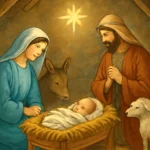
The central idea: Las Posadas combines the biblical story of the Nativity with a physical reminder of hospitality. Guests do not simply hear about Mary and Joseph’s search for shelter; they take part in asking for and offering a place to stay.
When Las Posadas takes place
Las Posadas traditionally begins on December 16 and ends on December 24, Christmas Eve. The nine nights are often understood as representing the nine months of Mary’s pregnancy, although the exact symbolism can vary between communities.
Each night may be hosted by a different family or household. In some places, participants visit several homes during one evening. In others, one church, community center, or home hosts the gathering for all nine nights. There is no single format that every community follows.
The final night, December 24, may lead directly into Nochebuena, the Christmas Eve celebration. Depending on local customs, the evening can include a late church service, a family meal, the placement of the infant Jesus figure in a Nativity scene, or a larger gathering with relatives and neighbors.
How a traditional posada unfolds
The order varies, but a traditional celebration often follows a recognizable sequence. The religious elements may be formal or brief, while the social portion can last much longer.
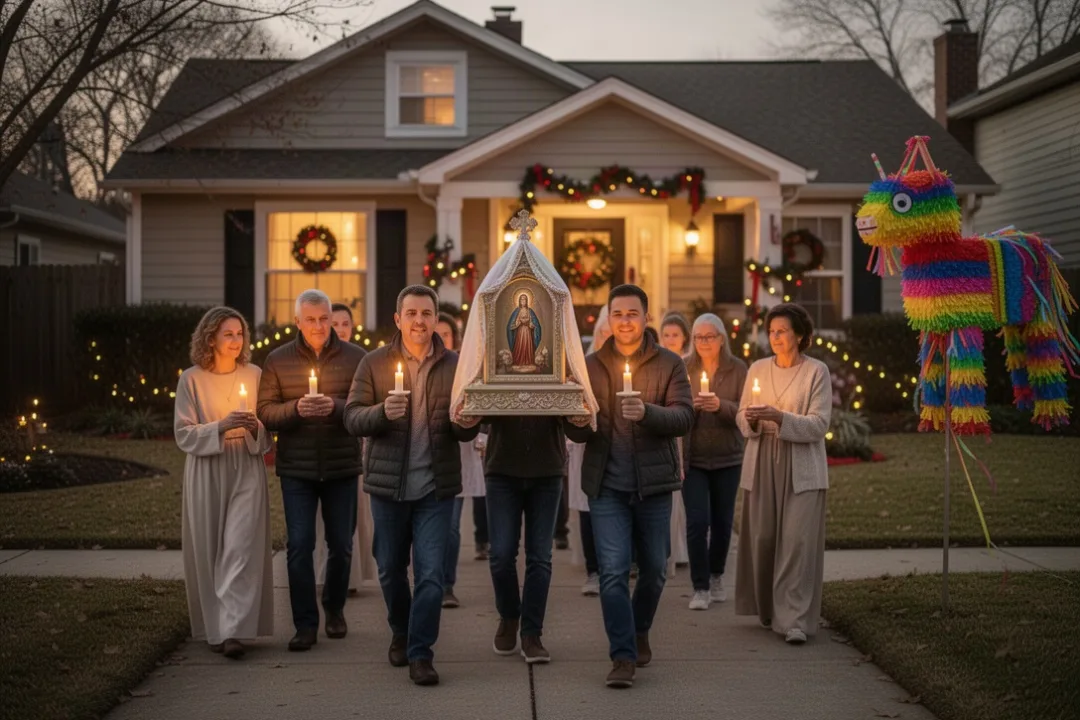
Participants gather. Families, neighbors, or church members meet at a starting point or at the home hosting that evening’s posada.
Mary and Joseph are represented. Some participants carry small statues or images of the couple. Others carry candles, lanterns, or simple decorations.
The procession begins. The group walks through a neighborhood, church property, or home while singing. In some communities, children lead the procession.
The travelers ask for shelter. Participants outside sing verses requesting a place to stay for Mary and Joseph.
The household answers. Those inside initially respond that there is no room. The sung exchange continues until the people inside recognize the travelers and open the door.
The group enters. Everyone joins together in prayer or a devotional service, often including a Rosary or a prayer connected with the Nativity.
The celebration begins. Hosts serve food and drinks, children may break a piñata, and guests spend time together.
The repeated movement from outside to inside gives the gathering its emotional shape. The first part emphasizes uncertainty and rejection; the moment the door opens represents welcome, mercy, and shared responsibility.
The songs and the request for shelter
The most recognizable part of Las Posadas is the call-and-response song between the people outside and those inside. The verses are traditionally sung rather than spoken, and different regions or families may use slightly different wording and melodies.
The travelers explain that they are seeking lodging and identify themselves as Mary and Joseph. The people inside initially refuse, often saying that the house is already occupied or that they do not know the travelers. As the exchange continues, the travelers reveal who they are, and the hosts invite them in.
The song is not merely a performance. It gives every participant a role in the story. People outside experience the uncertainty of seeking shelter, while people inside eventually make the decision to receive them. That structure allows the tradition to connect the Nativity story with questions about hospitality and the treatment of people in need.
Some modern celebrations shorten the song or use a printed program so that children and first-time participants can follow along. Others preserve the complete traditional exchange. Both approaches can be meaningful when the leaders explain the significance rather than treating the singing as a decorative holiday activity.
Las Posadas asks a simple question through its ritual: who will open the door?
Why there are nine nights
The nine-night period reflects the time Mary and Joseph are traditionally understood to have spent traveling before Jesus’ birth. Catholic communities may also connect the number nine with a novena, a set of prayers or devotions observed over nine days or nights.
Each evening can have its own host, prayer intention, food, and small variation in the program. In some families, the nine nights are treated as a form of preparation for Christmas. In others, the main emphasis is gathering relatives and neighbors during the holiday season.
The number nine does not mean that every posada must be identical or that every participant must attend all nine nights. Some people attend one evening, while others take part in the full series. A single gathering can still preserve the central features: the procession, the request for shelter, the welcome, and the shared celebration.
What happens during the prayers
After the group enters, the hosts may lead a Rosary, a prayer service, a reading about the Nativity, or a shorter prayer. The exact practice depends on the family’s religious tradition and the setting.
A Rosary is common in many Catholic observances, but it is not the only possible format. Some communities include hymns, a reflection, or a prayer for families, people experiencing homelessness, immigrants, or others who need welcome and protection. Churches may provide a more structured service, while a home gathering may use only a few familiar prayers.
The religious portion often comes before the food and games because the celebration is meant to preserve the connection between the social event and the story of Mary and Joseph. Even when the gathering is primarily cultural, a brief explanation of the ritual can help guests understand why the door-opening moment matters.
Common foods and drinks served at posadas
Food is one of the most anticipated parts of a posada. Hosts usually serve dishes that fit their family’s region, budget, and personal traditions. There is no required menu, but several foods appear frequently at Mexican and Mexican American celebrations.
Ponche: A warm fruit punch often made with ingredients such as guava, tejocote, sugar cane, cinnamon, and other seasonal fruits. Recipes differ widely.
Tamales: Corn dough filled with savory or sweet ingredients, wrapped in corn husks or other coverings and steamed.
Buñuelos: Crisp, thin fried pastries that may be coated with sugar or served with syrup.
Churros: Fried dough that is commonly dusted with sugar and cinnamon.
Tostadas, tacos, or antojitos: Savory foods that are easy to serve to a large group.
Pan dulce: Mexican sweet bread often served with coffee, hot chocolate, or another warm drink.
Fruit and candy: Seasonal fruit, sweets, and small treats may be placed in children’s gift bags or used to fill a piñata.
Regional cooking matters. A posada in one Mexican state may feature dishes that are uncommon at a gathering elsewhere. Mexican American families may combine traditional foods with local favorites, and hosts often adjust recipes for allergies, vegetarian guests, or different dietary needs.
Because many guests may be children, organizers should label foods that contain nuts, dairy, meat, or alcohol. Ponche can be prepared without alcohol for a family event, while adults may receive a separate version if the hosts choose to serve one.
The role of the piñata
A piñata is a familiar feature of many Las Posadas celebrations, especially those involving children. The traditional seven-pointed star piñata has been associated with the seven deadly sins, although the meaning and design are not interpreted uniformly today.
In the traditional game, a blindfolded participant tries to break the suspended piñata with a stick while others sing or give directions. When it breaks, candy and fruit fall to the ground for the children to collect.
Many communities use star-shaped piñatas because they are recognizable symbols of the season. Others use different shapes or avoid assigning a religious meaning to the game. A family or organization can preserve the festive activity while choosing a design that fits its own understanding of the tradition.
Safety requires attention when a piñata is included. Keep spectators at a clear distance, use an appropriate space, supervise children closely, and avoid placing the piñata near traffic, fragile objects, or low branches. For younger children, a pull-string piñata can provide a safer alternative to swinging a stick.
Las Posadas developed in Mexico during the colonial period and became connected with Catholic efforts to teach the Nativity story. Religious leaders used dramatic and communal forms of instruction, including processions and seasonal observances, to help people engage with Christian stories.
The tradition also developed through local customs, music, foods, and community practices. For that reason, Las Posadas is best understood as a living tradition shaped over time, not as an event with one unchanging script. Its form differs according to region, family history, denomination, and whether the gathering takes place in Mexico, the United States, or another country.
Some accounts connect the nine-night observance with earlier seasonal celebrations in Mexico, but claims about a direct one-to-one replacement of a particular precolonial festival can oversimplify a complicated history. Cultural traditions often change through contact, adaptation, and reinterpretation rather than through a single documented moment.
Today, Las Posadas can express several identities at once: Catholic devotion, Mexican heritage, Latino family life, neighborhood solidarity, and a broader commitment to hospitality. One family may focus on prayer, another on cultural continuity, and another on bringing together people who would otherwise spend the holiday alone.
How Las Posadas differs from other Christmas traditions
Las Posadas shares features with Christmas caroling, Nativity plays, church novenas, and neighborhood parties, but it has its own structure. The most distinctive element is the ritual request for lodging, performed through the movement between outside and inside.
Unlike a standard Christmas party, the celebration usually includes a devotional or dramatic sequence before the meal and games. Unlike a Nativity play, it does not necessarily require actors, costumes, or a stage. Everyone can participate in the procession and singing, including people who are unfamiliar with the story.
Las Posadas is also different from Nochebuena. Nochebuena refers broadly to Christmas Eve and the celebration surrounding it. A posada is one of the nine gatherings leading up to Christmas, although the final posada on December 24 may become part of a family’s Nochebuena observance.
It is also different from a Christmas novena in a narrow sense. A novena centers on nine days or nights of prayer, while Las Posadas commonly adds a procession, sung dialogue, symbolic lodging, food, and community activities. In practice, the two may overlap in Catholic households.
How families and communities adapt posadas today
Modern celebrations often change to fit available time and space. A church may hold one large event rather than nine separate gatherings. A school may present the procession and songs without conducting a full devotional service. A neighborhood may organize one evening with a short explanation, a shared meal, and a piñata.
Common adaptations include:
Shortening the route: Participants may walk only around a building or from one room to another.
Using a single host: One home or community center may serve as the destination for the entire event.
Including multiple languages: Songs, prayers, and explanations may be offered in Spanish and English.
Making the gathering accessible: Organizers may provide seating, avoid stairs, offer printed lyrics in large type, and create a quieter alternative for guests sensitive to noise.
Linking the ritual to service: Some groups collect food, coats, toys, or financial donations for people facing hardship.
Inviting wider participation: Families may welcome neighbors, coworkers, or friends who have never attended a posada.
Adaptation does not automatically make the tradition less authentic. Customs remain meaningful because communities continue to practice and explain them. The key is to identify which elements matter to the people who carry the tradition and to avoid presenting one family’s version as the only correct one.
For respectful participation: Ask the host what role you should take, follow the group’s lead during prayers and songs, and treat the religious portions with the same care you would give the meal and entertainment.
How to attend a posada respectfully
If you are invited to a posada and have never attended one, you do not need to memorize the songs or prayers. Ask whether guests should arrive at a specific starting location, bring food to share, or contribute to a collection. In many cases, the host will provide instructions or printed materials.
During the procession, follow the group’s pace and stay with the other participants. If you are unsure when to sing, listen to the people around you. You can participate quietly, observe, or join in when you feel comfortable.
During prayer, guests may stand, sit, or remain silent according to their own beliefs and the group’s customs. Avoid interrupting the service for photographs or conversation. If the gathering includes a statue or Nativity figure, ask before touching or moving it.
Food is usually offered generously, but hosts may appreciate advance notice about allergies and dietary restrictions. Bringing a dish is a considerate gesture when the invitation suggests a potluck, although it is better to ask what would be useful than to assume.
How to organize a simple posada
A small gathering can preserve the essential structure without requiring elaborate decorations or a large budget. Begin by deciding whether the event will be primarily religious, cultural, social, or a combination of these purposes.
Choose the date and location. Select one evening between December 16 and December 24, and identify a safe route or indoor space.
Explain the format. Tell guests whether there will be a procession, prayers, singing, food, and a piñata.
Assign roles. Designate people to represent Mary and Joseph, lead the songs, welcome guests, prepare food, and supervise children.
Prepare the song exchange. Provide lyrics or a leader who knows the traditional verses. An English explanation can help guests understand the dialogue.
Plan the religious portion. Decide whether to include a Rosary, a short prayer, a Nativity reading, or another form of reflection.
Arrange food and drinks. Include nonalcoholic options and label common allergens.
Set up the celebration space. Make room for the procession, prayer, meal, and any piñata activity.
End with a clear welcome. After the group enters, thank participants and explain what will happen next.
For a secular or interfaith gathering, organizers can emphasize the story’s themes of travel, vulnerability, welcome, and community while explaining that the tradition comes from a Catholic Christmas observance. Clear context allows people with different beliefs to participate respectfully without erasing the tradition’s origins.
What Las Posadas teaches about hospitality
The symbolism of Las Posadas extends beyond the historical story it reenacts. The travelers are turned away before they are recognized, which gives the ritual a strong connection to the way communities respond to strangers and people seeking help.
For many participants, opening the door represents more than admitting Mary and Joseph into a home. It can symbolize making room for neighbors, newcomers, relatives, and people experiencing hardship. This is why some congregations pair a posada with a food drive, shelter donation, or other form of community support.
The tradition does not offer a simple solution to homelessness or displacement, and a symbolic welcome should not replace practical help. Still, the act of asking guests to consider who is outside and who controls access to shelter can give the celebration a meaningful social dimension.
Las Posadas remains recognizable because it brings together story, movement, music, prayer, food, and shared responsibility. Whether observed over nine nights or adapted into one evening, its central pattern stays the same: people travel together, ask for shelter, open a door, and celebrate the arrival of welcome.
Frequently asked questions
Are Las Posadas only celebrated by Catholics?
Las Posadas originated as a Catholic Christmas observance, and many celebrations still include Catholic prayers or a Rosary. However, families and community groups may also observe it as a cultural tradition centered on Mexican heritage, family, music, food, and hospitality. Participation varies, so guests should ask the host whether the gathering includes specifically religious elements.
Do you have to attend all nine nights of Las Posadas?
No. Some families and churches organize all nine evenings, while others hold one posada during the period from December 16 through December 24. Attending a single night is common, especially for guests with work, school, travel, or family scheduling limits. The host can explain whether a particular gathering is part of a larger series.
What should you bring to a posada?
Follow the invitation first. Hosts may request a dish, drinks, candy, or a donation for a piñata. If no instructions are given, ask what would be helpful. A shareable food item, nonalcoholic beverage, or small contribution toward supplies is usually appropriate. Tell the host about allergies or dietary restrictions before the event.
Is Las Posadas the same as a Nativity play?
No. Both may portray events surrounding Jesus’ birth, but Las Posadas is usually an interactive procession and song exchange in which participants ask for lodging. It does not require a stage, costumes, or scripted acting. A Nativity play tells or dramatizes the story, while Las Posadas invites the group to take part in the search for shelter.










Leave a Reply