Saint Moses the Black: life, teachings, and legacy
Saint Moses the Black: life, teachings, and legacy
Saint Moses the Black was a fourth-century Christian monk, priest, and spiritual teacher who lived in the Egyptian desert. Before his conversion, he was known as a violent criminal and the leader of a band of robbers; after becoming a monk, he became known for humility, patience, prayer, and mercy.
His story is preserved in the traditions of the Desert Fathers, especially the sayings associated with the monastic community of Scetis. Christians remember him as Moses the Ethiopian, Moses of Scetis, or Moses the Robber. His life shows that repentance is not merely regret over the past but a steady transformation expressed through daily choices.
Saint Moses the Black lived during the period when Christian monasticism was developing in Egypt. The exact details of his early life are not recorded with the precision of a modern biography, but the traditional accounts describe him as an Ethiopian or a man of African origin who began life in circumstances marked by violence and lawlessness.
Several early accounts say Moses was first enslaved and later became a robber. Some traditions describe him as physically powerful and feared because of his temper. He gathered a group of criminals around him and took part in theft, intimidation, and killing. These details matter because his later reputation was not built on an innocent past or a small mistake. The Christian memory of Moses emphasizes the depth of his change.
At some point, Moses left his former life and entered a monastery in the Scetis desert, one of the major centers of Egyptian monasticism. There he submitted himself to a demanding way of life that included fasting, prayer, manual labor, silence, and obedience to older monks.
His conversion did not instantly erase his habits. The sayings about him often portray a man who had to learn self-control through long, difficult practice. He struggled with anger, violent memories, sexual temptation, pride, and the impulse to rely on physical strength. The older monks did not treat holiness as a dramatic feeling. They taught him to keep returning to prayer and to accept the slow work of discipline.
The central lesson of his life: Saint Moses the Black is remembered not because his past was harmless, but because he refused to believe that his past had the final word.
His name is sometimes rendered as Moses the Ethiopian rather than Moses the Black. “Ethiopian” was used in ancient Christian sources in ways that could refer broadly to people from regions south of Egypt, and the surviving accounts do not provide the kind of modern biographical detail that would settle every question about his background.
How Moses changed from robber to monk
The traditional story of Moses’ conversion begins with a growing awareness that his former life had made him spiritually and morally empty. One account says he went to a church and was refused entry because people feared him. Rather than return to his old ways, he remained outside and treated the rejection as a revelation of how far he had fallen.
As with many stories about the Desert Fathers, the details vary between collections and later retellings. Their purpose is not to provide a complete chronological record. They present a spiritual portrait: a man confronted by his own sin, sought God’s mercy, and accepted the hard work of becoming trustworthy.
Moses initially brought his old patterns into the monastery. A famous group of sayings describes him asking an elder for guidance about a recurring temptation. The elder told him to stay in his cell, and Moses tried to obey. When the temptation continued, he took on additional labor and prayer rather than treating the struggle as proof that conversion had failed.
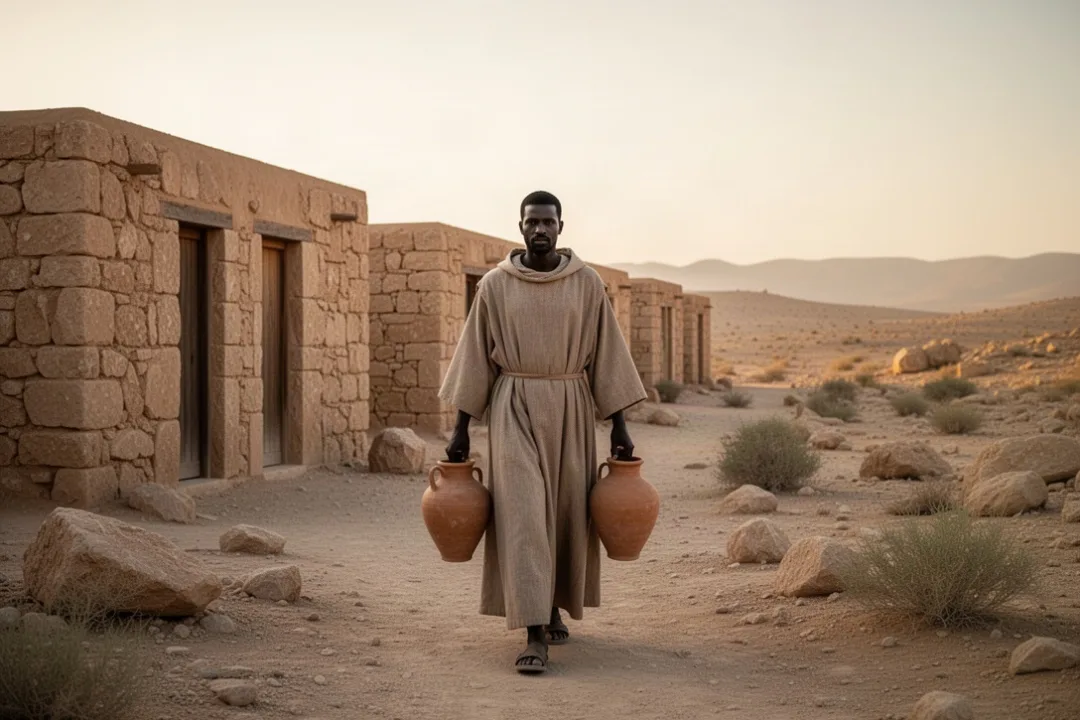
Another account describes Moses carrying water for the older monks. He drew water from a well some distance away, even though the effort was exhausting. The practice trained him to serve others and weakened his dependence on anger and force. The story is not meant to recommend reckless physical exertion. It illustrates how the desert monks used ordinary work to reshape a person’s instincts.
His repentance also involved restitution in a broader moral sense. He could not simply declare that he was different and expect everyone else to trust him. He had to accept obscurity, discipline, and the limits placed on him by the community. For someone accustomed to control and intimidation, obedience became a form of healing.
The elders also taught Moses not to measure spiritual progress by dramatic experiences. His life was formed through repeated acts:
confessing the truth about his past rather than excusing it;
accepting correction from wiser and more experienced Christians;
serving people he might once have despised or used;
responding to temptation with prayer and practical discipline;
learning to forgive others while asking forgiveness himself.
These practices help explain why Moses became such a powerful figure in Christian memory. His story avoids the idea that a person’s worst actions make change impossible. It also avoids a shallow view of conversion in which a single emotional moment solves every problem. His transformation was real, but it unfolded through years of effort, dependence on grace, and life within a community.
What Saint Moses taught about repentance and mercy
The sayings associated with Saint Moses the Black focus less on abstract theology than on the attitudes that make a spiritual life possible. He repeatedly appears as someone who has learned that harsh judgment of others can hide pride. His own history made him aware that visible behavior does not reveal everything about a person’s inner struggle.
One well-known story tells of a monk being judged by the community for a serious fault. Moses was asked to attend the meeting. Instead of delivering a condemnation, he carried a leaking sack filled with sand. When asked what he was doing, he explained that the sand represented his own sins, which he could not see because they were falling behind him, while he was preparing to judge another person’s wrongdoing.
The story is memorable because it does not deny that wrongdoing matters. It challenges the assumption that a person can correct others while ignoring the need for mercy and self-examination. For Moses, humility did not mean pretending sin was harmless. It meant remembering that every person stands in need of forgiveness.
Another saying attributed to him advises a monk to remain in his cell and let the cell teach him everything. In the language of desert monasticism, the cell was not simply a bedroom. It represented a stable place of prayer, work, and self-knowledge. Staying there meant resisting the constant urge to escape discomfort through distraction, argument, or restless movement.
Moses’ own struggle with anger made his teaching about mercy especially credible. He was not offering advice from a naturally calm personality. He had to learn how to stop using force as his first answer. The desert tradition presents this change as a process of replacing reaction with attention: notice the impulse, pray, seek counsel, and avoid making the next decision while emotionally inflamed.
His teachings can be applied carefully in ordinary life:
Pause before judging. Ask what you do not know about another person’s circumstances.
Confess specifically. General regret can remain vague; honest repentance names the harm and the pattern behind it.
Choose accountability. A trusted pastor, spiritual director, or mature Christian can help distinguish repentance from self-deception.
Practice small acts of service. Humility grows through concrete responsibilities, not only private intentions.
Seek reconciliation safely. Forgiveness does not require returning to an abusive situation or removing necessary boundaries.
That final point is particularly important for modern readers. The desert fathers praised forgiveness, but their sayings should not be used to pressure someone into tolerating violence, manipulation, or ongoing harm. Christian mercy and practical safety are not opposites. A person may forgive while still seeking protection, reporting abuse, or maintaining distance.
A useful way to read his sayings: Do not copy every ancient physical practice literally. Look for the spiritual purpose behind it—truthfulness, self-control, service, patience, and dependence on God.
Saint Moses the Black in the desert community
Moses did not become holy in isolation. He lived among monks who prayed, worked, corrected one another, and preserved the wisdom of earlier elders. The desert was physically remote, but monastic life was highly relational. A monk’s growth depended on learning how to live with other people without returning to domination, resentment, or self-protection.
According to the traditional accounts, Moses eventually became a respected spiritual guide. He was ordained a priest, commonly associated with the ministry of the community at Scetis. The stories emphasize the surprising nature of this development: a former robber became someone trusted to serve the sacraments and counsel others.
His ordination did not turn him into a flawless or self-important leader. One story says that a bishop wanted to test whether Moses was still aware of his unworthiness. When Moses was told to leave, he obeyed without protest, and the bishop then recognized his humility. The details differ in retellings, but the underlying point remains consistent: spiritual authority was measured by humility, not by status or reputation.
Moses also became known for welcoming people who had committed serious sins. When some monks questioned whether a repentant person should be received, Moses argued for mercy by recalling his own experience. He understood that communities can become proud of their standards while forgetting that everyone depends on forgiveness.
At the same time, the desert tradition does not portray him as permissive about evil. His compassion arose from repentance, not from indifference. He expected people to turn away from destructive behavior, but he believed that a person who sincerely turned back should not be permanently defined by the old life.
His relationship with the other desert fathers also reveals an important feature of early monastic Christianity: wisdom was often transmitted through brief conversations and memorable actions. The sayings were designed to be remembered, repeated, and practiced. They rarely offer a complete theory of human behavior. Instead, they direct the reader toward a change in posture.
When reading these accounts, it helps to separate three layers:
The historical person: Moses was a real monk associated with Egyptian desert Christianity.
The preserved tradition: His life and sayings were transmitted through collections written and compiled over time.
The spiritual interpretation: Later Christians read his story as evidence of repentance, mercy, and the possibility of transformation.
This distinction does not make the tradition meaningless. It simply encourages responsible reading. Ancient religious biographies often communicate truth through condensed stories, symbolic actions, and remembered sayings rather than through modern documentary methods.
His death, feast days, and Christian remembrance
The traditional account says that Moses died as a martyr with several other monks when a violent group attacked the monastery. Some versions say the monks had been warned that raiders were approaching and were encouraged to flee. Moses chose to remain, saying that if he escaped one danger, another might still await him. He was killed with the monks who stayed.
The exact number of companions and some details of the attack vary among sources. His death is generally placed around the early fifth century, during a period when isolated monastic settlements could face danger from armed groups and local unrest. It is best to describe the dating and circumstances with care rather than present every later detail as certain history.
Christian communities commemorate Saint Moses on different dates. In many Eastern Orthodox calendars, his feast is observed on August 28, while other traditions use different dates or emphasize related commemorations. Some Coptic Christian calendars remember him on a date corresponding to June 1 in the Gregorian calendar. Local calendars and liturgical traditions should be checked for the date used by a particular church.
He is often shown in religious art as a dark-skinned monk or priest, sometimes holding a cross or depicted with other desert saints. His iconography reflects his Ethiopian identity and his place among the holy ascetics of Egypt. The title “the Black” is not an insult; it distinguishes him from other figures named Moses and honors the traditional memory of his African origin.
Many Christians turn to Saint Moses when they are thinking about repentance after serious wrongdoing, addiction, anger, criminal behavior, or the fear that change has come too late. He is also significant for people who feel excluded from religious communities because of their past. His life does not promise that consequences will disappear. It offers a different promise: a person can begin a new way of living even while carrying responsibility for what came before.
A simple prayer inspired by his life might ask for honest self-knowledge, freedom from anger, courage to make amends, and mercy toward people who are changing slowly. Prayer to a saint, in traditions that practice it, is understood as asking the saint to intercede with God—not as treating the saint as a replacement for God.
Why Saint Moses the Black still matters
Saint Moses remains relevant because his story speaks directly to questions that churches and communities continue to face. Can a person with a destructive past be trusted again? How should a community balance accountability with mercy? What does real repentance look like after the emotion of confession has passed?
His life gives a demanding answer. Forgiveness is possible, but it does not make accountability unnecessary. Trust may need to be rebuilt over time. A person who has caused harm may need to accept restrictions, make restitution where possible, receive professional help, and demonstrate consistent change.
Moses also challenges the tendency to divide people into “good” and “bad” categories too quickly. His past was serious, and the tradition does not excuse it. Yet his later life shows that identity can be reshaped through grace, discipline, community, and truth. The church’s memory of him asks whether we believe redemption is available only to people whose failures are socially acceptable.
For someone personally seeking change, his story suggests several practical commitments:
Tell the truth about the behavior without minimizing its effects.
Ask for help from people who can offer both compassion and honest correction.
Accept that healing may require medical, psychological, legal, or financial support.
Replace harmful routines with stable practices of prayer, work, service, and rest.
Do not demand immediate trust from people who were hurt.
Measure change by sustained conduct rather than strong feelings alone.
For someone who has been harmed, his story should not become a burden placed on the victim. You are not required to reconcile with someone who remains dangerous, and you do not have to provide access in order to prove that you are merciful. The example of Moses is about the possibility of transformation in the wrongdoer; it is not a command for the injured person to ignore wisdom or safety.
His legacy ultimately rests on a clear Christian conviction: no past is beyond God’s ability to redeem, but redemption is shown through a changed life. Saint Moses the Black moved from violence to service, from self-reliance to dependence, and from judgment to mercy. That movement—not a romanticized account of his former crimes—is the reason Christians continue to remember him.
Frequently asked questions
Was Saint Moses the Black really a former robber?
Yes. Early Christian tradition consistently remembers Moses as a former robber and violent criminal who later became a monk in the Egyptian desert. The surviving accounts differ in their details, so not every episode can be verified as a modern biography. His criminal past is central to the spiritual meaning of his story: conversion required sustained repentance, discipline, and changed conduct.
Why is he called “the Black” or “the Ethiopian”?
These titles distinguish him from other saints named Moses and reflect the traditional belief that he was African, often described as Ethiopian or from a region south of Egypt. Ancient geographical terms did not always match modern national boundaries. “The Black” is a traditional honorific identifying his remembered African background, not a derogatory label.
What is Saint Moses the Black the patron saint of?
There is no single universally recognized patronage assigned to him across all Christian traditions. Many people seek his intercession when dealing with repentance, anger, addiction, violence, criminal pasts, or the need to rebuild a life after serious wrongdoing. His example is especially associated with mercy, humility, and the possibility of profound personal change.
How can I pray with the example of Saint Moses?
Begin by naming honestly what needs to change, then ask for strength to take one concrete step. That might involve apologizing, seeking counseling, joining a supportive church community, ending harmful behavior, or accepting accountability. You can also read traditional sayings attributed to Moses and reflect on how humility, patience, and mercy apply to your relationships.













Leave a Reply