Did Moses Go Into the Promised Land? What the Bible Says
The question “Did Moses go into the Promised Land?” is one of the most discussed topics in biblical study and in popular discourse about the Pentateuch. The Bible presents Moses as the central human leader who guides Israel from bondage to the edge of the land God promised to Abraham, Isaac, and Jacob. Yet the text also records that Moses did not personally enter the land of Canaan. This article explores the biblical record, the main verses involved, and the theological significance behind the outcome. We will trace the narrative, examine the reasons given for Moses’ restriction, and consider how later traditions and New Testament allusions relate to this question. The aim is to present a careful, evidence-based overview that clarifies what the Bible says and how scholars interpret it.
The biblical timeline and the central question
From the calling of Moses in Exodus through the wanderings in the wilderness, Moses occupies a pivotal role. He is the one whom God used to deliver Israel, to give the Law at Sinai, and to lead Israel toward the land promised to their ancestors. However, when Israel stands on the plains of Moab about to enter the land, the narrative pivots: who crosses into the land, and who does not? The explicit question—“Did Moses enter the Promised Land?”—has a straightforward answer in the biblical text, though it is accompanied by nuanced details about why and how this happens in the story’s larger theological arc. The simplest formulation is that Moses did not enter the land himself, but he did see it and is honored in various ways within the tradition. This is not merely a matter of a single verse, but a composite of several passages that together answer the question with clarity and context.
Key biblical passages and what they say
To understand did Moses go into the Promised Land, it helps to focus on several anchor texts. They describe the end of Moses’ leadership, his viewing of the land from a distance, and the command that he not cross into it, followed by his death in the land of Moab. Here are the principal passages, summarized and connected for clarity:
Numbers 20:12 — Moses and Aaron are rebuked by the LORD for their lack of trust when they spoke to the rock to bring water, instead of commanding it as God had instructed. The consequence given is that they shall not bring the assembly into the land which I have given them. This verse is frequently cited as the explicit biblical reason Moses would not enter the land.
Deuteronomy 3:27 and related verses describe another moment when Moses is told to ascend but not cross over to the land; this sets up the younger generation’s leadership under Joshua. The emphasis is on the boundary of crossing into the land itself.
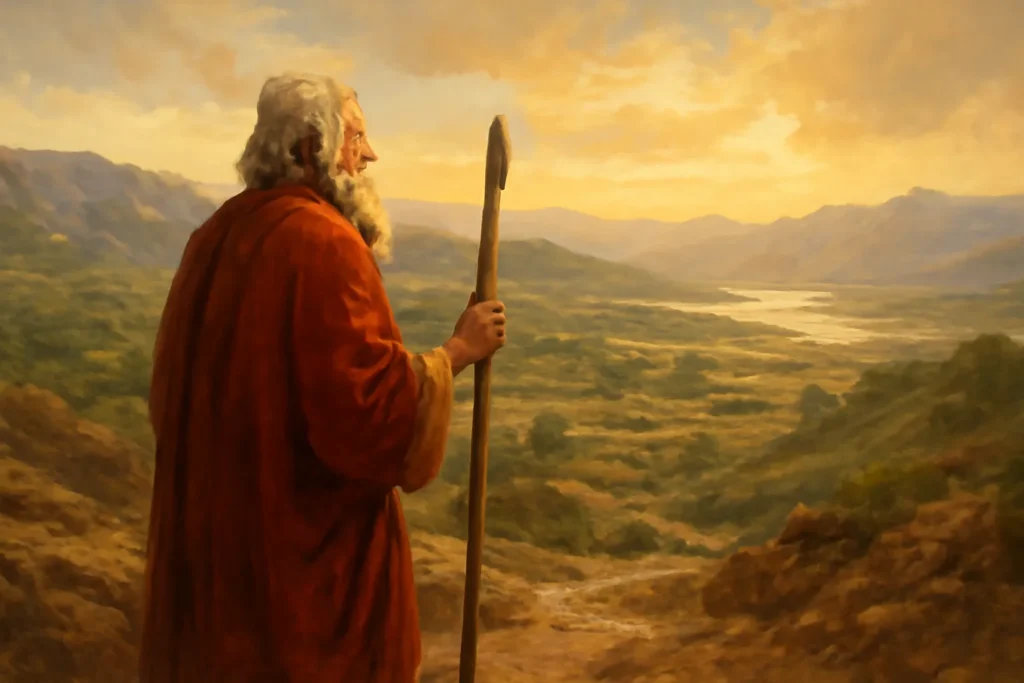
Deuteronomy 32:49–50 — God commands Moses to go up to the mountains of Abarim, to view the land from Pisgah, and then die there at the place called Nebo. The text explicitly states that he would view the land but would not enter it, which aligns with the later narrative arc.
Deuteronomy 34:4–5 — In one of the clearest statements, the LORD tells Moses, “This is the land which I swore to give to Abraham, to Isaac, and to Jacob,” and then adds, “thou shalt see it with thine eyes, but shalt not go over thither.” The verse then records Moses’ death in the land of Moab, fulfilling the divine word.
Deuteronomy 34:7 — Moses dies at the age of 120, with a distinctive description of his physical condition: his eye was not dim, nor was his natural force abated. This underscores that the limitation was not due to weakness but to God’s specific decree.
Joshua 1:1–2 — After Moses’ death, the leadership transition occurs to Joshua. The text marks the moment when the LORD commissions Joshua to lead the people into the land, signaling a continuity of promise through a new leader.
Beyond these core verses, others in the Pentateuch contribute to the surrounding narrative: Moses ascends Pisgah to view the land; the people mourn Moses’ passing; and the book of Joshua continues with the conquest and settlement in the land. Taken together, these passages provide a cohesive account: Moses did not enter the Promised Land, but he did view it from a distance and remains a central figure in the formation of Israel’s identity and covenantal history.
Several strands of interpretation emerge from the text about why Moses was barred from crossing into the land. The primary explanation in Numbers 20:12 is disobedience in the moment of water provision. Yet biblical scholars also explore broader themes that help readers understand both the constraint and the purpose of God’s administration of the covenant people. Here are the main lines of reasoning:
Disobedience and trust — The direct cause given is that Moses did not trust God enough to honor Him as holy in front of the Israelites when the rock was meant to produce water. This act of striking the rock, rather than speaking to it as God commanded, is portrayed as an insufficient display of faith in that moment.
Leadership transition — The restriction can be seen in light of the transition from Moses to Joshua. The narrative places a responsibility on a younger generation to take possession of the land, and the design may stress that a new phase of leadership requires a distinct set of actions and faith under a new commander.
Sanctity of the land — The land is presented as a holy promise with a sacred boundary. The people are called to enter the land in faith and obedience, and Moses’ misstep is framed as a failure to reflect God’s holiness in leadership before the people.
Theological emphasis on faithfulness — The broader arc of the Pentateuch emphasizes faithfulness to the covenant; even great leaders are subject to consequences for disobedience. Moses’ story upholds the principle that obedience to God’s word matters for all, including those whom God uses in a special way.
These interpretive angles are not mutually exclusive. They intersect to illuminate how the text uses this boundary moment to teach about leadership, trust, and the nature of the covenant. The result is a nuanced portrayal: Moses remains a pivotal, faithful servant, but his journey into the land is not part of his narrative arc from Exodus to Deuteronomy. The land is the stage for Joshua’s conquest, not Moses’ crossing.
Did Moses see the land from Nebo or Pisgah?
Several passages describe Moses viewing the land from a high place before his death. The geography matters for the theological symbolism as well as the literary design of the text. The locations most often named are Pisgah and the mountains of Abarim, from which Moses is granted a view of the land of Canaan. The phrase “Pisgah” is traditionally understood as a horizon or beholding vantage point perched on the eastern side of the Jordan. In this sense, Moses does not cross the Jordan into the land, but he does receive a privileged glimpse of the promise before it is handed to the next generation.
View from Pisgah — The text suggests a comprehensive panoramic view of the land, underscoring that God kept the promise by letting Moses observe what lay ahead, even as he stands apart from entering it.
Boundary of crossing — The act of seeing from a distance reinforces the boundary between leadership that enters the land and leadership that passes away before crossing. This distinction emphasizes the unfolding narrative arc from Moses to Joshua.
For readers and students of Scripture, the questions around sight versus entry can be meaningful for understanding themes such as vision and obedience, the ethics of leadership, and the way God’s promises are fulfilled across generations. The fact that Moses sees the land but does not enter invites reflection on how God’s plan often works through diverse instruments and phases rather than through a single figure alone.
Did Moses cross into the land in any sense?
While the canonical text states that Moses does not enter the land in a physical sense, some readers discuss whether there are other senses in which Moses might be considered to have an entry into the Promised Land. Several considerations help frame this question:
Symbolic presence — In biblical narrative, a leader’s legacy can be said to “enter” the land through the people who possess it and through the covenantal memory that guides the community. Moses’ teachings, laws, and example shape Israel’s life in the land even after his death.
New Testament motifs — Although the New Testament does not retell Moses’ entry into the land, it references Moses as a foundational figure in the history of Israel, and it presents Jesus as fulfilling and surpassing the law given by Moses. Some readers interpret this as Moses’ influence continuing beyond his physical life.
Transfiguration and heavenly recognitions — The appearance of Moses (alongside Elijah) with Jesus during the Transfiguration (Matthew 17:1–9; Mark 9:2–8; Luke 9:28–36) is sometimes cited to discuss ongoing significance in divine revelation, even though this scene is not a literal entering of land but a moment of divine revelation and affirmation.
In the strict sense of the land of Canaan, the text remains definitive: Moses did not enter the Promised Land. In broader spiritual and canonical terms, however, Moses’ influence persists in the people’s life in the land and in the unfolding of God’s redemptive plan through subsequent generations.
In discussing whether and how Moses entered the Promised Land, it is helpful to consider how later parts of Scripture and later Jewish and Christian traditions treat Moses’ life and death. A few notable points:
New Testament portrait — The New Testament does not record Moses crossing into the land, but it repeatedly references Moses as a paradigm of faith, law, and covenant. The emphasis remains on his leadership in the wilderness and his role as a lawgiver, rather than any literal crossing into the land itself.
Transfiguration and memory — The appearance of Moses at the Transfiguration underscores his enduring significance in the biblical narrative, but it is a moment of heavenly revelation, not a declaration about his terrestrial journey into the land.
Rabbinic and theological reflections — In post-biblical Jewish writings and in Christian patristic thought, Moses’ death is often treated with reverence and sometimes with interpretive frameworks that emphasize continuity between Moses’ mission and Israel’s broader story of redemption, even as the land is entered under Joshua’s leadership.
Thus, while the canonical record makes a clear distinction about entry into the land, later traditions often explore Moses’ enduring legacy and the ways his leadership informs the people as they settle in the land of promise. The theological takeaway is not simply about where Moses stood at a moment in time but about how the covenant community moves forward under God’s guidance, with faithful leadership, and in response to God’s promises.
Practical implications and lessons from the story
Beyond the textual specifics, the question “Did Moses go into the Promised Land?” offers several instructive themes for readers of the Bible today. Here are some practical takeaways that scholars and pastors often highlight:
Obedience matters at every level — Moses’ moment of disobedience is presented as a serious lapse, especially for a leader under whom a community is shaped. The story emphasizes that obedience to God’s word remains central, even for the most trusted servants.
Leadership transitions are a normal part of God’s plan — The transition from Moses to Joshua shows how God prepares a successor and ensures continuity in His covenant purposes. Transition can be difficult but is a natural and purposeful part of God’s governance of history.
God’s promises remain unfold over generations — The promise to Abraham, Isaac, and Jacob is not fulfilled in a single moment or person; it unfolds across generations. The narrative encourages patience and faith in God’s timing.
Memory and legacy shape faith communities — Although Moses did not cross into the land, his teachings and example become core elements of Israel’s identity in the land, illustrating how memory functions as a living force in a faith community.
When readers engage with this story today, the focus often shifts to how individuals and communities respond to God’s leading, learn from past failures, and press forward in faith. The question about the ground Moses walked—the lack of crossing into the land—becomes a lens through which we can reflect on obedience, trust, and divine sovereignty in our own context.
To help readers who are pondering this topic, here are some frequently asked questions with concise clarifications. These are not exhaustive theological arguments, but they summarize common points of discussion:
Was Moses punished for disobedience? — The biblical text presents a disciplinary outcome in which Moses would not enter the land, but it does not describe Moses as a fraud or unfaithful; rather, it presents him as a faithful servant who nonetheless bears a consequence for a specific act of disobedience.
Did Moses ever enter the land symbolically? — The text does not indicate a literal crossing into the land, but Moses’ influence and the covenantal framework that he helped establish persist in Israel’s life in the land under Joshua and beyond.
How do different traditions interpret this? — Jewish and Christian traditions often discuss Moses’ role in terms of covenant fidelity, leadership, and prophetic signification. Some traditions emphasize memory and legacy, while others focus on the theological purpose of the boundary in the narrative arc.
Readers should approach these questions with an eye toward the literary structure of the Pentateuch, the historical context of the wilderness generation, and the theological aims of the narrator(s). This careful approach helps prevent oversimplification and allows for a richer understanding of why the narrative unfolds as it does.
Conclusion: The final takeaway about Moses and the Promised Land
In answer to the central question—“Did Moses go into the Promised Land?”—the biblical accounts give a clear, well-supported response: no, Moses did not enter the land of Canaan, but he did view it from a distance, he died in the land of Moab, and his leadership and legacy deeply shaped Israel as they entered and settled the land under Joshua. This outcome is not presented as a punitive capstone for Moses alone; rather, it marks a transition within a larger divine plan to bring a people to rest in the land and to establish a lasting covenant community centered on God’s presence and law.
The story invites readers to consider how God fulfills His promises across generations, how leadership characters influence a people, and how obedience to God’s word remains central to the life of faith. In literary terms, the account of Moses’ death and the impending entry under Joshua serves to bridge two crucial phases of Israel’s journey: the deliverance from bondage and the possession of the land of promise. The biblical record thus remains a coherent narrative about faith, obedience, and the faithfulness of God to His covenant.
In sum, the question “Did Moses go into the Promised Land?” is answered decisively within the text, while the broader theological and literary implications continue to invite thoughtful exploration for readers, students, and theologians alike. Moses’ example—one of bold leadership, fervent advocacy, and earnest service—continues to resonate as part of the larger drama of Israel’s journey toward the land God promised.












Leave a Reply