Saint Anthony of Padua is best known as the patron saint of lost things, but his life was centered on preaching, Scripture, compassion, and service to people in need.
The name Saint Anthony can refer to more than one important Christian figure. Most people mean Anthony of Padua, the 13th-century Franciscan friar associated with finding lost objects and with powerful preaching. Others may mean Anthony the Great, an early Christian monk whose life in the Egyptian desert helped shape Christian monasticism.
Knowing which Anthony you mean makes it easier to understand the correct feast day, symbols, prayers, and traditions. Both saints are remembered for deep faith and disciplined lives, but they lived in different centuries and served the Church in different ways.
In everyday conversation, a person who says, “I prayed to Saint Anthony to help me find it,” almost certainly means Saint Anthony of Padua. His popular reputation comes from stories about recovering lost books, belongings, and even more intangible things such as faith, hope, or a sense of direction.
Anthony of Padua was born Fernando Martins de Bulhões in Lisbon, Portugal, around 1195. He first joined the Augustinian order, later became a Franciscan, and took the name Anthony. His preaching ministry eventually brought him to parts of Italy and southern France, where he became known for explaining Christian teaching clearly and urging people to live with integrity.
Anthony the Great, also called Anthony of Egypt or Anthony the Abbot, lived much earlier. He was born around 251 in Egypt and became one of the best-known leaders of the early desert monastic movement. His life emphasized prayer, fasting, solitude, spiritual discipline, and resistance to temptation.
Anthony of Padua: Franciscan preacher, teacher, and patron saint of lost items; feast day June 13.
Anthony the Great: Egyptian desert monk and father of Christian monasticism; feast day January 17 in many Western calendars.
Saint Anthony of the Caves: a later Eastern Christian monastic figure, especially associated with the founding traditions of the Kyiv Cave Monastery.
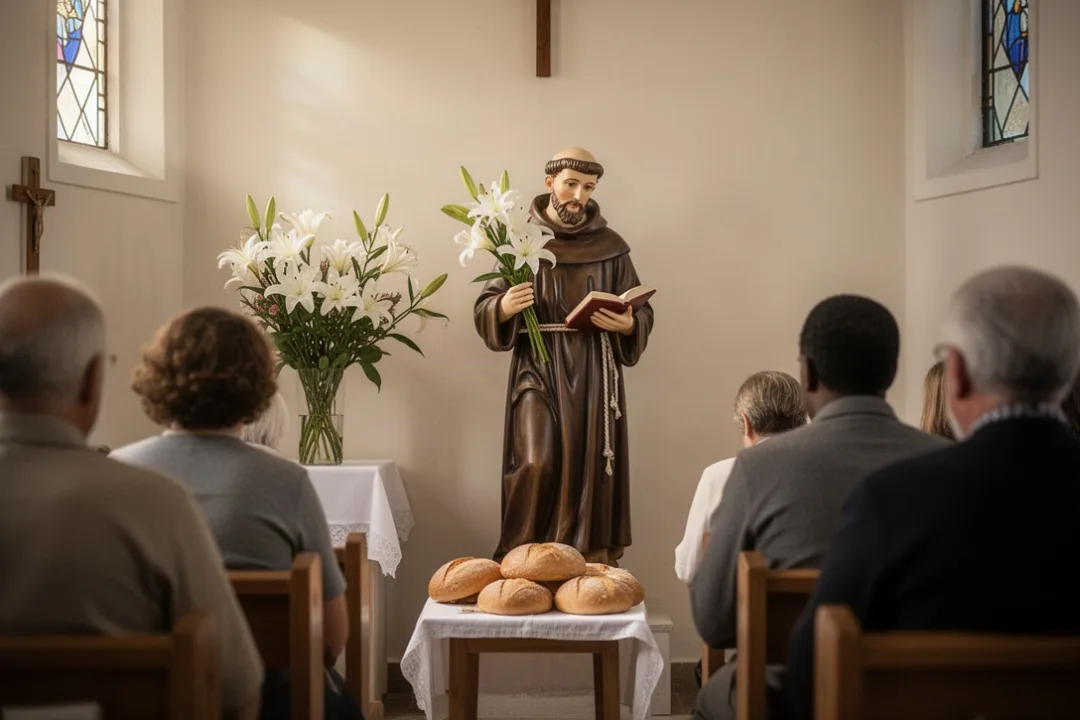
When a church, prayer card, medal, or statue simply says “Saint Anthony,” the image usually depicts Anthony of Padua. A friar holding the Christ Child and a lily is generally the Padua saint, while an elderly monk with a staff, a book, or a small pig usually represents Anthony the Great.
Why Saint Anthony of Padua is the patron saint of lost things
The tradition connecting Anthony of Padua with lost objects is linked to a story about a missing book of psalms. According to the tradition, a novice took Anthony’s treasured book, which contained his notes and teaching material. After Anthony prayed, the book was returned.
The story helped create a lasting custom: people ask Saint Anthony to help them recover something that has disappeared. The request may involve keys, a wallet, important paperwork, jewelry, or a phone. The devotion is not meant to treat prayer as a magical search technique. Instead, it expresses trust that God can help a person remain calm, attentive, and hopeful while dealing with a frustrating loss.
Many people also ask Saint Anthony to help them recover lost relationships, lost faith, or a sense of purpose. In that broader meaning, “lost things” includes anything valuable that has been misplaced physically, emotionally, or spiritually.
A grounded way to pray: Ask Saint Anthony’s intercession, then take practical steps such as retracing your movements, checking likely places, contacting others, and replacing essential documents when necessary.
The devotion became especially widespread among Catholics because Anthony was known for compassionate preaching and concern for ordinary people. His intercession is often invoked in a simple, direct way, making it accessible even to someone who has never developed a formal prayer routine.
Anthony was born into a respected family in Lisbon and received a religious education. As a young man, he entered the Canons Regular of Saint Augustine, where he studied theology and Scripture. His decision to become a Franciscan came after he saw the remains of several Franciscan missionaries who had been killed while preaching in Morocco.
Anthony hoped to preach in Morocco himself, but illness forced him to leave. On his return journey, he was redirected to Sicily and eventually became part of the Franciscan movement in Italy. For a time, his exceptional learning and preaching ability were not widely recognized. That changed when he was unexpectedly asked to speak at a gathering of clergy and delivered a compelling address.
His reputation grew quickly. Anthony preached against corruption, exploitation, dishonesty, and religious indifference. He addressed both educated audiences and ordinary townspeople, combining theological knowledge with practical moral guidance. His message called people to repentance, mercy, reconciliation, and a faith expressed through daily conduct.
Anthony also served as a teacher within the Franciscan order. He was associated with the study of theology among the friars, at a time when some religious communities were carefully considering how formal education could support preaching. His teaching joined intellectual preparation with pastoral concern.
He died near Padua in 1231 at about 36 years of age. Pope Gregory IX canonized him in 1232, less than a year after his death. This unusually rapid canonization reflected the strength of his reputation for holiness, preaching, and miracles during his lifetime and after his death.
Anthony is also honored as a Doctor of the Church, a title recognizing the lasting value of a saint’s teaching for Christian faith and theology. Pope Pius XII gave him that title in the 20th century. His sermons and biblical explanations remain part of the historical record of medieval Christian preaching.
What Saint Anthony’s symbols mean
Religious art uses several recurring symbols to identify Anthony of Padua. Each one points to a part of his life, ministry, or popular devotion.
The Christ Child: Anthony is often shown holding Jesus because of traditions describing his close relationship with Christ and because the image emphasizes love for the Incarnation.
The lily: A white lily represents purity, holiness, and the disciplined life associated with religious devotion.
The book: A book refers to Anthony’s study of Scripture, his teaching, and his role as a preacher and theologian.
The habit: His brown Franciscan clothing identifies his membership in the Order of Friars Minor.
A flame or heart: These symbols may represent fervent love of God, passionate preaching, or the spiritual intensity associated with his ministry.
Bread: Bread is connected with charitable traditions honoring Anthony and with concern for people experiencing hunger or poverty.
Statues and paintings may combine several of these symbols. The Christ Child and lily are especially common in churches, homes, prayer cards, and medals. The exact appearance can vary by region and artistic tradition.
Anthony of Padua is sometimes portrayed with a calm, youthful face because he died relatively young. The image is not meant to provide a historically exact portrait. It functions as a visual reminder of his preaching, compassion, and closeness to Christ.
Saint Anthony’s feast day and popular traditions
Saint Anthony of Padua’s feast day is June 13. Churches may celebrate it with Mass, a novena, a procession, a blessing of bread, charitable events, or a community festival. Customs differ widely depending on local culture and parish practice.
In some communities, people bring bread to be blessed and then share it with family, neighbors, or people who need food. This practice reflects the idea that devotion to Anthony should lead to generosity, not only private requests. The blessed bread is a sign of gratitude and charity rather than an object believed to have magical power.
Some people pray a novena to Saint Anthony, meaning they repeat a prayer or devotional practice over nine days. A novena may focus on a lost item, a family concern, healing, guidance, employment, or a desire to recover faith. Others simply say a brief prayer at the moment they need help.
Anthony the Great has a different feast day, usually January 17 in Western Christianity. His celebrations may include references to monastic life, spiritual struggle, animals, or rural customs. In some places, he is associated with the blessing of animals, although local traditions vary.
Before joining a public celebration, check the parish or church’s schedule and customs. A June 13 event may honor Anthony of Padua, while a January 17 service may honor Anthony the Great. Similar names do not mean the two feasts are interchangeable.
How to pray to Saint Anthony about something lost
There is no single required prayer for asking Saint Anthony’s help. You can pray formally using a novena or prayer book, or speak in your own words. A useful prayer includes the situation, a request for intercession, and a willingness to respond calmly and responsibly.
You might say: “Saint Anthony, please pray for me as I look for what I have lost. Help me remember where I placed it, stay patient, and accept whatever I need to do next. Pray that I use what I recover wisely and remain grateful.” This is an original devotional example, not a required formula.
After praying, pause before beginning the search. Stress can make you overlook an object that is directly in front of you. Then work methodically instead of repeatedly checking the same places without a plan.
Describe the item clearly: Identify its size, color, last known location, and when you last used it.
Retrace your movements: Check the route, rooms, bags, pockets, vehicles, and surfaces connected with the item.
Search by category: Look first in places where the object normally belongs, then in unusual locations created by rushing or distraction.
Ask for help: A household member or coworker may remember seeing it or may notice it more quickly.
Protect yourself: If the lost item contains financial or personal information, freeze cards, change passwords, or report documents promptly.
Give thanks: If the item is found, express gratitude. If it is not, decide what practical replacement or next step is needed.
Prayer can accompany a search, but it should not replace ordinary care. Saint Anthony’s traditional role points toward trust and perseverance, not superstition or guaranteed results.
Common mistakes when asking Saint Anthony for help
Devotion can be meaningful when it remains connected to faith, charity, and practical responsibility. Several misunderstandings can make the tradition less helpful than it could be.
Treating prayer like a guarantee: Asking for intercession does not promise that every lost item will be recovered.
Confusing faith with magical thinking: A medal, statue, or prayer card is a devotional reminder, not a charm that controls events.
Ignoring urgent security concerns: Lost credit cards, passports, keys, and devices may require immediate protective action.
Using only a private request: Anthony’s example also points toward generosity, honesty, and concern for vulnerable people.
Assuming every Saint Anthony image is the same: Check whether the artwork depicts Anthony of Padua or Anthony the Great.
Promising something you cannot keep: A person may offer a donation or act of charity in gratitude, but it should be sincere and realistic.
For urgent losses: Pray briefly, then protect your accounts and identity first. Spiritual devotion and practical action can work together.
These guidelines also help parents introduce the devotion to children. A child can ask Saint Anthony for help finding a toy, but the experience can become a lesson in patience, careful observation, gratitude, and sharing with others.
How Saint Anthony can represent more than lost objects
People often turn to Anthony during periods of uncertainty that have little to do with a misplaced possession. Someone may feel disconnected from family, unsure about a decision, distant from prayer, or discouraged by repeated mistakes. In these situations, Anthony’s association with lost things can become a symbol of recovery and return.
His ministry also makes him a meaningful intercessor for students, teachers, speakers, writers, travelers, and people seeking work. These associations arise from his preaching, learning, movement between communities, and concern for people facing material hardship. They are devotional traditions rather than claims that he guarantees a particular outcome.
Praying with Anthony in mind can help you name what has been lost. Perhaps the real need is not to locate an object but to recover patience, courage, honesty, or trust. Naming that need may lead to a more constructive response than simply wishing the difficulty away.
His life also connects prayer with clear communication. Anthony was remembered as a preacher who explained difficult religious ideas in ways people could understand. A person who follows that example might pray for the ability to speak truthfully, apologize sincerely, listen carefully, or advocate for someone being treated unfairly.
The most meaningful way to honor Anthony is not limited to lighting a candle or displaying an image. Those practices can support devotion, but his life also encourages concrete acts of mercy, learning, and moral courage.
Share food or support a local food pantry in honor of the tradition of Saint Anthony’s bread.
Help a child, student, or neighbor learn something that will strengthen their independence.
Return an item that belongs to someone else, even when keeping it would be easy.
Repair a relationship through an honest conversation when reconciliation is safe and appropriate.
Set aside time for prayer, Scripture, or quiet reflection rather than reacting immediately to stress.
Speak up when someone is being exploited, deceived, or unfairly excluded.
These actions connect devotion with the character Anthony was known for: truthfulness, compassion, disciplined study, and attention to people’s real needs. A person does not need elaborate religious objects or specialized knowledge to begin.
If you visit a church dedicated to Saint Anthony, take time to look at its artwork and ask which Anthony is represented. You may see a statue of the Franciscan preacher, a painting of the desert monk, or a local image shaped by regional history. Learning the story behind the image can make the visit more meaningful.
Choosing a Saint Anthony prayer or devotional practice
A suitable practice depends on your purpose and tradition. Someone searching for a lost wedding ring may want a brief prayer followed by a careful search. Someone preparing for a feast day may prefer a novena, attendance at Mass, charitable giving, or reading about Anthony’s life.
Keep the practice simple enough to sustain. You could pray for a few minutes each day, read a short passage about Anthony, write down one thing you are seeking to recover, or perform one act of charity. The point is not the complexity of the ritual but the connection between prayer and conduct.
If you are not Catholic, you can still learn from Anthony’s example without adopting a devotional practice that conflicts with your beliefs. Historians, Christians from other traditions, and people interested in religious art may approach him as a preacher, monk, cultural figure, or subject of medieval history.
Saint Anthony’s enduring appeal comes from the meeting of ordinary problems and serious spiritual questions. A missing key may prompt a short prayer, while a deeper loss may call for patience, community support, professional help, and renewed faith. In both cases, Anthony’s tradition encourages you to seek what matters, act honestly, and share what you have found.
Frequently asked questions
Is Saint Anthony the same person as Anthony the Great?
No. Saint Anthony usually refers to Anthony of Padua, the Franciscan preacher associated with lost things. Anthony the Great lived several centuries earlier in Egypt and is remembered as an early desert monk. Their feast days, symbols, and historical roles are different, although both are honored as Christian saints.
What should I do after praying to Saint Anthony for a lost item?
Search systematically rather than relying only on prayer. Retrace your steps, check normal storage places, ask others whether they saw the item, and protect sensitive accounts or documents if necessary. Prayer can help you remain patient and attentive, while practical action addresses the immediate problem.
Can I pray to Saint Anthony for something besides a lost object?
Yes. Many people ask his intercession for lost faith, strained relationships, guidance, work, patience, education, and financial or personal difficulties. You can describe your need in your own words and combine prayer with appropriate action, such as seeking advice, making amends, or helping someone else.
Why is bread associated with Saint Anthony?
Bread is connected with charitable traditions honoring Anthony, especially concern for people experiencing hunger. Some communities bless and share bread around his feast day on June 13. The practice emphasizes generosity and gratitude; the bread is not considered a magical object or a guarantee that a request will be granted.














Leave a Reply