Pentecost prayers for renewal, guidance, and courage
Pentecost prayers for renewal, guidance, and courage
Pentecost prayers help you ask the Holy Spirit for renewal, wisdom, courage, and a deeper love for God and other people. You can pray them alone, with your family, during a church service, or as part of a Pentecost vigil.
The prayers below include a simple opening prayer, prayers for spiritual gifts, unity, mission, healing, and daily guidance. Each one is written in original language so you can use it as it is or adapt it to your own tradition and circumstances.
Pentecost is a Christian feast that comes fifty days after Easter. It remembers the coming of the Holy Spirit upon Jesus’ disciples in Jerusalem, an event described in Acts 2. The disciples, who had been uncertain and afraid, received fresh courage to speak about Jesus and serve others.
The celebration is often associated with wind, fire, many languages, and communal worship. These signs point to the Spirit’s power to awaken faith, strengthen witness, and bring people together without erasing their differences. Pentecost prayer therefore reaches beyond private comfort. It can also ask how God wants a congregation or community to live with greater love, truth, and courage.
Different Christian traditions observe Pentecost in different ways. Some use formal liturgical prayers, hymns, and a special service. Others gather for prayer meetings, read Acts 2, sing worship songs, or spend quiet time asking for the Spirit’s presence. The form may vary, but the central focus remains the same: welcoming God’s renewing presence and becoming more ready to follow Christ.
A simple starting point: Pray slowly, name the need that brought you to God, and leave quiet space afterward. Pentecost prayer is not a performance; it is an act of openness, attention, and trust.
How to pray on Pentecost step by step
You do not need a special setting or long preparation. A few quiet minutes can become a meaningful prayer when you approach the time with honesty and attention. If you are praying with others, invite each person to contribute a short prayer, a Scripture reference, or a moment of silence.
Begin with praise. Thank God for life, grace, Jesus Christ, and the continuing work of the Holy Spirit.
Become still. Put aside distractions and take a few unhurried breaths. Ask for an attentive heart.
Confess what needs to change. Name fear, resentment, pride, indifference, or any habit that keeps you from love and obedience.
Ask for the Spirit’s help. Pray for wisdom, courage, patience, compassion, self-control, or another gift you need.
Pray for other people. Remember your family, church, neighbors, leaders, people who are suffering, and those whose faith or language differs from yours.
Listen and respond. Sit quietly, write down a helpful thought, or identify one faithful action you can take.
End with willingness. Offer your time, words, choices, and relationships to God’s purposes.
This pattern can take five minutes or an hour. The goal is not to create a dramatic experience. It is to become more receptive to truth, love, correction, and service. If your thoughts wander, return gently to a short phrase such as “Holy Spirit, guide me” or “Make me ready to serve.”
A short Pentecost prayer for personal renewal
Holy Spirit, come into the places in me that have grown tired, distracted, or closed. Renew my love for God and make my faith active in the way I speak and live. Clear away fear, bitterness, and self-reliance so that I can receive your wisdom with humility.
Give me courage to obey what is right, patience with people who are difficult, and compassion for those carrying burdens I cannot see. Teach me to recognize your work without trying to control every outcome. Let my thoughts, words, and actions reflect the character of Christ. Make me willing to begin again, to forgive, and to serve. Amen.
This prayer is especially suitable when Pentecost feels like a personal time of spiritual reawakening. You can pray it at the beginning of the day, before worship, or after reading Acts 2. Consider repeating one sentence that expresses your most immediate need.
A Pentecost prayer welcoming the Holy Spirit
Holy Spirit, we welcome you. Be present in our worship, our homes, our conversations, and our decisions. Open our understanding to God’s truth and soften our hearts toward one another.
Where there is fear, bring courage. Where there is confusion, bring wisdom. Where there is division, bring patience and a desire for reconciliation. Where there is weariness, bring strength that does not depend on pride or control. Shape us into people who listen well, speak truthfully, and act with mercy.
Help us receive your presence as a gift, not as something we can claim or use for our own status. Make us attentive to the needs around us and ready to share the good news of Jesus with humility, clarity, and love. Amen.
Prayers for the gifts and fruit of the Spirit
Pentecost is a natural time to pray for qualities that help you follow Christ faithfully. The New Testament uses several passages to describe the Spirit’s work, including spiritual gifts and the fruit seen in a transformed life. These descriptions should lead to service rather than comparison.
Ask not only, “What ability do I have?” but also, “How can God use me to strengthen someone else?” A gift becomes meaningful when it is practiced with love, wisdom, and concern for the common good.
For wisdom: Holy Spirit, help me see situations clearly and choose what is faithful rather than what is merely convenient.
For understanding: Teach me to listen before I answer and to learn from people whose experiences differ from mine.
For courage: Give me strength to speak honestly, resist wrongdoing, and act with kindness when silence would be easier.
For compassion: Keep me from becoming numb to suffering. Show me practical ways to help.
For patience: Slow my reactions and make room for growth in myself and others.
For self-control: Help me govern my words, desires, anger, and use of time.
For encouragement: Put people in my path who need hope, and give me words that build rather than flatter.
For faithful service: Make me dependable in ordinary responsibilities, not only in visible tasks.
These requests can be made one at a time. Choose the quality most needed in your present season and pray over it for several days. You might also ask a trusted Christian friend where they see evidence of the Spirit’s work in you and where further growth may be needed.
God of strength, the first disciples needed courage to speak and serve after receiving the Holy Spirit. Give me that same willingness to live openly as a follower of Jesus without becoming harsh, proud, or argumentative.
Help me speak about my faith with honesty and respect. Give me the courage to defend people who are mistreated, to admit when I am wrong, and to choose integrity when no one is watching. Teach me to notice opportunities for service rather than waiting for recognition.
Let my witness be more than words. May my generosity, reliability, forgiveness, and care for vulnerable people make the love of Christ visible. When I feel inadequate, remind me that faithful action can begin with a small step. Equip me to serve the people already near me. Amen.
Witness does not require you to have an answer for every question. A Pentecost prayer for courage can prepare you to listen, share what you genuinely believe, and treat another person with dignity even when you disagree.
A Pentecost prayer for unity in the church
Holy Spirit, gather your people in truth and love. We confess that our preferences, assumptions, fears, and pride can become barriers between us. Forgive us for treating difference as a threat or for making personal opinions more important than the call to love.
Give church leaders wisdom and humility. Give congregations patience, honesty, and a willingness to repair relationships. Help us honor different gifts, generations, cultures, languages, and ways of serving while holding firmly to the central hope of the gospel.
Protect your church from manipulation, contempt, gossip, and the desire for influence. Teach us to disagree without demeaning one another and to seek reconciliation when trust has been damaged. Make our communities places where lonely people are welcomed, the grieving are supported, children are protected, and newcomers are treated with respect. Amen.
The account of Pentecost includes people from many regions hearing the disciples in ways they could understand. That image can guide prayer for unity without uniformity. Christian unity does not require every person to share the same background, personality, worship style, or opinion on every secondary issue.
A Pentecost prayer for families and homes
Holy Spirit, rest upon this home and everyone who enters it. Help us speak with gentleness, listen without rushing, and forgive without keeping a private record of past offenses. Give parents, children, spouses, roommates, and relatives grace to care for one another through ordinary responsibilities and difficult seasons.
Bring peace where there is tension and wisdom where decisions are complicated. Protect this household from cruelty, neglect, dishonesty, and fear. Teach us to make room for prayer, gratitude, hospitality, and meaningful conversation.
For families separated by distance or conflict, provide comfort and wise opportunities for repair. For those grieving someone they love, give patience for the long process of sorrow. May this home become a place where faith is practiced through kindness, honesty, service, and welcome. Amen.
You can pray this together by asking each person to name one thing they are thankful for and one area where they need help. Keep the practice accessible. A short prayer at the kitchen table may be more sustainable than an elaborate routine that quickly becomes a burden.
A Pentecost prayer for healing and comfort
Merciful God, bring your comfort to people who are sick, exhausted, grieving, anxious, or afraid. Give strength to those living with chronic pain or uncertainty, and support the caregivers who often carry invisible responsibilities.
Guide doctors, nurses, counselors, chaplains, family members, and all who provide care. Give them skill, patience, and compassion. Where healing is possible, provide effective treatment and renewed strength. Where healing takes a different form or does not come as quickly as hoped, surround people with faithful companionship and practical support.
Do not let suffering isolate anyone. Show us how to offer help without making promises we cannot keep or giving shallow explanations for another person’s pain. Make us willing to sit quietly, deliver a meal, arrange transportation, listen carefully, or seek professional help when needed. Amen.
Prayer can accompany medical care, counseling, and other forms of support; it should not be used to pressure someone to reject appropriate treatment. A compassionate Pentecost prayer honors both spiritual care and practical care.
For prayer with someone who is suffering: Ask permission first, keep your words brief, and avoid suggesting that illness or hardship proves a lack of faith. Presence, listening, and practical help may be the most loving response.
A Pentecost prayer for people who feel afraid or uncertain
Holy Spirit, meet me in uncertainty. I do not know every answer, and I cannot control everything that may happen. Give me enough light for the next faithful step rather than an illusion of complete control.
Quiet the fears that distort my judgment. Help me separate real responsibility from imagined disaster, and teach me when to act, when to wait, and when to ask for help. Put trustworthy people around me and give me humility to receive their counsel.
When circumstances remain unresolved, keep me from becoming harsh with myself or others. Let courage grow alongside honest concern. Give me peace that does not deny reality, but enables me to face reality with steadiness, wisdom, and hope. Amen.
This prayer can be helpful before a difficult conversation, a major decision, a move, an examination, or a period of change. Afterward, write down the next responsible action you can take. Prayer and discernment often work together through careful thought, wise counsel, and patient attention.
A Pentecost prayer for mission and service
God of love, send me where I can serve with the abilities, time, and resources you have given me. Keep me from seeking impressive work while overlooking people who need ordinary care close to home.
Show me how to serve without treating people as projects. Help me learn before I assume, collaborate instead of controlling, and respect the knowledge of people who live with challenges I have not experienced. Give me endurance when results are slow and humility when someone else’s contribution is greater than mine.
Provide for communities facing poverty, displacement, violence, discrimination, or loneliness. Move churches and individuals to respond wisely, generously, and consistently. May our service address immediate needs while also honoring the dignity, voice, and long-term well-being of the people involved. Amen.
A Pentecost focus on mission can lead to specific action. Consider choosing one need and responding in a realistic way:
Call someone who is isolated and listen without trying to fix everything.
Volunteer with a local organization whose work is accountable to the community it serves.
Give to a trustworthy relief or ministry effort after learning how funds are used.
Welcome a newcomer at church or help someone understand an unfamiliar service.
Offer a practical skill, such as transportation, childcare, translation, tutoring, or meal preparation.
Pray for people who serve in difficult places, then ask how you can support them responsibly.
How to use Pentecost prayers in a worship service
A service can include a prayer of invocation, a reading from Acts 2, a time of confession, intercessions, silence, music, and a closing blessing. The prayer leader can connect each part to the movement of Pentecost: God calls, the Spirit renews, the community receives, and disciples are sent to serve.
Keep spoken prayers understandable and focused. Instead of listing every possible need, select a few concerns and allow space for the congregation to pray silently. Responses such as “Come, Holy Spirit” can help people participate, but a service should explain the response so visitors do not feel excluded.
For a multicultural congregation, include several languages when appropriate and ensure that translation or interpretation is available. This reflects the Pentecost theme of people hearing good news in language they understand. It also requires careful preparation so that participation is genuinely welcoming rather than symbolic only.
Before the service, prayer leaders can ask:
What does this congregation most need from the Holy Spirit right now?
Which people or communities should receive particular prayer?
How can the service include children, visitors, people with disabilities, and different cultural backgrounds?
What practical response will follow the prayer?
How to create a Pentecost prayer vigil
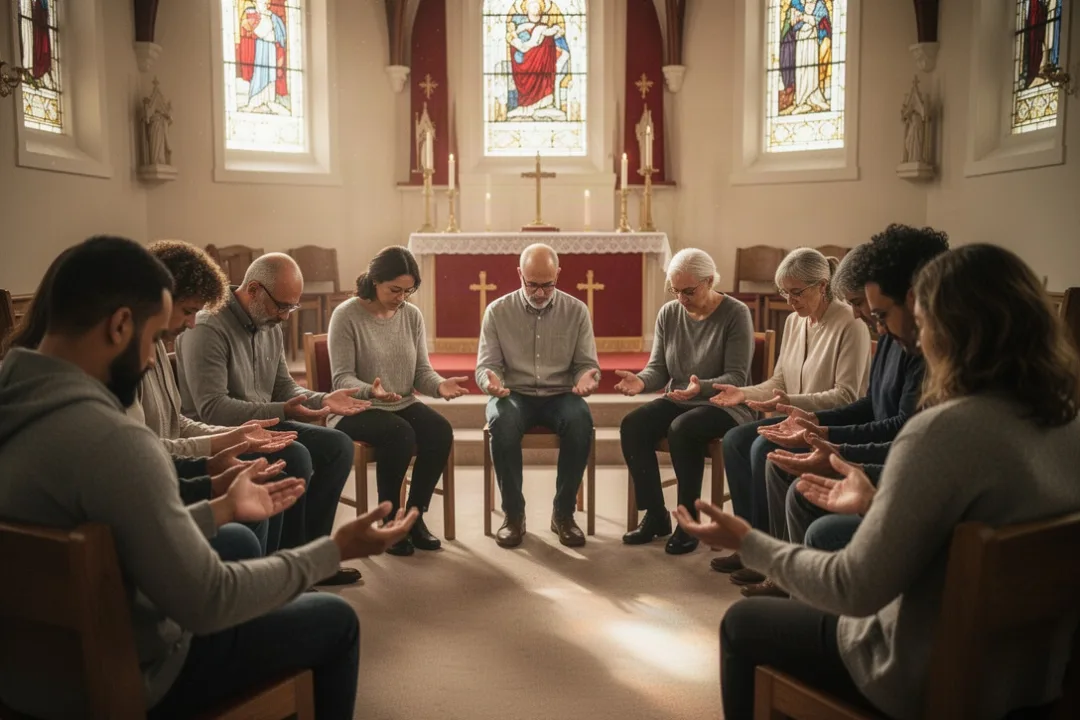
A prayer vigil may last an hour or continue through several scheduled periods. It can be held in a church, home, outdoor setting, or online gathering. The atmosphere does not need to be elaborate; a quiet room, a Bible, a candle, and a clear schedule may be enough.
Begin by explaining the purpose and length of the vigil. Participants should know when they may pray aloud, when silence will be observed, and how to leave or take a break. People who are new to prayer gatherings often participate more freely when expectations are simple and clear.
Gathering: Welcome people and name the intention of the vigil.
Adoration: Thank God for creation, grace, Jesus, and the Spirit’s work.
Confession: Offer a quiet period for honesty and repentance.
Scripture reflection: Read or paraphrase a passage related to the Spirit, then allow silence.
Intercession: Pray for the church, the world, local needs, families, and people in distress.
Personal response: Invite participants to write a prayer or choose a practical act of service.
Sending: Pray for courage to carry the Spirit’s work into daily life.
If prayer becomes emotional, avoid pressuring anyone to speak or display a particular response. A healthy vigil makes room for quiet faith, tears, uncertainty, joy, and thoughtful reflection. The value of the gathering does not depend on dramatic experiences.
Prayers for children on Pentecost
Children can understand Pentecost through simple ideas: God is near, the Holy Spirit helps us, people can share good news, and the church includes people from many places. Use short sentences and concrete examples rather than expecting children to understand every theological term at once.
A child-friendly prayer might say: “God, thank you for loving us. Holy Spirit, help us be brave, kind, patient, and ready to help. Teach us to welcome people and listen to their stories. Help our church share your love. Amen.”
After praying, ask open questions such as, “When might someone need courage?” or “How can we welcome someone who feels new?” Let children draw a picture, name a person to pray for, or choose a small act of kindness. These activities connect Pentecost prayer with lived faith instead of treating the celebration as only a lesson to memorize.
How to continue Pentecost prayer after the feast
Pentecost does not have to remain a single day on the calendar. You can continue the practice by choosing one short prayer for each day of the following week. Use a different focus each day: presence, repentance, wisdom, courage, unity, service, and gratitude.
A simple weekly rhythm might look like this:
Sunday: Welcome the Holy Spirit and pray for your worshiping community.
Monday: Ask for wisdom in work, school, parenting, or other responsibilities.
Tuesday: Pray for courage to address one difficult or neglected matter.
Wednesday: Pray for reconciliation in a relationship or community.
Thursday: Pray for someone who is sick, grieving, lonely, or under pressure.
Friday: Ask how your time, money, or abilities can serve another person.
Saturday: Give thanks and review where you noticed grace during the week.
Keep a small record of prayers and responses, but do not treat it as a way to measure spiritual performance. The purpose is to notice patterns: where you are growing, where you remain resistant, and where practical obedience is needed. Return to the central request often: “Holy Spirit, form my life for love and service.”
Questions to bring into Pentecost prayer
Good prayer sometimes begins with a question rather than a polished speech. Sit with one or two of these prompts and answer honestly before God:
Where have I become spiritually numb or overly self-reliant?
What fear is limiting my ability to love or serve?
Which relationship needs patience, truth, forgiveness, or a boundary?
What gift or responsibility am I avoiding?
Whose experience or language have I failed to understand?
Where might God be asking me to listen before I act?
What practical step would make my prayer visible this week?
There may be no immediate answer. Silence can be part of prayer, and uncertainty does not mean that prayer has failed. Return to what is clear: pursue love, tell the truth, seek wisdom, care for vulnerable people, and remain willing to be changed.
How to write your own Pentecost prayer
Personal prayers often become more meaningful when they name a real situation. Start by addressing God, then describe what is happening without disguising your feelings. Ask for the specific help you need, remember the needs of others, and finish by offering one response you are willing to make.
Use this pattern as a guide:
Address: Name God as loving, holy, merciful, wise, or faithful.
Recognize: Acknowledge the Holy Spirit’s work in the church and in human lives.
Tell the truth: Name your fear, need, gratitude, confusion, or hope.
Request: Ask clearly for wisdom, strength, healing, reconciliation, or courage.
Release: Entrust the outcome to God rather than demanding a particular result.
Respond: Offer a concrete action that reflects what you have prayed.
For example, someone facing conflict at work might write: “Holy Spirit, help me speak truth without humiliating anyone. Give me wisdom to understand what I do not know, courage to address the problem, and patience to listen. Show me one action that promotes fairness today.” Specific language makes prayer easier to carry into real decisions.
The most useful Pentecost prayer is not necessarily the longest or most eloquent. It is a prayer that turns your attention toward God, makes room for transformation, and helps you become more available to love, truth, courage, and service.
Frequently asked questions
Can I pray Pentecost prayers if I am not attending a church service?
Yes. You can pray at home, outdoors, with family, or with a small group. Read or reflect on Acts 2, sit quietly, and ask the Holy Spirit to renew your faith and guide your actions. A church service can add shared worship, but Pentecost prayer does not depend on being in a particular building or following a specific format.
What should I ask the Holy Spirit for during Pentecost?
Ask for what will help you faithfully love God and other people, such as wisdom, courage, patience, compassion, self-control, or strength to serve. You can also pray for healing, unity, guidance, and a deeper ability to recognize truth. Make the request specific to your current situation rather than trying to name every possible need.
How long should a Pentecost prayer be?
There is no required length. A prayer of two or three sentences can be sincere and meaningful, while a longer service or vigil may include several prayers and periods of silence. Choose a length that helps you pay attention rather than one that creates pressure. Quiet reflection afterward can be as valuable as the spoken words.
Is Pentecost prayer only for Christians who speak publicly about their faith?
No. Pentecost prayer is also for people seeking renewal, wisdom, faithful relationships, and strength for ordinary responsibilities. Speaking publicly is one form of witness, but listening, caring for others, practicing honesty, and serving quietly can also express faith. You can ask for the kind of courage and service that fits your circumstances.













Leave a Reply