If you have opened a prayer book and found several ribbons, changing psalms, and unfamiliar headings, you may be wondering which Liturgy of Hours book you actually need. The answer depends mainly on how often you want to pray, which hours you want to include, and whether you need the full Catholic office or a shorter version.
For most people in the United States, the practical choices are the four-volume Liturgy of the Hours, the one-volume Christian Prayer, or the shorter Shorter Christian Prayer. Each contains official or approved forms of daily prayer, but they differ in size, coverage, seasonal material, and ease of use.
The Liturgy of the Hours is the Church’s structured prayer throughout the day. It combines psalms, Scripture readings, hymns, intercessions, and prayers so that personal prayer follows the rhythm of the liturgical year rather than relying entirely on spontaneous choice.
A printed book usually includes several parts for each prayer hour. The opening elements often include an invitation to prayer, a hymn, and a psalmody. Later sections may provide a Scripture reading, a responsory, a canticle, intercessions, the Lord’s Prayer, and a concluding prayer.
The exact arrangement depends on the hour. Morning Prayer and Evening Prayer are the principal hours and generally receive the most attention. The Office of Readings offers longer biblical and spiritual readings, while Daytime Prayer and Night Prayer are shorter and easier to fit around work, travel, or family responsibilities.
The basic choice: Choose a full four-volume set if you want the complete Roman Catholic office. Choose Christian Prayer if you primarily want Morning Prayer and Evening Prayer in a manageable single book.
Which Liturgy of Hours book is right for your routine?
Your ideal book should match your actual prayer routine, not an imagined schedule. A large, complete set can be an excellent choice, but it may remain unused if you mainly want ten or fifteen minutes of prayer before work. A smaller volume can be more helpful when it is easy to keep nearby and open every day.
The four-volume Liturgy of the Hours
The four-volume set is the most comprehensive common Catholic edition in English. It covers the entire liturgical year and includes the full cycle of the principal hours, daytime hours, Night Prayer, and the Office of Readings, along with the proper prayers for Sundays, weekdays, solemnities, feasts, memorials, and saints.
The volumes are arranged by seasons and weeks rather than being a single compact book. One volume generally covers Advent and Christmas, another covers Lent and Easter, and the remaining volumes cover the weeks of Ordinary Time. The precise volume titles and publication details can vary by edition.
This option works well if you want to pray several hours each day, follow the full calendar, or participate in parish, religious community, or clergy prayer. It also gives you access to material that shorter books omit, including the complete Office of Readings and more extensive daytime prayer.
Best for: daily use of multiple hours and close participation in the complete office.
Advantages: broad coverage, seasonal completeness, and access to the full range of prayers.
Limitations: higher cost, more shelf space, and a steeper learning curve.
Christian Prayer
Christian Prayer is a one-volume edition designed especially for Morning Prayer and Evening Prayer. It includes the principal daily structure in a format that is less intimidating than the four-volume set. It also contains Night Prayer and selected material for the liturgical seasons and major celebrations.
Because it is compact, this book is often a sensible starting point for someone who wants a regular habit without managing several volumes. It can also suit people who have prayed the office before but now want a durable print edition for home, a desk, or a travel bag.
The trade-off is that a single volume cannot contain everything found in the complete set. You may find fewer options for certain hours, less extensive saint material, or limitations around the full Office of Readings. Check the contents page before buying if a particular hour matters to you.
Shorter Christian Prayer
Shorter Christian Prayer offers a more condensed form of the office. It is aimed at readers who want a simple daily pattern, especially Morning Prayer, Evening Prayer, and Night Prayer, without the size and navigation demands of a complete breviary.
Its smaller format makes it convenient for beginners, travelers, and people with limited time. It is also useful when a consistent short prayer routine matters more than having every liturgical option available. The reduced selection means that it is not a substitute for the complete four-volume set when full coverage is your goal.
Other Christian and Anglican daily office books
Not every daily office book belongs to the Roman Catholic Liturgy of the Hours. Anglican, Episcopal, Lutheran, Orthodox, and other Christian traditions publish their own forms of daily prayer. They may use similar elements—psalms, readings, canticles, and collects—but their calendars, translations, and arrangements can differ substantially.
Before purchasing, identify the tradition you want to follow. A book described as a “daily office” may be excellent for its intended church but not correspond to the Roman Catholic calendar or structure you expected.
How the daily hours fit together
You do not have to pray every hour to begin. The Church’s daily office is extensive, but many lay readers establish a sustainable rhythm by starting with one or two principal hours. Understanding the purpose of each hour helps you choose a book and decide what to use.
Morning Prayer
Morning Prayer marks the beginning of the day with praise and thanksgiving. Its central structure normally includes psalms or other biblical songs, a short Scripture reading, a Gospel canticle, intercessions, and a concluding prayer.
This hour is a good fit if you want to pray before checking messages, leaving home, or beginning work. It usually takes longer than Night Prayer but can become a stable anchor for the day when you pray at roughly the same time.
Evening Prayer
Evening Prayer gives the day a deliberate pause. It recalls God’s faithfulness, offers the day’s work and concerns, and turns attention toward rest. Like Morning Prayer, it includes psalmody, Scripture, a canticle, intercessions, and a concluding prayer.
Many people find this hour easier to maintain than a morning routine because it can follow dinner, the end of work, or a regular evening transition. If you are choosing just one principal hour, either Morning Prayer or Evening Prayer can serve as a meaningful starting point.
Daytime Prayer
Daytime Prayer is shorter and traditionally connected with the middle portions of the day. The full office includes options associated with different times, while shorter editions may combine or simplify them. This prayer can help break up a busy schedule with a brief period of Scripture and psalmody.
It is particularly practical for people who have a dependable lunch break, commute, or midday pause. You can pray it quietly at home, in an office, or in another suitable place where a few minutes of concentration are possible.
The Office of Readings
The Office of Readings provides a longer period of biblical and spiritual reading. Along with psalms, it includes a substantial reading from Scripture and another reading drawn from Christian writers, Church documents, or the lives and teachings of saints.
This hour is valuable when you want extended spiritual reading rather than only a short daily prayer. Depending on the edition, it may be difficult to access in a one-volume book, so readers who want it regularly usually choose the complete set or an approved digital resource.
Night Prayer
Night Prayer is a brief office for the end of the day. It includes an examination of conscience, psalmody, a short reading, a canticle, and a prayer for protection and rest. Its quiet structure makes it suitable for people who are too tired for a longer office but still want to end the day intentionally.
Because it is short and relatively consistent, Night Prayer can be an approachable first step. It also works well alongside Morning Prayer or Evening Prayer as your routine develops.
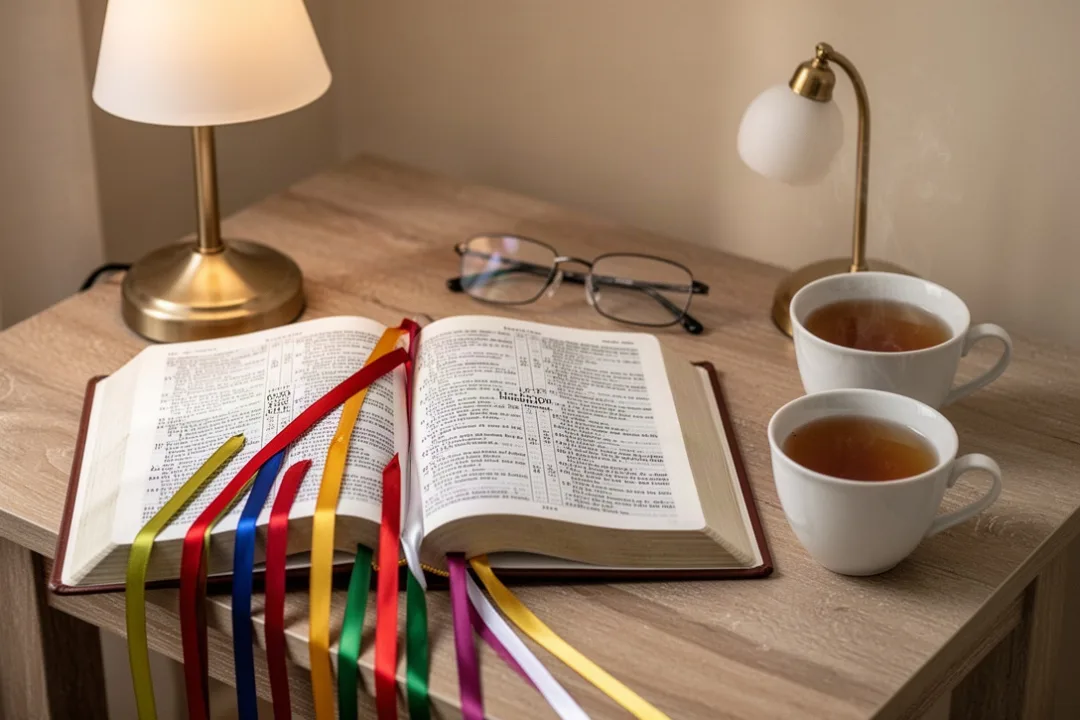
A Liturgy of Hours book is not read straight through from the first page to the last. It is assembled from several sections, and the page sequence changes according to the date, weekday, season, and celebration. This is why ribbons and bookmarks are so useful.
Most editions use recurring sections such as the Ordinary, the Psalter, the Proper of Seasons, the Proper of Saints, and the Commons. The Ordinary provides the fixed outline of an hour. The Psalter supplies the recurring four-week cycle of psalms, while the seasonal and saint sections provide material specific to the day.
Start by checking the calendar for the date. Then identify the liturgical season and the day of the week. The calendar or table of contents will help you determine whether a saint’s memorial, feast, solemnity, or another celebration changes the normal weekday office.
Find the date and celebration. Check the calendar near the front or in the appropriate seasonal section.
Locate the correct week of the Psalter. The four-week psalter cycle usually determines the main psalmody for the day.
Open the Ordinary. Use it to follow the repeated structure of the chosen hour.
Check the Proper of Seasons or Saints. These pages may replace or add to the ordinary weekday material.
Return to the Ordinary for the ending. The final prayers and responses may be printed there rather than in the daily section.
At first, you may need several bookmarks: one for the Ordinary, one for the Psalter, one for the current seasonal page, and one for the saint or feast being observed. With regular use, the movement among these sections becomes familiar.
Helpful habit: Prepare the next day’s pages before going to bed. A few minutes of setup can remove much of the hesitation that makes a printed breviary feel difficult.
What to check before buying a Liturgy of Hours book
Book listings can be vague, especially when sellers use “breviary,” “daily office,” and “Liturgy of the Hours” interchangeably. Read the description carefully and confirm the edition, language, publisher, and contents before placing an order.
Edition and tradition: Confirm that it follows the Roman Catholic Liturgy of the Hours if that is your intention.
Coverage: Check whether it includes all hours or mainly Morning Prayer, Evening Prayer, and Night Prayer.
Liturgical calendar: Make sure the calendar corresponds to the region and church calendar you plan to follow.
Translation: Compare the wording with the translation used by your parish or prayer group when consistency matters.
Physical format: Consider page size, print size, binding, paper quality, and whether the book is comfortable to hold.
Accessories: Ribbons, a sturdy cover, and a clear page layout can make daily use considerably easier.
Condition: For a used set, inspect missing pages, writing, loose signatures, damaged bindings, and the condition of the ribbons.
A complete set is a substantial purchase, so buying one volume at a time can be practical if you are testing the format. However, volumes from different printings or editions may not match perfectly. If you expect to expand later, verify that the set remains available and that the volumes belong to the same edition.
Common mistakes when starting the daily office
The most frequent problems are not failures of prayer. They are practical misunderstandings about the book. A few simple adjustments can make the experience calmer and more consistent.
Trying to use every hour immediately: Begin with one principal hour, then add another after the first routine feels stable.
Assuming the book reads in page order: Expect to move among the Ordinary, Psalter, seasonal material, and saint sections.
Skipping the calendar: A memorial or feast can change the prayers, readings, and psalmody for the day.
Buying the largest set by default: Choose the book that matches your intended use rather than your idealized schedule.
Getting discouraged by unfamiliar terms: Learn one section at a time and use the table of contents or an instruction guide.
Treating a missed hour as a reason to quit: Resume at the next suitable hour instead of trying to recreate every missed prayer.
Ignoring comfort: Small print, a heavy binding, or poor lighting can make a good book hard to use regularly.
Some readers also try to force the office into a rigid timetable. The hours have traditional times, but ordinary life includes work, caregiving, transportation, and changing responsibilities. A flexible, respectful routine is generally more sustainable than abandoning prayer because the ideal time has passed.
Printed books and digital Liturgy of Hours options
A printed book gives you a tangible, screen-free way to pray. It does not require a battery or notifications, and many readers value the physical sense of returning to the same pages each day. A well-used volume can also serve as a visible reminder of prayer in your home.
Digital resources can simplify navigation. They may automatically provide the correct date, season, psalmody, readings, and saint material, reducing the need to manage multiple ribbons. They are especially useful when you are learning the structure or traveling without a full set of books.
The choice is not necessarily either-or. You might use a digital resource to learn the order of an hour and a printed book for regular prayer. If you use an app or website, verify that it follows the calendar and approved text appropriate to your tradition and location.
Screen-based prayer has its own challenges. Incoming messages, low battery, and the temptation to switch applications can interrupt attention. A printed book has different obstacles, especially navigation, but some people find that those small physical actions help them slow down.
How to begin with your first Liturgy of Hours book
Start by choosing a realistic prayer point. Morning Prayer after waking, Evening Prayer before dinner, or Night Prayer before sleep are all reasonable choices. Give yourself enough time to learn the book without expecting perfect speed or flawless page turns.
For the first several days, use the same hour and write down the pages you need. If the book has an instruction section, read it before attempting the full office. You can also follow along with someone experienced in the prayer, attend a parish celebration, or use a reliable guide that explains the day’s page sequence.
It is acceptable to pause and look up a direction. The structure is meant to support prayer, not test your ability to memorize a complicated system. Over time, the repeated elements—the opening, psalmody, canticle, intercessions, and closing—will become familiar.
A simple starting pattern might look like this:
Use Night Prayer for several days if you want the shortest entry point.
Move to Morning Prayer or Evening Prayer when you are ready for a fuller office.
Add the other principal hour only after the first one fits comfortably into your schedule.
Explore Daytime Prayer or the Office of Readings if you want more frequent or extended prayer.
Do not measure the value of the office only by how much material you complete. The repeated return to psalms, Scripture, praise, repentance, thanksgiving, and intercession is central to its purpose. A smaller edition used faithfully can serve you better than a complete set left untouched.
Where to find help with a confusing page sequence
If you are unsure which pages to use, begin with the book’s instructions rather than guessing. Many editions include directions for Sundays, weekdays, solemnities, feasts, memorials, and the use of the psalter. The calendar is often the most reliable first reference for the date.
A parish, religious community, or prayer group may also provide practical guidance. Someone who already uses the same edition can show you how to set the ribbons and identify the sections in a few minutes. This kind of hands-on help is often more useful than reading several explanations at once.
When using online guides, confirm that they match your exact edition. Page numbers differ between books, and a guide prepared for a full four-volume set may not apply to Christian Prayer or Shorter Christian Prayer. The wording of a prayer may also differ between translations.
Once the basic pattern is clear, keep the process simple: find the date, locate the psalter week, open the Ordinary, and follow the directions for the celebration. The book becomes easier to use through repetition rather than through trying to master every section before you begin.
Frequently asked questions
Do I need all four volumes to pray the Liturgy of the Hours?
No. The four-volume set is the fullest Roman Catholic option, but many laypeople begin with Christian Prayer or Shorter Christian Prayer. Those editions focus on the principal hours and selected additional prayers. Your choice should reflect the hours you realistically plan to pray, not a requirement that every reader own the complete set.
Is a breviary the same thing as a Liturgy of the Hours book?
“Breviary” is a broad term for a book used for the Church’s daily office. In common Catholic usage, it can refer to the Liturgy of the Hours, but publishers may use the word for different editions or traditions. Check the contents and calendar to confirm that a particular book matches the form of prayer you want.
Can lay Catholics pray the Liturgy of the Hours?
Yes. The office is public prayer of the Church, and lay Catholics may pray it privately or with others. You do not need to be ordained or a member of a religious community. Many laypeople choose Morning Prayer, Evening Prayer, or Night Prayer as a manageable way to share in the Church’s daily rhythm.
How long does praying one hour usually take?
The time varies by edition, pace, and the hour selected. Night Prayer is generally brief, while Morning Prayer and Evening Prayer take longer because they include more elements. Reading instructions, finding pages, and reflecting quietly can add time. After you become familiar with the book, the same office usually becomes easier to complete.















Leave a Reply