You may be reading the Book of Ezra because you want to understand what happened after Judah’s exile, or because its account of rebuilding seems difficult to follow. The book answers that question through a focused story: God brings the exiles home, the returned community rebuilds the temple in Jerusalem, and Ezra later works to restore faithful life around the law.
Ezra is not mainly a story about an easy homecoming. The people face opposition, administrative delays, discouragement, internal problems, and painful decisions. Its central message is that restoration involves more than repairing a building. It requires renewed worship, attention to God’s word, responsible leadership, and a community willing to deal honestly with its failures.
The Book of Ezra describes events following the Babylonian exile, when the Persian Empire allowed Jewish exiles to return to Judah. Babylon had destroyed Jerusalem and its temple, but the Persian king Cyrus permitted displaced peoples to return to their lands and restore their sanctuaries. For the Judeans, this policy opened the way back to Jerusalem.
The book follows two major returns. The first group comes under the leadership of Sheshbazzar and Zerubbabel and begins rebuilding the temple. The second comes decades later with Ezra, a priest and scribe who teaches the law and confronts serious problems within the community.
These two movements give the book its basic shape:
Ezra 1–6: the return from exile and the rebuilding of the temple.
Ezra 7–10: Ezra’s journey to Jerusalem, his teaching ministry, and the community’s response to intermarriage.
The temple is completed before Ezra arrives, so the book does not present him as the leader of the original construction project. His task is different. Zerubbabel leads the physical restoration, while Ezra leads a spiritual and communal restoration centered on the law of Moses.
Central idea: Ezra presents restoration as a process. Returning to a place is only the beginning; the community must also rebuild worship, identity, obedience, and shared responsibility.
Where Ezra fits in Israel’s history
Ezra begins after a long period of judgment and displacement. The kingdom of Judah had fallen to Babylon, Jerusalem had been captured, and the temple had been destroyed. Many Judeans were taken into exile, where they lived under foreign rule rather than as an independent kingdom.
The political situation changed when Persia defeated Babylon. Cyrus became the dominant ruler and adopted policies that allowed certain displaced peoples to return and restore local religious centers. Ezra presents Cyrus’s decision as more than a political act: God moves the Persian king to fulfill the promise of restoration.
The story takes place within the Persian period, not immediately after the destruction of Jerusalem. The first return and the temple rebuilding occur under Cyrus and Darius. Ezra’s own arrival occurs later, during the reign of an Artaxerxes. The precise dating of Ezra’s mission is discussed by scholars, but the book clearly presents a significant gap between the temple’s completion and Ezra’s arrival.
This historical setting helps explain why the returned Judeans face practical obstacles. They are not returning to an empty, untouched city. They are rebuilding among neighboring populations, within an imperial system, and under leaders who must obtain official permission for major projects. Their community has to establish itself while remaining subject to Persian authority.
How the first return and temple rebuilding unfold
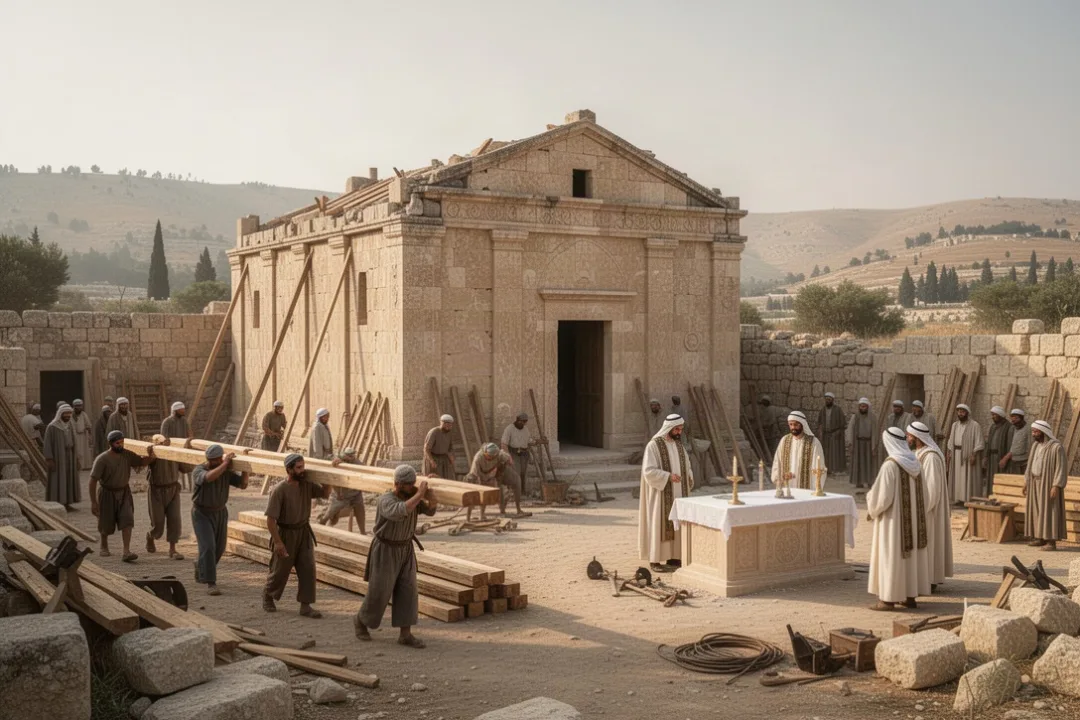
At the beginning of the book, Cyrus authorizes the return of Judean exiles and the rebuilding of the temple in Jerusalem. The people receive sacred vessels that Babylon had taken from the former temple. Their return is therefore connected not only with land but also with the recovery of worship.
Zerubbabel and Jeshua, the priestly leader, organize the returning community. One of their earliest actions is to restore the altar and begin sacrifices. The altar comes before the temple structure is finished, showing that worship is central to the restoration rather than a final decoration added after construction.
The community then lays the foundation of the temple. The response is mixed. Some people rejoice because they can see the beginning of a new sanctuary. Others, especially older people who remember Solomon’s temple, weep because the new beginning appears modest compared with what was lost.
This scene captures a recurring tension in Ezra: new work can be genuinely good while still feeling smaller than the past. The returned community is not told to pretend that loss never happened. Celebration and grief exist together as the people begin again.
Opposition appears when local groups offer to help with the construction. The leaders of the returned community refuse the offer, explaining that the temple has been authorized for the Judeans to rebuild. The text then describes resistance, discouragement, accusations, and attempts to interfere with the work.
The passage in Ezra 4 can be difficult because it gathers several episodes of opposition across different Persian reigns. Some material concerns the temple, while another letter concerns the rebuilding of Jerusalem’s walls and city defenses. The chapter is not written as a simple year-by-year sequence. It presents a broader pattern: the restoration project repeatedly encounters political resistance.
Opponents accuse the Judeans of planning rebellion and portray Jerusalem as a historically dangerous city. Their goal is to persuade Persian officials that the rebuilding should stop. For a small community dependent on imperial permission, such accusations could have serious consequences.
The work eventually stops for a period. Discouragement is reinforced by official pressure, but the prophets Haggai and Zechariah challenge the leaders and the people to resume construction. Their preaching helps restore courage and focus.
When the work begins again, Persian officials investigate. The Judean leaders explain that Cyrus had authorized the temple’s rebuilding. Darius searches the royal records, confirms Cyrus’s decree, and orders that the project be allowed to continue. He also directs local authorities not to interfere and to provide support from imperial resources.
The temple is completed in the sixth year of Darius’s reign. The people dedicate it with sacrifices and observe Passover. The sequence matters: the restored temple becomes a place of worship, but its dedication also reconnects the community with Israel’s historic calendar and covenant story.
What the Book of Ezra teaches about worship
Worship in Ezra is practical, public, and ordered around the temple. The people rebuild the altar, restore sacrifices, appoint priests and Levites, and observe festivals. These actions demonstrate that the return from exile is understood as a return to covenant life rather than merely a change of residence.
The temple also represents God’s continuing presence among the people. Its rebuilding declares that the disaster of exile did not mean God had abandoned his purposes. Yet Ezra does not treat the building as magical protection. The community’s history shows that a temple by itself cannot guarantee faithfulness.
The book connects worship with holiness, obedience, and communal identity. The people must live as a distinct community shaped by the law. This connection becomes especially prominent when Ezra arrives and learns about intermarriage with surrounding peoples.
Ezra’s worship is also communal. Leaders, families, priests, Levites, singers, gatekeepers, and ordinary members all appear in the account. Lists of names may seem repetitive, but they emphasize that restoration depends on identifiable people accepting particular responsibilities.
Who Ezra was and why his role mattered
Ezra is introduced as a priest descended from Aaron and as a scribe skilled in the law of Moses. He travels from Babylon to Jerusalem with official authorization from the Persian king. His mission includes teaching the law, appointing judges, and helping the community practice justice and religious faithfulness.
Ezra’s authority comes from several sources. He belongs to the priestly line, he is trained in the law, and he receives permission from the Persian government. More importantly, the book describes him as preparing his heart to study, practice, and teach God’s law. His teaching is meant to be embodied, not merely transmitted as information.
The Persian authorization allows Ezra to collect offerings, appoint officials, and administer justice according to the law. The document shows the complicated position of the Judean community: it is religiously distinctive but politically subject to Persia. Ezra must work within imperial structures while seeking faithfulness to Israel’s tradition.
When Ezra reaches Jerusalem, he does not immediately launch a public program. He first learns about the community’s condition. Leaders tell him that many people, including officials, have entered marriages with surrounding populations. Ezra responds with mourning, prayer, and confession.
His prayer in Ezra 9 identifies the community with the sins of its ancestors and acknowledges that God has shown mercy by allowing a remnant to survive and rebuild. Ezra does not treat the return as proof that the people are now automatically righteous. Grace creates responsibility; the restored community must respond with repentance.
How to understand the intermarriage crisis in Ezra 9–10
The final chapters are among the most difficult parts of the book for modern readers. Ezra discovers marriages between members of the returned community and people from surrounding populations. A proposal is made to separate from these marriages, and a process is established for examining the cases.
The text frames the issue as a threat to the community’s covenant identity and religious faithfulness. It is not simply discussing ethnicity in a modern racial sense. The concern is tied to the danger of adopting practices that conflict with Israel’s worship and law, especially after the exile had been interpreted as judgment for persistent unfaithfulness.
Even with that historical context, the passage contains painful human consequences. The account mentions wives and children, and it does not provide a detailed narrative of every family affected. Readers should resist treating the episode as an easy formula for dealing with relationships today.
The book’s concern is preserving a vulnerable postexilic community whose identity could be absorbed by surrounding religious cultures. At the same time, other biblical passages show that foreigners who turn toward Israel’s God can be welcomed, so the Bible’s treatment of outsiders is broader than a simple ethnic boundary.
Ezra 9–10 should therefore be read carefully, with attention to its postexilic setting, its covenant concerns, and the serious cost of the community’s decision. The passage raises questions about identity, leadership, belonging, and the limits of reform. It should not be used casually to justify hostility toward people from other nations.
How the Book of Ezra relates to Nehemiah
In the Hebrew Bible, Ezra and Nehemiah were traditionally treated as a single work. In many Christian Bibles they appear as two separate books. They share historical concerns, names, themes, and a focus on the restoration of Jerusalem and the community after exile.
Ezra emphasizes the temple, the law, and priestly leadership. Nehemiah gives greater attention to the city walls, civil administration, and the leadership of Nehemiah as governor. The books overlap in their concern for rebuilding both public structures and communal faithfulness.
The relationship between the two books can create chronological questions. Ezra’s arrival is described before Nehemiah’s leadership in the biblical arrangement, but scholars debate how certain episodes should be dated and whether some material is organized thematically rather than strictly chronologically.
That uncertainty does not erase the main message. Together, the books portray restoration as involving several connected tasks:
Reestablishing worship in the temple.
Rebuilding and securing Jerusalem.
Teaching the law to the people.
Organizing priests, Levites, officials, and families.
Addressing behavior that threatens the community’s covenant identity.
Major themes that shape the Book of Ezra
God works through unexpected rulers
Cyrus is a Persian king, not a Judean ruler, yet Ezra describes him as an instrument in God’s plan. Persian decrees, royal archives, and imperial funding all become part of the restoration story. The book does not suggest that Persia has become Israel; it shows that God’s purposes are not limited to familiar religious leaders.
Restoration requires perseverance
The temple project does not move forward without interruption. The people face opposition, official delays, and discouragement. Ezra presents perseverance not as a personality trait possessed by a few heroic individuals but as a communal response supported by prophets, leaders, records, and renewed trust.
God’s word guides communal life
Ezra’s distinctive contribution is his commitment to study, practice, and teach the law. The law is not presented merely as a private source of comfort. It guides worship, leadership, justice, identity, and decisions about how the restored community should live.
Lists preserve memory and responsibility
Ezra includes long lists of families, priests, Levites, temple servants, and returning exiles. These records establish who came back, who could serve, and how the restored community understood its continuity with the past. The lists also communicate that ordinary names matter in the work of restoration.
Repentance is communal
Ezra’s confession identifies him with the people’s wrongdoing even when he is not described as personally participating in every offense. This representative approach shows that community leaders may confess and address shared failures rather than blaming only individuals at the margins.
Several approaches can make Ezra harder to understand or lead to conclusions the book itself does not support. These practical guidelines help keep the reading grounded in its historical and literary setting.
Do not assume the book is strictly chronological. Ezra 4 includes material from different periods and should be read with attention to shifts in rulers and events.
Do not reduce Ezra to a construction story. The temple matters, but the book also focuses on worship, teaching, identity, leadership, and repentance.
Do not treat every Persian policy as accidental background. Royal decrees and records are part of the book’s argument that God can work through political institutions.
Do not skip the lists automatically. They explain how the returning community was organized and why recognized families and religious roles mattered.
Do not apply Ezra 9–10 without historical care. The intermarriage crisis arises in a specific postexilic setting and should not be turned into a general command for ethnic separation.
Do not confuse Ezra with the leader who began the temple rebuilding. Zerubbabel and Jeshua lead the initial return and construction; Ezra arrives later with a teaching and reforming mission.
Do not mistake external success for complete spiritual restoration. The temple is rebuilt, yet the community still faces serious internal problems.
Reading tip: Keep a simple timeline beside you: the exile and return under Cyrus, the temple’s completion under Darius, and Ezra’s later arrival under an Artaxerxes. This prevents the book’s shifts in time from becoming confusing.
What the Book of Ezra can mean for readers today
Ezra speaks to people rebuilding after disruption. Its community is not returning to normal; the old city, temple, leadership structures, and national independence are gone or changed. The people have to decide what faithfulness looks like in a reduced and unfamiliar setting.
The book offers a realistic picture of beginnings. A foundation can be laid while grief remains. A project can be authorized and still face resistance. A community can experience genuine renewal and still discover serious problems within itself. Progress and unfinished work appear together throughout Ezra.
Its treatment of leadership also remains relevant. Zerubbabel, Jeshua, the prophets, and Ezra have different roles. No single leader performs every task. Restoration depends on people who build, teach, worship, organize, investigate, encourage, and accept responsibility.
Ezra further challenges readers to connect belief with practice. Ezra is praised not only for knowing the law but for preparing himself to practice and teach it. Knowledge that never shapes conduct is not the kind of wisdom the book commends.
The book also encourages careful reflection about community boundaries. Every community needs convictions and practices that define its identity, but Ezra’s difficult final chapters warn against shallow readings. Questions about belonging should be handled with historical understanding, moral seriousness, and attention to the wider biblical witness.
A practical way to read the Book of Ezra
Reading Ezra in sections can make its structure easier to follow. Start by identifying the leaders, the Persian rulers, and the main project in each part. Then ask what kind of restoration is taking place: physical, religious, social, or moral.
Read Ezra 1–2 as the opening of the return and pay attention to the royal decree, the temple vessels, and the list of returning families.
Read Ezra 3 for the restoration of the altar, the beginning of worship, and the mixed response to the temple foundation.
Read Ezra 4–6 while tracking opposition, prophetic encouragement, Persian investigation, and the temple’s completion.
Read Ezra 7–8 as the account of Ezra’s mission, his authority, the journey to Jerusalem, and the organization of the returning group.
Read Ezra 9–10 slowly, considering the historical setting and the ethical difficulty of the community’s response.
As you read, notice repeated ideas such as the hand of God, royal authorization, the law, the remnant, worship, and separation from practices understood to threaten covenant faithfulness. These repetitions connect the book’s historical events to its theological interpretation.
The Book of Ezra ultimately presents a community learning how to live after catastrophe. Its restoration is real but incomplete, joyful but painful, and dependent on both divine providence and human responsibility. The temple can be rebuilt in a generation, but a faithful community must be formed through teaching, worship, repentance, and sustained attention to God’s purposes.
Frequently asked questions
Who wrote the Book of Ezra?
Jewish and Christian tradition has often associated the book with Ezra, especially because large portions are written in the first person and describe his actions. Modern scholars generally understand Ezra as part of a larger historical work that was compiled and edited from lists, records, letters, and personal memoirs. The exact process and final author cannot be established with certainty.
How many chapters are in the Book of Ezra?
The Book of Ezra has 10 chapters. The first six describe the return under Zerubbabel and the rebuilding of the temple. The final four focus on Ezra’s arrival in Jerusalem, his teaching ministry, his prayer of confession, and the community’s response to marriages viewed as threatening its covenant identity.
Why does Ezra include Persian letters and official records?
The documents show how the Judean restoration operated within the Persian Empire. They also support the book’s claim that the temple project had legitimate authorization and that God worked through political rulers. The letters give the narrative an administrative setting rather than presenting restoration as an isolated religious event.
What is the main message of Ezra?
Ezra teaches that God can restore a community after judgment and displacement, often through unexpected political circumstances. It also shows that restoration requires more than returning home or rebuilding a sacred building. The people must renew worship, follow the law, accept responsible leadership, and confront practices that threaten their understanding of covenant faithfulness.













Leave a Reply