Nehemiah: leadership, faith, and rebuilding what was broken
Nehemiah: leadership, faith, and rebuilding what was broken
When a responsibility has been neglected for years, you may wonder where to begin: repair the damage, gather help, or first understand what went wrong. The biblical account of Nehemiah speaks directly to that situation. He saw the ruined walls of Jerusalem, grieved over the city’s condition, prayed, made a plan, and led a difficult rebuilding effort.
Nehemiah is remembered not simply as a construction organizer. He was a praying leader, a skilled administrator, a protector of vulnerable people, and a person willing to confront corruption. His story shows how spiritual conviction can become practical action without losing patience, humility, or moral clarity.
Nehemiah was a Jewish official serving as a cupbearer to the Persian king. A cupbearer was not merely a servant who carried drinks. The position required trust, discretion, and regular access to the royal court, so Nehemiah held a role of considerable responsibility.
He lived in the Persian period, probably during the fifth century BCE, after Babylon had conquered Jerusalem and destroyed much of the city. Many Jewish people had returned from exile, but Jerusalem remained vulnerable. Its walls were broken, its gates had been burned, and the community faced shame, danger, and internal hardship.
The Book of Nehemiah, which follows the Book of Ezra in the Christian Old Testament, describes his return to Jerusalem and his work as governor. The book focuses on rebuilding the walls, organizing the population, addressing injustice, renewing the covenant, and protecting the community’s worship and identity.
The account is also connected with Ezra, a priest and teacher of the Law. Ezra emphasizes instruction and religious reform, while Nehemiah often appears as the practical organizer who secures resources, coordinates labor, inspects defenses, and enforces reforms. Together, the two accounts present restoration as both a spiritual and community-wide task.
Central idea: Nehemiah’s leadership begins with honest grief, moves through prayer and careful planning, and produces concrete work that serves other people.
What happened in the Book of Nehemiah
The book can be understood as a sequence of connected movements rather than as a collection of unrelated events. Nehemiah’s work develops through a pattern of burden, permission, inspection, construction, resistance, reform, and renewed dedication.
Nehemiah hears about Jerusalem. Visitors tell him that the city’s walls remain broken and its gates destroyed. The people who live there are exposed and humiliated.
He mourns and prays. Nehemiah confesses the community’s failures, recalls God’s promises, and asks for favor before the Persian king.
He requests permission to return. The king notices his sadness and asks what he wants. Nehemiah asks for authorization, letters of passage, and materials for the project.
He inspects the damage privately. After arriving in Jerusalem, he surveys the walls at night before announcing the full plan. This gives him firsthand knowledge and prevents premature claims.
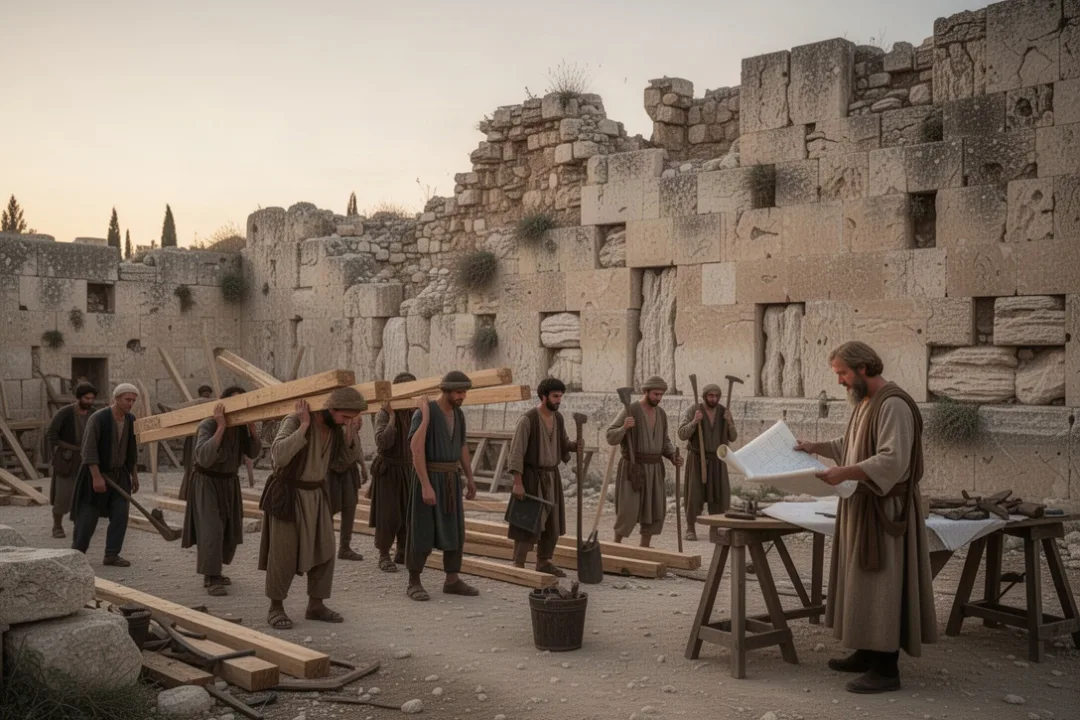
The people begin rebuilding. Families, priests, craftsmen, merchants, and local leaders repair different sections. The work becomes a shared civic responsibility.
Opposition increases. Local adversaries mock the project, threaten violence, spread accusations, and attempt to lure Nehemiah away from his assignment.
The community protects itself while working. Builders carry tools, remain alert, and organize guards. Construction continues without ignoring genuine danger.
Nehemiah confronts economic injustice. Wealthier Jews have been charging interest and taking property or family members as security. Nehemiah demands restitution and models generosity.
The wall is completed. The finished defenses strengthen Jerusalem’s security and become a visible sign that the community can act together.
The people renew their commitment. Ezra reads the Law, the people confess their sins, and the community makes formal commitments concerning worship, Sabbath observance, marriage, and temple support.
This sequence matters because the wall is never treated as the entire solution. Physical restoration creates stability, but ethical reform and faithful community life are necessary if the restoration is to endure.
How Nehemiah responded when he heard bad news
Nehemiah’s first response to Jerusalem’s condition was not a speech, a political maneuver, or an immediate trip. He sat down, wept, mourned, fasted, and prayed. His emotional response shows that serious leadership begins with truthful attention to suffering rather than with the desire to appear capable.
His prayer in Nehemiah 1 includes several recognizable elements. He addresses God with reverence, acknowledges the community’s disobedience, remembers the covenant, and asks for help with the conversation he expects to have with the king. The prayer is personal, but it does not reduce the crisis to his private feelings.
Nehemiah identifies himself with the people’s failure even though the text does not present him as the person who caused Jerusalem’s ruin. That posture demonstrates solidarity instead of blame-shifting. He does not say that the problem belongs only to distant officials, previous generations, or people less faithful than himself.
His example does not mean that every difficult situation requires prolonged sadness before action. It does suggest that rushing to solutions can produce shallow plans. Grief helps you see the human cost of a problem, while prayer helps place the work within a larger moral and spiritual framework.
How Nehemiah turned a burden into a practical plan
Nehemiah’s prayer was followed by preparation. When the king asked why he was sad, Nehemiah answered carefully and then made specific requests. He asked to be sent to Judah, received letters that would help him travel safely, and obtained a letter requesting timber for the gates and other parts of the project.
This combination of dependence on God and detailed planning is one of the clearest features of the book. Nehemiah does not treat planning as a substitute for faith. He treats it as one way faith becomes responsible action.
His approach offers a useful model for any major repair effort:
Define the actual problem. “The city is struggling” is too broad to guide action. Nehemiah identifies damaged walls, burned gates, public shame, and danger.
Understand the authority structure. He knows who can grant permission, provide materials, and protect the journey.
Ask for resources specifically. General enthusiasm cannot replace transportation, supplies, labor, time, and legal authorization.
Inspect before making promises. Nehemiah sees the damage personally before presenting a public plan.
Invite shared ownership. The work belongs to the people of Jerusalem, not to one heroic individual.
Plan for opposition. He expects resistance and develops ways to continue without exposing the workers carelessly.
His careful requests also show that humility and confidence can coexist. Nehemiah knows he needs help, yet he is not vague about what that help should look like. A responsible leader can admit dependence while still offering a clear, workable proposal.
Why Nehemiah inspected the walls before speaking publicly
After reaching Jerusalem, Nehemiah waits several days and then examines the walls at night with a small group. He does not immediately announce his authority or reveal every detail of his plan. The inspection allows him to understand the scale of the damage without creating unnecessary attention.
This quiet assessment is a lesson in disciplined leadership. Public enthusiasm can be useful, but it can also outrun reality. Leaders who promise repairs before seeing the condition of the work may later lose trust, waste resources, or overlook people who are already carrying the burden.
Nehemiah’s inspection also seems designed to protect the project. His opponents are already present in the region, and the rebuilding effort has political implications. Keeping the initial assessment limited gives him time to distinguish facts from rumors and priorities from distractions.
After inspecting the walls, he speaks to the officials and residents. He explains the city’s condition, describes the king’s support, and calls the people to rebuild. The people respond by accepting the work. The order is significant: observe, communicate, then organize.
How the wall was rebuilt through shared responsibility
Nehemiah 3 names groups and individuals who repaired specific sections of the wall and gates. Priests worked alongside local officials, craftspeople, merchants, and families. Some repaired areas near their homes, while others took responsibility for sections beyond their immediate property.
This record can feel repetitive, but its repetition makes an important point. Restoration is usually completed through many ordinary contributions rather than through one dramatic act. The wall becomes a map of shared responsibility.
The organization also makes accountability possible. When a group knows which section it is responsible for, progress can be observed and problems can be addressed. Nehemiah does not merely tell everyone to work harder; he helps convert a large, intimidating task into defined assignments.
There is another useful lesson in the variety of workers. The project does not depend on one kind of expertise or social status. Different people contribute different skills, resources, relationships, and labor. A community becomes stronger when it recognizes that restoration needs more than one professional or personality type.
Practical principle: Break a large repair into clearly assigned sections, give people meaningful ownership, and connect each task to the shared purpose.
How Nehemiah handled mockery, threats, and manipulation
The rebuilding attracted opposition from Sanballat, Tobiah, and Geshem, regional figures who viewed the project with suspicion or hostility. Their methods varied. They mocked the Jews, questioned the legitimacy of the work, threatened violence, and later tried to draw Nehemiah into meetings that could put him in danger.
Nehemiah’s response combines prayer, vigilance, organization, and refusal to be distracted. When the workers face threats, he does not pretend the danger is imaginary. He assigns guards, positions people by families, and encourages the community to remember the Lord while defending their households and neighbors.
The workers continue with one hand engaged in construction and the other prepared to respond to danger, as the narrative conveys. The point is not a literal formula for every situation. It is a picture of balanced readiness: the mission continues, but security is not ignored.
Later, Nehemiah rejects invitations designed to pull him away from the work. He understands that not every request for a meeting deserves equal attention. Some interruptions are innocent, while others are strategic attempts to weaken a project by exhausting its leader or isolating the community.
His response can guide modern decisions when someone uses pressure, accusation, or manufactured urgency to redirect your attention. Ask whether the request supports the stated mission, whether the setting is safe, and whether a rushed response would make you easier to manipulate.
What the internal economic crisis reveals about leadership
The most serious problem in the book is not always outside the walls. During the rebuilding, poorer Jews complain that famine, taxes, and debt have forced them to mortgage fields, borrow money, and surrender family members to servitude. Meanwhile, some wealthier Jews are charging interest and taking advantage of the crisis.
Nehemiah becomes angry, but he does not stop at private frustration. He calls a public assembly, confronts the nobles and officials, and demands that they return property and cancel improper claims. He also points to his own conduct as governor, explaining that he and his household have not taken the food allowance available to the office.
This episode demonstrates that external success cannot excuse internal injustice. A city may have secure walls and impressive public projects while its residents are being exploited. Nehemiah understands that protection must include economic fairness and attention to people with less power.
His response also illustrates a leader’s need for moral credibility. He is able to challenge the wealthy partly because his own behavior is consistent with the standard he announces. He is not asking others to sacrifice while quietly using the office for personal gain.
For contemporary communities, the application is broad. Organizations should examine who bears the cost of a project, who receives its benefits, and whether urgent goals are being used to excuse coercion or unfair treatment. Efficiency without justice is not the restoration Nehemiah seeks.
Why completing the wall was only one stage of restoration
The wall is completed in a short period according to the biblical narrative, and the achievement changes the community’s circumstances. Jerusalem is more defensible, the residents have a renewed sense of dignity, and surrounding peoples recognize that the work has been accomplished with God’s help.
Yet the book does not end when the construction ends. The people gather to hear the Law read aloud, and their response includes grief, confession, worship, and renewed commitments. This shows that visible repair is not the same as complete renewal.
The public reading is associated with Ezra, who helps the people understand the Law. Leaders instruct the crowd so that the reading can be understood, and the people respond as they grasp the seriousness of their history and obligations. The goal is not merely to produce emotion but to form a community capable of living differently.
The people then make commitments concerning temple support, offerings, Sabbath practices, and relationships with surrounding peoples. These decisions can appear highly specific because they address the pressures facing that community. Renewal becomes durable when broad convictions are translated into ordinary policies and habits.
Nehemiah’s account therefore asks more than whether a broken structure can be repaired. It asks whether the people connected to that structure are willing to change the practices that helped create instability in the first place.
What Nehemiah teaches about prayer and action
Nehemiah contains several prayers, including brief prayers offered during tense moments and longer prayers of confession and remembrance. Prayer is not confined to a private religious setting. It appears before conversations, during conflict, after progress, and when Nehemiah must make difficult judgments.
At the same time, Nehemiah does not use prayer to avoid responsibility. He prays, then speaks to the king. He prays, then inspects the wall. He prays, then organizes guards and workers. The narrative presents prayer and action as partners, not as competing alternatives.
For a reader applying this pattern, prayer may include several movements:
Honest description: Name the damage rather than minimizing it.
Confession: Consider your own responsibility and the community’s shared failures.
Remembering: Recall the values and promises that should guide the response.
Specific requests: Ask for wisdom, access, resources, courage, and protection.
Readiness to act: Decide what faithful obedience requires after the prayer.
The book also leaves room for brief prayers in the middle of demanding work. Nehemiah does not need to leave every situation for a long retreat before seeking God. A short prayer can steady a person before a difficult conversation, a public decision, or a moment of fear.
What kind of leader Nehemiah was
Nehemiah’s leadership has several dimensions that explain why the project advances despite resistance. He is decisive, but he does not begin with impulsiveness. He is politically aware, but he does not make influence an end in itself. He is willing to confront wrongdoing, yet his concern is directed toward the community rather than personal prestige.
His strengths include the following:
He listens before acting. The report from Jerusalem shapes his understanding of the crisis.
He accepts personal cost. He leaves a secure position in the Persian court for a difficult assignment.
He communicates a clear reason to act. He connects the wall to the city’s disgrace, safety, and future.
He delegates work. He does not attempt to inspect or repair every section himself.
He remains alert to threats. He distinguishes legitimate cooperation from dangerous distraction.
He confronts internal abuse. He refuses to let powerful people exploit the poor.
He returns to unfinished reform. Near the end of the book, he addresses problems that reappear after his temporary absence.
Nehemiah is not portrayed as a flawless or gentle figure in every scene. Some of his reforms are forceful, and his anger is intense. That complexity prevents a simplistic reading. His story invites discernment: courage and authority are valuable, but they must be governed by justice, accountability, and concern for the people affected by decisions.
How to apply Nehemiah’s pattern to a broken situation
You do not need to be rebuilding a city wall to use the pattern found in Nehemiah. The same sequence can help with a damaged relationship, a neglected organization, a struggling congregation, or a community project that has lost direction.
Let yourself see the condition clearly. Gather facts and listen to people who experience the problem directly.
Allow an appropriate emotional response. Grief, concern, or anger may reveal that the issue matters, but emotion should lead toward wisdom rather than rashness.
Pray or reflect according to your convictions. Place the problem within your deepest values and examine your own responsibility.
Identify the decision-makers and needed resources. Know who can authorize, fund, supply, or protect the work.
Inspect before announcing a solution. Test assumptions and look for damage that is not visible from a distance.
Divide the work into meaningful assignments. Give people clear responsibilities and realistic expectations.
Prepare for resistance without becoming obsessed with it. Protect the work, answer credible concerns, and avoid chasing every insult.
Check for injustice inside the project. Ask whether weaker people are paying an unfair price for everyone else’s progress.
Build practices that preserve the repair. A completed task needs habits, policies, and shared commitments to remain effective.
This pattern is especially useful because it avoids two common mistakes. One is passive concern, in which people feel deeply but never make a plan. The other is technical problem-solving, in which people fix visible structures while leaving exploitation, mistrust, or disobedience untouched.
Where to read Nehemiah and what to notice
The Book of Nehemiah contains thirteen chapters. The opening chapters focus on the report about Jerusalem, Nehemiah’s prayer, his commission, the wall inspection, and the beginning of construction. The middle chapters describe opposition, internal economic injustice, leadership challenges, and the completion of the wall.
The later chapters turn toward population records, public reading of the Law, confession, covenant commitments, dedication of the wall, and reforms concerning temple service, Sabbath observance, and intermarriage. Reading the book in these movements helps you see why the narrative shifts from construction to worship and ethics.
As you read, look for repeated contrasts:
Prayer and planning rather than prayer versus planning.
External enemies and internal injustice as separate but related threats.
Public achievement and private character as measures of restoration.
Individual leadership and shared labor as necessary partners.
Short-term completion and long-term faithfulness as different goals.
Nehemiah’s story remains compelling because it addresses a familiar human experience: seeing something valuable in ruins and deciding whether to accept the condition or begin repairing it. Its answer is neither quick optimism nor solitary heroics. It points toward honest assessment, prayerful courage, organized service, protection of the vulnerable, and commitments strong enough to outlast the first success.
Frequently asked questions
Is Nehemiah a person or a book of the Bible?
Nehemiah refers primarily to a Jewish leader who served in the Persian court and later governed Jerusalem. It is also the name of the biblical book that records his mission to rebuild Jerusalem’s walls and reform the community. The book is written largely around Nehemiah’s first-person memoirs, alongside related historical and religious material.
What is the main message of Nehemiah?
The central message is that restoration requires more than repairing visible damage. Nehemiah shows that prayer, wise planning, shared labor, courage under pressure, economic justice, and renewed commitment to God must work together. A community may rebuild its structures, but lasting renewal also depends on changing the habits and injustices that weakened it.
How long did Nehemiah take to rebuild Jerusalem’s wall?
Nehemiah 6:15 states that the wall was completed in fifty-two days. That figure describes the main rebuilding effort after the work was organized; it does not mean every problem in Jerusalem was solved within that period. The book continues with population, worship, ethical, and administrative reforms after the wall is finished.
What is the difference between Ezra and Nehemiah?
Ezra was a priest and teacher associated especially with explaining the Law and guiding religious reform. Nehemiah was a governor and administrator known for rebuilding Jerusalem’s defenses, organizing labor, confronting injustice, and overseeing civic restoration. Their work overlaps, and the two leaders cooperate, but the biblical accounts emphasize different responsibilities.
















Leave a Reply