Zechariah 2 is a vision of Jerusalem’s restoration under God’s protection and presence. The chapter moves from a man measuring the city to a promise that Jerusalem will become too full to contain within ordinary walls.
Zechariah ministered to the Jewish community after the Babylonian exile, when some of the people had returned to Jerusalem and were rebuilding their religious and civic life. The city was not yet restored to its former strength, and the temple project had faced serious delays.
The visions in the opening chapters of Zechariah speak into that uncertainty. They assure the returned exiles that God has not abandoned Jerusalem, even though the city still appears vulnerable. Zechariah 2 follows the first vision, in which God promises mercy and judgment on the nations that have harmed Judah, and it continues the theme of Jerusalem’s renewal.
The chapter is commonly understood as the third of Zechariah’s night visions. Its imagery is compact but powerful: a measuring line, an expanding city, a protective fire, a call to leave Babylon, and a promise that God will live among his people.
Central message: Jerusalem’s future will not be secured primarily by walls, military strength, or human planning. Its security will come from God’s presence, and its restoration will ultimately extend beyond one ethnic community to include many nations.
The four movements of Zechariah 2
The chapter can be followed as a sequence of connected scenes. Each scene develops the same expectation: God is restoring his people and claiming Jerusalem as his dwelling place.
A man measures Jerusalem. A prophetic figure prepares to assess the city’s length and width, suggesting planning, rebuilding, and a defined future.
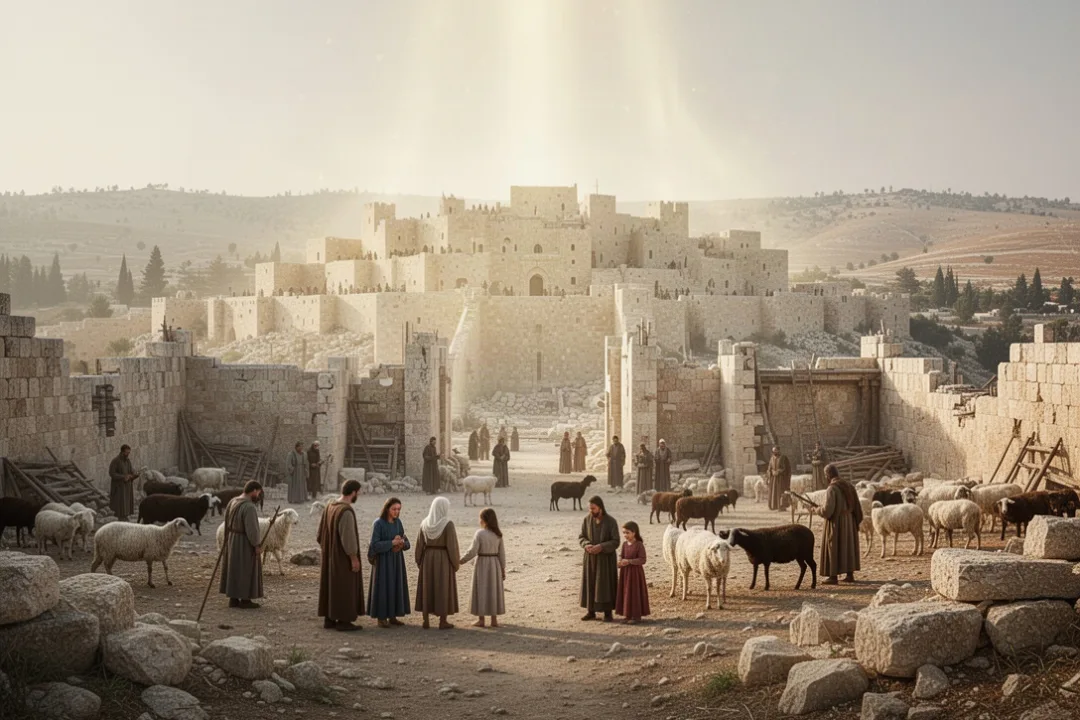
Jerusalem will outgrow its walls. The city is pictured as a place of open growth, filled with people and animals rather than confined within traditional defenses.
God becomes Jerusalem’s protection. Instead of relying on a physical wall, the city will have the Lord’s fiery protection around it and his glory within it.
God calls his scattered people home. Those still living in Babylon are told to escape, while the nations are warned that harming God’s people is an offense against God himself.
God comes to dwell among his people. Jerusalem is called to rejoice because the Lord will live in its midst, and many nations will come to him and become his people.
These movements should not be separated from one another. The expanding city, the wall of fire, the return from exile, and the gathering of the nations all point toward a restoration that is larger than rebuilding houses or repairing streets.
The man with the measuring line and Jerusalem’s future
Zechariah sees a man carrying a measuring line toward Jerusalem. When asked where he is going, the man explains that he is going to measure the city. Measurement suggests order and purpose: Jerusalem is not being abandoned to ruin but considered for reconstruction.
In biblical prophetic imagery, measuring can communicate several related ideas. It may indicate ownership, as a person measures what belongs to him. It may also indicate protection or preparation, because a city must be assessed before it is rebuilt. In this vision, the act of measuring points to a future God has already determined.
The measuring scene is interrupted by another messenger who announces that Jerusalem will become inhabited like an unwalled settlement. The picture is not of a deserted or diminished city. It is of a community spreading outward because its population and prosperity have grown beyond the limits of conventional fortifications.
The reference to people and livestock matters. It presents a normal, thriving community rather than a symbolic monument. Families live there, animals are kept there, and daily life takes place in safety. The vision imagines Jerusalem as a living city whose growth cannot be reduced to a carefully enclosed center.
Why an unwalled Jerusalem is a surprising promise
For an ancient city, walls were a basic defense against invading armies, raiders, and political enemies. A city without walls could appear exposed and foolishly vulnerable. Yet Zechariah 2 does not treat the absence of walls as a weakness. It treats it as evidence that God himself will provide a greater kind of security.
The promise does not necessarily reject every practical form of construction or civic defense. Its emphasis is theological: human fortifications will not be the ultimate source of Jerusalem’s safety. The city’s future will depend on the Lord’s protection rather than on stone alone.
The image also challenges narrow expectations about restoration. A rebuilt city could have been imagined as a smaller, fortified community trying to survive among hostile powers. Zechariah instead sees a growing city that cannot be contained by fear.
Walls represent limits and defense. They define a city and keep danger outside.
Open growth represents blessing. People and animals fill the surrounding area because life is flourishing.
God’s presence replaces false security. The city’s safety rests on the Lord, not merely on architecture.
Expansion points toward inclusion. Jerusalem’s future is connected with the arrival of people from many nations.
The Lord as a wall of fire around the city
The next promise supplies the reason Jerusalem can exist beyond ordinary walls: God will be like a wall of fire around it. Fire in Scripture often represents divine power, holiness, judgment, or protection. Here the image combines strength and danger. God protects his people, but his presence is not harmless or casual.
A wall of fire is impossible to treat as a normal barrier. It cannot be easily climbed, broken, or removed. The image communicates that the Lord’s protection is active and formidable. Enemies do not simply encounter an empty city; they encounter God’s presence surrounding it.
The verse also promises that God will be the city’s glory within it. Protection outside and glory inside form a complete picture. The Lord is not only guarding Jerusalem from external threats; he is also making the city a place marked by his presence.
This combination corrects two incomplete ideas about security. A community may have strong defenses but no spiritual life, or it may speak about spiritual life while ignoring real danger. Zechariah holds both together: God protects from outside and dwells within.
Reading the image carefully: The “wall of fire” is prophetic imagery, not a construction instruction. It emphasizes God’s presence as the city’s true defense and warns against assuming that visible strength is the same as lasting security.
The command to leave Babylon and return home
After the promise about Jerusalem, the message turns directly to the exiles. Those still living in the land of the north are told to flee. This language refers especially to Babylon, the empire associated with Judah’s destruction and the deportation of its people.
Babylon had fallen as the dominant imperial power, but many Jewish people remained scattered outside the land. Some may have built stable lives there, established businesses, or formed families. Returning to Jerusalem could involve real sacrifice and uncertainty. Zechariah’s call therefore addresses people who may have felt that exile was now permanent.
The command to leave is both practical and spiritual. The people are being called out from the place of captivity and judgment so that they can participate in God’s renewed work in Jerusalem. The return is not merely a change of address; it is a response to the Lord’s promise.
That does not mean every individual in every later circumstance must relocate to Jerusalem. The original message concerns the postexilic community and its place in God’s unfolding purposes. For readers today, the enduring principle is that God’s restoration may require leaving behind arrangements formed under oppression, even when those arrangements have become familiar.
God’s care for his people and the “apple of his eye” image
Zechariah says that the nations that have harmed God’s people have, in effect, touched what is most precious to him. Many English translations use the familiar expression “the apple of his eye,” but the underlying image refers to the pupil of the eye, a part of the body that is highly sensitive and carefully protected.
The point is not that Judah has earned perfect moral standing. The surrounding prophetic books openly address Judah’s own sin and disobedience. Instead, the image expresses God’s personal concern for a people he has chosen and disciplined without abandoning.
This matters because the returned exiles could have interpreted their suffering as proof that God no longer cared about them. Zechariah gives the opposite interpretation. Their defeat and exile were real, but the nations that mistreated them would still answer to God.
The passage presents a serious warning to oppressors. God identifies himself with the vulnerable people under his care, so violence against them is not treated as a distant political event. It becomes an offense against the Lord himself.
“After glory” and the nations’ accountability
Zechariah describes God as sending glory after the nations that plundered Judah. The wording is difficult to interpret with complete certainty, but the broad movement is clear: God will act against those who have exploited his people, and his action will display his authority.
The nations had treated Judah as a spoil to be taken. The vision reverses that situation. Those who seemed powerful are not beyond judgment, and those who seemed defeated are not forgotten. God’s glory is revealed through his defense of his people and his restoration of the city.
This section should not be read as permission for personal revenge. The judgment belongs to God. The passage gives hope to the oppressed by insisting that injustice is visible to the Lord, while also reminding powerful nations that military success does not place them outside divine accountability.
“Sing and rejoice” because God will dwell among his people
The emotional center of the chapter is the call for Daughter Zion to sing and rejoice. The reason for this joy is not simply that buildings will be repaired or political circumstances will improve. The decisive promise is that the Lord himself will come and dwell in the midst of his people.
In the Old Testament, God’s dwelling among Israel is associated with covenant relationship, worship, holiness, and protection. The restoration of Jerusalem therefore means more than national recovery. It means the renewal of the relationship between God and his people.
The invitation to rejoice comes before every visible detail of restoration has been completed. The community is asked to respond to God’s promise even while rebuilding remains underway. Faith does not deny the ruins; it refuses to treat the ruins as the final word.
The phrase “Daughter Zion” personifies Jerusalem as a woman or community addressed with tenderness. This language turns the city from a mere location into a people who can grieve, hope, and rejoice before God.
How the nations fit into Zechariah 2
One of the chapter’s most significant features is its movement from the restoration of Judah to the inclusion of many nations. The Lord declares that numerous peoples will join themselves to him and become his people. This is not a minor detail. It expands the vision beyond a national return from exile.
The nations are not described only as enemies receiving judgment. Some are also pictured as people who come to the Lord and share in his covenant blessing. Zechariah therefore holds two truths together: God judges violent opposition, and God welcomes those who turn toward him.
This creates a broader picture of Jerusalem. The city is not restored merely for the comfort of its existing residents. It becomes a place associated with God’s presence and a gathering point for people from many peoples.
Judgment is not the only future for the nations. Those who respond to God may be brought into his people.
Restoration is outward-facing. Jerusalem’s renewal has consequences beyond its own borders.
God’s presence creates belonging. The nations become connected to God, not merely to a political capital.
The promise anticipates a wider people of God. Later biblical writings develop this theme in different ways.
Christians often read this promise alongside New Testament passages about the inclusion of Gentiles in God’s people. That later theological connection should not erase Zechariah’s original setting, but it does show why this chapter has been important in Christian interpretation.
“The Lord’s portion” and the holiness of Jerusalem
The chapter then describes Judah as the Lord’s portion in the holy land. The language of inheritance indicates belonging. Judah is not an accidental remnant with no future claim; it remains connected to God’s covenant purposes.
The designation “holy” points to being set apart for God. It does not mean that every resident of Jerusalem is automatically righteous or that the city’s people no longer need correction. Rather, the city has a special relationship to God and is intended to reflect that relationship in its worship and communal life.
The statement that God will again choose Jerusalem echoes earlier promises that the city remains significant despite its judgment. Jerusalem has experienced destruction, but destruction has not canceled God’s purpose. Restoration is presented as a renewed act of divine choosing.
This also prevents a shallow reading of prosperity. A larger population and greater safety matter, but they serve a more important goal: a holy community living near the presence of God. Material restoration without faithfulness would not fulfill the chapter’s deepest hope.
The command for all people to be silent before the Lord
Zechariah 2 ends with a command for all flesh to be silent before the Lord because God has risen from his holy dwelling. Silence here is not empty quiet or passive indifference. It is the proper response to the Lord’s authority and imminent action.
After the chapter has described threatened people, powerful nations, expanding cities, and international gathering, the final word belongs to God. Human plans and imperial boasts are placed in perspective. The Lord is not a distant observer; he is active and has taken his stand.
The command also carries the sense of reverence. People should stop speaking as though they control history. The nations may appear dominant, but God’s judgment and restoration determine the ultimate outcome.
For worship and prayer, this ending offers a useful pattern. Joy and silence belong together. God’s people may celebrate his promises while also becoming quiet before his holiness and authority.
Major themes for reading Zechariah 2 today
God’s presence is greater than visible protection
The image of the wall of fire does not encourage carelessness, but it does challenge fear-based faith. Human safeguards have a legitimate place, yet they cannot carry the weight of ultimate trust. Zechariah directs confidence toward God’s presence rather than toward circumstances that can quickly change.
The people may have hoped for a repaired city, but the vision gives them a city that expands beyond its walls and becomes connected with many nations. God’s promised future is not merely a return to the past. It is a transformed future shaped by his presence.
God does not overlook oppression
The “apple of his eye” image offers comfort to people who feel exposed or forgotten. It does not promise that suffering will be immediately removed. It does promise that God sees the harm done to his people and will hold oppressors accountable.
Belonging to God involves holiness
The chapter celebrates safety and growth, but it also calls the land and city holy. Restoration is not just about comfort, size, or influence. It is about becoming a people whose life is ordered around God’s presence.
God’s work reaches beyond one group
The nations’ inclusion prevents a narrow interpretation of blessing. God restores his people in a way that opens a path for outsiders to join themselves to him. The vision combines particular covenant care with a widening invitation.
Questions to ask when studying Zechariah 2
A careful reading benefits from holding the chapter’s images together rather than treating them as isolated promises. These questions can guide personal study, group discussion, or teaching:
What does the measuring line suggest about God’s intentions for Jerusalem?
Why would an unwalled city seem dangerous in its historical setting?
How does the wall of fire differ from ordinary human defenses?
What does God’s concern for the “apple of his eye” reveal about his relationship with his people?
How are judgment and welcome both present in the chapter’s treatment of the nations?
Why is God’s presence more central than the city’s physical expansion?
What does the final call to silence teach about responding to divine authority?
These questions keep interpretation anchored in the chapter’s own emphasis: God restores, protects, dwells, judges, and gathers. They also help prevent the vision from being reduced to a prediction about urban development or a general promise of personal success.
How Zechariah 2 differs from a personal prosperity promise
Because the chapter speaks about growth, safety, and blessing, it can be misused as a guarantee that every believer will receive increasing wealth, influence, or physical security. That interpretation overlooks the historical setting and the communal nature of the vision.
Zechariah is speaking first about God’s covenant people, Jerusalem, the nations, and the restoration of worship. The chapter does not promise that faithful individuals will avoid hardship or that every community will expand visibly. Its central promise is that God remains faithful to his purposes and present with his people.
The vision can still shape personal faith. You may draw comfort from God’s care, examine where you place your security, and seek a life centered on his presence. But those applications should arise from the chapter’s meaning rather than replace it.
A clear way to pray through Zechariah 2
The chapter can guide prayer in several directions without turning its prophetic imagery into a formula. Begin by acknowledging God as the protector and rightful center of his people. Then bring fears about vulnerability, displacement, or injustice before him.
Ask for trust. Pray for wisdom to use practical safeguards without treating them as ultimate security.
Pray for the displaced. Remember people who have been forced from homes or separated from their communities.
Pray for justice. Ask God to restrain oppression and expose systems that exploit vulnerable people.
Pray for welcome. Seek a community shaped by God’s presence rather than by suspicion of outsiders.
Pray for holiness. Ask that worship, relationships, and public life reflect the Lord’s claim on his people.
Practice reverent silence. Spend time listening before God rather than filling every moment with requests.
Zechariah 2 leaves the reader with a city that is larger than its walls, a people guarded by God, nations drawn toward him, and a holy dwelling place filled with his glory. The chapter’s hope rests not in human control but in the Lord who returns, protects, and dwells among his people.
Frequently asked questions
Who is the man with the measuring line in Zechariah 2?
The text presents him as a prophetic figure preparing to measure Jerusalem. His exact identity is not stated, so interpretations differ. His role in the vision is clear: measuring represents planning for the city’s future and signals that Jerusalem will be rebuilt and inhabited. The following message shows that the city’s growth will exceed ordinary physical boundaries.
What does the wall of fire mean in Zechariah 2?
The wall of fire symbolizes God’s powerful protection surrounding Jerusalem. It also conveys holiness and danger, showing that divine presence is not merely comforting but authoritative. The image does not promise that God’s people will never face trouble. It teaches that their ultimate security rests in the Lord rather than in military defenses or human structures.
Is Zechariah 2 predicting the modern state of Israel?
Interpretations vary, and the chapter originally addressed Jerusalem and the postexilic Jewish community in Zechariah’s time. Some readers connect its restoration language with later events, while others understand it primarily as a prophetic vision of God’s future kingdom. Any modern application should respect the chapter’s historical setting and its emphasis on God’s presence, holiness, and the inclusion of nations.
What does Zechariah 2 teach Christians about the nations?
The chapter shows that God’s purposes extend beyond restoring Judah. Many nations are portrayed as joining themselves to the Lord and becoming part of his people. Christians commonly connect this theme with the later inclusion of Gentiles in the church, while recognizing that Zechariah speaks in its own historical and prophetic context about Jerusalem, God’s dwelling, and the nations’ response to him.















Leave a Reply