When a task feels too large, you may wonder whether determination, money, influence, or better planning will be enough. Zechariah 4:4-6 points to a different source of strength: God’s work is carried forward by his Spirit, not by human power alone. The passage is part of a vision shown to the prophet Zechariah, and its message addresses both discouragement and misplaced confidence.
In these verses, Zechariah asks the interpreting angel about the meaning of what he sees. The angel responds by directing the message to Zerubbabel, the governor responsible for leading the rebuilding of Jerusalem’s temple. The central statement is that success will not come through military force, political influence, or personal ability, but through the Spirit of the Lord.
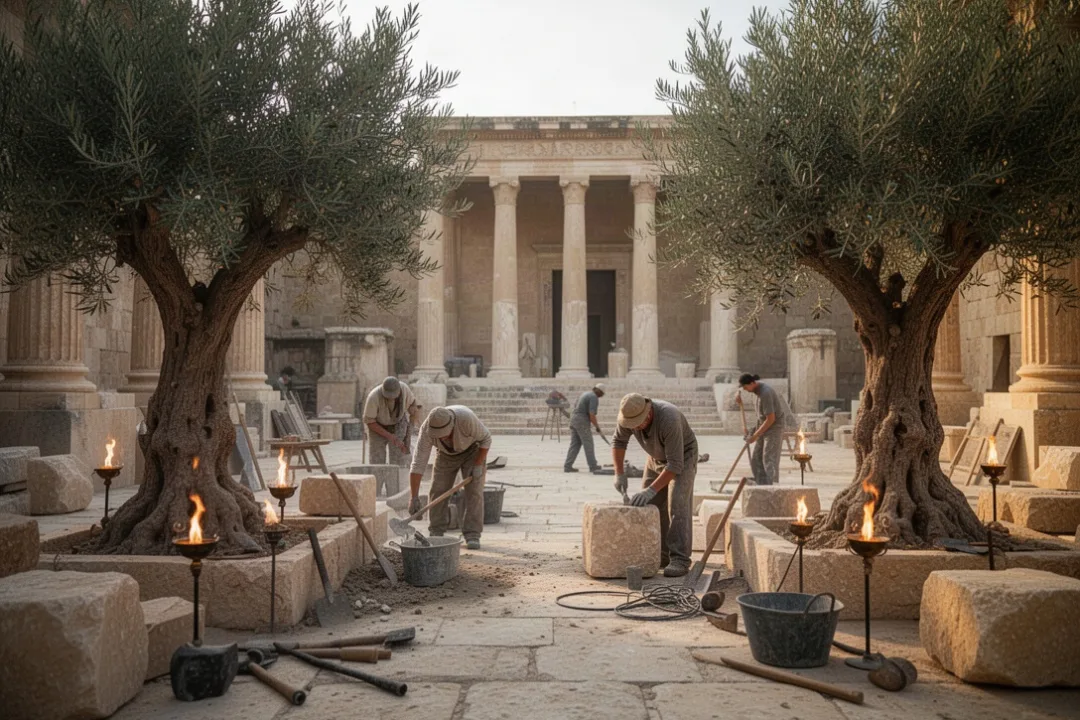
Zechariah 4 records a vision involving a gold lampstand, a bowl above it, lamps, and two olive trees. The design is unusual enough that Zechariah does not assume he understands it. Instead, he asks the angel what these things mean, showing that spiritual images should be interpreted carefully rather than assigned a meaning based only on personal impressions.
The lampstand represents a source of light maintained by a continuing supply of oil. In the vision, the oil is connected with the two olive trees, suggesting an abundant and ongoing provision. The picture is not of lamps struggling to remain lit because of a limited supply. It portrays light being sustained by what God provides.
The exact meaning of every detail in the vision has been discussed by Bible interpreters, and not every symbol receives a full explanation in the passage itself. The main emphasis becomes clear in verse 6: God’s purposes depend on his Spirit. The imagery supports that message by showing a divine supply that does not depend entirely on human effort.
Zechariah’s question also matters because it reflects a healthy response to difficult Scripture. He does not pretend to know what the lampstand, oil, or trees signify. He asks. Readers can follow the same pattern by paying attention to the passage’s context, the words spoken by the angel, and the broader message of the book.
Reading principle: The vision contains many details, but the angel’s explanation gives the clearest interpretive center: God’s Spirit, rather than human strength, enables the work God has assigned.
What “not by might nor by power” means
The wording in Zechariah 4:6 contrasts two forms of human capability with God’s Spirit. “Might” can refer to collective strength, military resources, wealth, or the force available to a group. “Power” can point to individual ability, authority, competence, or personal exertion. The statement does not claim that effort, leadership, organization, or practical resources are worthless. It rejects the idea that they are the decisive cause of God’s success.
The verse is therefore not a command to become passive. Zerubbabel still had a real responsibility. The temple still needed to be rebuilt, workers still needed to work, and obstacles still needed to be addressed. The message was that the project would not be completed merely because a leader had enough influence or because the community could generate enough strength on its own.
This distinction is useful in many areas of faith. You may need to study, apologize, plan, serve, give, lead, or persevere. Those actions can be genuine expressions of obedience. Yet obedience is not the same as self-reliance. The Christian understanding of this principle is that human action has a proper place, but God remains the source of spiritual effectiveness.
Self-reliance: assuming that success depends entirely on talent, control, status, or visible resources.
Passive spirituality: using dependence on God as an excuse to avoid responsibility, preparation, or faithful action.
A balanced reading holds these truths together: people are called to act faithfully, and God is the one who supplies the power that makes faithful work fruitful. The instruction to Zerubbabel was not “do nothing.” It was “do not confuse human capacity with the source of God’s work.”
How the message addressed Zerubbabel’s rebuilding work
To understand Zechariah 4:4-6, it helps to remember the situation facing the returned Jewish community. After the Babylonian exile, the people returned to Jerusalem and began rebuilding the temple. The work encountered opposition, delays, discouragement, and political complications. What had begun with hope became a prolonged and difficult assignment.
Zerubbabel was a leading figure in that restoration effort. He had authority, but his authority was limited. He was responsible for the project, yet he could not simply command every obstacle to disappear. The temple’s reconstruction depended on the cooperation of the community and on circumstances beyond his personal control.
God’s message through Zechariah met Zerubbabel in that pressure. The rebuilding would not be accomplished by impressive military force or by the governor’s personal influence. It would proceed because God was sustaining his people and enabling the work. The lampstand’s continual oil supply fits this setting: the light does not remain lit through frantic human effort but through provision that comes from outside the lampstand itself.
The immediate message was also connected with the temple’s completion. Later in the chapter, the text speaks of Zerubbabel’s hands laying the foundation and finishing the work. This shows that the promise was not an abstract statement about feeling encouraged. It concerned a concrete assignment with a visible outcome.
That historical setting protects the verse from being reduced to a vague slogan. “Not by might nor by power” does not mean that every desired project will succeed exactly as imagined. It means that God’s purposes do not ultimately depend on the size of human resources. In this passage, God assured his people that the temple work would reach its appointed end despite the weakness and limitations surrounding them.
The passage also shows that discouragement is not evidence that God has abandoned a calling. A work may be slow, contested, or unimpressive while still being under God’s care. The community needed patience as well as courage, because restoration often took place through ordinary acts repeated over time.
What “by my Spirit” reveals about God’s help
The phrase “by my Spirit” identifies the true source of the work’s success. In the Old Testament, God’s Spirit is associated with creation, prophetic speech, wise leadership, empowerment for service, and the renewal of God’s people. The Spirit is not merely an inner feeling or a surge of enthusiasm. The phrase refers to God actively enabling what he commands.
That help can include courage, wisdom, endurance, conviction, unity, and timely provision. It does not always appear as a dramatic event. In the setting of Zechariah, the Spirit’s work involved keeping a discouraged community oriented toward obedience and helping a long-delayed project move forward.
Dependence on the Spirit changes the way you evaluate progress. Visible size is not the same as spiritual fruitfulness. A large organization may have substantial resources and still be acting from pride or fear. A small group may have limited means and yet faithfully carry out work that reflects God’s purposes. The verse does not provide a formula for making every effort succeed; it teaches you to measure faithfulness by a different standard.
Dependence also changes the way you pray. Instead of asking only for fewer obstacles or more resources, you can ask God to provide the wisdom and strength needed to respond well to the situation in front of you. You can pray for a clean motive, endurance when results are delayed, and discernment to know which opportunities genuinely fit your calling.
At the same time, “by my Spirit” does not mean every strong impression or claimed spiritual experience comes from God. The message should be tested against Scripture, godly character, sound judgment, and the responsibilities God has already given. A person cannot justify manipulation, carelessness, or harmful behavior by attaching spiritual language to it.
God’s Spirit produces a dependence that is both humble and active. It leads you to acknowledge your limits without surrendering your responsibility. It also keeps success from becoming an occasion for boasting, because the ultimate credit belongs to God rather than to the person who happened to hold the visible leadership role.
How to apply Zechariah 4:4-6 without misusing it
Many readers turn to this passage when they are facing a difficult assignment, a ministry challenge, a family burden, or a personal weakness. Its message can provide real steadiness, but application requires care. The verse does not promise that every plan will receive immediate approval, unlimited resources, or a painless path.
Instead, it gives you a way to approach work that matters:
Identify the responsibility clearly. Ask what God has actually placed before you rather than treating every desire as a divine assignment.
Examine your source of confidence. Notice whether you are relying mainly on money, reputation, expertise, control, or other people’s approval.
Use responsible means. Plan carefully, seek counsel, develop your skills, and take practical steps. Dependence on God does not cancel wise preparation.
Ask for the Spirit’s help. Pray for strength, wisdom, courage, patience, and integrity instead of asking only for a particular result.
Continue through ordinary obstacles. Faithfulness may involve repeated, unremarkable actions rather than one dramatic breakthrough.
Leave the outcome with God. Work diligently while recognizing that you cannot control every response, timing, or result.
For someone facing a demanding job, the verse may challenge the belief that everything rests on personal performance. You still need to prepare and make sound decisions, but you do not have to treat your competence as your ultimate security. For someone serving a church or community, the passage can expose the temptation to rely on branding, numbers, fundraising, or personality instead of prayerful dependence and faithful care.
For someone confronting a personal weakness, the verse should not be used to avoid professional help, accountability, medical care, or practical change. God may work through counselors, physicians, wise friends, structured habits, and patient learning. Dependence on the Spirit can include receiving help through ordinary means.
The passage is also useful when your work seems small. The rebuilding of the temple involved a large communal purpose, but it advanced through particular people carrying out particular responsibilities. You may not see the full significance of your contribution. Faithfulness does not require you to control the entire project or receive public recognition.
One practical question to carry from Zechariah 4:6 is: “Am I trying to produce through force what can only be sustained by God?” The question does not condemn effort. It helps distinguish diligent obedience from anxious control. When your plans depend entirely on your ability to manage everyone and everything, fear usually grows. When you acknowledge God’s authority and provision, you can work with seriousness without pretending to be sovereign.
How Zechariah 4:4-6 fits the Bible’s wider message
The principle in this passage appears throughout Scripture: God often works through people who are aware of their weakness. He calls Moses despite Moses’ reluctance, gives Gideon a reduced army, uses David despite his youth and low social standing, and sustains the early church through witnesses who do not possess worldly influence. These accounts do not glorify weakness for its own sake. They show that God’s power cannot be reduced to human resources.
The New Testament continues this theme by emphasizing the work of the Holy Spirit in the life of the church. Jesus’ followers are told to wait for power from above before carrying out their witness, and the apostles repeatedly describe spiritual ministry as dependent on God rather than human eloquence or status. These later passages do not erase the original setting of Zechariah 4, but they help readers see why the Spirit’s role is central to biblical faith.
The lampstand imagery also connects with the wider biblical theme of light. Light can represent God’s presence, truth, witness, and life-giving guidance. In Zechariah’s vision, the lampstand’s light is maintained through a supply that points beyond human effort. The image therefore encourages a community to remain faithful as God provides what is needed for its witness and worship.
Christians should still read the passage first in its own context. It was addressed through Zechariah to a community rebuilding the temple under Zerubbabel. Only after understanding that setting should you draw broader principles about dependence on God’s Spirit. This approach prevents the verse from becoming a detached promise that guarantees success for any project a person chooses.
Zechariah 4:4-6 ultimately calls for humble confidence. Humble, because human ability is not enough to accomplish God’s purposes. Confident, because God is not limited by the weaknesses, delays, or modest resources that cause people to lose heart. The right response is neither despair nor boasting, but faithful work carried out in reliance on the Spirit.
Frequently asked questions
Who was Zerubbabel in Zechariah 4?
Zerubbabel was the governor of Judah during the period when the Jewish community was restoring Jerusalem after exile. He played a leading role in rebuilding the temple. Zechariah 4 encouraged him to continue the work despite opposition and discouragement, assuring him that the project’s completion depended on God’s Spirit rather than political influence or human strength.
Does Zechariah 4:6 mean Christians should not make plans?
No. The verse does not oppose preparation, organization, skill, or perseverance. It teaches that these tools are not the ultimate source of success in God’s work. Christians can plan responsibly while praying for wisdom, remaining open to correction, and recognizing that results depend on God’s providence rather than personal control.
What do the two olive trees represent?
The vision’s two olive trees are associated with the continuing supply of oil for the lampstand. Later in the chapter, they are connected with two anointed figures serving before the Lord. Interpretations differ on some details, but the imagery clearly supports the theme of divine provision and Spirit-enabled service.
How can I pray Zechariah 4:6 in a difficult season?
Ask God to show you the responsibility you should carry, provide wisdom for practical decisions, and strengthen you to remain faithful. Confess any dependence on status, control, or personal ability. Then take the next obedient step while releasing the timing and final outcome to God.














Leave a Reply