For Christians, the face of Jesus is not merely a religious picture or artistic subject. It points to the person of Christ, who Christians believe is both truly human and truly divine. Looking at an image of Jesus can therefore become a way to remember his compassion, enter more attentively into prayer, and respond to the love shown through his life, death, and resurrection.
The devotion often focuses on several connected ideas: Christ’s mercy, the suffering visible in his Passion, his humility, and the hope of seeing God more fully. A Holy Face image may show Jesus as peaceful, sorrowful, crowned with thorns, or marked by the wounds of the crucifixion. Each presentation emphasizes a different aspect of the same Christian mystery.
The devotion is especially associated with Catholic prayer, although Christians from other traditions may also meditate on the face of Jesus through Scripture and sacred art. It is not necessary to possess a particular image, medal, or prayer card. The central focus is Jesus himself, not the material object used to help you pray.
Historical context behind the Holy Face devotion
The New Testament does not describe Jesus’ physical appearance in detail. The Gospels identify him through his words, actions, relationships, death, and resurrection rather than by giving a portrait. For that reason, every painted, sculpted, or printed image of Jesus is an interpretation rather than a confirmed photograph.
Early Christian art gradually developed recognizable ways of portraying Christ. Artists used visual features such as long hair, a beard, a halo, or a compassionate expression to communicate theological meaning. These images helped worshipers contemplate the incarnate Word—God made human—not because the artwork was proven to be an exact likeness.
Tradition also connects the Holy Face with the woman commonly called Veronica. According to later Christian tradition, she offered Jesus a cloth as he carried the cross, and his face was miraculously impressed upon it. This story is not recorded in the biblical Gospels, and the name Veronica is not identified there as the woman who performed this act. It remains a longstanding devotional tradition rather than a historical detail established by Scripture.
Other objects have also influenced Holy Face devotion, including the Shroud of Turin and the Holy Face of Manoppello. Claims about their origins and relationship to Jesus remain subjects of discussion and, in some cases, disagreement. Catholic devotion does not require you to accept any one artifact as an authenticated image of Christ.
How the devotion developed in Catholic practice
Modern Catholic devotion to the Holy Face is strongly associated with Sister Marie of St. Peter, a nineteenth-century Carmelite nun in Tours, France. She reported receiving interior inspirations that led her to promote reparation for offenses against God and devotion to the face of Jesus. Her spiritual experiences are part of private devotion, not a replacement for the public teaching of the Church.
The devotion also became associated with Leo Dupont, a layman in Tours who prayed before an image of the Holy Face and encouraged others to do the same. Reports of favors connected with prayer at his home helped spread the practice. These reports should be approached as devotional testimony rather than as proof that a particular image possesses supernatural power.
Saint Thérèse of Lisieux later helped give the devotion a wider spiritual reach. She entered the Carmelite convent with the religious name Thérèse of the Child Jesus and the Holy Face. For her, the Holy Face expressed both the hiddenness of Christ’s glory and the tenderness of trusting God as a child. Her writings connect the devotion with humility, confidence, suffering, and love.
Some Catholic communities observe a special Holy Face celebration on the Tuesday before Ash Wednesday, often called Shrove Tuesday or Mardi Gras in the broader calendar. The exact liturgical observance can vary by place and approved calendar. The devotion may also be practiced during Lent, Holy Week, or on any day when a person wishes to pray with greater attention to Christ’s Passion.
Keep the focus clear: A Holy Face image is a devotional aid, not an object that works by magic. Christian prayer is directed to God, while the image helps the mind and heart remember Jesus.
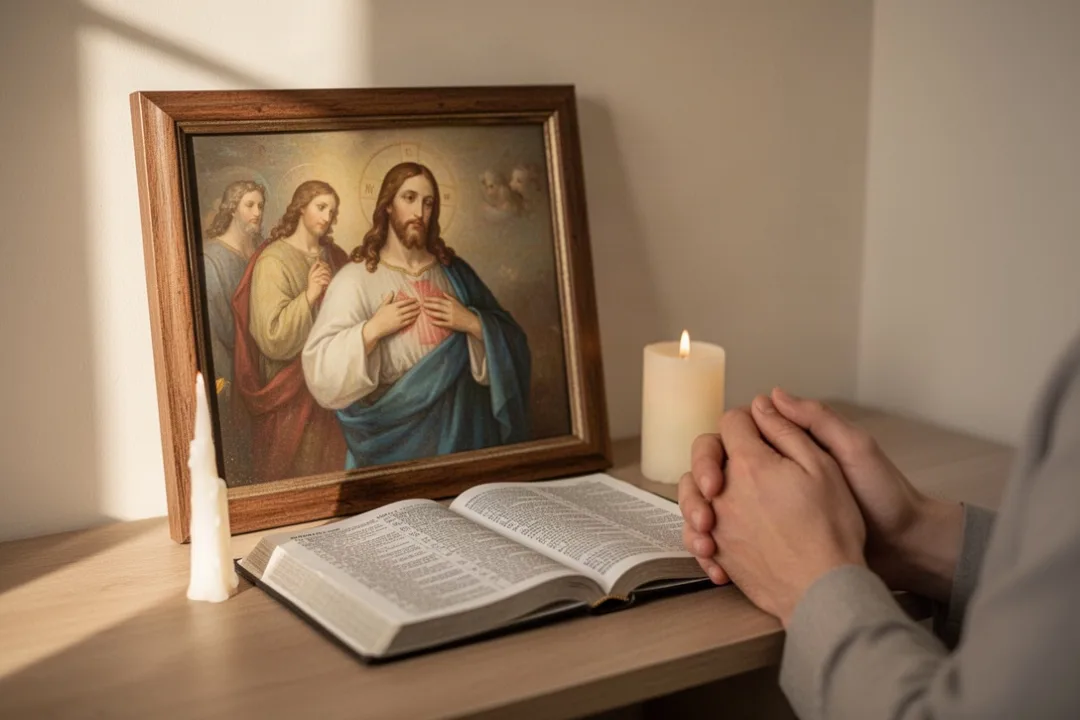
You do not need a complicated ritual to begin. A quiet space, a cross or image if you have one, and a few undistracted minutes are enough. The following pattern can help you pray in a steady and personal way.
Become still. Sit or kneel comfortably, place the image where you can see it, and set aside distractions. Make the Sign of the Cross if that is part of your tradition.
Recognize who you are addressing. Speak to Jesus as the living Lord, not merely as a historical figure or artistic subject.
Look attentively. Notice the expression, posture, wounds, or other details without trying to force an emotion.
Bring a Gospel scene to mind. You might consider Jesus welcoming children, healing the sick, praying in Gethsemane, standing before Pilate, or appearing to his disciples after the resurrection.
Respond honestly. Offer gratitude, sorrow for sin, a request for mercy, or a concern involving another person.
Remain in silence. Allow a few minutes for quiet attention rather than filling every moment with words.
Choose one response. End by deciding how you will show patience, truthfulness, forgiveness, or practical care during the day.
This method protects the devotion from becoming a purely visual exercise. The image draws your attention, Scripture gives the prayer a reliable foundation, and your response carries the prayer into ordinary life. You may pray for five minutes or longer, depending on your circumstances.
Scripture passages that deepen Holy Face prayer
Several passages can guide meditation without claiming to describe Jesus’ physical features. The prologue of John’s Gospel presents Christ as the Word who becomes human and lives among people (John 1:1–18). This passage supports reflection on the mystery that God becomes visible and approachable in Jesus.
The account of the Transfiguration shows Jesus’ appearance shining with divine glory before the disciples (Matthew 17:1–8; Mark 9:2–8; Luke 9:28–36). The scene can help you hold together two truths: the same Jesus who suffers is also the beloved Son revealed in glory.
The Passion narratives invite a more sober form of prayer. Matthew 26–27, Mark 14–15, Luke 22–23, and John 18–19 describe betrayal, mockery, violence, abandonment, and death. Rather than treating suffering as attractive in itself, meditate on Christ’s faithful love and on the human cruelty he endured.
The risen Jesus is recognized in different ways after Easter. Mary Magdalene recognizes him when he calls her by name (John 20:11–18), while the disciples on the road to Emmaus recognize him in the breaking of the bread (Luke 24:13–35). These accounts remind you that Christian recognition of Jesus is not limited to physical sight.
Saint Paul’s teaching about Christ’s humility and exaltation in Philippians 2:5–11 is also fitting. The passage describes Jesus’ self-emptying, obedience, death on a cross, and exaltation by God. A Holy Face meditation can therefore move from sorrow to hope rather than stopping at the image of suffering.
What different Holy Face images may communicate
There is no single universally required Holy Face design. The details of an image shape the emphasis of prayer, so it can help to understand what common features suggest.
A peaceful face may encourage trust, mercy, and the awareness that Christ remains present in quiet prayer.
A sorrowful or wounded face may lead you to contemplate the Passion and to pray for people experiencing pain or injustice.
A face crowned with thorns recalls mockery, rejection, and the contrast between worldly power and Christ’s humble kingship.
A luminous face can direct meditation toward the Transfiguration, the resurrection, and the hope of sharing in God’s life.
A veiled or faintly visible face may express the hiddenness of God and the limits of human understanding.
A face looking directly at the viewer can make prayer feel personal, inviting an honest response rather than detached observation.
These meanings are not fixed rules. An image’s effect depends on its artistic style, your experience, and the prayer context. A simple icon, a traditional painting, a crucifix, or a photograph of a stained-glass window may all serve as reminders of Christ without needing to look alike.
The relationship between the Holy Face and the Passion
Many Holy Face images emphasize the suffering Jesus endured during the hours before his crucifixion. The bruises, swelling, blood, and thorns are intended to make the Passion concrete. They can challenge indifference and lead to gratitude for Christ’s self-giving love.
Still, Christian meditation should not reduce Jesus to an image of pain. The face belongs to a living person who teaches, forgives, serves, prays, and rises from the dead. A balanced prayer remembers that the Passion leads to the resurrection; suffering is neither the final identity of Jesus nor a reason to glorify violence.
The devotion can also expose the harm caused by contempt and dehumanization. The face of Christ was mocked and abused, and the Gospel accounts show that he was treated as disposable. Prayer before the Holy Face may therefore inspire concern for people who are humiliated, trafficked, imprisoned unjustly, persecuted, or ignored.
“Whoever has seen me has seen the Father” is the point Jesus makes in John 14:9; the passage directs attention to his relationship with the Father, not to a physical portrait.
Some people include the Holy Face in a rosary meditation. Before each decade, they may name a Gospel scene involving Christ’s expression, words, or encounter with another person. For example, while praying a sorrowful mystery, you might ask for compassion toward people who suffer unjustly rather than focusing only on the appearance of Jesus in an image.
A novena can provide a more structured practice over several days. The form varies among Catholic communities, but a sound novena usually includes prayer, Scripture, a specific intention, and a concrete act of charity or conversion. You can use an approved devotional prayer or speak in your own words.
A simple personal pattern might include these elements:
Begin with the Sign of the Cross and a brief acknowledgment of Christ’s presence.
Read a short Gospel passage and sit with one phrase or scene.
Ask for mercy for yourself, your household, the Church, and people who are suffering.
Pray the Lord’s Prayer, a Hail Mary, or another familiar Christian prayer.
Make one practical act of reparation, such as apologizing, refusing gossip, assisting someone in need, or spending time in quiet worship.
The word reparation can sound unfamiliar. In this devotional setting, it means responding to wrongdoing with love, repentance, prayer, and a desire to repair harm. It does not mean trying to control God or claiming that human actions can purchase forgiveness.
Using Holy Face medals, cards, and home images responsibly
Medals and prayer cards can remind you to pray during the day. A card placed near your bed may prompt a morning prayer, while a small medal can serve as a reminder to speak patiently or resist a destructive habit. These objects have value as sacramentals when they direct you toward faith and lived discipleship.
A blessed object is not a good-luck charm. Blessing sets an object apart for sacred use, but it does not guarantee protection from every hardship or ensure that a particular request will be granted. Treat medals, cards, and images with respect, while remembering that your relationship with God is not measured by how many devotional items you own.
If you are choosing an image for your home, select one that supports prayer rather than fear or sensationalism. Consider the following:
Does the image help you remember the Jesus described in the Gospels?
Does it encourage mercy, humility, and hope?
Is the source respectful and consistent with Christian teaching?
Will it help your household pray, or does it mainly create anxiety about supernatural claims?
You may also want to learn who created the image and what tradition it represents. A responsible seller or parish resource should distinguish between established doctrine, longstanding tradition, private revelation, and personal opinion.
Claims about miraculous images and private revelations
Stories about images that seem to weep, heal, glow, or produce other unusual effects can attract strong attention. The Church generally examines alleged supernatural events carefully rather than assuming that every report is authentic. A person can practice Holy Face devotion without accepting any particular miracle story.
Private revelations, including reported visions or interior messages, do not add new public revelation necessary for Christian faith. Even when a devotion receives ecclesial approval, that approval does not mean every supernatural claim connected with it has been proven. It usually indicates that the practice contains spiritual value and does not contradict faith or morals.
Use discernment: Be cautious about anyone who promises guaranteed healing, demands large payments for a special image, or says that salvation depends on possessing one particular object.
Healthy devotion produces recognizable fruits: greater love for God and neighbor, more honest repentance, patience under difficulty, concern for the vulnerable, and deeper participation in Christian worship. If a practice produces fear, obsession, contempt for other Christians, or dependence on a supposed spiritual expert, step back and seek guidance from a trusted pastor or spiritual director.
How the Holy Face can shape daily conduct
The purpose of contemplating Jesus’ face is not to remain at the level of private feeling. In the Gospels, encounters with Jesus lead people toward changed relationships and practical faithfulness. A person who prays for mercy before the Holy Face should also become more willing to forgive, tell the truth, serve quietly, and protect the dignity of others.
One useful practice is to connect each prayer with a specific action. After meditating on Christ’s compassion, call someone who is lonely. After considering his silence before accusation, avoid a needless argument. After reflecting on his wounds, offer concrete help to a person dealing with illness, poverty, grief, or abuse.
This does not turn prayer into a test of perfection. You will still become impatient, distracted, or inconsistent. The point is to let the image bring you back to the question of how Christ is asking you to love today.
A short prayer before the Holy Face
You can pray in your own words, using a form such as this:
Jesus, I turn to you with gratitude and trust. Let me remember your mercy, your humility, and your faithful love. Forgive the ways I have wounded others or ignored their dignity. Teach me to see you in the people who suffer, and help me respond with patience and practical compassion. Keep my attention on you rather than on the image itself. Amen.
Afterward, remain silent for a moment. Notice whether one word, person, or responsibility comes to mind. If the prayer has brought sorrow, peace, or no clear feeling at all, you can still end with trust; emotional intensity is not the measure of authentic prayer.
When to seek guidance about this devotion
A parish priest, deacon, religious sister, or experienced spiritual director can help you distinguish a healthy devotion from misleading claims. Ask for guidance if you feel compelled to repeat prayers in fear, believe that a particular object controls your safety, or become distressed by competing messages about visions and miracles.
It is also wise to seek help when devotion to the Holy Face becomes disconnected from the rest of Christian life. Regular worship, Scripture, service, moral reflection, and relationships with other believers provide a broader setting for prayer. The Holy Face is best understood as one path of contemplation that leads you toward the whole Gospel of Jesus Christ.
You can begin simply: choose a respectful image, read a short Gospel passage, pray honestly, and let the face of Jesus remind you to treat each person with mercy. The lasting value of the devotion appears not in the image’s appearance, but in the love and faithfulness it helps you practice.
Frequently asked questions
Is the Holy Face of Jesus a specific image?
No. The phrase can refer to many artistic representations and devotional images of Jesus. Some traditions emphasize the face of Christ on Veronica’s veil, the Shroud of Turin, or another sacred object, but none is universally required as Jesus’ verified physical likeness. Christians may use any respectful image—or no image at all—while directing prayer to Christ rather than to the artwork.
Is the Holy Face of Jesus mentioned in the Bible?
The Bible does not use “Holy Face” as the name of a formal devotion. It does present Jesus as the visible revelation of God and describes his life, suffering, death, and resurrection. Passages such as John 1:1–18, John 14:8–11, and the Passion narratives provide the biblical foundation for meditating on Christ’s face and person.
What is the Holy Face novena?
A Holy Face novena is a nine-day prayer practice focused on Jesus, often including Scripture, petitions for mercy, and an intention related to reparation or conversion. Different communities use different prayers and schedules. You may follow a trusted Catholic booklet or pray simply in your own words, provided the practice encourages faith, repentance, charity, and trust rather than superstition.
Can I pray to the Holy Face for protection or healing?
You may ask Jesus for protection, healing, strength, and help for other people. The image itself should not be treated as a charm or guarantee. Christian prayer remains open to God’s will, and healing may involve medical care, emotional support, pastoral help, or gradual spiritual renewal. Seek appropriate professional assistance alongside prayer when illness, danger, or mental distress is involved.













Leave a Reply