Pauline epistles: books, themes, and how to read them
Pauline epistles: books, themes, and how to read them
The Pauline epistles are letters connected with the apostle Paul that address Christian belief, church life, ethical decisions, and personal leadership.
They make up 13 books of the New Testament, from Romans through Philemon, although scholars continue to discuss the authorship of several letters. Taken together, they show how early Christian communities understood Jesus, handled conflict, organized worship, and applied faith to ordinary relationships.
An epistle is a formal letter, but the Pauline letters are more than private correspondence. They were written to specific churches and individuals facing real questions: disagreements over Jewish law, tensions between wealthy and poor believers, confusion about Jesus’ return, sexual ethics, spiritual gifts, leadership, and suffering.
Because the letters address particular situations, you should read them as both historical documents and theological writings. Paul was not usually presenting an abstract system from beginning to end. He was applying the gospel to people, communities, and problems he knew or had heard about.
The letters also differ in purpose and tone. Romans develops a sustained explanation of Paul’s gospel. First Corinthians responds to many disputes within one congregation. Philemon is a short personal appeal concerning a household relationship. These differences help explain why no single letter represents the entire range of Paul’s thought.
Central idea: Read each epistle first as a letter written to a particular audience, then ask how its central theological claims may apply beyond that original setting.
Which books belong to the Pauline epistles
The traditional collection contains 13 New Testament letters associated with Paul. They are commonly arranged from longest to shortest, rather than in the order they were written.
Romans: A wide-ranging presentation of the gospel, human sin, faith, Israel, Christian ethics, and life in the church.
First Corinthians: Guidance for a divided church dealing with worship, spiritual gifts, sexual misconduct, lawsuits, marriage, resurrection, and communal meals.
Second Corinthians: A personal and sometimes intense defense of Paul’s ministry, along with teaching about suffering, generosity, reconciliation, and weakness.
Galatians: A forceful argument that Gentile believers do not need to become Jewish proselytes in order to belong to God’s people.
Ephesians: A vision of God’s work in Christ, the unity of Jews and Gentiles, the church, Christian conduct, and spiritual resistance.
Philippians: An encouraging letter about joy, humility, partnership, perseverance, and confidence in Christ amid hardship.
Colossians: A presentation of Christ’s supremacy and a call to live with new priorities within the Christian community.
First Thessalonians: Encouragement for a young church facing pressure, with teaching about holiness, hope, and the future coming of Jesus.
Second Thessalonians: Further instruction about perseverance and confusion surrounding the day of the Lord.
First Timothy: Counsel about church leadership, teaching, worship, community responsibility, and the character expected of overseers and servants.
Second Timothy: A personal charge to remain faithful, teach responsibly, endure suffering, and continue the ministry.
Titus: Guidance about appointing leaders, sound teaching, good conduct, and the relationship between grace and practical obedience.
Philemon: A brief personal letter appealing for a transformed relationship between Philemon and Onesimus.
Hebrews is sometimes placed near the Pauline letters in older Christian collections, but it does not name Paul as its author. Its authorship remains uncertain, and most modern scholars do not classify it as one of the Pauline epistles in the same sense as the 13 letters listed above.
How the letters fit Paul’s life and ministry
Paul, also known as Saul, was a Jewish follower of Jesus who became a major missionary and theological leader among Gentiles. His letters portray him traveling through the eastern Mediterranean, announcing the gospel, forming congregations, training coworkers, and maintaining relationships with churches after he moved on.
The letters were likely written across several years during the middle and later periods of Paul’s ministry. The exact order is not certain for every book, and some dates depend on how readers reconstruct events described in Acts and the letters themselves.
Paul wrote to communities in places such as Corinth, Galatia, Philippi, Thessalonica, Colossae, and Rome. Some churches knew him personally; others, especially the Roman congregations, received a letter from him before he had visited them. The personal letters to Timothy, Titus, and Philemon address individuals connected with his ministry and social world.
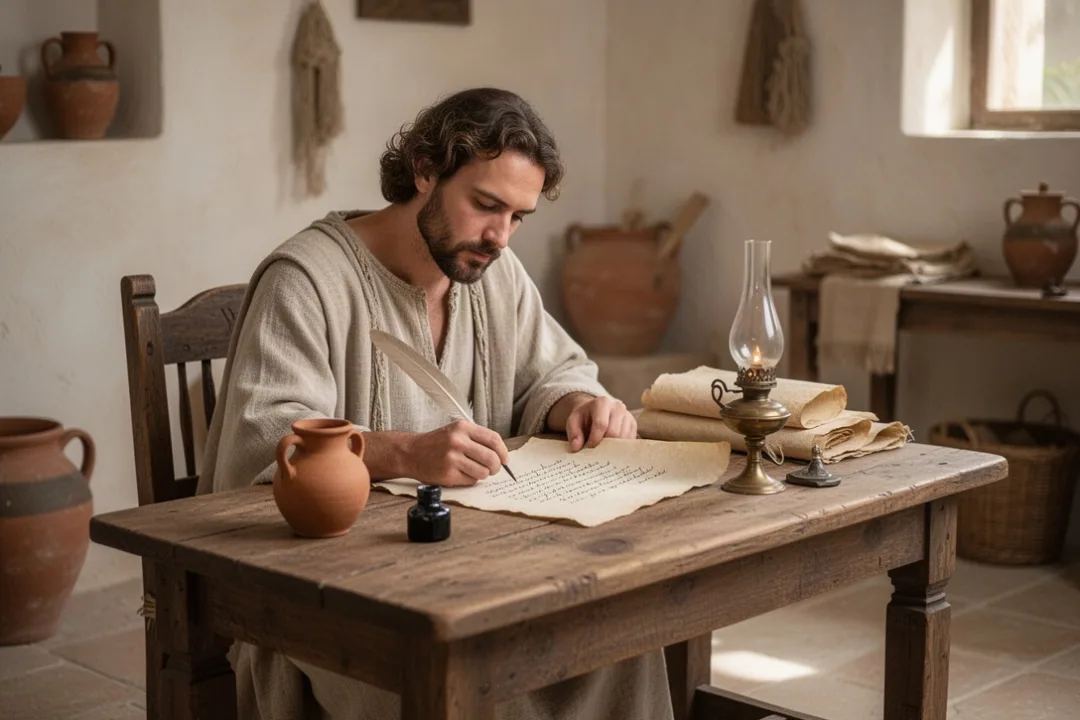
Many letters were probably produced with the help of a secretary or coworker. Romans, for example, names a person who wrote down the letter. This does not settle every question about composition, but it shows that ancient letter writing could involve collaboration while still representing the sender’s message and authority.
A practical step-by-step way to read the Pauline epistles
Paul’s letters become easier to understand when you move from the original situation to the argument and then to present-day application. The following process helps prevent isolated verses from controlling the meaning of an entire passage.
Identify the audience. Determine whether the letter addresses a whole church, several congregations, a ministry coworker, or one individual.
Look for the immediate problem. Notice references to conflict, false teaching, persecution, financial support, worship, family life, or questions about the future.
Read the whole unit. Follow the surrounding paragraphs before interpreting a sentence. Paul often develops an argument over several sections.
Mark repeated ideas. Words related to faith, grace, law, body, Spirit, freedom, wisdom, suffering, knowledge, and love often reveal the letter’s main concerns.
Separate explanation from application. Ask what Paul meant in the first-century setting before deciding how a principle may apply today.
Compare related passages. Paul can address the same theme differently in Romans, Galatians, Corinthians, and other letters because the situations differ.
Read difficult passages with humility. Consider historical background, translation differences, literary context, and major interpretive options rather than relying on one isolated phrase.
A useful first reading can be simple. Write down the recipients, the apparent reason for the letter, its emotional tone, and the main action Paul wants the readers to take. Then return to the major sections and examine how each one supports the letter’s purpose.
The central themes running through the Pauline epistles
Jesus Christ and the gospel
Paul’s letters center on Jesus’ death and resurrection. Paul presents the gospel not merely as information about forgiveness but as God’s action to create a new people and a new way of life. Jesus is described through themes such as Lordship, reconciliation, redemption, wisdom, resurrection, and victory over death.
The letters do not all emphasize the same aspect of Jesus. Philippians highlights humble obedience and exaltation. Colossians stresses Christ’s supremacy. First Corinthians connects the cross with God’s wisdom and the resurrection with Christian hope. These perspectives complement one another while responding to different pastoral needs.
Grace, faith, and justification
Grace refers to God’s generous action toward people who cannot establish their own standing before God. Paul repeatedly argues that belonging to God is not a status earned through ethnic identity, achievement, or the performance of religious boundary markers.
Romans and Galatians are especially important for understanding Paul’s teaching about faith and justification. Their arguments are connected to the question of how Gentiles can enter the people of God and what role the law of Moses plays in the life of believers. Paul’s language is theological, but it is also social: he is addressing who may share the same table and community.
Interpretations differ over the phrase “works of the law” and over how Paul’s teaching relates to Jewish practice. A careful reading should avoid presenting Judaism as a simple religion of self-salvation. Paul’s debates took place within a Jewish scriptural and communal world, even as he argued for the inclusion of Gentiles apart from circumcision and other identity markers.
The law, Israel, and the inclusion of Gentiles
The Pauline epistles repeatedly ask how the followers of Jesus relate to Israel’s Scriptures and covenant story. Paul does not treat this as a minor issue. In Romans 9–11, he wrestles with Israel’s place in God’s purposes and warns Gentile believers against arrogance.
Galatians approaches the issue through a crisis involving circumcision and Gentile identity. Romans treats it within a broader account of sin, faith, Israel, and God’s mercy. Reading these passages together shows that Paul’s teaching about the law is connected to community identity, salvation, and God’s faithfulness.
Life in the Spirit
Paul describes the Holy Spirit as the source of new life, transformed character, discernment, prayer, and belonging to God. The Spirit is not presented as a private spiritual possession only; the Spirit forms a community whose members depend on one another.
Galatians contrasts destructive patterns of life with the fruit produced by the Spirit. First Corinthians discusses spiritual gifts, but Paul places those gifts under the authority of love and the good of the whole body. Romans connects life in the Spirit with freedom from condemnation, hope, prayer, and transformed living.
The church as one body
Paul uses the image of a body with many members to explain both unity and diversity. Different gifts and roles do not justify competition or exclusion. The community belongs together because its members share a common relationship to Christ.
This theme becomes especially practical in First Corinthians. The church’s problems include rival teachers, social divisions, status competition, and disorder at the Lord’s Supper. Paul responds by directing attention away from personal prestige and toward love, mutual responsibility, and the building up of the community.
Love, holiness, and everyday conduct
Paul connects theological belief with concrete behavior. His letters address sexual conduct, marriage, singleness, money, work, speech, anger, hospitality, forgiveness, generosity, and relationships between people with different levels of social power.
These instructions are not all identical across the letters. Paul may give a direct command in one setting, a pastoral judgment in another, or a principle that leaves room for discernment. The surrounding situation matters when deciding whether a statement addresses a universal moral claim, a local dispute, or a temporary emergency.
Suffering, weakness, and Christian leadership
Paul does not present ministry as a path to comfort or public status. In Second Corinthians, he repeatedly challenges the assumption that impressive appearance proves spiritual authority. He associates apostolic ministry with endurance, vulnerability, service, and reliance on God.
This theme also shapes Philippians, First Thessalonians, and Second Timothy. Suffering is not treated as proof that God has abandoned the church. At the same time, Paul does not romanticize pain. He encourages practical support, perseverance, prayer, and hope while acknowledging the real cost of discipleship.
Resurrection and the future
Future hope appears throughout the Pauline letters. Paul teaches that Jesus’ resurrection is central to the Christian message and that believers await the resurrection of the dead. First Corinthians 15 gives the fullest sustained treatment of this subject in the Pauline collection.
First and Second Thessalonians address questions about the coming of the Lord and the fate of believers who have died. These letters encourage alertness and faithful living rather than speculation. Paul’s future-oriented teaching is meant to shape present conduct, comfort grieving people, and strengthen communities under pressure.
What makes the major letters distinct
Romans develops a broad theological argument
Romans is often read as Paul’s most systematic letter, but it remains a real communication to a particular network of house churches. Its major movements include humanity’s universal need, God’s saving action, the significance of faith, Israel’s story, transformed life, relations within the church, and responsibilities toward governing authorities and neighbors.
Romans should not be reduced to a collection of famous statements about salvation. Its later chapters show how Paul expects doctrine to produce humility, mutual welcome, practical service, and love. The letter’s vision is both personal and communal.
First Corinthians addresses a divided congregation
First Corinthians is valuable because it shows Christian theology being worked out amid messy community life. Members disagree over leaders, bring lawsuits against one another, misunderstand spiritual gifts, and behave selfishly at shared meals.
Paul’s response moves between correction and instruction. He addresses marriage and singleness, food associated with pagan worship, worship practices, love, and resurrection. The letter demonstrates that spiritual knowledge without concern for other people can damage the church.
Galatians defends freedom and shared belonging
Galatians has a sharper tone because Paul believes the gospel itself is at stake. He opposes pressure placed on Gentile believers to adopt Jewish boundary markers as a condition of full membership.
The letter’s freedom is not permission for self-centered behavior. Paul directs freedom toward service through love and life shaped by the Spirit. Its argument about faith and law must be read alongside its strong call to bear one another’s burdens and practice active goodness.
Philippians joins joy with costly faithfulness
Philippians is warm and personal, but it is not shallow. Paul writes from imprisonment and thanks the church for its partnership while addressing rivalry, fear, and the need for unity. He points to Jesus’ self-emptying humility as a pattern for relationships within the congregation.
The letter’s joy is therefore compatible with hardship. It arises from shared participation in the gospel, confidence that God is at work, and hope that does not depend on favorable circumstances.
Philemon raises questions about reconciliation and social status
Philemon is brief enough to read in one sitting, yet its implications have been widely debated. Paul appeals to Philemon concerning Onesimus, a person connected with Philemon’s household who has become useful to Paul and a fellow believer.
Paul does not give a lengthy abstract treatment of slavery. Instead, he uses personal persuasion, affection, and Christian kinship to reshape the relationship. Readers differ on how directly the letter challenges the institution itself, but it clearly presses the parties toward a relationship transformed by their shared faith.
How authorship questions affect interpretation
The early church traditionally connected all 13 letters with Paul. Modern scholarship generally regards Romans, First and Second Corinthians, Galatians, Philippians, First Thessalonians, and Philemon as the undisputed Pauline letters, because their language, theology, historical setting, and personal details strongly cohere with Paul’s known ministry.
Ephesians, Colossians, and Second Thessalonians are often called disputed letters. Some scholars believe Paul wrote them, perhaps with assistance or at a later stage of his ministry. Others see differences in vocabulary, style, theological emphasis, or church structure as evidence that a later follower wrote in Paul’s name or tradition.
First and Second Timothy and Titus are commonly called the Pastoral Epistles. Their instructions about leaders, teaching, widows, opponents, and church order have led many scholars to question direct Pauline authorship. Other interpreters defend Paul’s authorship by proposing different historical settings, secretarial involvement, or development within his ministry.
These debates do not make the letters useless or meaningless. They clarify what questions readers should ask. A letter may preserve Paul’s teaching directly, develop his legacy within a later church, or combine both elements. In every case, its final form has been read as part of the Christian canon.
Reading tip: Do not treat authorship debates as a reason to ignore a letter. Let them encourage careful attention to the letter’s language, historical setting, theology, and relationship to the undisputed Pauline writings.
Common mistakes when reading Paul’s letters
Quoting a sentence without its argument: A short statement may depend on several preceding paragraphs or respond to a specific dispute.
Assuming every letter addresses the same church: Corinth’s conflicts, Rome’s questions, and Thessalonica’s concerns require different applications.
Flattening every command into a modern rule: Ancient household, civic, and worship settings must be considered before drawing conclusions.
Reading Paul as anti-Jewish: His debates arise from within Jewish Scripture and address the place of Gentiles in God’s people.
Separating belief from behavior: Paul connects grace, faith, and life together rather than treating ethics as optional.
Ignoring economic and social realities: Wealth, slavery, patronage, gender, citizenship, household structure, and status shaped the situations Paul addressed.
Assuming Paul speaks with one unchanging tone: His letters include encouragement, rebuke, grief, affection, irony, argument, and pastoral patience.
Translation also matters. Greek words can have a range of meanings, and English translations sometimes make different interpretive decisions. Comparing two reputable translations, consulting footnotes, and reading the wider paragraph can reveal where a passage is less straightforward than it first appears.
Where to begin with the Pauline epistles
If you want a manageable starting point, begin with Philippians. It is relatively short and introduces themes of partnership, humility, suffering, joy, and faithful living. Then read First Thessalonians to see Paul encouraging a young church and addressing questions about hope and the future.
Move next to Galatians for a focused argument about Gentile inclusion, faith, freedom, and life by the Spirit. Read First Corinthians afterward to observe how Paul applies his theology to conflict, worship, relationships, spiritual gifts, and resurrection.
Romans is best approached once you have seen some of Paul’s recurring concerns in shorter letters. Read it slowly in sections rather than expecting to master the whole argument in one sitting. Ephesians, Colossians, and the Pastoral Epistles can then broaden your understanding of how Pauline teaching was expressed in different communities and possibly later stages of the Pauline tradition.
Start with Philippians for its personal tone and compact structure.
Read Galatians to examine faith, law, freedom, and Gentile identity.
Read First Corinthians for practical church problems and community ethics.
Read Romans for a more extensive presentation of Paul’s gospel.
Read the remaining letters with attention to their distinct audiences and pastoral situations.
As you read, keep four questions in view: What problem is Paul addressing? What does he say God has done through Christ? What kind of community does he want these believers to become? What change in conduct follows from that vision?
How the Pauline epistles continue to shape Christian reading
The letters have influenced Christian theology, preaching, worship, ethics, missions, and debates about church authority for centuries. They have also generated serious disagreements over salvation, gender, sexuality, government, slavery, wealth, spiritual gifts, and the relationship between Christianity and Judaism.
Their continuing influence makes careful reading more necessary, not less. Paul’s letters can comfort, challenge, correct, and unsettle readers. They ask communities to connect God’s grace with shared responsibility, spiritual conviction with humility, and hope for the future with faithful action in the present.
Read as complete letters rather than disconnected quotations, the Pauline epistles present a coherent center without erasing their differences: God’s work in Christ creates a people marked by faith, love, holiness, mutual care, endurance, and hope.
Frequently asked questions
Are all 13 Pauline epistles definitely written by Paul?
No. The early church traditionally attributed all 13 letters to Paul, but modern scholars commonly distinguish between undisputed letters, disputed letters, and the Pastoral Epistles. Romans, First and Second Corinthians, Galatians, Philippians, First Thessalonians, and Philemon have the broadest scholarly agreement. Authorship questions do not prevent readers from studying the remaining letters as important parts of the New Testament.
Why is Hebrews sometimes associated with Paul?
Hebrews was placed near Paul’s letters in some early Christian collections, and some Christians historically believed Paul wrote it. However, Hebrews does not identify its author, and its vocabulary, style, and theological presentation differ from Paul’s known letters. Most modern scholars therefore treat Hebrews as an anonymous New Testament work rather than one of the Pauline epistles.
Which Pauline epistle should someone read first?
Philippians is often a helpful starting point because it is concise, personal, and organized around recognizable themes such as humility, joy, partnership, suffering, and perseverance. Galatians is useful next for understanding Paul’s teaching about faith and freedom. Romans is valuable but denser, so many readers find it easier after becoming familiar with Paul’s recurring ideas in shorter letters.
What is the main message shared by Paul’s letters?
Paul’s letters present God’s saving work through Jesus as the foundation for a new community. People are welcomed by grace and faith rather than by ethnic status or personal achievement, and the resulting community is called to live through the Spirit, practice love, endure suffering, serve one another, and hope in resurrection. Each letter applies that message to a different situation.
















Leave a Reply